
You are using an out of date browser. It may not display this or other websites correctly.
You should upgrade or use an alternative browser.
You should upgrade or use an alternative browser.
Some Type of Spoon Bit for a Drill Brace?
- Thread starter J5hort
- Start date

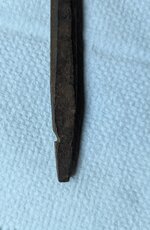

The notch allows the bit to be held in a modern “patented” brace. They had a spring catch. The taper is a bit too steep or not close enough for taper lock. That might be by design.
In terms of age, bits made before Q4 C18 were not typically square tapers. Many were custom fitted to the brace and irregular. Many had wooden adapters having flattened tangs. When the patented braces were introduced they had the little spring loaded hook. A notch had to be filed in the tangs to accommodate.
Augers weren’t invented until later in C18 IIRC but became popular later. Eventually, they replaced bits like this one, even though spoons and shells are vastly superior. So your bit was probably made sometime in the C19. But yours looks a bit irregular, so I’d say earlier than later in the 19th.
A couple interesting things about spoons: The entire radius is sharpenable even tho only one half of it cuts at any given time. This allows the spoon to cut when rotated in either direction. They can cut holes at angles much lower than modern bits. You can pretty easily drill a hole 45 degrees to the work. They excel at cutting holes in cylinders, which is why they get the name “chair maker’s“ bits. I have found them difficult to start very accurately. There is no center point. But like shell bits, their cousins, you can sorta ratchet the bit back and forth to precisely center the hole on a cross hair.
In terms of age, bits made before Q4 C18 were not typically square tapers. Many were custom fitted to the brace and irregular. Many had wooden adapters having flattened tangs. When the patented braces were introduced they had the little spring loaded hook. A notch had to be filed in the tangs to accommodate.
Augers weren’t invented until later in C18 IIRC but became popular later. Eventually, they replaced bits like this one, even though spoons and shells are vastly superior. So your bit was probably made sometime in the C19. But yours looks a bit irregular, so I’d say earlier than later in the 19th.
A couple interesting things about spoons: The entire radius is sharpenable even tho only one half of it cuts at any given time. This allows the spoon to cut when rotated in either direction. They can cut holes at angles much lower than modern bits. You can pretty easily drill a hole 45 degrees to the work. They excel at cutting holes in cylinders, which is why they get the name “chair maker’s“ bits. I have found them difficult to start very accurately. There is no center point. But like shell bits, their cousins, you can sorta ratchet the bit back and forth to precisely center the hole on a cross hair.
Last edited:
RTM
Well-known member
Additionally, supposedly, you can start them perpendicular, then tilt them to a different angle to cut what you need. As said, Windsor chair makers love them.couple interesting things about spoons: The entire radius is sharpenable even tho only one half of it cuts at any given time. This allows the spoon to cut when rotated in either direction. They can cut holes at angles much lower than modern bits. You can pretty easily drill a hole 45 degrees to the work. They excel at cutting holes in cylinders, which is why they get the name “chair maker’s“ bits. I have found them difficult to start very accurately. There is no center point. But like shell bits, their cousins, you can sorta ratchet the bit back and forth to precisely center the hole on a cross hair.
Additionally, supposedly, you can start them perpendicular, then tilt them to a different angle to cut what you need. As said, Windsor chair makers love them.
No supposedly about it. It's easier to do that than to bore a hole perpendicular with them. They're also useful for drilling banana shaped holes, should you need to drill through holes that aren't straight, but have an unpredictable curve to them.
There's a reason they were displaced by augers for almost everything, and the forstner later replaced them for the rest, except for crazy hand tool chairmaker types.
You have to do this. But because the cut is a hemisphere, it leaves a high quality hole.Additionally, supposedly, you can start them perpendicular, then tilt them to a different angle to cut what you need. As said, Windsor chair makers love them.
Augers were cheaper to make. Spoons were really hand made. Forstners are really for machines. Augers are best used by carpenters, and not well suited to fine work or hard woods. The ancestors of the spade bit, called a centre/center bit is the shizz, followed by spoons and shells. If you know how to sharpen and use them, you will wonder why someone hasn't figured out a way to mass produce these ancient drill bits. There are companies making new spoons. I have them and they are good. But no one making the other bits.There's a reason they were displaced by augers for almost everything, and the forstner later replaced them for the rest, except for crazy hand tool chairmaker types.
Point is: modern manufacturing didn't make all tools better. It made all tools cheaper, which is not at all the same thing.
RTM
Well-known member
I grab all the fun center bits, gimlets, RJ augers, ships augers, barefoot augers, (if I ever find a spoon bit), Yankee push drill, etc.The ancestors of the spade bit, called a centre/center bit is the shizz, followed by spoons and shells. If you know how to sharpen and use them, you will wonder why someone hasn't figured out a way to mass produce these ancient drill bits. There are companies making new spoons. I have them and they are good. But no one making the other bits.
Point is: modern manufacturing didn't make all tools better. It made all tools cheaper, which is not at all the same thing.
People don't realize the number of styles of bits lost over the decades. Used to be twist drills for wood with different tip angles that are gone, made great progress making everything use a metal twist bit

You have to do this. But because the cut is a hemisphere, it leaves a high quality hole.
Augers were cheaper to make. Spoons were really hand made. Forstners are really for machines. Augers are best used by carpenters, and not well suited to fine work or hard woods. The ancestors of the spade bit, called a centre/center bit is the shizz, followed by spoons and shells. If you know how to sharpen and use them, you will wonder why someone hasn't figured out a way to mass produce these ancient drill bits. There are companies making new spoons. I have them and they are good. But no one making the other bits.
Point is: modern manufacturing didn't make all tools better. It made all tools cheaper, which is not at all the same thing.
Spoon bits are hard to use -- it's hard to drill a hole where you want, it's hard to bore a hole that's more than a couple diameters deep that has straight sides. They're slow. They're hard to sharpen, especially in smaller sizes. They're not suitable for use under power.
Again, there's a reason no one but crazy hand tool chairmakers use them. Not at all incidentally, you left out one of the big reasons chair makers use them -- you can drill almost through a board, and not have to stop because you're worried about a spur or snail poking through.
I’ve spent a lot of time with all these bits. You get used to them. And I gave you my trick to accurately centering them: You ratchet the brace, back and forth. Try it.Spoon bits are hard to use -- it's hard to drill a hole where you want, it's hard to bore a hole that's more than a couple diameters deep that has straight sides. They're slow. They're hard to sharpen, especially in smaller sizes. They're not suitable for use under power.
Sharpening is hard for many of these. Spoons are not the hardest to sharpen. And right on, they aren’t effective in a power drill.
You used the present tense there. Very few people alive today use them. I know many of them. Once upon a time, many many people used them. Because they are dead now, doesn’t mean they were stupid then. Versions of this bit were used to make large wooden pipes for irrigation. They were used on ships.Again, there's a reason no one but crazy hand tool chairmakers use them. Not at all incidentally, you left out one of the big reasons chair makers use them -- you can drill almost through a board, and not have to stop because you're worried about a spur or snail poking through.
You lost me on the spur or snail but if you meant they greatly reduce backside fiber breakout (British term "spelching"), you’d be right and right again that I failed to mention that. Spoons and shells both exhibit that attribute.
More, I’ve seen evidence that not all chairmakers needed or used spoons. New England ladder back style chairs were sometimes made using center bits. Backside tear out can be an issue with them. Many NE chairs had "dry tenons" (i.e. not "thru" tenons, that when x-rayed (or disassembled) indicated square bottomed holes.
Last edited:
Wow, just revisited and it looks like my post sparked an interesting discussion.
So, is there any hope in identifying the manufacturer. It looks pretty crude with squared and beveled edges, but has no markings other than a string of dots in a snake pattern. As always, interested if it has any use or value.
So, is there any hope in identifying the manufacturer. It looks pretty crude with squared and beveled edges, but has no markings other than a string of dots in a snake pattern. As always, interested if it has any use or value.
whateg01
Well-known member
Who says you can't use them in an electric drill?
why do you think that's anything other than a brace?Who says you can't use them in an electric drill?
Ya, you can see a shadow movement in the background, probably the woodworkers arm moving.why do you think that's anything other than a brace?
RTM
Well-known member
Who says you can't use them in an electric drill
why do you think that's anything other than a brace?
If not, it's someone with impressive skill at low speed drilling.Ya, you can see a shadow movement in the background, probably the woodworkers arm moving.

RTM
Well-known member
Probably blacksmith made, probably older than 1915 (guess)So, is there any hope in identifying the manufacturer. It looks pretty crude with squared and beveled edges, but has no markings other than a string of dots in a snake pattern. As always, interested if it has any use or value
Yes value, just gotta find the right person.
RTM
Well-known member
I think he meant the point of a spade or center bit, or the screw point of an auger bit popping out before the main hole diameter did.You lost me on the spur or snail but if you meant they greatly reduce backside fiber breakout
I think he meant the point of a spade or center bit, or the screw point of an auger bit popping out before the main hole diameter did.
yes. the center point is a spur, if it's just a point. If it's threaded, it's a snail.
Chairs are full of blind mortices (there's a chair across the room from me, an antique windsor style arm chair, quite likely hand made, with 35 of them.), and not worrying about the spur poking through means the chair maker can either drill the mortices a little deeper, or use a thinner piece of stock.