To avoid these ads, REGISTER NOW!

Split bus generator panel

mcbane

Well-known member
Joined
Jul 23, 2017
Messages
794
Location
California
I am putting in a 350A electrical service at my new shop and plan to feed power from the shop down to the house. But since I will battery backed solar at the shop, I want to run utility power as well as auxiliary power down to the house.

My original plan was to replace an existing 100A meter base/load center at the house with a split bus generator panel. That would allow use of a 150 or 200A main breaker for utility power and a 50A breaker for auxiliary power. Since it is a single panel, it would be close to a drop in replacement in terms of connecting all my existing branch circuits. The alternative would be two panels and a transfer switch and lots of rerouting of wiring because I dont have wall space for two panels at the location of the existing panel.

The problem is I am getting sticker shock as I shop for split bus generator panels such as this unit: https://www.se.com/us/en/product-range/65812-homeline™-generator-panels/#tabs-top

Is there a cheaper way to approach this? Maybe a split bus panel not sold specifically as a generator panel? I already looked into just putting a 200A automatic transfer switch at the shop with a simple 200A load center at the house but that would require automatic load shedding which adds other costs and complexity.
 
To avoid these ads, REGISTER NOW!

mike93lx

ALLIANCE MEMBER
Joined
Dec 9, 2013
Messages
38,398
Location
Richmond, VA
How about a reliance control XR panel? I have one in my current house.

One flip switches you from utility to generator and they use a 3-wire disconnect
 

wyliesdiesels

Well-known member
Joined
Aug 14, 2012
Messages
20,257
Location
Modesto, CA
So you will have a service at the shop and you want to keep the service at the house?

How about a service entrance rated transfer switch at the house? You would have to convert the meter main combo panel to a subpanel, then set a new meter pan and wire the TS in between the 2.
 
OP
M

mcbane

Well-known member
Joined
Jul 23, 2017
Messages
794
Location
California
So you will have a service at the shop and you want to keep the service at the house?

I need to feed the house from the shop because county rules permit only one electrical service per parcel. New service entrance and meter is at the shop rather than the house because the shop is way closer to the power pole.
 

theoldwizard1

Well-known member
Joined
Feb 22, 2011
Messages
43,634
Location
SE MI
I am putting in a 350A electrical service at my new shop and plan to feed power from the shop down to the house. But since I will battery backed solar at the shop, I want to run utility power as well as auxiliary power down to the house.
Why bother with two feed to the house ?

Worst case is the house will trip the breaker in the generator/inverter. You will learn what you can and can not run.

You might want to look into a grid tie solar system that also supports emergency power when the grid is down,
 

wyliesdiesels

Well-known member
Joined
Aug 14, 2012
Messages
20,257
Location
Modesto, CA
I need to feed the house from the shop because county rules permit only one electrical service per parcel. New service entrance and meter is at the shop rather than the house because the shop is way closer to the power pole.

ok then i am not understanding what you propose.

Is this battery backed solar system grid tied at the shop? if so, then is there a transfer switch between the solar system and the PoCo?

If there is a transfer switch, then no need to dual feed the house.

We really need some more info here on your current setup.

Can you post some pics please of your panels and solar systems connections

BTW the meter main at your house needs to be converted to a subpanel with an isolated neutral and 4-wire feeder running to the shop service. On meter main panels, this can prove to be sifficult.
 
Last edited:
To avoid these ads, REGISTER NOW!
OP
M

mcbane

Well-known member
Joined
Jul 23, 2017
Messages
794
Location
California
350A was a typeo. Service is a 320 continuous. Sorry about the confusion that caused.

Battery backed solar will be grid tied but when grid is down would only be good for 50A peak. No photos of the solar because it isnt installed yet.

A bit more explanation re: the problem I am trying to solve:

The only reason I plan to install battery backed solar is to ensure that a handful of small essential loads continue to operate during power outages, particularly at times when the property is unoccupied. I will have a few of those small essential loads at the shop and a few at the house.

While I could use a service entrance rated transfer switch and then run only a single feed down to the house, that would require that either that the transfer switch be manually operated (not good if I am not home) or that automatic load shedding be in place so that transferred loads do not exceed the capacity of the solar system. If a small battery backed solar system tries to run everything it will trip a breaker and then my small essential loads will be off line.
 

wyliesdiesels

Well-known member
Joined
Aug 14, 2012
Messages
20,257
Location
Modesto, CA
ok so the grid-tied solar will go offline when the inverter senses loss of grid unless its programmed to remain running during loss of grid power. This then means it would need a transfer switch anyways to isolate from the grid. This is required to prevent islanding.

So what you propose and what is required doesnt jive.

You will need an automatic transfer switch to keep the solar on. the split buss or separate feed to the house then becomes a moot point since the house will be a branch feeder off of the shop service.

So dont focus on the house. Just plan on replacing the meter main with a subpanel.

You need to focus on the automatic transfer switch at the shop to keep the solar on.

So what loads do you have at the shop and house?
 

kaffine

Well-known member
Joined
Dec 13, 2009
Messages
3,610
Location
Henderson, NV
if you aren't home, would you really be above 50a load?

If the AC kicks on or electric water heater turns on it wouldn't be hard to trip a 50a breaker with the other things in the house even if no one is home.

I am looking at doing something similar all solar gear will be in the shop but what I want backup power for is in the house. The system can't support the entire house so either I use a second feed and put the ATS with load shedding at the house or I use a manual transfer switch at the shop and have to turn off breakers myself at the house for load shedding. Can't use an ATS unless it has load shedding or the system is capable of the entire load from my understanding.


Does the panel need to be rated for outdoor or will indoor work?

https://www.amazon.com/dp/B0052MGEO2/?tag=atomicindus08-20

https://www.amazon.com/dp/B005GLDETC/?tag=atomicindus08-20

Then another $250 for the auto transfer switch option.
 
OP
M

mcbane

Well-known member
Joined
Jul 23, 2017
Messages
794
Location
California
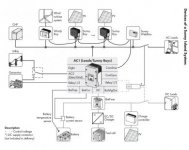
I have attached a schematic for a typical battery backed solar install. A somewhat busy schematic since they are trying to illustrate every possible accessory you might connect. The unit has an integral transfer switch to allow island mode operation for loads that are within its rated capacity. Separately it has a relay to make use of a standby generator and auto transfer on the grid side of the unit. The protected loads are typically served from a separate distribution panel with overcurrent protection that matches the capacity of the inverters.

I have a few protected loads in the shop and a few at the house. I am looking for a practical way to keep those loads powered in both buildings during a power outage. I dont see how that can be accomplished without either a lot of automated load shedding or a separate standby power feed to the house that would run only battery backed loads. Since an island solar system has an integral transfer switch, I wouldnt need a transfer at the house so long as the protected loads feed a separate bus and have a separate disconnect that meets code for disconnecting means. I was looking at split bus gear as a way to solve a physical space issue - no need for the transfer switch that can be installed in a generator split bus panel.

With respect to exceeding the 50A load rating for the inverters, there are two limiting levels of power consumption. 1) The code is concerned only with rated capacity of the standby power and is happy to have your battery pack try to run 50A worth of loads so long as your inverters are rated for 50A. 2) Batteries. The code doesnt care how long your batteries will last after the grid goes down, but available battery capacity is what limits the loads that can practically by protected by battery backed solar. Those loads need to be kept down to a couple of kW average to avoid running the batteries flat in the first few hours of an outage.
 

Attachments

  • Screen Shot 2020-05-11 at 6.35.36 AM.jpg
    Screen Shot 2020-05-11 at 6.35.36 AM.jpg
    19.1 KB · Views: 10
To avoid these ads, REGISTER NOW!
Top Bottom