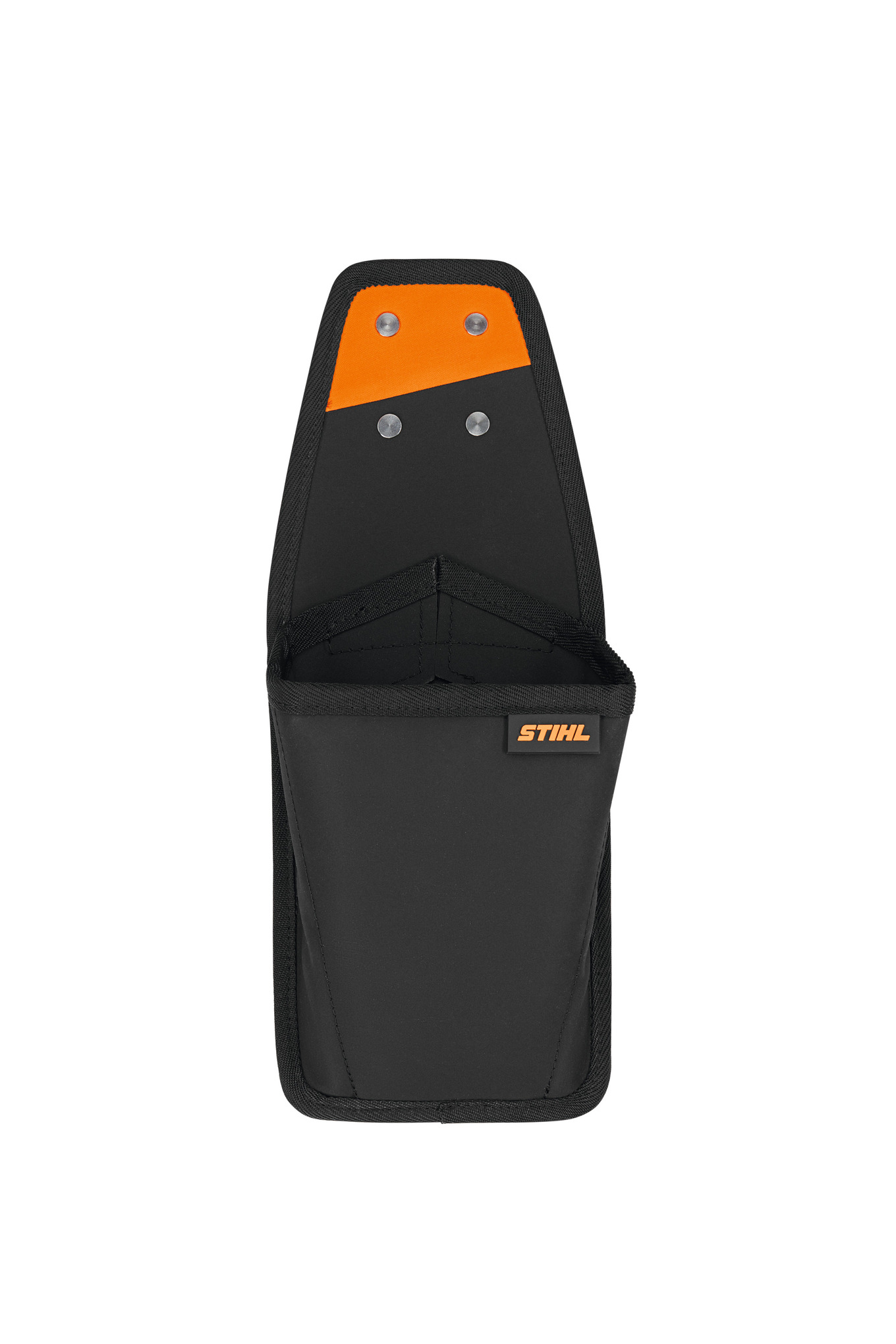
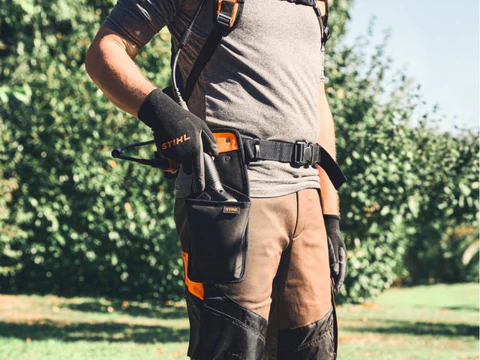
Stihl ASA 20 Battery-Powered Pruning Shears
For a horticulturalist, a pair of secateurs are always in your back pocket, to the point where they become an extension of your body, like a hammer is to a carpenter. I dare say a pair of secateurs is THE most important tool a gardener has, and not just for cutting plant material. In addition to the usual pruning, I also use them to cut irrigation line, and even removal of stubborn irrigation fittings. I'd also use them to cut root systems prior to potting, cutting bamboo stakes to size, cutting grow bags when planting advanced trees, cutting twist plant ties or plastic maxi-lock chain, and I may or may not have cut thin gauge wire too....................don't do that.
I've used a variety of secateurs over the years, from ultra cheap to ultra expensive, small snippers to full size shears, normal handles to the rotating type, plastic or metal construction. All do something different for different applications or user preferences. I've also had a play with a pair of Bosch battery powered secateurs, which proved handy when pruning fruit trees and roses.


Stihl AS-Series Tools -
The AS battery system represents Stihl's entry level line of battery tools, sitting below the mid-series AK and professional series AP. The AS system revolves around the 10.8v lithium-ion AS-2 battery, which is similar in shape and concept to the Milwaukee M12 series. The key factor here being the lightweight and versatile shape of the battery, meaning a variety of tools can be designed around it to suit different applications. These batteries are charged with the AL-1 single slot or AL-5 single and dual slot chargers.
The AS tools are for occasional light duty usage in a homeowner application. They offer everything from hedge trimmers, shrub shears, blowers and grass trimmers. In recent times, they've added a mini chainsaw, handheld vacuum, tyre inflator, even a mini-pressure washer.
https://www.stihl.com.au/en/search?text=battery&facets=batterySystem:AS
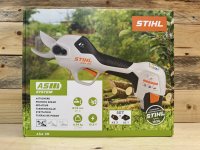
And so, this leads us to one of Stihl's newest products, the ASA 20 Battery-Powered Pruning Shears.....................
https://www.stihl.com.au/en/p/prune...197126#asa-20-with-battery-and-charger-197054
The What & Why -
Automated shears like this are not new, orchardists have been using air-powered secateurs for decades, mainly for the winter pruning schedule. They are ideal for extended heavy usage in that they help boost productivity and prevent hand fatigue. With the powered assistance, you can also cut through thicker material without straining your body or causing damage to the tree. In this case, Stihl have taken the concept and designed their version around the AS battery architecture.
I wouldn't say powered shears like this replace tradition secateurs. For example, sometimes you need an element of finesse that only a pair of snips can achieve. For cutting fine material, I don't think power assistance is needed or desirable. But for cutting larger branches too small for a chainsaw, these tools are ideal because they do it quicker and easier without forcing your way through the cut via traditional means. In some ways, that could actually be safer than struggling with an inappropriate tool.
What Comes In The Box?
The ASA 20 can be purchased in kit form or as a skin. In relation to the skin, you must use the current AS-2 battery, the older AS-1 battery used on the early HSA 25 Shrub Shears are not compatible. Because of that, I had to go for the kit, which is annoying because now I have battery and chargers for both AS-1 and AS-2. I'm not sure why they did that, the old and new batteries look very similar and have the same output.
The ASA 20 kit comes with the tool itself, a blade guard for storage, the AL-1 charger, and a single AS-2 battery. The dealer kindly added a second battery free of charge, valued at $89..............it's not what you know, its who you know. :wink2


The older HSA 25 and AS-1 battery, which isn't compatible with newer tools -

A Closer Look -
Stihl claims the ASA 20 can make up to 2,000 cuts per charge, while comfortably cutting branches up to a diameter of 25 mm. While the batteries don't have a charge indicator, the OLED screen on the tool provides charge level statis and the number of cuts made. The screen also shows selected blade opening width, of which the user can choose between two settings.

As per traditional secateurs, the blades can be removed for cleaning and sharpening.
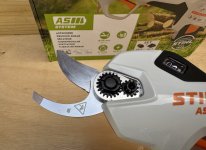

The tool itself features rubberized touch points, which is for both user comfort and non-slip safety in mind.
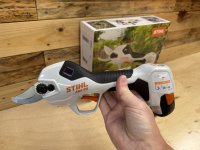
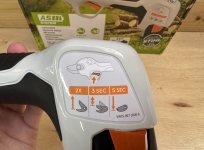
The unit is powered up by a single button above the battery. From there, hold the trigger down for 3-seconds to open the blades, confirmed with an audible beep. To close the blades prior to shut down, hold the trigger for 5-seconds or until a beep is heard. The default blade opening width is set at the maximum 25mm setting. To select the smaller setting, with the unit powered up, press and hold the power button for about three seconds. This in turn also increases the cutting speed because the blades don't open fully.


Usage -
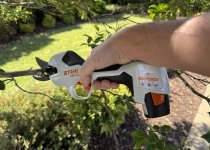
While I've yet to put the ASA 20 to work, I have had a play around in the backyard.
Even in the full blade width mode, the cutting speed is impressive. In that regard, I'm actually a little scared of these things as the blades are activated with lightest touch of the trigger. But the tool itself is well balanced and not excessively weighted, which would assist in fatigue management with prolonged usage.
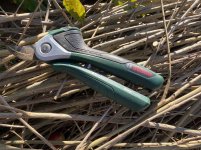
The Bosch secateurs mentioned earlier are packaged and function very differently to the ASA 20. Where the Stihl is bulky with a separate battery, the Bosch take on the same footprint as a regular pair of secateurs and integrates the battery into the handle. Where the Stihl does all of the work for you via the lightest touch of the trigger, the Bosch use the same spring action movement as a regular pair of secateurs. In that I mean you still need to clamp down with your hand, and when the tool feels resistance, the motor will kick in to assist your pressure on the tool. If little resistance is felt, the unit won't provide powered assistance. In some ways that is actually quite intuitive and saves on bulk. But from experience, you also don't get the same cutting performance or battery longevity. Bosch have since added a similar looking ASA 20 competitor, but it's bulkier and slightly heavier (without or without batteries).
https://www.amazon.com.au/Bosch-Sec...&hvtargid=pla-1966012706870&gad_source=1&th=1
https://www.totaltools.com.au/22939...MItpeOh5_dkQMVoZGmAx0CVjRSEAQYASABEgIO0vD_BwE
I actually have a large pruning job in mind for this tool, so stay tuned for updates and further usage notes.
For a horticulturalist, a pair of secateurs are always in your back pocket, to the point where they become an extension of your body, like a hammer is to a carpenter. I dare say a pair of secateurs is THE most important tool a gardener has, and not just for cutting plant material. In addition to the usual pruning, I also use them to cut irrigation line, and even removal of stubborn irrigation fittings. I'd also use them to cut root systems prior to potting, cutting bamboo stakes to size, cutting grow bags when planting advanced trees, cutting twist plant ties or plastic maxi-lock chain, and I may or may not have cut thin gauge wire too....................don't do that.
I've used a variety of secateurs over the years, from ultra cheap to ultra expensive, small snippers to full size shears, normal handles to the rotating type, plastic or metal construction. All do something different for different applications or user preferences. I've also had a play with a pair of Bosch battery powered secateurs, which proved handy when pruning fruit trees and roses.
Stihl AS-Series Tools -
The AS battery system represents Stihl's entry level line of battery tools, sitting below the mid-series AK and professional series AP. The AS system revolves around the 10.8v lithium-ion AS-2 battery, which is similar in shape and concept to the Milwaukee M12 series. The key factor here being the lightweight and versatile shape of the battery, meaning a variety of tools can be designed around it to suit different applications. These batteries are charged with the AL-1 single slot or AL-5 single and dual slot chargers.
The AS tools are for occasional light duty usage in a homeowner application. They offer everything from hedge trimmers, shrub shears, blowers and grass trimmers. In recent times, they've added a mini chainsaw, handheld vacuum, tyre inflator, even a mini-pressure washer.
https://www.stihl.com.au/en/search?text=battery&facets=batterySystem:AS
And so, this leads us to one of Stihl's newest products, the ASA 20 Battery-Powered Pruning Shears.....................
https://www.stihl.com.au/en/p/prune...197126#asa-20-with-battery-and-charger-197054
The What & Why -
Automated shears like this are not new, orchardists have been using air-powered secateurs for decades, mainly for the winter pruning schedule. They are ideal for extended heavy usage in that they help boost productivity and prevent hand fatigue. With the powered assistance, you can also cut through thicker material without straining your body or causing damage to the tree. In this case, Stihl have taken the concept and designed their version around the AS battery architecture.
I wouldn't say powered shears like this replace tradition secateurs. For example, sometimes you need an element of finesse that only a pair of snips can achieve. For cutting fine material, I don't think power assistance is needed or desirable. But for cutting larger branches too small for a chainsaw, these tools are ideal because they do it quicker and easier without forcing your way through the cut via traditional means. In some ways, that could actually be safer than struggling with an inappropriate tool.
What Comes In The Box?
The ASA 20 can be purchased in kit form or as a skin. In relation to the skin, you must use the current AS-2 battery, the older AS-1 battery used on the early HSA 25 Shrub Shears are not compatible. Because of that, I had to go for the kit, which is annoying because now I have battery and chargers for both AS-1 and AS-2. I'm not sure why they did that, the old and new batteries look very similar and have the same output.
The ASA 20 kit comes with the tool itself, a blade guard for storage, the AL-1 charger, and a single AS-2 battery. The dealer kindly added a second battery free of charge, valued at $89..............it's not what you know, its who you know. :wink2
The older HSA 25 and AS-1 battery, which isn't compatible with newer tools -
A Closer Look -
Stihl claims the ASA 20 can make up to 2,000 cuts per charge, while comfortably cutting branches up to a diameter of 25 mm. While the batteries don't have a charge indicator, the OLED screen on the tool provides charge level statis and the number of cuts made. The screen also shows selected blade opening width, of which the user can choose between two settings.
As per traditional secateurs, the blades can be removed for cleaning and sharpening.
The tool itself features rubberized touch points, which is for both user comfort and non-slip safety in mind.
The unit is powered up by a single button above the battery. From there, hold the trigger down for 3-seconds to open the blades, confirmed with an audible beep. To close the blades prior to shut down, hold the trigger for 5-seconds or until a beep is heard. The default blade opening width is set at the maximum 25mm setting. To select the smaller setting, with the unit powered up, press and hold the power button for about three seconds. This in turn also increases the cutting speed because the blades don't open fully.
Usage -
While I've yet to put the ASA 20 to work, I have had a play around in the backyard.
Even in the full blade width mode, the cutting speed is impressive. In that regard, I'm actually a little scared of these things as the blades are activated with lightest touch of the trigger. But the tool itself is well balanced and not excessively weighted, which would assist in fatigue management with prolonged usage.
The Bosch secateurs mentioned earlier are packaged and function very differently to the ASA 20. Where the Stihl is bulky with a separate battery, the Bosch take on the same footprint as a regular pair of secateurs and integrates the battery into the handle. Where the Stihl does all of the work for you via the lightest touch of the trigger, the Bosch use the same spring action movement as a regular pair of secateurs. In that I mean you still need to clamp down with your hand, and when the tool feels resistance, the motor will kick in to assist your pressure on the tool. If little resistance is felt, the unit won't provide powered assistance. In some ways that is actually quite intuitive and saves on bulk. But from experience, you also don't get the same cutting performance or battery longevity. Bosch have since added a similar looking ASA 20 competitor, but it's bulkier and slightly heavier (without or without batteries).
https://www.amazon.com.au/Bosch-Sec...&hvtargid=pla-1966012706870&gad_source=1&th=1
https://www.totaltools.com.au/22939...MItpeOh5_dkQMVoZGmAx0CVjRSEAQYASABEgIO0vD_BwE
I actually have a large pruning job in mind for this tool, so stay tuned for updates and further usage notes.