To avoid these ads, REGISTER NOW!

Tankless Hot Water Heater

CitadelBlue

Well-known member
Joined
Aug 1, 2009
Messages
710
Location
Northern VA
All,

Is there a DIY link/thread somewhere that will help me install a Rinnai R75LSi Natural Gas Indoor Tankless Water Heater, the service valves and termination kit located here:
( http://tinyurl.com/4xa9jrl ) ?

I'm one of those DIY guys that can quite grasp the cost (over $2000) that I've been quoted to remove a conventional gas hot water heater from the back wall of my garage and install one of these new water heaters. I see about a 2 hour job if that .....
1) turn off the gas
2) cut off the water and drain the waterlines and old hot water heater
3) disconnect the gas line, water lines and exhaust flue
4)move the old water heater out of the way
5) hang the new heater on the back wall
6) cut a circle hole in the sheetrock and outside siding to accommodate the termination kit(new exhaust vent)
7) redirect the cold water supply and hot water return lines
8) connect the gas line (I'm told that my current heater has a 1/2" gas supply line coming out of the crawl space and that a 3/4" line is required. Actually there is a 3/4 to 1/2 reducer in the crawl space so I view this as an easy fix .. if in fact a 3/4" line is required)
9) plug in the unit to a 15amp 110v power source.

So did I miss something?

PS. Is there a simple formula to calculate how many gallons per minute in a system is needed? i.e. number of people, number of bedrooms, washing machine, dishwasher, etc???

Ken
Knoxville, TN
 
Last edited:
To avoid these ads, REGISTER NOW!

HVAC Phil

Well-known member
Joined
May 3, 2011
Messages
221
Location
Akron, Ohio
Your unit should give you some baseline directions, but not step-by-step. These aren't as easy to put in as a conventional HWT. The unit needs 3/4" gas line based on the BTU rating of the burner, you can't just put a reducer on the old 1/2".

Sizing the unit is different based on how many appliances will be used at once. You need to look at the specs for each different unit and choose accordingly. I see so many of these installed wrong, they rot out the heat exchanger in 5yrs or less. Takes more than 2 hrs to put in the correct way.
 

Hud

Well-known member
Joined
Feb 7, 2011
Messages
61
Location
Orange , Tx
Dont forget it requires class III stainless vent! That is the reason I went with an outdoor version (Rheem) and have had it for about 4 years and love it. You also need to install the manifold system to allow you to backflush the system.3/4" gas is required.
 
OP
C

CitadelBlue

Well-known member
Joined
Aug 1, 2009
Messages
710
Location
Northern VA
Dont forget it requires class III stainless vent! That is the reason I went with an outdoor version (Rheem) and have had it for about 4 years and love it. You also need to install the manifold system to allow you to backflush the system.3/4" gas is required.

I don't think this requires the class III stainless vent..... the web site shows a "termination kit" which is an intake and exhaust piping system and also "service valves" or manifold ... and yes 3/4 inch gas line is required......
 

Frank The Plumber

Well-known member
Joined
Feb 19, 2011
Messages
2,644
Location
Chicago.
Install the required vent kit as per the manufacturers warranty or it's void. If this unit is not installed by a manufacturers certified and listed installer the warranty is void. 3/4 gas yes required or it will soot the burner. Flush kit or warranty void. 2 grand is unit and installed with the proper vent kit. The average install time for one of these is 4 hours for one man. About $120 worth of consumables.
If you doubt the warranty claims take the time to read carefully the entire service brochure. The words qualified installer, there it is, and question what may constitute a qualified installer. When the thing craps out and you call them with your warranty claim, they will ask you for "the name of the qualified installer", myself the home owner, he aint listed.
Fore warned is fore told. I'm certified for like 9 brands of these things and I have to get recerted every year. Or no warranty. PIA'S.

BTW, that's why there is not a manufacturers link readily available for homeowners on several of these type units. Warranty,
 
Last edited:

Jackfre

Well-known member
Joined
Dec 26, 2010
Messages
4,435
Location
N CA
Analyze your fixture lay-out. The old water heater is likely there because of the chimney location. You are not going to use the chimney, so given that, find the best most central location for the unit. It will reduce delay of hw delivery. The R75 will make 4.3gpm at a 70f rise. Test your water.Rinnai requires that the water meet the Secondary Drinking Water Standards put forth by the EPA. The install manual is at rinnai.us/tanklessr75/details/documents. Pretty much everythingnis there...if, as Frank points out, you know how to connect the dots:)

Rinnai requires the use of a concentric ventpipe. It is 3" interior and 5" exterior. Pay attention to the grade of the vent. You do not want condensate generated from the vent or rain water coming back onto the unit. Absolutely use the iso valves. Excellent unit. I've sold about 80,000 of them:beer:
 
OP
C

CitadelBlue

Well-known member
Joined
Aug 1, 2009
Messages
710
Location
Northern VA
Jack .. I'm a little confused about the SIZE of unit needed. DOI need an R75 or R94? The R75 is for 2 to 3 bathrooms (we have 2 baths with shower/tub and 1 powder room- no tub/shower), The R94 will supply continuous hot water to as many as five plumbing and appliance outlets simultaneously. Why does the description replace the same type of measurement - either use bathrooms of plumbing/appliances.
Our house has washer, dishwasher, 2 showers/tubs and what happens when all 4 bedrooms are filled maybe 8 people ,,,,,,, I'm thinking bigger might be better ....
 

99_xc600

Well-known member
Joined
Dec 18, 2010
Messages
176
Well I can tell you what I did.

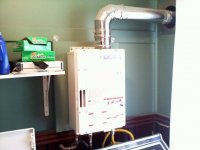
I installed my Takagi in my utility room. This was the best spot since I already had access to both the hot and cold feeds as well as a 1" gas line.

I used the stainless steel venting. The Takagi wouldn't accept a PVC venting kit at the time. However I can tell you, if your going with stainless steel venting, plan your run accordingly. The venting is expensive and can add up very quickly if you have a long run. My run was relatively short. However it ended up around $250 for everything. (This was about 6 years ago, pricing may have changed).

As already mentioned, make sure you install shut off valves and service valves (Hose Bib's -Basically) so you can do the descaling process if you have hard water. I do have them installed, but you can't see them in the picture.

The unit works great. I highly recommend it to anyone. If I could change one thing. I would install the fresh air kit, so it draws the combustion air from the outside. Since I have it installed in the utility room, I had an issue with the heater sucking in some lint/dust from the dryer.

I contacted Takagi and they sent me the instructions on how to clean the heat exchanger. (Very simple to do). So as apart of my annual maintenance, while I run the de-scaling process. I also pull the heat exchanger and clean it.

As said before. I highly recommend this to anyone. With my family of 4, Gas Stove, Gas Dryer...my avg gas bill is $40 a month. A hell of a lot cheaper than running my oil fired boiler to generate domestic hot water year round.
 

Attachments

  • Takagi.jpg
    Takagi.jpg
    47.1 KB · Views: 69

99_xc600

Well-known member
Joined
Dec 18, 2010
Messages
176
Jack .. I'm a little confused about the SIZE of unit needed. DOI need an R75 or R94? The R75 is for 2 to 3 bathrooms (we have 2 baths with shower/tub and 1 powder room- no tub/shower), The R94 will supply continuous hot water to as many as five plumbing and appliance outlets simultaneously. Why does the description replace the same type of measurement - either use bathrooms of plumbing/appliances.
Our house has washer, dishwasher, 2 showers/tubs and what happens when all 4 bedrooms are filled maybe 8 people ,,,,,,, I'm thinking bigger might be better ....

The "Ideal" method is too size the unit for the amount of hot water taps in your home and if they were all open at the same time.

However this isn't practical in the real world as most people never do this. I would size it for 2 showers that you have now. Typically the heater will run if the output is on the threshold of it's capacity. What will happen is you will get a reduced flow as the heater tries to meet the demand.

I can take a shower and have the washer running and I'll get a slightly reduced flow. However, I'm running the updated water saving heads in my shower. If your bathroom's have multiple heads or the rainfall heads. You may need to upsize it.
 

6t7gto

Well-known member
Joined
Dec 6, 2005
Messages
522
Location
bedford,ohio
notice he installs a water filter before the tankless.
my friend installed his, on city water, and the inlet screen on the tankless plugged with debris.
cost him $400.00 for a certified tech to come out and fix the problem.
he is going to install a water filter to stop future problems.
 
To avoid these ads, REGISTER NOW!

99_xc600

Well-known member
Joined
Dec 18, 2010
Messages
176
notice he installs a water filter before the tankless.
my friend installed his, on city water, and the inlet screen on the tankless plugged with debris.
cost him $400.00 for a certified tech to come out and fix the problem.
he is going to install a water filter to stop future problems.

$400...wow!!!

Is the screen buried in the heater, or is installed on the cold water inlet side? I know on my Takagi, it's right at the bottom and it takes about 30 seconds to pull and remove.
 

6t7gto

Well-known member
Joined
Dec 6, 2005
Messages
522
Location
bedford,ohio
$400...wow!!!

Is the screen buried in the heater, or is installed on the cold water inlet side? I know on my Takagi, it's right at the bottom and it takes about 30 seconds to pull and remove.

the plumber spent quite a bit of time on the phone calling the mfg. on the problem this tankless was having.
the screen is accessible.
but he had taken the unit apart and checked numerous things and he found a broken o-ring on a solenoid that was buried inside.
about 5 hours total on the job.
 

Jackfre

Well-known member
Joined
Dec 26, 2010
Messages
4,435
Location
N CA
I hate the way they say X number of faucets. I never and I mean never say X faucets. I once had a home owner blow a gasket because he couldn't do 4 fixtures at once. He could have, had he not had a 22gpm shower. I kid you not. He didn't want to buy water heaters, but he did spend $6,000 for the shower head.

The 75 will produce 4.3gpm @70f temp rise, which is what I use here in NE. The 94 will do 4.7 on NG & 4.5 on lp. Next look at use temp at the point of use. Your shower valve is set by code at 112f max. If you sit in a tub above 105f you are no longer bathing, you are par boiling. I remodelled all my bathrooms and had good 2.5gpm shower heads. You can read the actual flow thru the unit and of the 2.5 gpm, 2.1 was hot water with .4 to deliver the 2.5 at the showerhead. Filling a bathtub will take 100% of capacity for the 8-10 min it takes to fill the tub. I can run two showers all day long. When you try to put more water thru it than the max input can heat, the unit will slow down flow to guarantee temp. In some cases I've had people keep the 2.5gpm showerhead in the master and put a good 1.5 gpm in the other shower. Either unit will suit your needs.
 

Frank The Plumber

Well-known member
Joined
Feb 19, 2011
Messages
2,644
Location
Chicago.
You have a basic grasp on the bones of the install, but forget about the additional costs that a business must pay, like employee benefits and business insurance.

2 hours? Yeah, sure.

Tankless water heaters deal only in GPM and temperature rise. Some tankless units will throttle the flow to meet the set temperature rise depending on water inlet temperature.

Some menufacturers are using shady big GPM claims by using "warm" inlet temperatures. You need to know what your cold water supply temperature is then your desired outlet temperature and then cross check temperature rise to get actual delivered GPM.

Unless you daisy chain two or more, you cannot turn everything on, so you must know the GPM delivery rate of your common fixtures.

A tub fixture will flow far more than a single regulated showerhead. Those fancy shower setups with multiple heads and body sprays use lots of water.

Gas pipe sizing takes distance and flow (btu's) into account. A relatively short run of 3/4" pipe won't handle 200,000 btu's at residential pressures.

Depending on the size of your gas meter and the other gas appliances in your home, a too small meter is a real possibility.

The last one I put in, a Navien, I burned through over $500.00 in copper parts and pieces, valves and other items listed in the instructions. Also burned through about $200.00 in PVC vent materials. Had to redo 20' of gas line- about $100.00 in parts. Fortunately, I have my own threader.

The galvanized pipe is the combustion air intake.

Took several hours to set it up on a 4' square board. Probably about 10 hours in the install.

That $2000.00 number you were quoted, probably pretty fair if it is a "basic relocation" and done right. This one was moved 5 feet (straight line distance, 10 feet piping distance) from the previous tank water heater location.

There's always some guy cheating the numbers to undercut the price on these. I don't even want to put them in anymore, Big PIA, our water temp is 35 f here in January, you think I'm going to cheat, god no they'll be going nuts in the winter. I just install the tank type, in the end you save no real money because these things are very expensive when done properly as compared to a tank type. They just do not last long enough to recover the initial cash investment. Oh unless you cheat, but then not so much in the winter.
 

99_xc600

Well-known member
Joined
Dec 18, 2010
Messages
176
There's always some guy cheating the numbers to undercut the price on these. I don't even want to put them in anymore, Big PIA, our water temp is 35 f here in January, you think I'm going to cheat, god no they'll be going nuts in the winter. I just install the tank type, in the end you save no real money because these things are very expensive when done properly as compared to a tank type. They just do not last long enough to recover the initial cash investment. Oh unless you cheat, but then not so much in the winter.

I beg to differ. However my situation is a little different.

Until we installed our Tankless 6 years ago. We used our oil fired boiler to make domestic hot water. Not only was this a huge waste of fuel during the non heating months (April to October) it never met demand for our home.

Since the boiler would run to maintain the water in the jacket at 120* even when there was no call for hot water it was just literally sending money up the chimney.

For example, we have a 275 gal tank. If I had 100 gallons of oil in the tank at the end of the season (April). The tank would be empty by June. At $2.00/gal (6 years ago). That's an operating cost of $200 just for hot water not including the cost of electricity to run the boiler. Add another 100 gallon's to get us into the beginning of the heating season and it's another $200.00. Ending up a grand total of $400 in just in domestic hot water costs.

On the flip side. I purchased the Takagi for $500, venting was aprox $250 and misc plumping was $50.

Total investment was $800.00

I received a $500 tax credit from the Fed and a $150 tax credit from the state. Which bring's down the investment cost to $150.00.

Now let's talk operating cost.

With my Gas Dryer, Gas Stove, and the Takagi. My avg gas bill is $45.00 for everything. Before the Takagi, my avg bill was about $27 a month. So the Takagi costs about $18.00 a month to run.

That's an annual operating cost of $216.

Now fast forward 6 years and take the cost of fuel oil. Currently around $3.68/gallon. I still think I made the right choice.
 

Underdog

Well-known member
Joined
Sep 24, 2007
Messages
1,135
Location
Treasure Coast, Florida
There's always some guy cheating the numbers to undercut the price on these. I don't even want to put them in anymore, Big PIA, our water temp is 35 f here in January, you think I'm going to cheat, god no they'll be going nuts in the winter. I just install the tank type, in the end you save no real money because these things are very expensive when done properly as compared to a tank type. They just do not last long enough to recover the initial cash investment. Oh unless you cheat, but then not so much in the winter.

Frank, how about these new heat pump water heaters. Have you installed any yet? I have conventional 230 volt, two element water heater. Don't want to go tank less with the hassle of venting and gas install, but this heat pump heater might work.

http://www.rheem.com/Products/tank_water_heaters/Hybrid_electric/how_it_works
 

Jackfre

Well-known member
Joined
Dec 26, 2010
Messages
4,435
Location
N CA
I had a Buderus G224, Buderus 40 gal indirect, Logomatic control, cold start, outdoor reset, off cycle damper. All I did in the house with gas in the summer was dhw. 36-44 therms. Installed my tankless. For 10 yrs monthly bill was 10-13 therms. 2 of 3 btus paid for were system loss. As I also have mini-split heat pumps and a Rinnai Energysaver inthe house, I only run the boiler from early Nov to late March when there is a load against it.

Pay attention to how many minutes a day you have a hot tap open. Why store hot water the rest of the day? Indirects are fine and I never had a problem with mine. Check your water quality. If it is good then you will be well served with a tankless. ON the inlet filter, I was on a job yesterday training the staff for operation maintenance for 4 units on their building. We checked all four inlet filters in less than 10 min. Install the Webstone or similar valve kit...every time!

Heat pump water heaters are very efficient as well. Their drawback is they give poor recovery. If I was looking at them, I'd look at Airgenerate. It is an add on to your current tank. The Problem with GE and AO Smith units is they are mounted to the tank. I'm not sure you can keep the heat pump part and just add a standard tank. With the Airgenerate you can. I hear it is a fairly straight forward install but have not done one.
 

Jackfre

Well-known member
Joined
Dec 26, 2010
Messages
4,435
Location
N CA
So, how much money did you spend to save 26-31 therms?

You also went from a natural draft appliance to an induced draft appliance, so the energy "savings" comparison isn't valid.

i don't know what it was. Assign any value you choose. 10-13 vs 36-44 "units of fuel" is the proper comparison. As to the nat'l draft boiler vs a mod con, yes, I used what was appropriate at the time (mid 90's), but that Buderus stil runs in the mid 80% range and it was driving old baseboard so higher temps. It is an excellent piece of equipment. If I go to the mid-90%er's for a substantially higher cost mod con boiler (and with the units available today I certainly would) my saving between the two would be less. With 12 yrs experience with a tankless and the savings and never a problem with my tankless, why would I bother with a boiler/indirect. With the cost of the indirect, controls and circ I'd call the tankless/indirect about a push. Yes? Locally the utilities are offering $800 rebates on tankless. $500 on indirects.

To me, the best system is the tankless water heater combined with the smallest heat only mod-con boiler you can get driving the lowest temp distribution system. Mini-splits for AC and heat help. As well, any house I live in will have at least one Rinnai Energysaver.

I'm pretty sure you and I can twist this thing into the ground, if we haven't all ready. My experience and my choice say tankless. You get to decide for yourself. Boilers, furnaces, heat pumps, mini-splits, tankless, indirects, dhw heat pumps. They are all just another tool in the tool bag. You as a professional choose what you are happiest with. :beer:
 

99_xc600

Well-known member
Joined
Dec 18, 2010
Messages
176
Your boiler should be running at 180*

With proper controls, the boiler would not be "on" all the time. With proper piping, it would hit 180* quickly in a DHW loop.

A properly set up indirect fired tank water heater will smoke a tankless unit.

If the boiler combustion is tuned properly, operational efficiency is improved. There is no way anyone can set up a fuel burning appliance without a combustion analyzer.

This is true on a modern boiler. However the boiler in our home is a steel lined boiler with no insulation around the tank operating on a Beckett burner. A very simple setup and really not cost effective to retrofit.

I'm planning on replacing the current setup and will be going with a Viessman condensing boiler to produce heat and DHW via a standby tank in the fall.
 
To avoid these ads, REGISTER NOW!
Top Bottom