To avoid these ads, REGISTER NOW!

Truss concerns

burleymike

Well-known member
Joined
Feb 25, 2009
Messages
935
Location
SE Idaho
I have a 21x48pole barn I would like to convert to a shop someday. Currently it is just storage. The previous owners built it sometime in the late 80's. Like everything they built it has some major problems. Seriously I wonder how these people did not drown on a glass of water.

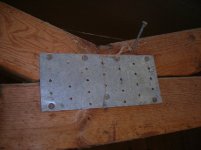
A friend pointed out the trusses look like they are not factory built. He was concerned about the gusset plates. Money is very tight right now so what ever I do it will have to be minimal cost.

One idea I had was to cover both sides of the trusses with OSB glued and a boat load of nails. Another thought is put a pole from the floor to the top of each truss, which would **** cutting the shop in half, though provide a lot of support.

The trusses are 21'7" long, the top cord is 2x8 and the rest is 2x4 doug fir, 8' centers, perlins are 2x4 on 24' centers.


attachment.php


attachment.php
 

Attachments

  • truss.jpg
    truss.jpg
    61.4 KB · Views: 769
  • gusset.jpg
    gusset.jpg
    52.2 KB · Views: 760
To avoid these ads, REGISTER NOW!

skeletonizer

Well-known member
Joined
Sep 25, 2008
Messages
1,320
Location
Michigan
Yikes.

Do you get lots of snow there?

The OSB would surely stiffen the truss, even if you only did one side. The 8' centers would still concern me though.
 

theoldwizard1

Well-known member
Joined
Feb 22, 2011
Messages
43,097
Location
SE MI
Definitely not "factory" built. Factory plates have dozens of barbs on the back and are pressed in.

What is the spacing between trusses ?

That one splice where the 2 web pieces join the bottom cord looks like there are cracks coming from the 2 nails :shocking: I would temporarily brace the bottom chord at that point and then drill a pilot hole from the top edge of the web 2x4 all the way into the bottom chord and then install a 6" screw. You need to do a pilot hole because the wood is old and brittle and you don't want any more cracking
If you are really paranoid, drill all the way through both the web 2x4 and the bottom chord and install a 1/2" carriage bolt with a washer and nut.


Find a good carpenter/framer for advice . You might be better off placing new, larger plates over the top of what is there. A pair of larger, through bolted, 1/2" plywood plates at each joint would easy my mind ! I would also add a vertical web piece from the peak to the bottom plate/web joint.
 

Nighttrain

Well-known member
Joined
Aug 6, 2009
Messages
2,682
Location
Dripping Springs, Tx
They have been up there for 25 plus years! Why do you think they are bad now? Are they sagging? Factory made trusses have come a long ways in 25 years. Back then a lot where bulit to engineer standards at the local lumber yard by hand with those same type of plates. Now they do use those press on plates with no nails with a lot of pine that is full of knots etc. that fir is much better than what you can by now.

Looks like you may have some water leaking in though that needs to be fixed.
 

1948

Well-known member
Joined
Oct 14, 2011
Messages
569
Location
IL WI border
doesnt look all that bad to me, i mean is it proper, no.... but... its holding up and the way that they are setup all the force gets pushed down, not side to side.
 

35mastr

Well-known member
Joined
Dec 6, 2007
Messages
2,534
Location
Norcal
Double Plate them with some 5/8 plywood and lots of screws and they will be there for another 100 years. Oh and fix that water leak.
 

mambo

Active member
Joined
Mar 30, 2012
Messages
35
They look ok to me. Maybe bang a few more nails in, and i like the bolt idea.
 

Zeke

Well-known member
Joined
Aug 13, 2009
Messages
17,176
Location
Long Beach CA, the sewer by the sea.
I think I'd save those. Plywood, piloted screws, bolts, adhesive, whatever. No more nails or screws through those. Make your new attachments away from those plates. The bigger the plywood mending plate, the better. You could use 3/8ths even, IMHO.
 

DekeT

Well-known member
Joined
Aug 12, 2011
Messages
2,234
Location
USA
Larger gusset plates, construction adhesive and screwed, on each side of the joint should do some good. Do not use OSB. Use real plywood.

On the other hand if you plated the whole truss with OSB on each side that too could work. Your biggest problem I see is the bottom chord bowing. Without lifting the trusses back to somewhat their original shape the load carrying ability is severely compromised. You will not have a straightedge on the bottom chord. I would never at this point drill any kind of hole to thin the cross section of the bottom chord through the vertical. Anything you attach to the bottom should be fastened from the side as close to the center of the board as possible.

If it were my repair I would put beams beneath the bottom joints and top joint then raise the truss evenly very, very slowly before attaching any fixes. Then slowly remove the braces.

Just my opinion but I think the bolt idea is sure to collapse those trusses faster than you can get out of the way. The bottom chord is closest to failure of any member. Screwing with it now is asking for disaster.
 
Last edited:

tcianci

Well-known member
Joined
Feb 7, 2009
Messages
4,242
Location
Walpole, Ma
You could go to an engineer, but considering that the structure has seen some typical strong weather over the years, it may be somewhat better than you think. As was previously asked... what are the indications for your concern? Is it just that it looks a little too wimpy or does it exhibit sagging or other failure?
You posted that the trusses are a little under 22 feet, that would give you a rafter of about 12 feet and it's 2x8, even with the shallow pitch you have, a 2x8 rafter isn't bad. My gut feel is that you don't have enough of them. In addition to adding GLUED PLYWOOD (not OSB) butterfly type gussets you may want to simply install new 2x8 rafters midway between the trusses. Don't attempt to prop the structure up by jacking under the bottom chord and installing posts or by attempt to install posts from the floor to the ridge, you will just create a camel humpy ridge as viewed from the outside. What you do want to support is each truss at the center from the bottom chord to crown it before you assemble the gussets to the trusses. By doing that you will be loading the truss, after the adhesive dries and the supports are removed, the gussets can distribute the forces throughout the truss. If you dont do this, the gussets will not be distributing forces throughout the truss until the truss is additionally loaded.
Also, you would probably want to NAIL the gussets in place with 6 penny nails. Drilling the assembly and installing bolts puts a lot of force on one point and may cause weight induced cracking of the truss members
 
Last edited:

theoldwizard1

Well-known member
Joined
Feb 22, 2011
Messages
43,097
Location
SE MI
I think I'd save those. Plywood, piloted screws, bolts, adhesive, whatever. No more nails or screws through those. Make your new attachments away from those plates. The bigger the plywood mending plate, the better. You could use 3/8ths even, IMHO.

I agree, larger is better than thicker !

Check the bottom chord for level. SLOWLY jack back to level before installing plates (both sides).
 
OP
B

burleymike

Well-known member
Joined
Feb 25, 2009
Messages
935
Location
SE Idaho
Thanks for all the ideas guys. The reason I am worried about these trusses is the wind. Yesterday I was doing some sprinkler work and went in the building to get some pipe. A huge gust of wind hit and I heard a lot of creaking noises, I looked up at the truss in the picture and saw it lightly shaking, perhaps it is normal but it did make me think. Sometimes I think too much about nothing.

As for the leak all the lumber in this barn has water stains on it. In the 6 years we have been here they have had those stains, yet during the 2 heavy rains a year we get they stay dry. All I can figure is they sat outside for a long time before being installed, which would explain the lumber grade stamp being really faded.

tcianci, adding (2) 2x8 rafters between the trusses is exactly what I thought about after making this post. The cost is minimal and I think it will really help add some strength. I will go ahead and make plywood gussets as well. I will make them oversize to cover a lot more of the truss than what the metal plates are covering. I have a couple sheets of 5/8 sitting around, now I have a use for them.

Question, All the pole buildings I have seen they have one sometimes two 2x6 or 2x8 running between poles with the trusses that don't sit over a pole the sitting on them. Could I use a 2x6 and do I need 2 of them or should one be enough?
 

tcianci

Well-known member
Joined
Feb 7, 2009
Messages
4,242
Location
Walpole, Ma
.

.

tcianci, adding (2) 2x8 rafters between the trusses is exactly what I thought about after making this post. The cost is minimal and I think it will really help add some strength. I will go ahead and make plywood gussets as well. I will make them oversize to cover a lot more of the truss than what the metal plates are covering. I have a couple sheets of 5/8 sitting around, now I have a use for them.

Question, All the pole buildings I have seen they have one sometimes two 2x6 or 2x8 running between poles with the trusses that don't sit over a pole the sitting on them. Could I use a 2x6 and do I need 2 of them or should one be enough?[/QUOTE]


Yes, you need to make the plywood gussets much larger than the connecting plates, think on the order of 2 feet or so and you will need to add a doubled 2x8 from post to post to pick up the additional rafters.
 
To avoid these ads, REGISTER NOW!

DekeT

Well-known member
Joined
Aug 12, 2011
Messages
2,234
Location
USA
Don't attempt to prop the structure up by jacking under the bottom chord and installing posts or by attempt to install posts from the floor to the ridge, you will just create a camel humpy ridge as viewed from the outside. What you do want to support is each truss at the center from the bottom chord to crown it before you assemble the gussets to the trusses. By doing that you will be loading the truss, after the adhesive dries and the supports are removed, the gussets can distribute the forces throughout the truss. If you dont do this, the gussets will not be distributing forces throughout the truss until the truss is additionally loaded.
Also, you would probably want to NAIL the gussets in place with 6 penny nails. Drilling the assembly and installing bolts puts a lot of force on one point and may cause weight induced cracking of the truss members

My suggestion was to lift all the trusses at the joints simulataneously so the roof raises evenly. That is what the beam would be for. I suppose that wasn't clear the way I said it. I think pushing up on the center of bottom truss in between the joints in order to straighten it will snap the bottom chord.
 

WNYflyer

Well-known member
Joined
Sep 13, 2009
Messages
2,117
Location
Lockport, NY
If you have some truss shaking during strong wind gust it is probably because it looks like you have no truss bottom chord bridging.

Low slope roof + Light weight roof + wind gusts may mean wind suction/uplift on the trusses thus the truss bottom chord may go into compression when it is normally in tension under snow, dead loads etc. If the bottom chord goes into compression rather than tension then it needs to be braced by bridging running the length of the building and tied into the endwalls.

If you don't have any bridging (doesn't look like it from the photo) then I would run 2x material on top of the bottom chord and tucked close to the truss panel points (point where diagonals meet the bottom chord) and connect to the bottom chords and tie it well into the endwall structure. This should help with the truss shaking during strong wind gusts.

Next time you go into a big box store look up and you will typically see small angle bridging run the length of the building and connected to the bottom chord of the trusses. Steel yes but same basic concept. Helps brace the bottom chord for load reversal as well as for erection stability.

I made no mention of those connections but I would bulk those up also as other's have said, they are pretty ugly.
 
Last edited:

Boomer343

Well-known member
Joined
Mar 19, 2012
Messages
519
That old Douglas Fir is going to be harder than nails....just an expression but if you go popping in a bunch of nails or screws then it is going to split.

If you must reinforce these trusses then I would look at using exterior grade plywood, structural adhesives and as few screws as possible installed with pilot holes drilled for each one in a staggered pattern down the middle 3 inches spaced a foot apart.

Make sure the glue you use is spec'd as a structual adhesive....
 

cyamaha2007

Well-known member
Joined
Apr 20, 2009
Messages
2,001
Location
St.Charles MO
Some of our farm buildings have the trusses on 12ft centers. Its very common to see them on 8ft centers here. I would add 3 runs or 2x4s front to rear on the bottom truss cord. Ive been told it helps a ton. My building calls for 3 runs and its 36ft wide. I believe they are called rat runs.
 

brownbagg

Well-known member
Joined
Mar 20, 2006
Messages
5,208
I dont see anything wrong with it, looks like the typical truss everywhere else, and yes truss do move. but that how they hold weight, the top push on the bottom.

leave them alone, worry about something else
 

JimVonBaden

Well-known member
Joined
Dec 2, 2011
Messages
15,716
Location
Northern Virginia
I dont see anything wrong with it, looks like the typical truss everywhere else, and yes truss do move. but that how they hold weight, the top push on the bottom.

leave them alone, worry about something else

I am a total no0b on these things, but other than minimal nailing on the plates, they look fine to me, and like many I have seen in old buildings in the past.

Jim :cool:
 

mmhouse

Well-known member
Joined
Aug 31, 2008
Messages
754
Location
Desert Southwest
Thanks for all the ideas guys. The reason I am worried about these trusses is the wind. Yesterday I was doing some sprinkler work and went in the building to get some pipe. A huge gust of wind hit and I heard a lot of creaking noises, I looked up at the truss in the picture and saw it lightly shaking, perhaps it is normal but it did make me think. Sometimes I think too much about nothing.

It's surprising how much force wind can put on a building. I used to live in an area with a very high incidence of earthquakes. When involved in building some large storage sheds I was talking with the structural engineer about the reason for the final shed design and he mentioned that wind, not earthquake, had the potential to exert the greatest forces on the structure. So you have good reason to be concerned.

I'd suggest you Google 'permanent bracing for wood trusses' a read up a bit on the subject. If you currently have no bracing it would probably help a lot.
 

Outlawmws

Well-known member
Joined
Aug 9, 2011
Messages
39,123
Location
The Badlands
The plates you have shown are not there to take the load, but to keep the structural members from falling out of alignment from each other. (how is that last low attachment made?)

I'm guessing that under the insulation there would be enough structure to span the 8' between centers, (which is why the top cord is 8")

If you want to make them stringer, then Plywood (not OSB...) is the way, glued and nailed/screwed; you don't need it real thick, as it's load is in shear. Even 1/4' ply will do fine with such a shallow span from the peak to the straight span. If you have ever looked at engineered floor joists, it is a thin sheet of ply glued (with some cross nails/staples to hold it while the glue dries) into two grooved 2X's, and done. Incredibly strong.
 

Zeke

Well-known member
Joined
Aug 13, 2009
Messages
17,176
Location
Long Beach CA, the sewer by the sea.
I thought about this since my last post. I would use the ply plates as we have all discussed. I would use a LOT of small nails from both sides with the adhesive. One through bolt on each member about a foot away from the intersection and with nails on both sides of the bolt would be hell for stout.

The reason is — as already mentioned — is that the lumber there is well seasoned and very hard. It will like to split. A gang of thin shank nails, not ring shank either, will penetrate well enough to provide plenty of shear. You don't want nails that will go all the way through, IMHO. The bolts are just there to prevent any movement that would cause the nails to want to work loose.

If you do this well, it will even look attractive and interesting.
 
OP
B

burleymike

Well-known member
Joined
Feb 25, 2009
Messages
935
Location
SE Idaho
I finally got the majority of the barn stuff out of there as well as half the manure on the floor which has dried rock hard.

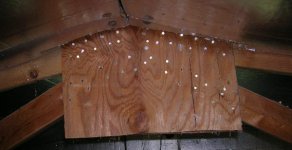
Tonight I got part way done with the first truss. I placed the plywood on each joint over the metal plates. First I liberally applied a urethane adhesive then put 4 screws into each piece of plywood. After putting the plywood on the opposite side I nailed the hell out of them.

After shooting a few test nails I was happy to discover the wood is not splitting. I am using 2 1/2" 10 gauge nails. I have a boat load of these nails sitting around so I really wanted to put them to use. Hopefully going all the way through will not be an issue.

The wind was blowing pretty good all day. When I started I noticed the truss bending to the side a little with the big gusts. After putting the plywood on it straightened out and became much more rigid. I also noticed that when I grab the bottom chord and rock it, it no longer wobbles. The entire truss moves as one unit when I rock it from the bottom.

As I continue to go I will keep checking for splitting and if any of the wood does I will pre drill and use screws. This wood is pretty good with very few knots.

truss1.jpg

truss2.jpg
 
To avoid these ads, REGISTER NOW!
Top Bottom