To avoid these ads, REGISTER NOW!

US ac plug point questions

jaye944

Banned
Joined
Nov 26, 2013
Messages
1,077
Location
GTA, Ontario, Canada
ok, here in canadia,
I have noticed 2 things

1> on 2 pin plugs there polarized. Why? in UK terminology, we use 3 phase, 240v, Earth, Neutral and Live; so here it's 110 1phase? so Neutral and Live are interchangeable? When I say that, in the UK 2 pin mains plugs, they are NOT polarised, so you can put the plug in Anyway. I have seen some US style plus which are NOT polarized, could someone explain why.
Also what goes to what pin, i.e. Neutral/Live goes to the big one or the small one


2> Also noticed that the metal pins have a small hole in them ? Weight saver? :)


txs
 
To avoid these ads, REGISTER NOW!

Falcon67

Well-known member
Joined
Jun 11, 2009
Messages
18,371
Location
Merkel, TX
240V is usually two hots. A neutral in a 240V run is usually there - not always - to be able to supply 120V to controls at the appliance. The big pin on US plugs is the neutral/return. Hot will be the smaller blade. Old incandescent lamps and maybe double insulated tools don't have issues with polarity. I think the holes are there to better seat the wipers in the socket for good contact.
 

Kevin C

Well-known member
Joined
Aug 4, 2011
Messages
1,653
Location
Portland OR
You can put a lockout device in the holes to prevent it from being used.

Or if you don't have a wall outlet you can put the wires directly in the holes. :)

Possibly a remnant from WW2 to save material.

This seems to make sense...

Type A and B plugs have two flat prongs with a hole near the tip. These holes aren’t there without a reason. If you were to take apart a type A or B socket and look at the contact wipers that the prongs slide into, you would find that in some cases they have have bumps on them. These bumps fit into the holes so that the outlet can grip the plug’s prongs more firmly. This prevents the plug from slipping out of the socket due to the weight of the plug and cord. It also improves the contact between the plug and the outlet. Some sockets, however, do not have those bumps but just two spring-action blades that grip the sides of the plug pin, in which case the holes are not necessary.

http://www.worldstandards.eu/electricity/plugs-and-sockets/ab/

Fun question!
 
Last edited:

404

Well-known member
Joined
Aug 23, 2014
Messages
3,463
Location
Mass
3 phase is 3 lives with the voltage waves 120 degrees apart ( 1/3 of a wave apart) if plotted out.

The polarized plugs came about when some nanny busy body stuck their finger in an empty bulb socket with it on and got shocked from the threaded sleeve instead of the center contact.
 
OP
J

jaye944

Banned
Joined
Nov 26, 2013
Messages
1,077
Location
GTA, Ontario, Canada
ok that makes sense

cheers

240V is usually two hots. A neutral in a 240V run is usually there - not always - to be able to supply 120V to controls at the appliance. The big pin on US plugs is the neutral/return. Hot will be the smaller blade. Old incandescent lamps and maybe double insulated tools don't have issues with polarity. I think the holes are there to better seat the wipers in the socket for good contact.
 

theoldwizard1

Well-known member
Joined
Feb 22, 2011
Messages
43,659
Location
SE MI
ok, here in canadia,
I have noticed 2 things

1> on 2 pin plugs there polarized. Why? in UK terminology, we use 3 phase, 240v, Earth, Neutral and Live; so here it's 110 1phase? so Neutral and Live are interchangeable?
As others have said, you do NOT use 3 phase (ate least in residential buildings). Your "live" conductor is just 240V above your "neutral" conductor. I would guess, that on plugs/outlets that have 3 prongs/hole (I don't recall seeing any of those when I was in UK 20+ years ago) that neutral and ground are "bonded" together at the "main" fuse/breaker panel (although, it don't know if UK have any similar to that as all the plugs I saw had a fuse built in to the plug!)

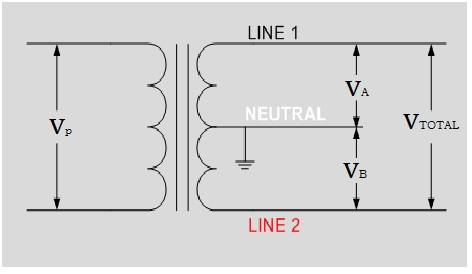
In the US, the power coming into our residents is 240V, "split phase". 1 phase, but it can be used as half the voltage or the full voltage.

Centre-Tapped-Transformer.jpg


We call the center tap "neutral" and it is "bonded" to ground at the main fuse/breaker panel. UK transformers simply do NOT have that center wire !


2> Also noticed that the metal pins have a small hole in them ? Weight saver? :)
I am not certain, but my guess would by that a very small lock, with a small shackle could be run through the hole, preventing the appliance from being plugged in. (It also makes a convenient place for a piece of bare wire to be inserted , turned 180° and twisted back on to itself for a very temporary connection !)


The really question is, WHY the difference in voltage ?

My "SWAG" is that the US lead the world in "electrification" and much of the early wiring had "cloth" insulation. Higher voltages might have caused that "cloth" to "break down" and cause a short.

The "plastic" insulation used today in house wiring is much thinner than what was used 50 or 60 years ago. Plastic insulation from that era cracks easily when flexed now a days.
 
To avoid these ads, REGISTER NOW!

ishiboo

Well-known member
Joined
Oct 27, 2010
Messages
9,481
Location
Oshkosh, WI
ok, here in canadia,
I have noticed 2 things

1> on 2 pin plugs there polarized. Why? in UK terminology, we use 3 phase, 240v, Earth, Neutral and Live; so here it's 110 1phase? so Neutral and Live are interchangeable? When I say that, in the UK 2 pin mains plugs, they are NOT polarised, so you can put the plug in Anyway. I have seen some US style plus which are NOT polarized, could someone explain why.
Also what goes to what pin, i.e. Neutral/Live goes to the big one or the small one


2> Also noticed that the metal pins have a small hole in them ? Weight saver? :)


txs

Electrical potential is the difference in voltage between two sources. So, electrically, it does not really matter (basically) if one wire is 120v and the other is 0v, or if it's the opposite... or even if one is +120v and one is +240v, or one is -60v and one is +60v. The device always sees 120v.

So. Why polarize the plugs? Well, it is sometimes beneficial to know for safeties sake what is hot and what isn't hot. Especially when your intent is to switch the hot.

Take for example a lamp or toaster. You shut it off, but hot and neutral are reversed as the plug is not polarized. When you shut it off, you could have then switched off neutral... but there is still hot to the socket, toaster element, etc. Reach your hand in to change the bulb, remove some pieces of toast that are stuck... zing!

So we try to assure what we think is hot, is actually hot. Despite the device operating the same way either way. (There are a few exceptions to this)
 

Charles (in GA)

Well-known member
Joined
Jan 11, 2006
Messages
12,489
Location
50 mi south of Atlanta
What you have in the UK is not 3 phase, its single phase. One transformer, one primary one secondary winding. The hot is tapped off one end of the secondary winding, the neutral off of the other end of the winding and it too, just as in the US, is connected to the earth grounding.

In the US and Canada, the difference is that we tap the neutral off the center of the transformer (and ground it) and this gives you two hots off opposite ends of the transformer. The effect at 240v is the same, no matter if in the US or the UK. In the US the use of one hot tap, either one, plus the neutral tap gives you a hot plus neutral, but at a lower voltage, 120v since you are only using half of the transformer winding.

While the pin for the neutral in the UK is the same as the hot pin in a plug, the positioning of the pins and connection of wires is consistent, the neutral always being the same side of the plug/recetptacle.

plug-socket-diagram.jpg
 
OP
J

jaye944

Banned
Joined
Nov 26, 2013
Messages
1,077
Location
GTA, Ontario, Canada
hey lots of good replies thanks

cool on the phase explanation,

can somone expand on why we use 240 and not 110 (or vice-versa)
some heavy duty apps here in canada USE 240; washers for example and ovens

also on a 240VAC, we can get up 13A
here on 110VAC its lower, I noticed a CAN amplifier version of the same UK is a **** load lighter, due to it having a smaller (I assume transformer)

For example my PV1.3k amp form the uk is like 3 times the weigth of the same one I hired here.

txs
 

ishiboo

Well-known member
Joined
Oct 27, 2010
Messages
9,481
Location
Oshkosh, WI
hey lots of good replies thanks

cool on the phase explanation,

can somone expand on why we use 240 and not 110 (or vice-versa)
some heavy duty apps here in canada USE 240; washers for example and ovens

also on a 240VAC, we can get up 13A
here on 110VAC its lower, I noticed a CAN amplifier version of the same UK is a **** load lighter, due to it having a smaller (I assume transformer)

For example my PV1.3k amp form the uk is like 3 times the weigth of the same one I hired here.

txs

As voltage increases, amperage decreases to deliver the same amount of power, in an equal ratio.

IE, a 10-amp motor running on 240v requires 20 amps at 120v. The wiring, plugs, connectors, etc. can all be that much smaller on 240v. However, as the voltage increases, the insulating properties of the wire/cable, switches, etc. may need to be increased. (Most wire good for 120v is good for 400-600v, but it varies.)

The actual voltages, frequencies, etc. vary by country and are largely a function of historical purposes - it costs a ton to change them. There are reasons why each was decided in the first place in every country.
 
To avoid these ads, REGISTER NOW!
Top Bottom