I would re-think that. While engineered wood floors and composite floors are always floating, LVP is often allowed to be glued down to concrete. As always, consult the manufacturer's instructions before following such advice.
I have about 900 sq-ft of vinyl, and my parents and friends all now have rooms of similar stuff. They're not all the same, and in this instance, it is the core that matters. My in-laws have an expanded rock core that's designed to have lower sound transmission (they chose the floor on the image, and not on the properties), and it got dented where I dropped something. The core on mine is quite solid, and I could easily see jack stands being used on it.
The wear layer isn't even vinyl. It's got more aluminum oxide than binder nowadays.
Most lvp cores used to be made out of some type of wood material 4-5 years ago, although recently most are made out of some type of "solid" or "stone" as it's advertised, which is usually limestone.
I would not and have not heard of people gluing down LVP (planks), and would strongly recommend against that for a bunch of reasons. 1) you still need a vapor barrier if youre doing it on concrete and 2) if you have to replace it ever, which you will, its going to be awful.
Even my stone core LVP that I got a couple years ago says you need a vapor barrier (in the fine print) despite all the marketing **** about them being waterproof, having that squishy backing glued on the back already, etc.
When I got mine there were videos of people lighting them on fire, beating them with a hammer, and leaving them underwater for days at a time. I did all of that just to "test" them. They technically held up, once, but I wouldn't waste the effort for a garage.


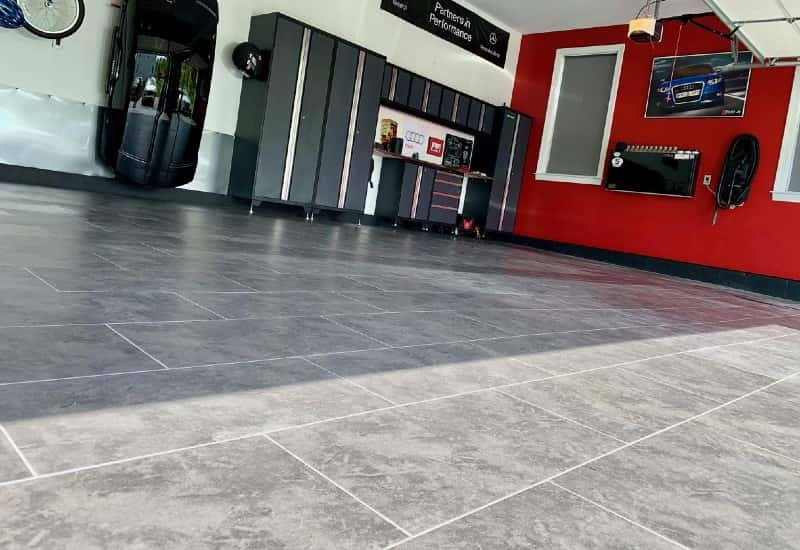

 We state why New Age defies the rules with an LVP designed specifically for a garage floor environment.