theoldwizard1
Well-known member
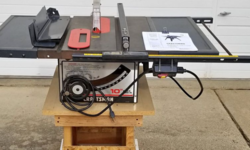
This is a Craftsman table saw for sale near me.
What is that flex shaft coming off the motor for ?

What is that flex shaft coming off the motor for ?



This sounds and looks like a profoundly bad idea. WTF were they smoking?It is probably a 113.241691 Flex Shaft Table saw. The flex shaft drives the blade. I would not buy it. It is a terrible design.
Flex shafts are used as drive components in aircraft and industrial production lines.This sounds and looks like a profoundly bad idea. WTF were they smoking?
Why, just why? No torque multiplication, 180* bend in a flex shaft, awkward packaging, has to be more expensive to make.
The motor clearly has the power to drive the blade directly so why not attach it right on the arbor as others did? Perhaps they wanted a light weight mechanism for moving the blade/arbor. No wonder they are in the *******.
Did a little sniffing around on these. Apparently the fence is **** too.
 shop.suhner-abrasive.com
I suspected this as a reason.Flex shafts are used as drive components in aircraft and industrial production lines.
Flex shafts are also used to drive the “industrial” version of the Dremel tool known as the Foredom.
Before small compact motors existed that could somewhat be held in the hand, angle and die grinders were routinely made as a flex shaft system, with a motor powering a large flex shaft, which then might spin a 7” angle grinder or larger die grinder.
Suhner of Germany/Switzerland still manufactures large flex shaft machines for industrial fabrication.
Foex, the German power tool brand that has been around 100 years or close started out making Flex shaft grinders, before switching to smaller motors, hence their brand name, “Flex”.Suhner Abrasive Shop
The flex shaft systems won’t have issues with belts slipping or breaking.
Unlike most “contractor style” tablesaws, since you don’t have a motor with drive belt hanging out the back of the saw, a potential safety issue is eliminated, since nobody can walk around the back of the saw whole the saw is running, and accidentally get a hand or their privates caught in the motor and drive belt. (Their were images I saw decades ago on cable of some guy who got his ***** caught in a drive belt, who basically had to get his ***** reconstructed).
Manufacturers later had to start adding motor and drive covers to saws to eliminate the safety risk, but that is extra cost, and in many cases seemed poorly though out as an after design add on.
With a belt drive saw, the motor also has to hang and adjust with blade angle adjustments, requiring a heavier arbor and adjustment mechanism, simply due to the extra motor weight.
As can be seen in the photographs, with the flex drive shaft system, the motor can be firmly affixed to the saw cabinet, on the mounting table, potentially eliminating or at least reducing motor vibration from the saw.
Compared to a direct drive motor system found in some compact saws, were the blade gets run directly by the motor arbor, a flex shaft has a narrow end, allowing the blade to lift higher above the saw table, for deeper cuts.
Depending on how the flex shaft attachments are made, it might also have been possible for Sears to sell other tools without motors, that could be run from the same flex shaft, although I haven’t looked up the saw to see if Sears bothered doing this. I know there have been stationary tools that did this in the past though.
The major issues with a flex shaft, are the outer hose sleeve tends to get warm in use, and the grease inside needs to be occasionally replaced, (as does the coiled spring drive shaft and outer hose sleeve).
I’m guessing some issues with these saws may be cause by owners not doing maintenance on the grease, (which is sort of messy), and maybe not even knowing it is necessary.
The outer sleeves can also crack over time.
As seber points out though, if the Flex shaft breaks, replacement cost can be high, and probably a pain to find nowadays, even if a standard size, since flex shaft drives are a weird industrial thing.
I’ve never used one of the saws, but it seems an interesting and elegant solution to certain potential power tool issues such as safety.
Nah, could not be. /SarcasmSomething tells me the Swiss and Germans may have this built to a quality, not a price as Sears most certainly did.