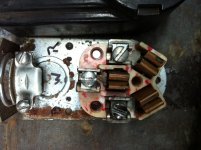
I tore out a oven that was built into the cabinets/countertop. It was an old 70's type of thing. The buit in unit was hardwired. I turned the breaker off and cut the wires, no problems.
Make that "...no problems THAT [YOU] ARE AWARE OF."
I'm installing a normal oven in there once I trim the excess countertop backsplash.
Exactly what do YOU consider a "normal" oven? And how does this differ from the one you're replacing?
The oven I'm putting in has the three prong cord.
Which near-certainly should be replaced with a proper four-prong type.
I have a 220 outlet that accepts the oven cord, but it only has 3 screws for wires.
That too should be replaced.
I have 3 wires and a copper ground. Where does the copper gound go to once I install the 220 outlet?
First, a somewhat pedantic point: It is a
240V circuit (and hence, outlet), which has been the USA standard split-phase line voltage for decades now.
Second, to directly answer your question: That bare copper wire goes to the ground (EGC) terminal on the receptacle. And not to be unkind; but if that doesn't tell you EVERYTHING you need to know, you probably ought not be messing with this stuff.
Please excuse my ignorance on this, but the outlet I'm using has three prongs just like the oven cord. I just don't know where the copper ground goes.
As above. It goes to the Ground terminal.
I hate to have to call an electrician out to do such a tiny job as wiring an outlet.
I understand. But this job is apparently not quite as trivial as you had presumed. For one thing, it appears likely that the wiring inside the oven will need to be changed.
What kind of oven is this? Any modern electric oven is 240/120 and 4 prongs. The receptacle should have 4 prongs. Red and Black makes up the 240 portion for heating elements. White is the neutral that can be combined with the black or red internally to give 120V for the control panel. The ground is the ground.
Exactly.
To the OP: Re-read the above paragraph as many times as it takes to sink in, BEFORE you connect anything to anything.
If this is some old oven you can get a new proper cord with ground and a new proper receptacle with ground and do it right. You have the correct wiring in place to bring it up to code.
Again, exactly correct.
And again: OP, take heed!
Better yet, hard wire it, which is the way it should be done anyway.
Well... Maybe. But the IMPORTANT thing is that each of the (FOUR) connections are made properly, to the correct wire/terminal on each side of the connection. We've seen people screw this up before, right here on GJ. The results COULD be disastrous.
The copper ground goes nowhere in your situation. Just put a wire nut on it and you're good...
This is very dangerous advice. You now have ungrounded metal parts if this advice is followed.
Agree completely.
No pictures, but no matter, bottom line, you are going to need a new cord or whip (if you choose to hardwire it) with 4 wires to match an appropriate recptacle you install in the wall. On the switch over you will need to remove a jumper from the sheet metal ground to the white neutral connection in the wiring panel of the oven. You will attach you new whip or cord ground to the sheetmetal chassis of the oven.
Again correct.
You don't want to wing this and install "old style" with no ground and have ungrounded metal chassis as Norcal stated.
Not only correct, but ABSOLUTELY ESSENTIAL.
If there is a 3 wire, line,line,neutral, with no equipment ground supply, the instructions shouldallow the neutral & grounding conductors to be connected together, but since complying w/ NEC requirements also means manufacturers instructions have to be followed please read the instructions prior to doing it.
I do not like grounding to the neutral, but the huge number of existing installs from the time it was allowed, means they are going to have to be dealt with for decades to come.
But a major part of "dealing with" these connections is fixing them whenever they are encountered. The only plausible exception would be for an appliance which contains
NO 120V circuitry. In the case of a residential oven, this would probably mean no timer control, etc.; and it would CERTAINLY mean no digital controls. Have any such even been built in the last decade or so?
Unfortunately, those pics show only the "wrong" stuff you want/need to replace. Aceman asked for pics of the existing (house) wiring SUPPLYING the oven.
This is not a NEW oven, it is a oven I had installed in another house previously with the cord on it and an outlet already in the house. It's the same as a dryer cord/outlet.
And there, in a nutshell, is the crux of your problem.
I'm also wagering that "not a NEW oven" is a serious understatement -- just how old is it, anyway? As noted above (and by others), any reasonably modern oven will have come (from the factory) set up for a FOUR-wire connection. It is possible that this was "kludged" in the previous installation to accommodate an existing three-wire feed, by combining the Neutral and Ground connections internally; but it should
NOT be left that way, if at all avoidable (which it near-certainly is, at least if the oven is worth installing in the first place). As "MrMark" pointed out above, you can easily get a new PROPER (four-wire) power cord for the oven, and a matching FOUR-wire receptacle, at any local home center or hardware store. And (save for hard-wiring ALL FOUR wires) THAT is the only CORRECT way to install this oven, today.
I didn't add a pic of the wires, but again, its a red, black, white and bare copper gorund.
That is as it should be. Notably, each of those wires has an important purpose; so you
DO NOT want to forego using any of them.
I was ASSuming the red, white, black went went on the posts on the outlet. I was unsure where the bare copper ground went.
Well, you DO know what they say about "***-u-me", right?
The way that oven USED TO BE INSTALLED, it used the two Hots and the Ground, with no separate Neutral connection. But as noted above, that is NOT the way you want to install it this time, as this would effectively turn the EGC ("Ground" into a current-carrying conductor if there is
any 120V circuitry inside that unit (which there very probably is) -- and you
NEVER want to do that.
I can buy another outlet.
Do that. And a new power cord for the oven, too.
That is an old one I had. I have rentals, so I have aquired all kinds of dryer and oven cords from switching them out due to different prongs.
Most of which PROBABLY ought to be tossed into the dumpster, for any of several reasons.
This cord matches the outlet I have as far as prongs go, there is just nowhere to put the copper ground.
I am both disappointed and dismayed -- not to mention somewhat incredulous -- that even after all of the foregoing thread, wherein you have been corrected on this point SEVERAL times, you apparently still think "...nowhere to put the copper ground" is the problem.