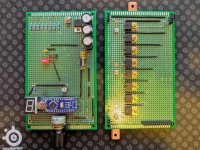
Comparison between the Maletrics and Kweld welders.
https://malectrics.eu/
https://www.keenlab.de/index.php/portfolio-item/kweld/
https://endless-sphere.com/forums/viewtopic.php?t=93274
Spent some time looking at the Malectrics and the Kweld welders. Both are excellent welders. Both have support on forums, both are continually being updated hardware and software wise. From many comments I have read, the affordable Asian spot welders are not well liked due to reliability issues.
“In my understanding, KWeld is discharge energy based welder, it does not need 2 pulses and welds will be more consistent, as they do not depend much on contact and time consistency, every weld receives same amount of energy, time is the variable.
Time fixed welds can vary from one to other because of current path inconsistencies, caused by varying pressure on the tab, distance of electrodes, cleanliness of the weld patch, some of those issues are fixed with 2 pulses, where 1st is to clean and clear the path, but there is no guaranty that every weld receives same amount of energy at the end.”
With the KWeld changes to power /time vary due to the weld materials conditions and user interaction, basically changes to resistance during the actual spot weld in real time. The KWeld is slightly better for building multiple large battery arrays in a professional atmosphere.
With the Malectrics, the time and power are manually preset before a welding session. For occasional/light professional use the Malelectrics is still excellent.
There are a few common issues for me with either unit…..
I do not like the enclosures, either kit should be in a larger metal case with a decent size muffin fan. A tiny muffin fan does not cut it
The control knob , screen, inputs should be able to be mounted away from the main PCB as on a front panel of a metal case, all doable but with extra effort.
The 300 amp fuse I find amusing. I understand the reasoning for such a large fuse, as power cable resistance is extremely critical on these welders, the slightest milliohm resistance increase drops the welding current maximum considerably. This also interferes with the cable size limit. Due to the fuse, increasing the cable gauge for higher weld currents has less of an effect then it should, as the resistance of the fuse is the deciding factor, the fuse resistance is a bottleneck. Thicker cables allows lower current loses which allows cooler electrodes, it also allows for longer cables if lower resistance is obtained (no fuse).
With both units, I think the electrode bodies should be thicker to produce less heat and transfer the heat to the cable for cooler operation.