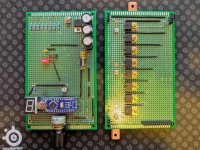
The summer of weird and nerdy electronics projects continues... Lately, I've been using a lot of 18650 based Li-Ion battery packs in 2, 3, and 4s. As such, I'm thinking...
To read the rest of this blog entry from The Garage Journal, click here.
.

Seems interesting. I've successfully soldered to 18650 cells before, but it's tricky and you do risk damaging them if you take too long to do it.
I am working on the ultimate, CHEAP design. 12v car battery, wires, relay, push button. V1 did not work well, probably because I was using 12AWG wire.
V2 is almost done. Double up the 12AWG feed wires. The wires from the relay to the "contact" (solid copper nails) are now 8AWG. The biggest problem I have had location the correct size connector (ring terminals).
I'll keep you posted, as it should be complete in the next couple of days.
(That one from Germany is WAY over priced !)

Not sure about the arduino version, probably fun but at 109EUR that is crazy...
I have been eyeing on these controllers, minus the welding transformer and what nots chromium copper tips they use.
https://www.ebay.com/itm/110V-Spot-...attery-welder-includ-transformer/283009560494
You get what you pay for. You can also weld battery tabs with a single super capacitor, if your lucky.
....
Not saying you can not weld with this, compare the specs in two kits mentioned by others, specifically current and weld thickness and your support option; the mention of 100 amp scr means little, does not give anything about peak current, the .15mm max gives a hint, none of the info is verified. Using a transformer is an old design. Personally I do not want Chinese support or do I believe what is quoted.
This is a home brew, DIY, hobby battery welder, or doing maybe a dozen or so cells at a time. The muffin fan was clearly an addon. Better than nothing.pcmeiners said:I do not like the enclosures, either kit should be in a larger metal case with a decent size muffin fan. A tiny muffin fan does not cut it
The control knob , screen, inputs should be able to be mounted away from the main PCB as on a front panel of a metal case, all doable but with extra effort.
So do I ! The multiple MOSFET in parallel, in theory, should be good for more than 300A, but I bet they would blow before the fuse !pcmeiners said:The 300 amp fuse I find amusing.
did you buy the kit or go by a schematic / plans ?
Rabid, are you interested in Maxwell 350F ultra caps ?....
https://www.ebay.com/itm/60-Maxwell-Technologies-350F-2-7V-Supercapacitor-Ultracapacitors-6F-160V-EDLC/274379002217?ssPageName=STRK%3AMEBIDX%3AIT&_trksid=p2060353.m2749.l2649
Cheaper for 100F caps...
https://www.ebay.com/itm/MAXWELL-TE...&brand=Maxwell&_trksid=p2060778.c100290.m3507
Plan for the inductance causing a good deal of kickback on the power leads, enough inductance to make the electrode leads jump.
Good luck
 . I bought one yesterday. Figure I could put together a 6S4P setup, and only partially charge the caps for welding....and still have some extra caps.
 The first link with the 60 caps is a great price if it was not abused, which does not seem likely. It should be sold with flash gear
If you want an insane read.....
http://www.turtlesarehere.com/html/continuied___.html
The last couple chapter goes into issues with the need for TVSS devices, ended up getting a few of each on Ebay
15KPA28A LITTELFUSE
30KPA28A LITTELFUSE
Now I need to make the leads and some kind of housing.
This has been my struggle ! I can't find an "elegant" way to connect the 8AWG wire to my copper nails (contacts).
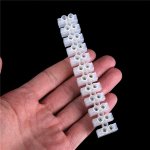
I want to use something like this, but the ones I have bought are either too small (10A rating) or too large (60A rating).
I got mine to the point where I could do a functional test last night. Everything worked as it was supposed to.
Now I need to make the leads and some kind of housing.

Have not worked on my project a great deal. In the middle of moving out to Penn state. Assembled a slew of parts, and as usually it is costing multiples of my original plan. Using a server 800 watt output power supply, which will supply a 5s5P Maxwell super cap array.
Ended up getting a $100 in Lexan to create the array and house the other components within the aluminum case. Now all I need in a medium size house with a 4 car garage, to get my 12 or so projects going again, hoping for the next couple months.
Yeah, DIY electronics is great for learning but not so much for saving money...or time.