To avoid these ads, REGISTER NOW!

Solar on the Garage subpanel?

Vintage Veloce

Well-known member
Joined
Feb 27, 2015
Messages
1,076
Location
San Diego
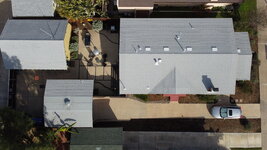
drone view.JPG

My garage is a separate building with a 100A subpanel. The subpanel, a "Siemens Indoor Load Center" is actually rated for 125A.
The garage subpanel is wired to the house 200A main panel with approx 60 feet of this stuff:
CME WIRE & CABLE QI® E102470 S (UL) MTW OR THHN OR THWN-2 OR AWM OR GR II 2 AWG (33.6MM2) CU 600 V VW-1 SR OR C(UL) TYPE T90 NYLON OR TWN75 FT1

Imagine I put solar on the garage roof and run it into the garage subpanel.

The questions
1) Does anyone know how much power I can put on the garage roof?

2) Now say on some sunny day someone goes to the main panel on the house on and turns off the main breaker. They will expect the main panel to now be "cold". However, the panels attached to the subpanel would be feeding the load side of the main panel, right?
Sounds like a problem...
I read somewhere that you can actually do this as long as the main panel has some appropriate labeling alerting about the issue?
Is there some kind of automatic cutoff that would disconnect the solar attached to the subpanel if it sees the main service disconnect?
 
To avoid these ads, REGISTER NOW!

ipgenie

Well-known member
Joined
Jan 29, 2020
Messages
562
Location
Idaho
It probably depends on your power provider and state regulations.
Here you have to run a line from your solar generation to the first panel fed by the meter and provide a disconnect on that line within a couple of feet of the load panel and meter.
Also, the solar production must not provide enough power to theoreticaly overload the bus.

I was limited to 60A on the bus bars in my breaker panel so I replaced the 200A with a new 400A and fed one side from the solar. I could have replaced the main 200A breaker with a 125A but didn't want to go that route. The other option could be to tap the main line.

I like the solar. My panels are on the shop and have been covering our power needs for a couple of years now. DIY can save you a lot of money if you are up to the task.
 

ipgenie

Well-known member
Joined
Jan 29, 2020
Messages
562
Location
Idaho
Oh, I missed the question about flipping the main breaker. By design, the anti-islanding protection will shut down the solar generation if there is a loss of grid power. So if the main is tripped, everything just shuts down until its reconnected.
 
OP
V

Vintage Veloce

Well-known member
Joined
Feb 27, 2015
Messages
1,076
Location
San Diego
Oh, I missed the question about flipping the main breaker. By design, the anti-islanding protection will shut down the solar generation if there is a loss of grid power. So if the main is tripped, everything just shuts down until its reconnected.
That's great to know, thank you. And it makes sense.
 

dcg9381

Well-known member
Joined
Jun 20, 2018
Messages
11,778
Location
Austin, TX
The questions
1) Does anyone know how much power I can put on the garage roof?

It's not clear to me which structure is the garage. Is the picture above oriented with the top north? In general, your solar needs to be due south and the first limitation you're going to run into is "roof area".

I do see installers that drop panels every which way, they do add power, but it's fractional... Don't recommend.

2) Now say on some sunny day someone goes to the main panel on the house on and turns off the main breaker. They will expect the main panel to now be "cold". However, the panels attached to the subpanel would be feeding the load side of the main panel, right?
Sounds like a problem...
I read somewhere that you can actually do this as long as the main panel has some appropriate labeling alerting about the issue?
Is there some kind of automatic cutoff that would disconnect the solar attached to the subpanel if it sees the main service disconnect?

I have a 100A sub-panel in our shop, 6KW solar system. This sub panel essentially feeds to the whole ecosystem so anything upstream or downstream of that sub-panel will attempt to use the power and if it is unused, it goes back to the grid.

Your local POC will have requirements for solar install. Mine requires labelled and "readily accessible" AC and DC disconnects on the exterior of the building. IE, disconnects that the fire department could turn off. The reality is that modern solar systems with "rapid shut down" technology don't really need these disconnects, but we still need to follow the POC rules.
 

nadogail

Well-known member
Joined
Jan 23, 2009
Messages
31,998
Location
Coronado, CA
Any competent Solar Engineer should be able to calculate this based on the available area to set the panels on.
 

gsmith22

Well-known member
Joined
Jul 14, 2015
Messages
337
Location
Central NJ
i don't know if there are specific rules in CA, but generally you aren't allowed to create a system that will generate more than your yearly use. So that is an upper bound to system size. you can probably use your electric bills to determine your yearly use. use PVWatts to see how large of a system is needed to match yearly use: https://pvwatts.nrel.gov/

The size and/or geometry of your roof may also be an upper bound too limiting how many panels will actually fit. panels for roofs generally use the 60 cell format and are 3.25' x 5.5'. two other sizes exist (72 cell and 96 cell) but they are larger and typically used on steep slope residential roofs due to the larger size.
 

reader2580

Well-known member
Joined
Dec 31, 2014
Messages
14,556
Location
Minneapolis, MN
I initially put my solar panels on the roof of my detached garage. Code typically requires a three foot open space on the top and sides of the roof for firefighters. The local fire chief said I could cover 100% of the roof as they never go on the roof of detached garages. The inverters were connected to a 200 amp panel in my garage that has a 70 amp connection to the house. The solar panels eventually got moved to a ground mount since I plan to demolish the garage.

You have to deal with the 120% rule when connecting to a breaker panel. The size of the main breaker plus the size of the solar breaker added together cannot exceed 120% of the bus capacity. I am going to assume you have a 100 amp main breaker so that means the solar breaker can be a maximum of 50 amps. I don't know if things have changed in the newer code. California has their own 2022 electric code based on the 2020 NEC.
 
To avoid these ads, REGISTER NOW!

dcg9381

Well-known member
Joined
Jun 20, 2018
Messages
11,778
Location
Austin, TX
i don't know if there are specific rules in CA, but generally you aren't allowed to create a system that will generate more than your yearly use.
Really? In Texas there is no such rule. But "yearly" power use would be substantial (considering 24/7) - certainly more power than can be produced by the south facing roof surfaces in that photo.
 

gsmith22

Well-known member
Joined
Jul 14, 2015
Messages
337
Location
Central NJ
Really? In Texas there is no such rule.
for a grid tie system in a state with net metering, yes, you generally aren't allowed to install more solar generating capacity than your average yearly use. otherwise (on the long term) you would be a wholesale producer of elctricity in competition with POCO. each state is different with net metering rules. I can't speak to what goes on in CA or TX because I don't live there and haven't researched their rules. If nothing else, its a reminder to research your state and/or POCO rules for a grid tie system.

But "yearly" power use would be substantial (considering 24/7) - certainly more power than can be produced by the south facing roof surfaces in that photo.
Not necesserily. Very high wattage panels aren't that unusual these days - I have 35 - 485W panels that produce ~20kWh per year. Couple that with a house that has a mix of electric and gas utilties, large south facing surface, and you could very easily be producing as much as you use. Its a case by case basis for sure to be investigated with PVWatts. But certainly the area of the roof is an upper bound limit on how many panels can fit which is why I noted the size of a 60cell format panel.
 

dcg9381

Well-known member
Joined
Jun 20, 2018
Messages
11,778
Location
Austin, TX
for a grid tie system in a state with net metering, yes, you generally aren't allowed to install more solar generating capacity than your average yearly use. otherwise (on the long term) you would be a wholesale producer of elctricity in competition with POCO. each state is different with net metering rules. I can't speak to what goes on in CA or TX because I don't live there and haven't researched their rules. If nothing else, its a reminder to research your state and/or POCO rules for a grid tie system.

There is no TX Net meter rule. Individual POCOs make their own rules. Mine will allow you to be a generator, but will pay you a fraction of wholesale.

Agree on know the state/local/poco rules.


Not necesserily. Very high wattage panels aren't that unusual these days - I have 35 - 485W panels that produce ~20kWh per year. Couple that with a house that has a mix of electric and gas utilties, large south facing surface, and you could very easily be producing as much as you use. Its a case by case basis for sure to be investigated with PVWatts. But certainly the area of the roof is an upper bound limit on how many panels can fit which is why I noted the size of a 60cell format panel.
 

reader2580

Well-known member
Joined
Dec 31, 2014
Messages
14,556
Location
Minneapolis, MN
for a grid tie system in a state with net metering, yes, you generally aren't allowed to install more solar generating capacity than your average yearly use. otherwise (on the long term) you would be a wholesale producer of elctricity in competition with POCO. each state is different with net metering rules. I can't speak to what goes on in CA or TX because I don't live there and haven't researched their rules. If nothing else, its a reminder to research your state and/or POCO rules for a grid tie system.
Minnesota still has net metering. My utility does not limit me to producing only what I use. I can have an array up to 40,000 watts. I have produced about 140% of my annual consumption ever since I installed my panels. Some of the 40% covers a $22 per month solar fee. I have been getting a cash payment from my utility every year of $300 to $400 to pay me for my overage. The payment is at the full retail rate. This year I have a credit of $266 I will be getting a check for soon.
 

gsmith22

Well-known member
Joined
Jul 14, 2015
Messages
337
Location
Central NJ
There is no TX Net meter rule. Individual POCOs make their own rules.
Texas is its own unique thing being that it has its own grid bounded by state lines. I understand you live there but using it as the point of comparison is always going to create confusion - its like using the exception to describe the rule. I would also point out that States set the rules that POCOs have to follow. Again, TX is unique so for someone residing there it may seem like they are one in the same when virtually everywhere else they are not.
 

gsmith22

Well-known member
Joined
Jul 14, 2015
Messages
337
Location
Central NJ
Minnesota still has net metering. My utility does not limit me to producing only what I use. I can have an array up to 40,000 watts. I have produced about 140% of my annual consumption ever since I installed my panels. Some of the 40% covers a $22 per month solar fee. I have been getting a cash payment from my utility every year of $300 to $400 to pay me for my overage. The payment is at the full retail rate. This year I have a credit of $266 I will be getting a check for soon.
sounds like they do limit you to 40kW :) regardless, get this while you can. I can forsee a future wholesale rate coming your way for that extra 40%
 

cherokee

Well-known member
Joined
Mar 2, 2010
Messages
980
Location
Kansas City MO
There is another forum called diysolar, some smart folk over there for questions. If you have someone do it or you "diy" it.

My DIY system is quite small, but mobile on a HF tool cart. It is all part of my total rework of my shop space. I have the transfer switch up but nothing is wired yet.
 

theoldwizard1

Well-known member
Joined
Feb 22, 2011
Messages
43,212
Location
SE MI
Grid-tied inverters shutoff upon loss of grid power so....

almost every jurisdiction requires labeling as to there being alternate power source on site
Concur !

You want to use micro-inverters. In some jurisdiction theses are truly "plug and play" !
 
To avoid these ads, REGISTER NOW!
Top Bottom