To avoid these ads, REGISTER NOW!

Lets make an all vintage Snap-on tool picture thread!

Jacobs976

Well-known member
Joined
Sep 11, 2020
Messages
830
Location
Indiana
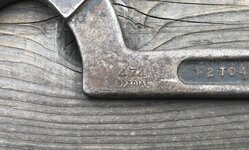
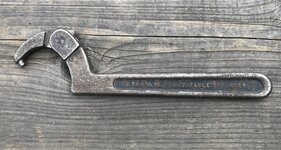
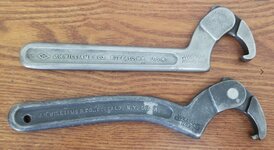
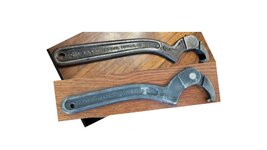
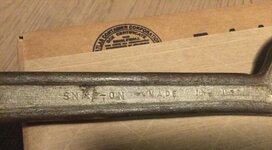
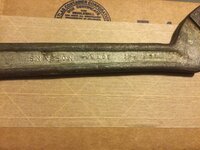
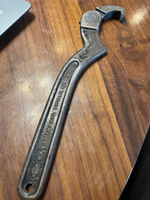
Don't know if this one's been covered, here's a WW2 Allison V1710 service kit spanner dual marked. The 2425 number is the the Allison#. That engine was used on P-38's, The Curtiss P-40 and even the pre Merlin P-51's among others. I'm sure many Snap On collectors have other tools from that kit but I thought the Snap on stamp on a Williams wrench was interesting.
Probably bought by SO to go with the specialized kit due to necessity/lack of facilities to produce it at the time. Kinda like Vaughan hammers (or a good variety of modern tools)being restamped(or branded in other ways) and probably moved into SO's order after being made and stamped Williams(usual process) but before heat treatment leading to the double stamp and extra designation (2425).

Checked my Williams 474 that came in a lot of WW2-Korean War tools and it's just the traditional Williams stamping although it has some japanning left and it's a straight handle versus the curved(probably due to the different model) but that's where my logic came from for the stamping.
 
To avoid these ads, REGISTER NOW!

Private Lugnutz

Well-known member
Joined
Mar 30, 2012
Messages
30,617
Location
The Authentic Jersey Shore
I accidentally erased my reply along these lines while editing it but I assumed someone would theorize basically the same thing so I said F it.
Well, now Jacobs thirded it, so we've got a growing consensus. :)
Here's my bluepoint I use at work
That's new-ish, though. Not sure when they started making them (or having them made for them and re-branded), but I don't see any in the prewar, 1942, or 1945 catalogs.
I mean, maybe for military use they didn't mind? Still very odd.
That was the context, yeah.
To elaborate, not only would the military not mind, it was a requirement. (EDIT: Note that I only have GGG-W-636, dated December 9, 1942, which is the Fed Spec for DOE engineers' wrenches, but I have always assumed the marking requirement would be the same on all tools, and it pretty much bears out empirically.) It was for accountability. Marking it Snap-on would let the gov't know where they got it, which was not from Williams. Snap-on would be accountable contractually.
 
Last edited:

Private Lugnutz

Well-known member
Joined
Mar 30, 2012
Messages
30,617
Location
The Authentic Jersey Shore
and it's a straight handle versus the curved(probably due to the different model)
I read Jock's explanation for why he thinks he has seen them with that curve or bend in them "fairly often", but I've never seen a model with a curve or bend in it by design from the factory as a separate model in a catalog. At least not in prewar or wartime Williams or Billings, and I can't think of two better manufacturing representatives of hook spanners, adjustable or otherwise, than Williams or Billings. I just double-checked to make sure I wasn't misremembering or overlooking something like that, but they were both offering them with straight handles only before, during, and just after the war. Not to doubt Jock or his recollection, I am still astonished they would be used with enough force to bend the bar like that without first snapping the hook, the pivot pin (on a Williams) or the sliding collar on a Billings.

Perhaps mfgrs started making them with a curve from the factory as an optional model later, but if so, I wouldn't know anything about that.
 

Private Lugnutz

Well-known member
Joined
Mar 30, 2012
Messages
30,617
Location
The Authentic Jersey Shore
There are at least three bent ones on ebay right now.
I wonder if they were made like that?
I'm starting to wonder if they were special order. I don't know if you saw my post #3,684, but I did not find any with the bend as a factory model in the catalogs of that era, or even a footnote you sometimes see about the availability of a variation like that by request. But the bends are all starting to look "too good", also the same exact curvature, to me. And as Jock first noted, without also twisting at the same time. Maybe I missed them or a note or they made them optionally without advertising or noting it in catalogs.
 
Last edited:

snapmom

Well-known member
Joined
Sep 4, 2008
Messages
3,521
Location
Florida
AT-8028 and AT-8061. Both Williams. Both from the Merlin P51 tool kit
 

Attachments

  • IMG_5049.JPG
    IMG_5049.JPG
    651.4 KB · Views: 27
  • IMG_5048.JPG
    IMG_5048.JPG
    388.9 KB · Views: 15
  • IMG_5047.JPG
    IMG_5047.JPG
    723.8 KB · Views: 14

Provincial

Well-known member
Joined
Sep 21, 2011
Messages
6,871
Location
Near Salem, OR
I read Jock's explanation for why he thinks he has seen them with that curve or bend in them "fairly often", but I've never seen a model with a curve or bend in it by design from the factory as a separate model in a catalog. At least not in prewar or wartime Williams or Billings, and I can't think of two better manufacturing representatives of hook spanners, adjustable or otherwise, than Williams or Billings. I just double-checked to make sure I wasn't misremembering or overlooking something like that, but they were both offering them with straight handles only before, during, and just after the war. Not to doubt Jock or his recollection, I am still astonished they would be used with enough force to bend the bar like that without first snapping the hook, the pivot pin (on a Williams) or the sliding collar on a Billings.

Perhaps mfgrs started making them with a curve from the factory as an optional model later, but if so, I wouldn't know anything about that.
I assume you haven't been around millwrights much! Millwrights with a piece of pipe for a cheater.

I'm refining my theory. I think the bent ones that are not twisted were used with a cheater pipe that was flattened where it slipped over the handle of the spanner. That kept the force applied in the same plane as the handle. The twisted ones were either hammered on, or were used with an unmodified pipe, which allowed the force to wander off and twist the handle.

I came up with this modified theory after reflecting on the habits of the better millwrights I've known. The really good ones didn't bend the handles, because they knew just how far they could push things without damaging them.
 

Provincial

Well-known member
Joined
Sep 21, 2011
Messages
6,871
Location
Near Salem, OR
A further explanation of my theory on why the handles bend and the rest of the spanner is undamaged:

If I were making spanners (or pipe wrenches, for that matter) I would make the handle the weak link. There are two reasons for this. First, you want to avoid a sudden, catastrophic failure, like the pin on the adjustable spanner breaking or the head of the pipe wrench snapping off. In either case, the sudden release of the tool could cause the user to lose balance and fall, or impact something and be injured. If the handle bends, but not breaks, the user generally just quits trying to overload the tool. Second, for the purpose of warranty, the bent handle is clearly proof of abuse.
 

Private Lugnutz

Well-known member
Joined
Mar 30, 2012
Messages
30,617
Location
The Authentic Jersey Shore
I assume you haven't been around millwrights much!
Nope! But I have and I have seen plenty of adjustable hook spanners. None were bent.

I have to re-emphasize, however, lest you're misreading, that I am not questioning you or others saying they exist or posting them to show they exist. I said I didn't see them with bends in catalogs. From the factory.

I think it would be an interesting little study to gather or virtually gather as many examples as we can, though, to measure the bend. Don's, for example, and MR. X's, for example. For starters. Where the bend starts on the bar and its exact curvature. That would be very telling on the mod vs. un-advertised factory option question.
 

Provincial

Well-known member
Joined
Sep 21, 2011
Messages
6,871
Location
Near Salem, OR
That will be interesting to research. I do not see a reason for a curved handle option, since the nature of use (bearing nuts) implies that any clearance issue could be dealt with by rotating the shaft a little.
 

Private Lugnutz

Well-known member
Joined
Mar 30, 2012
Messages
30,617
Location
The Authentic Jersey Shore
That will be interesting to research.
So, this doesn't prove anything, especially because MR. X's is not taking from a perpendicular angle, which is slightly distorting the view, but I will go so far as to say it does look similar to the one Don posted from an eBay sale. If we had good squared up photos of several other examples (I looked but could not find the "at least three others" that @3baygarage had mentioned), we could do this without taking measurements, using this simple, crude modeling technique. I could even outline then, remove the outline from the photo, and just compare and use a template to measure the outlines.

Bent Williams Adjustable Hook Spanners.jpg
 

tin medic

Well-known member
Joined
Oct 7, 2014
Messages
589
Location
Fort Sam Houston, TX
My Williams catalogs cover from 1935-1960 and there are no curved handled spanners offered or notes saying to inquire about them. One thing to take note of is the 400 series (carbon steel) of hook spanners was not designed for mechanical use, that was the domain of the 1400 series (Chrome-Molybdenum steel). The 400 series was intended for lathe and machinery use. Now I'm not familiar with the aircraft kit that is mentioned above but I think the tensile strength and breaking point would be crucial and the 1400 series would be correct for the kit not the 400 series.
 

3baygarage

Well-known member
Joined
Sep 1, 2013
Messages
11,967
Location
SW Florida/from Buffalo,NY
To think, this much space in the Snap-On thread devoted to bent Williams wrenches. I felt like an apology was due to someone, perhaps Snapmom, but since she joined in too…:LOL:

Now that the thread’s been unhinged, unpinned, unhooked, and derailed, this is sitting in my tool box. Has the markings like Mr. X posted.

It too, looks like somebody leaned on it a little bit.

744D1C1A-D6B0-4DF9-A403-CF1E89E9D5DF.jpegF51E60C9-89FE-46B6-AF95-3552996F25F9.jpeg17CA0507-D021-4B4E-B977-D9F6235AF67A.jpeg604E57C3-EA49-4E15-8A73-E1893F6B0F6B.jpeg
 

Attachments

  • C7A8CD80-DFD2-4435-9010-4CF7EB9C81A5.jpeg
    C7A8CD80-DFD2-4435-9010-4CF7EB9C81A5.jpeg
    753.1 KB · Views: 6
  • 7BB28ACF-A5A2-4EA5-BB6E-CB0B7B246A05.jpeg
    7BB28ACF-A5A2-4EA5-BB6E-CB0B7B246A05.jpeg
    804.7 KB · Views: 8

Jacobs976

Well-known member
Joined
Sep 11, 2020
Messages
830
Location
Indiana
I read Jock's explanation for why he thinks he has seen them with that curve or bend in them "fairly often", but I've never seen a model with a curve or bend in it by design from the factory as a separate model in a catalog. At least not in prewar or wartime Williams or Billings, and I can't think of two better manufacturing representatives of hook spanners, adjustable or otherwise, than Williams or Billings. I just double-checked to make sure I wasn't misremembering or overlooking something like that, but they were both offering them with straight handles only before, during, and just after the war. Not to doubt Jock or his recollection, I am still astonished they would be used with enough force to bend the bar like that without first snapping the hook, the pivot pin (on a Williams) or the sliding collar on a Billings.

Perhaps mfgrs started making them with a curve from the factory as an optional model later, but if so, I wouldn't know anything about that.
I was assuming the curve might've been due to the purpose needing a bend to change the orientation but if there's examples of both straight and curved marked by Snap On with the same code then there's a good chance it was abuse. Handle would probably be softer than the head like a pipe wrench and it's surprising seeing pipe wrenches(not quite the same thing but the closest comparison I could think of) bent too but there's some 8 inch Ridgids occasionally showing up that are hard to imagine bending myself. Plus the weakest point would be in the same area as the bend(where the handle is thinner but towards the head).

Factories did do some custom order work(not listed) but in this case all the Snap On codes should be the same since it's already a custom order (assuming they followed their traditional code system of granting a letter to the code after changing the design).
 

Farmer J.

Well-known member
Joined
Sep 18, 2016
Messages
1,995
Location
UK, Cornwall/Hertfordshire.
Obviously, the bent ones are just 'bent wrenches'. Someone put a cheater pipe on them. That's all. Out in big wide real world of needing to get jobs done and not collecting and fussing about tools that's just what happens. Often.
I do know of several excellent agricultural engineers who have a selection of flattened pipes in their van to use as 'cheater bars'. I did have one myself , but tore the pipe open trying to undo a disc harrow axle nut by using a pipe wrench which now has a bent handle.
 
To avoid these ads, REGISTER NOW!

Private Lugnutz

Well-known member
Joined
Mar 30, 2012
Messages
30,617
Location
The Authentic Jersey Shore
Obviously, the bent ones are just 'bent wrenches'. Someone put a cheater pipe on them. That's all. Out in big wide real world of needing to get jobs done and not collecting and fussing about tools that's just what happens. Often.
After seeing several with different bends (thanks 3bay), I'm definitely convinced they're from overstrenuousness, J. I'm going to have to disagree with you about it being obvious, though. I'm sure that Jacobs, who thought they were a separate model, and Don, who also wondered if they might be factory, have seen their fair share of bent wrenches in the workplace, as have I, and could see where both of them were coming from. Something about these - again, as Jock first alluded to, bent but seemingly gracefully, and uniformly, without also twisting, just seemed different. I'm still surprised they bent that much without the hook or the pivot not breaking first. But that's the last time I'll say it.
 

Private Lugnutz

Well-known member
Joined
Mar 30, 2012
Messages
30,617
Location
The Authentic Jersey Shore
I do not see a reason for a curved handle option, since the nature of use (bearing nuts) implies that any clearance issue could be dealt with by rotating the shaft a little.
One thing to take note of is the 400 series (carbon steel) of hook spanners was not designed for mechanical use, that was the domain of the 1400 series (Chrome-Molybdenum steel). The 400 series was intended for lathe and machinery use. Now I'm not familiar with the aircraft kit that is mentioned above but I think the tensile strength and breaking point would be crucial and the 1400 series would be correct for the kit not the 400 series.
Goid points, guys.
Now that the thread’s been unhinged, unpinned, unhooked, and derailed, this is sitting in my tool box
Is there a date code on that?
 

Mintgrun

Well-known member
Joined
Oct 7, 2015
Messages
2,134
Location
Kingston, Wa.
bent but seemingly gracefully, and uniformly, without also twisting

I wonder if dents on the side of this one suggest that it may have twisted and then been flattened back out with a hammer.

1675614816053.png

I have a couple of Williams spanners and one is marked SPECIAL. I'm curious as to what makes it special, but that's a question for the Williams thread.
 

3baygarage

Well-known member
Joined
Sep 1, 2013
Messages
11,967
Location
SW Florida/from Buffalo,NY
Found this odd special order piece on ebay a while back and had to get it. Some kind of 3/4” drive torque adapter/extension. It’s 20-1/2” long and made from several tools.

Looks like an older logo on the shank, and maybe a later logo on the head, which seems to have started life as a sliding t bar head. The whole thing might be covered over in cad plating.

09FFBB60-D9A0-4F3F-8A66-960EC8DD81B5.jpeg4660C815-3400-47B7-A021-C7A293D11279.jpegCCBAF306-D631-4AB6-9C73-1C4A2BEA4224.jpegD7F8FC6D-BC50-4AFA-A5C4-C1FCAD22E6DA.jpeg
 

Ricky Joe

Well-known member
Joined
Sep 15, 2013
Messages
2,452
Location
Roanoke, Va.
I have struggled hard to keep my mouth shut, but I’m losing the battle. I will give $100 to anyone who can take a pipe or any extension and bend a spanner wrench like these are bent. These wrenches were made that way. No way a spanner could take the forces necessary to duplicate that bend and not shear the pin or hook. Easy $100 if I’m wrong! Document it on video. Ha
 

Private Lugnutz

Well-known member
Joined
Mar 30, 2012
Messages
30,617
Location
The Authentic Jersey Shore
No way a spanner could take the forces necessary to duplicate that bend and not shear the pin or hook.
I'm still surprised they bent that much without the hook or the pivot not breaking first.
:beer:
I will give $100 to anyone who can take a pipe or any extension and bend a spanner wrench like these are bent.
HAHA! This is way more fun than my idea of measuring the bends to see if they're the same! :)
 

Jacobs976

Well-known member
Joined
Sep 11, 2020
Messages
830
Location
Indiana
I have struggled hard to keep my mouth shut, but I’m losing the battle. I will give $100 to anyone who can take a pipe or any extension and bend a spanner wrench like these are bent. These wrenches were made that way. No way a spanner could take the forces necessary to duplicate that bend and not shear the pin or hook. Easy $100 if I’m wrong! Document it on video. Ha
I got the right size to fit on my forklift's main lift cylinder that hasn't been serviced after over 30 years in a humid environment... Tempting but also probably not worth the new parts and fluids after something breaks. Think it's $500 just for pick up to get it serviced.

I still think it's possible though with enough willpower and probably a big enough cheater bar. The hook keeps it where it's supposed to be but a lot of the force is also transferred into the arch towards the handle same as grabbing something with your hand(or pipe wrench for same idea but different design and more parallel positions) and trying to twist it in the same fashion, a lot of the force is directed into the palm of your hand(bottom jaw on pipe wrench) too. Plus the weakest point would be the area where the metal thins towards the head if the pin is intact.

Need to just get one of the physics guys to join the conversation and run the numbers. Differential force applied to the cylinder along the contact area with the pin factored in as an anchor point and the lever input position being where a hand would be then where a pipe would be for comparison.
 

Jacobs976

Well-known member
Joined
Sep 11, 2020
Messages
830
Location
Indiana
PXL_20230206_050559120.jpg
Here's the difference in force(Fb & R) applied to a pin spanner from the two active contact points(A & B) using a Williams 474 and 66.08Ft/Lbs of force(P) exerted to turn a 4.75" collar(the maximum size for the 474). Point B has 29.48Ft/Lbs(Fb) exerted on it while point A has 36.60Ft/Lbs(R) exerted on it. So more force is acting on Point A(the back of the arch) than Point B(the pin and surrounding material within the active contact point) in active use.

Haven't had to play with math like this for awhile but I think it's accurate. Was also a bit of amusement which was nice.

It's just a basic version showing the distribution of force in static 2D but it's a start if someone wants to calculate the force exerted on the pin itself. And/Or bring in material properties and a 3D rendering to verify stress points, moving towards modern industrial engineering standards.
 

Private Lugnutz

Well-known member
Joined
Mar 30, 2012
Messages
30,617
Location
The Authentic Jersey Shore
:banhim:

Just kidding, although the last time I posted an equation - showing the difference in torque and sheer between 9/32- and 1/4-inch drive to show why the USAAF preferred it I almost got tarred and feathered. :)

I would expect more force at A. But there is more steel there and the beam helps dissipate it, as it does with any wrench. The critical question for me isn't, "Which point, A or B, has more amount of force applied to it?", which I think you have shown well, but, "What amount of force is too much for point A to withstand?" and "What amount of force is too much for point B to withstand?" Those are not necessarily the same amounts. In other words, if you put a cheater bar on it, will it reach point B's breaking point before it reaches point A's? RJ says yes - with $100 behind it! :lol: The bent wrenchers say no.

But we really probably actually SHOULD move this discussion to its own thread. It's not the first time we've had similar conversations, to wit my earlier reference to midget drive comparisons, so it could be the 'Physics of Wrenches' place to argue. :)
 

Ricky Joe

Well-known member
Joined
Sep 15, 2013
Messages
2,452
Location
Roanoke, Va.
:banhim:

Just kidding, although the last time I posted an equation - showing the difference in torque and sheer between 9/32- and 1/4-inch drive to show why the USAAF preferred it I almost got tarred and feathered. :)

I would expect more force at A. But there is more steel there and the beam helps dissipate it, as it does with any wrench. The critical question for me isn't, "Which point, A or B, has more amount of force applied to it?", which I think you have shown well, but, "What amount of force is too much for point A to withstand?" and "What amount of force is too much for point B to withstand?" Those are not necessarily the same amounts. In other words, if you put a cheater bar on it, will it reach point B's breaking point before it reaches point A's? RJ says yes - with $100 behind it! :lol: The bent wrenchers say no.

But we really probably actually SHOULD move this discussion to its own thread. It's not the first time we've had similar conversations, to wit my earlier reference to midget drive comparisons, so it could be the 'Physics of Wrenches' place to argue. :)
My two cents is that that is an obstruction spanner, designed to reach something that needed a different clearance than a typical spanner would need. I think the wrench is factory.

I stand behind my offer.
 

Ricky Joe

Well-known member
Joined
Sep 15, 2013
Messages
2,452
Location
Roanoke, Va.
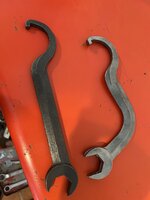
Lugz is probably right about this should be a separate thread. Here is an obstruction spanner and it’s non-obstruction counterpart. They are both for Model A Fords, and both have the same Ford part number.
 

Attachments

  • image.jpg
    image.jpg
    819.9 KB · Views: 20
  • image.jpg
    image.jpg
    441.9 KB · Views: 22
  • Like
Reactions: RTM

Jacobs976

Well-known member
Joined
Sep 11, 2020
Messages
830
Location
Indiana
Made a physics thread if anybody wants to continue the debate and let Snap On Pictures go back to pictures (plus conversation around them).


d42jeep

Well-known member
Joined
Oct 22, 2014
Messages
16,558
Location
Northern California
I found a little Snap-on magnetic tray at an estate sale yesterday. I was able to remove some black spray paint that had gotten on it. It’s doing a good job holding on to the grease fittings I found at the same sale.
-Don58F66D9D-234E-45A0-9AD5-E91BD5F823FA.jpeg182A3781-DA1A-4A57-8ECD-57CA530BEB88.jpeg
 

S-K Tool Fanatic!

Well-known member
Joined
Nov 28, 2022
Messages
776
Location
NE Ohio
Here is my growing collection of snap-on stuff, I always get excited when I find snap-on stuff out and about for cheap. Does anyone have info about the magna-tip snap-on screwdriver. I think its pretty cool, i have one that is the exact same thing except it has a metal cap and it doesn’t say snap-on.
The ratchet is awesome, its a military issue one from 1963 and it was in a whole tool box of stuff that I paid $10 for.
-Tommy
7A400264-472D-4A90-B435-D4BAF3BB6C69.jpeg
1F991EA6-4652-4AE0-BF32-33CB1669BB26.jpeg20EE025E-6861-4E15-AC98-0B65FD26DAEA.jpeg
 

Steven 33

Well-known member
Joined
Oct 13, 2022
Messages
665
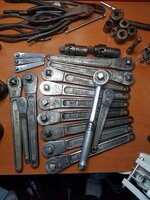
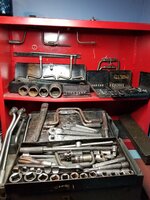
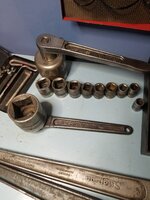
Only started collecting a few months ago and already feeling like it's time to downsize a little bit so I figured I'd share a few pictures before I get down to too little (only to rebuild of course) hopefully this time with a little more direction. And those who may be confused by that big 4 point on a no7 ratchet. I took a broken captive plug and converted it to take a 5/8 plug so it's a 5/8 drive 1-7/16 4 point.
Okay have a good one everyone


20230213_154635.jpg20230219_205404.jpg20230214_003639.jpg
 
To avoid these ads, REGISTER NOW!
Top Bottom