To avoid these ads, REGISTER NOW!

Jacobs' Physics of Tools Debate Corner

Jacobs976

Well-known member
Joined
Sep 11, 2020
Messages
830
Location
Indiana
This thread is for all of you who wish to argue about, debate, or otherwise discuss the physics of tools and other things whether it's the structural properties, forces acted upon, if a tree falls in the woods, etc..

This thread is a place to take these discussions to limit overcrowding other threads with information outside, but potentially related to, their topics.

Anybody who happens to have insight on any topic raised I urge to assist. I have some knowledge (mainly practical) but attempting to go into the more advanced physics is a leap I may have difficulty with along with a lack of modern modeling software required for some topics.
 
Last edited:
To avoid these ads, REGISTER NOW!
OP
J

Jacobs976

Well-known member
Joined
Sep 11, 2020
Messages
830
Location
Indiana
First post: Steel Plate moving from 2023 Garage sale thread posts #656-#661.


Figured the request was made out of curiosity and to tease a bit at the same time so I had to reply in kind naturally.

Started messing with it but I need to find the right formula to calculate with the pivot(irregular formula since pivoting objects were usually just wrote up as the height and length transcribed as a high risk area and actual math wrote off/ignored, basically don't go in that area regardless of what it could actually do, usually good advice). Meanwhile though, static weight is .282Lb/In² on the flat. Not really useful yet but it's info.
 
Last edited:

bmwrd0

Well-known member
Joined
Nov 7, 2010
Messages
5,453
Location
Beaver Fever Oregon
So, I will repeat what I ended up posting on the other thread:

"As far as the steel plate fall goes, I was on the other side of a table and facing about 75* to the right, so I did not see everything that happened, only the aftermath. There was stuff all over the floor which would have prevented it falling flat, but that doesn't prevent all of its weight coming down. I did see one man who was knocked into the table as I heard shouting and looked over, and I did, later, see his skinned leg where he was hit and broke the fall of the plate to some degree. I also saw one man with his hand and wrist trapped under the plate, and I watched, as it is hard to help when you walk with a cane, several other people come to help and they had to use crowbars to move the plate enough to get the mans hand out.

And, after all of that, I saw the man walk away and not ask for any further assistance.

Now, I will tell you why I walk with a cane, and that is due to slipping into a hole in such a plate after coming around a car in a parking garage when I was headed to a MPOE (phone talk for service entrance). After that slip I notified my supervisor, went home, and the next morning woke in extreme pain. Pain that hadn't been there the day before, but was due to two of the discs in my back blowing out in a direct result of that slip. So, sometimes it takes a bit of time for the end result to manifest itself. I have no idea if that one guy ended up with issues the next day or not, but it is entirely possible.
 

MShaw

Well-known member
Joined
Mar 2, 2015
Messages
1,013
Location
York, Pa.
For years I have used torque wrenches. The formula for using an extension adapter on the drive end always includes the length of the wrench handle. If the wrench measures the torque exerted at the drive square, why does the handle length matter?
 

Shiftless

Well-known member
Joined
Mar 9, 2014
Messages
14,523
Location
East Bay SFO
For years I have used torque wrenches. The formula for using an extension adapter on the drive end always includes the length of the wrench handle. If the wrench measures the torque exerted at the drive square, why does the handle length matter?
I’m in for the answer to that one.
 
OP
J

Jacobs976

Well-known member
Joined
Sep 11, 2020
Messages
830
Location
Indiana
Continuation of Steel Plate:

PXL_20230206_203905005.jpg
Had some issues finding a formula to calculate the force exerted on the floor from the total area of the plate(too complex to calculate without modeling due to all the variables given it's not a direct action) but simplifying the issue to the force exerted on collision with specific point to point in 2D came up with this.

The average force exerted by the plate going off point A is 532.41Lb meaning the plate unhampered by any other obstructions would be equivalent to 532.41Lbs of force on impact at the top(where most pinnings happen when attempting to catch an object after slipping/failing to support it) as it collides with an obstruction.

The peak force however is 1064.826Lb which would be more closely aligned with Point B being met by Point A(like a toe/foot pinning).

As for a human, the force necessary for fracture (hairline to complex) isn't well defined due to variables such as age, bone density, body type, weight, contact point, and orientation of the force but the average range for injury is 16Lb to 1200Lb with 1200Lb being considered crushing while 16Lb is hairline.
 
OP
J

Jacobs976

Well-known member
Joined
Sep 11, 2020
Messages
830
Location
Indiana
Torque Wrenches and Extensions:

PXL_20230206_203850602.jpg
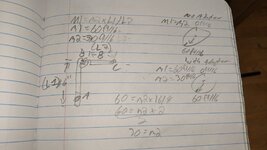
Torque wrenches are calibrated to give accurate torque readings under specific circumstances. Those circumstances are: one the handle is held at Point A(the grip), two the force exerted on Point A is transfered to Point B(the anvil).

The handle length is directly related to those calibrations due to the changes in force appliable via distance from Point B. Holding the handle too close to the anvil will require more input force to exert the proper force on the anvil while adding a pipe to increase length would do the opposite.

So now the extension. It adds more length, creating Point C, and decreasing the applied torque value. The issue is the calibration from Point A to Point B is now useless because of the increase in length from point A while the measurement only accounts for Point A to Point B.

In the example provided above, using a 16" long wrench and an 8" long extension, you can see applied torque is halved(30Ft/Lb) while the reading is still at 60Ft/Lb and the total length from Point A to Point C is 24" instead of the 16" from Point A to Point B.

As for why the handle length matters since the measurement(60Ft/Lb) should be applied regardless of input position (anywhere between Point A and Point B, with more input force) leading to Point B, it could probably be ignored.

The only variation not included in the calibration is the extension so you could write up another variation of the formula excluding the handle length but the original formula would still be necessary for any calibration testing and/or recalibration.
 

MShaw

Well-known member
Joined
Mar 2, 2015
Messages
1,013
Location
York, Pa.
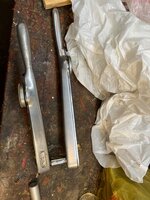
I took a 1/2" drive torque wrench and coupled it to a 3/8" drive torque wrench as shown. No matter where I applied force along the body / handle of the 3/8" drive unit when it reached 120 inch pounds the 1/2 " drive wrench registered 10 inch pounds. Since the torque is measured at the drive square, where the force is applied makes no difference.
 

Attachments

  • IMG_0086.jpg
    IMG_0086.jpg
    571.9 KB · Views: 37
OP
J

Jacobs976

Well-known member
Joined
Sep 11, 2020
Messages
830
Location
Indiana
I took a 1/2" drive torque wrench and coupled it to a 3/8" drive torque wrench as shown. No matter where I applied force along the body / handle of the 3/8" drive unit when it reached 120 inch pounds the 1/2 " drive wrench registered 10 inch pounds. Since the torque is measured at the drive square, where the force is applied makes no difference.
Sorry for any confusion. You can apply force anywhere along the handle since it's calibrated towards the drive. Applied force is the same regardless of where the input force is applied(assuming the desired torque is achieved) but the input force is increased for the same effect as the length is shortened between the input and drive.

It won't be noticable in smaller units but if you have a 3/4 drive or two 1/2 drive torqometers and connect them together and set them up for a higher torque then start with proper form and work through different input points down the handle you'll notice it takes more force to get the same applied torque as you get closer to the drive.
 

AdAstra

Well-known member
Joined
Aug 27, 2021
Messages
195
I took a 1/2" drive torque wrench and coupled it to a 3/8" drive torque wrench as shown. No matter where I applied force along the body / handle of the 3/8" drive unit when it reached 120 inch pounds the 1/2 " drive wrench registered 10 inch pounds. Since the torque is measured at the drive square, where the force is applied makes no difference.

Sorry for any confusion. You can apply force anywhere along the handle since it's calibrated towards the drive. Applied force is the same regardless of where the input force is applied(assuming the desired torque is achieved) but the input force is increased for the same effect as the length is shortened between the input and drive.

It won't be noticable in smaller units but if you have a 3/4 drive or two 1/2 drive torqometers and connect them together and set them up for a higher torque then start with proper form and work through different input points down the handle you'll notice it takes more force to get the same applied torque as you get closer to the drive.
Little more complex than this....

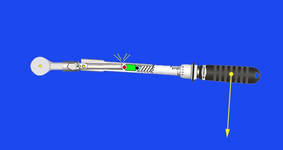
In the case of MShaw's torquometer indicator/wrench, hand position along the handle shouldn't change indicated torque. The sensing differential flexure happens right at the drive square.

However, in the case of a "clicker" type wrench with a cam/detent/rocker/ball under spring pressure, hand position does matter, because there are two lever arms in question, one from your hand to the mechanism pivot, and another to the axis of the fastener. The torque "sensing" takes place at the mechanism pivot located in the beam, not at the business end. Thus at the mechanism pivot there is both shear and moment at play, and both can influence how the mechanism triggers. Half the hand distance would be twice the shear force at the mechanism pivot, for example. Also why it's important to apply force perpendicular to the beam, because any radial force will affect the mechanism's force balance as well.

1675752746270.png
 
Last edited:

Provincial

Well-known member
Joined
Sep 21, 2011
Messages
6,865
Location
Near Salem, OR
When I drop a socket, it always rolls under a car.
Why is this? Is luck real?
It is an example of the First Law of Auto Mechanics: "The dropped part always moves to the geometric center of the car."

There is a corollary to this Law, the first corollary is "Unless there is a less accessible location, in which case the part ends up there."
 

Provincial

Well-known member
Joined
Sep 21, 2011
Messages
6,865
Location
Near Salem, OR
Little more complex than this....

In the case of MShaw's torquometer indicator/wrench, hand position along the handle shouldn't change indicated torque. The sensing differential flexure happens right at the drive square.

However, in the case of a "clicker" type wrench with a cam/detent/rocker/ball under spring pressure, hand position does matter, because there are two lever arms in question, one from your hand to the mechanism pivot, and another to the axis of the fastener. The torque "sensing" takes place at the mechanism pivot located in the beam, not at the business end. Thus at the mechanism pivot there is both shear and moment at play, and both can influence how the mechanism triggers. Half the hand distance would be twice the shear force at the mechanism pivot, for example. Also why it's important to apply force perpendicular to the beam, because any radial force will affect the mechanism's force balance as well.

1675752746270.png
Also, don't expect to get a good result from trying to change the arm distance on a beam-type torque wrench. By applying pressure at a spot other than the designed handle, the flex of the beam is changed, and the scale reading is no longer accurate. The needle on a simple beam-type torque wrench is merely another beam that has no force against it, so it remains straight while the main beam flexes away from that neutral point proportionally to the amount of force applied to the handle, thus the scale moves away from the needle and toward the higher readings.
 

AdAstra

Well-known member
Joined
Aug 27, 2021
Messages
195
Looking more into how the Torquometer types work, I think it will also have a similar dependence on hand position, but perhaps not significantly enough to notice:
 

Old Radar

Well-known member
Joined
Apr 17, 2019
Messages
2,754
Location
San Antonio, TX
Steel Plate Solution

Thanks Jacob! Just so I'm sure I understand: If the 1300 pound plate pivoted, unencumbered, from rest upright, to impact flat on the floor (with an embedded weight scale), the instantaneous reading on that scale would be what?
532.41Lb or 1064.826Lb?
 

RTM

Well-known member
Joined
May 13, 2019
Messages
13,127
Location
SF Bay Area
IMO, at the moment of impact, it would be much higher, but would settle back down to actual. If it landed completely on the scale, it should weigh the full weight. If partially, it would change depend on the partial %
 
OP
J

Jacobs976

Well-known member
Joined
Sep 11, 2020
Messages
830
Location
Indiana
Steel Plate Solution

Thanks Jacob! Just so I'm sure I understand: If the 1300 pound plate pivoted, unencumbered, from rest upright, to impact flat on the floor (with an embedded weight scale), the instantaneous reading on that scale would be what?
532.41Lb or 1064.826Lb?
Peak would be full distance so 1064.826Lb but that's one impact point so it might be easier to think of it as the top edge being a hammer hitting the platform of a strongman game at the fair to hit the bell.

Pivoting physics get a bit complicated without a computer so I set it up as just the force exerted on that edge hitting the floor(or any obstructions that would be close enough to the floor to make the difference negligible like a foot).
 
OP
J

Jacobs976

Well-known member
Joined
Sep 11, 2020
Messages
830
Location
Indiana
IMO, at the moment of impact, it would be much higher, but would settle back down to actual. If it landed completely on the scale, it should weigh the full weight. If partially, it would change depend on the partial %
It would be higher if it was a free falling object(no pivot) but I had to use a collision model so it's only looking at the edge hitting a point on the ground.

I can check free fall but it wouldn't be accurate. Same issue with trees, pivot points affect the forces acting on the object too much frame by frame. Actually would be easier to get a scale and a piece of wood/small steel plate and reenact the fall to get an estimate that could be scaled up to match the 1300Lb plate.
 
To avoid these ads, REGISTER NOW!

Old Radar

Well-known member
Joined
Apr 17, 2019
Messages
2,754
Location
San Antonio, TX
RTM--In the scenario I described above, I'm imagining the floor to have weight registering capabilities. Also, I'm mainly interested in the initial impact--whether the correct term is Peak, Instantaneous or something else. That's the one that will kill you.

Jacob--I think I understand appreciate the complications of physics in general--that is to say, physics is complicated and I understand appreciate this because I failed a couple of physics classes in college... :mad:

Thanks for bringing up the hammer, because I was thinking of that, but discarded the idea due to the mass being at the end of the handle vs. the plate which has the mass evenly distributed. Based on the hammer example, I assumed the peak weight would be higher than the resting weight. Allowing a 16Lb sledge to pivot from vertical to horizontal must (must!!) result in an instantaneous weight well in excess of 16Lbs!
 
OP
J

Jacobs976

Well-known member
Joined
Sep 11, 2020
Messages
830
Location
Indiana
Little more complex than this....

In the case of MShaw's torquometer indicator/wrench, hand position along the handle shouldn't change indicated torque. The sensing differential flexure happens right at the drive square.

However, in the case of a "clicker" type wrench with a cam/detent/rocker/ball under spring pressure, hand position does matter, because there are two lever arms in question, one from your hand to the mechanism pivot, and another to the axis of the fastener. The torque "sensing" takes place at the mechanism pivot located in the beam, not at the business end. Thus at the mechanism pivot there is both shear and moment at play, and both can influence how the mechanism triggers. Half the hand distance would be twice the shear force at the mechanism pivot, for example. Also why it's important to apply force perpendicular to the beam, because any radial force will affect the mechanism's force balance as well.

1675752746270.png
Also, don't expect to get a good result from trying to change the arm distance on a beam-type torque wrench. By applying pressure at a spot other than the designed handle, the flex of the beam is changed, and the scale reading is no longer accurate. The needle on a simple beam-type torque wrench is merely another beam that has no force against it, so it remains straight while the main beam flexes away from that neutral point proportionally to the amount of force applied to the handle, thus the scale moves away from the needle and toward the higher readings.
Looking more into how the Torquometer types work, I think it will also have a similar dependence on hand position, but perhaps not significantly enough to notice:
You're right, I was looking at Torqometers more specifically. Kinda forgot about the other types.

Applied force would be the same assuming the measurement on the dial is reached but only as long as the input force is applied behind whichever mechanism is in use.

Haven't looked much into the mechanism on torqometers but it'd likely have the same issue if the input position was close enough to the head. Fortunately that position would most likely be beyond ineffective before it'd be noticable.
 
OP
J

Jacobs976

Well-known member
Joined
Sep 11, 2020
Messages
830
Location
Indiana
Thanks for bringing up the hammer, because I was thinking of that, but discarded the idea due to the mass being at the end of the handle vs. the plate which has the mass evenly distributed. Based on the hammer example, I assumed the peak weight would be higher than the resting weight. Allowing a 16Lb sledge to pivot from vertical to horizontal must (must!!) result in an instantaneous weight well in excess of 16Lbs!
The collision model is based on the mass of the object in collision with a static object so my analogy wasn't quite right still. Basically the edge of the plate falling on the platform using the initial scenario should get that result. So the scale only touching the edge would be the same.

Also with the other end still being in contact with the ground not all of the weight is on the edge so it's not the full amount you'd expect with a free fall. The edge should impact at the peak then fall to the average(1064.826 to 532.41) sitting.

That said, scaling the scenario down and testing it would give both, edge and total area, impact values. Plus limit the math to a simple scaling problem.
 
Last edited:

RTM

Well-known member
Joined
May 13, 2019
Messages
13,127
Location
SF Bay Area
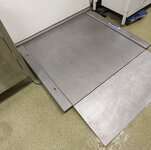
So, let us for a moment (pun intended) think of a floor that had weighing capabilities, like say a 2K+kg floor scale

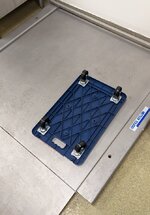
PXL_20230207_222909690-X2.jpg

And then lets go a little further, and say we found a light weight item of 3.0kg, which won't make too much noise as it fell onto said weighing floor. Lets prop it up, right at the seam where the ramp meets the scale, and let it slowly tip forward until it falls on said weighing floor.

PXL_20230207_223056310-X2.jpg

And lets say, instead of a high tech chart recorder on said weighing floor, we took a cell phone video of the digital read out of said weighing floor, and grabbed one frame which showed a reading of say 4.8kg, would that satisfy the curiosity of those gathered? Say 160% of the weight was the force of impact (I know, jumping incorrect units, weight v force)

PXL_20230207_223059424_exported_1101-M.jpg

Cuz if not, I got nothing. Too stressed at work to do it right, but a 2 min experiment, and 3 minute write up is a bit of comedic relief.
 

dnschmidt

Well-known member
Joined
Oct 3, 2014
Messages
7,271
Location
Phoenix, AZ
For years I have used torque wrenches. The formula for using an extension adapter on the drive end always includes the length of the wrench handle. If the wrench measures the torque exerted at the drive square, why does the handle length matter?
Because it determines the lever arm. Torque is force at a distance. The length of the wrench determines the distance. This is why you should always hold a torque wrench at the center of its handle.
 
OP
J

Jacobs976

Well-known member
Joined
Sep 11, 2020
Messages
830
Location
Indiana
So, let us for a moment (pun intended) think of a floor that had weighing capabilities, like say a 2K+kg floor scale

PXL_20230207_222909690-X2.jpg

And then lets go a little further, and say we found a light weight item of 3.0kg, which won't make too much noise as it fell onto said weighing floor. Lets prop it up, right at the seam where the ramp meets the scale, and let it slowly tip forward until it falls on said weighing floor.

PXL_20230207_223056310-X2.jpg

And lets say, instead of a high tech chart recorder on said weighing floor, we took a cell phone video of the digital read out of said weighing floor, and grabbed one frame which showed a reading of say 4.8kg, would that satisfy the curiosity of those gathered? Say 160% of the weight was the force of impact (I know, jumping incorrect units, weight v force)

PXL_20230207_223059424_exported_1101-M.jpg

Cuz if not, I got nothing. Too stressed at work to do it right, but a 2 min experiment, and 3 minute write up is a bit of comedic relief.
While rough(not a solid uniform mass) it is viable for rough scaling and about as good as possible given no prep work.

Converting to kg then scaling to the 589.67kg(1300Lb) plate then converting back you get 2080Lb impact force.

Only thing would be was the plate standing up long ways or short ways(assuming it's 10"x20" the 20" end should be the one on the ground). Probably doesn't make much difference but if it read differently at all it'd mean a little over/under the current result.
 

MShaw

Well-known member
Joined
Mar 2, 2015
Messages
1,013
Location
York, Pa.
"Because it determines the lever arm" This is true only for open beam wrenches where the measurement is the bend of the beam. As I proved in my experiment, the torque is measured at the drive square and the length of the lever changes how much pressure you apply to achieve a reading but does not change the output torque as measured by the wrench.
 
OP
J

Jacobs976

Well-known member
Joined
Sep 11, 2020
Messages
830
Location
Indiana
"Because it determines the lever arm" This is true only for open beam wrenches where the measurement is the bend of the beam.
Might be worth noting, torqometers aren't generally seen as torque wrenches but it's own category of tools while doing the same thing. Most people don't even know they exist unless they remember them from before click types came into fashion or watched a video with a digital torqometer being used.

When torque wrenches are brought up you should probably just assume a click type is the intended target of discussion.

Also the length of the handle(lever arm) is still important for torqometers, while not necessary to use a torqometer in general it does give you an idea of which drive/handle is necessary to achieve the desired torque with the least effort.
 

RTM

Well-known member
Joined
May 13, 2019
Messages
13,127
Location
SF Bay Area
While rough(not a solid uniform mass) it is viable for rough scaling and about as good as possible given no prep work.
I tried to repeat the study at home with a nice dense dark chocolate bar, but the kitchen scale responds too slow to see the spike


So I ate the chocolate bar. I feel much better about things.
 
OP
J

Jacobs976

Well-known member
Joined
Sep 11, 2020
Messages
830
Location
Indiana
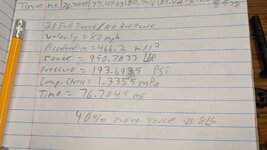
Got some new math, or rather the results for the somewhat decent spreadsheet, done for the force of an overhead swing with a sledge hammer.
PXL_20230819_014831811.jpg
I had heard some people saying a 20lb sledge could generate 3500-5000lbf and I figured it might be fun to try modeling the problem.

So I gathered the necessary info and calculated the results based on a resistance scale that matches the results expected from someone in good health but not experienced with sledge hammers. Exceeding the results by a noticeable margin would still be fairly difficult though with the scale being 1% resistance (ability to gain acceleration)at 10lb, 5% at 12, 10% at 14, 15% at 16, and 30% at 20 to match realistic rates.

Also for fun, the strongman scenario and driving force for 2d(15 gauge) and 60d(4 gauge) nails. Only issue with the nails is I couldn't find an accurate psi rating so 2d is based on the specs of a 15 gauge nail gun and 60d is based on the specs given by a guy who says his jumbo nailer can use 4 gauge and he uses 120 psi max. Overall though, I think a 20lb sledge could probably drive the nails in better than the nail gun as long as your aim is true and you don't care about the wood splintering a tiny bit.
PXL_20230819_014837058.jpg
PXL_20230819_014842802.jpg
Edit:error on comp. stress on 60d nail unit. It's mPa not psi.
 
Last edited:

merkyworks

Well-known member
Joined
Nov 11, 2016
Messages
587
Location
Texas
Love the concept and top marks for detailing the math, but the OCD in me is screaming seeing metric and standard/imperial units mixed together lol :eyecrazy:
 
OP
J

Jacobs976

Well-known member
Joined
Sep 11, 2020
Messages
830
Location
Indiana
Love the concept and top marks for detailing the math, but the OCD in me is screaming seeing metric and standard/imperial units mixed together lol :eyecrazy:
Sorry about that. I think I only used m/s which is the odd one in the bunch but it seemed to fit better for simplifying the math.

Also ft/s(fps) tends to have less impact since it's associated with stuff that's moving at excessive speeds.
 
OP
J

Jacobs976

Well-known member
Joined
Sep 11, 2020
Messages
830
Location
Indiana
It was the mpa and psi haha
Didn't really think about mPa and psi, did have to convert though. Pa has always been the standard for compressive stress, in my limited usage, and psi has always been standard for pressure since it's pretty much everywhere.

Don't know if Pa is better for understanding comp but if both, Pa and psi, are interchangeable to match their class of units I'll try to stick with psi if the rest of the work is in imperial already.
 

2ndGearRubber

Well-known member
Joined
Mar 24, 2014
Messages
14,185
Location
Pittsburgh
I took a 1/2" drive torque wrench and coupled it to a 3/8" drive torque wrench as shown. No matter where I applied force along the body / handle of the 3/8" drive unit when it reached 120 inch pounds the 1/2 " drive wrench registered 10 inch pounds. Since the torque is measured at the drive square, where the force is applied makes no difference.

Pretty much. Yes, error can be induced with poor technique, handle extensions, etc.

The axial load is academic, as most of these discussions are. There is a calculation that can be made to quantify this. Better yet, people could redo your test with a pipe extending one of the wrenches. While these forces and changes exist, they're very low on the scale vs the entire force applied in the situations we're talking about.


Given your example- I'm supposed to believe the additional friction from crookedly driving the handle axially is entering the realm of being error inducing to a 10 ftlb measurement? Of course not. People opined to me not to put a pipe on a 3/4 and up torque wrench. For that 750ftlbs, God forbid.

Just like in an engineering problem, assumptions are made to remove silly things like that. For instance, force required to push an object up a ramp. The friction coefficient is assumed constant, even though Joe and Tim both worked on different sections of the ramp, and have slightly different finish swirl techniques.
 

KnurledNut

Well-known member
Joined
Jan 28, 2011
Messages
8,115
Location
n/a
I use a digital torque adaptor at times for this very reason. With a strain gauge handle length is irrelevant. I can use a stubby ratchet or a 24” breaker bar and the reading is accurate either way.
 

Cc_windsurfer

Well-known member
Joined
May 1, 2015
Messages
258
Location
SB, ca
Someone explain titanium hammers.

Yes, lower mass means more velocity for the same swinging force. So a 14oz ti hammer drives at higher speed (f=ma) and more kinetic energy (e=mv**2) then a 20oz steel hammer. But why would a 14oz ti hammer outperform a much cheaper 14oz steel hammer?

(Note: I hold a PhD in applied physics and have extensive experience in material science but I still don't understand why my 14 oz ti hammer performs so well)
 

redwrench60

Well-known member
Joined
Sep 10, 2011
Messages
6,062
Location
East Tennessee
Someone explain titanium hammers.

Yes, lower mass means more velocity for the same swinging force. So a 14oz ti hammer drives at higher speed (f=ma) and more kinetic energy (e=mv**2) then a 20oz steel hammer. But why would a 14oz ti hammer outperform a much cheaper 14oz steel hammer?

(Note: I hold a PhD in applied physics and have extensive experience in material science but I still don't understand why my 14 oz ti hammer performs so well)
What weighs more:

A 50lb. Sack of feed or a 50lb. Sack of feathers? Our subconscious minds quietly whisper lies to us all.
 
To avoid these ads, REGISTER NOW!
Top Bottom