To avoid these ads, REGISTER NOW!

Question about torque angle with torque wrench

FSUwelder1212

Well-known member
Joined
Jul 9, 2013
Messages
149
This may be a stupid question, but I am looking at buying a 1/2" drive Snap on techangle. I haven't used one of these before with the angle function built in and had a question. When torquing the angle, how do you know if you are overshooting the max torque value of the wrench and potentially damaging it? A specific example would be duramax crank bolts which have a torque spec of 74 ft-lbs + 105 degrees (or 90 degrees depending on generation), from my understanding the actual resultant torque of this is over 260 ft lb, if I am using a 250 ft lb wrench, does the wrench give warning before it overshoots its max value and potentially damages the wrench? I'm just worried about damaging an expensive tool, because using the torque angle method I will never really be sure that the resultant value is within the range of the wrench.
 
To avoid these ads, REGISTER NOW!

2ndGearRubber

Well-known member
Joined
Mar 24, 2014
Messages
14,185
Location
Pittsburgh
If you go over the max torque, it will show red LEDs, just like if you overshot the torque. The display blinks the angle you reached and peak torque.

You can take a 125lb max techangle to 145ftlb or so max torque, cranking on it doing an angle sequence. It angrily beeps at you but that's it.

I wouldn't recommend making a habit of that. But the tool can do so.

I would also recommend buying the longer handle 1/2 drive 300ft/lb model for crank bolts
 

dnschmidt

Well-known member
Joined
Oct 3, 2014
Messages
7,285
Location
Phoenix, AZ
This is a great question and nobody thinks about this exact situation. I sell Eclatorq torque wrenches, which are great and are OEM for Mac and the rest of SBD, but these tools are designed to go into an error mode when maximum torque is exceeded. They still function but annoy the hell of of you as the error icon will not go away until you use special software and a special cable connected to the wrench, which I do have, along with a computer to remove the error code. I would not buy a angle capable wrench that is less than 340 N-m max capacity (250 ft-lb) because of this. That extra 90 degrees can be as much as 88 ft-lb more torque than your initial torque value prior to going for the angle. How do I know this? Well, because the harmonic balancer bolts (4 used on the Powerstoke 6.0 diesel engine) start at 50 ft-lb and with the additional 90 degrees show 138 ft-lb on the wrench. If you used a 3/8" drive wrench (100 ft-lb max) for this purpose you're in error mode before you even know it. We get a lot of lame assed questions here on GJ but certainly this isn't one of them.
 
Last edited:

plinker

Well-known member
Joined
Feb 28, 2007
Messages
4,286
Location
Northern Wi
With my 3/8 drive Snap-on if you pause when using angle torque function, it will display current ft lbs in addition to the total angle achieved so far. Which is helpful to know so as not to max out the unit.

The Matco 1/2 drive torque wrench (50-300ftlb) I have doesnt do this, but it will display ft lb once the angle torque is done. Which is nice to know, but not helpful compared to the way the Snap-on wrench works. VW wheel hub/bearings and Honda crank bolts may max out the wrench, so caution is needed there. I actually wanted to get a 1/2" Snap-on unit, but the dealer isnt reliable and the Matco guy is.
 

Odd-job

Well-known member
Joined
Aug 13, 2017
Messages
2,299
Location
SF Bay Area
This is a great question and nobody thinks about this exact situation. I sell Eclatorq torque wrenches, which are great and are OEM for Mac and the rest of SBD, but these tools are designed to go into an error mode when maximum torque is exceeded. They still function but annoy the hell of of you as the error icon will not go away until you use special software and a special cable connected to the wrench, which I do have, along with a computer to remove the error code. I would not buy a angle capable wrench that is less than 340 N-m max capacity (250 ft-lb) because of this. That extra 90 degrees can be as much as 88 ft-lb more torque than your initial torque value prior to going for the angle. How do I know this? Well, because the harmonic balancer bolts (4 used on the Powerstoke 6.0 diesel engine) start at 50 ft-lb and with the additional 90 degrees show 138 ft-lb on the wrench. If you used a 3/8" drive wrench (100 ft-lb max) for this purpose you're in error mode before you even know it. We get a lot of lame assed questions here on GJ but certainly this isn't one of them.

Good question OP and may all GJ members avoid the dreaded Eclatorq torque wrench permanent error/idiot message.

Need some math clarification since I am bad at it (as an accountant abused by engineer parents). Does your 88ft pound estimate scale at all relative to fastener torque/size?

Based on the math above with a 50ft pound fastener, a 90 degree angle on top implies a 176% on top. Whereas a 200 ft pound + 90 degree angle would be 44% based on the 88ft pound rule of thumb. Guessing there might be more to this due to fastener size, condition, cleanliness, stretch/elasticity, etc. Just trying to have some general rule of thumb in my head before I do something stupid...

Maybe everyone needs to use a torque multiplier or one of those angle gauges to be safe? Kind of defeats the purpose of having angle functionality built into the wrench though...
 

dnschmidt

Well-known member
Joined
Oct 3, 2014
Messages
7,285
Location
Phoenix, AZ
Good question OP and may all GJ members avoid the dreaded Eclatorq torque wrench permanent error/idiot message.

Need some math clarification since I am bad at it (as an accountant abused by engineer parents). Does your 88ft pound estimate scale at all relative to fastener torque/size?

Based on the math above with a 50ft pound fastener, a 90 degree angle on top implies a 176% on top. Whereas a 200 ft pound + 90 degree angle would be 44% based on the 88ft pound rule of thumb. Guessing there might be more to this due to fastener size, condition, cleanliness, stretch/elasticity, etc. Just trying to have some general rule of thumb in my head before I do something stupid...

Maybe everyone needs to use a torque multiplier or one of those angle gauges to be safe? Kind of defeats the purpose of having angle functionality built into the wrench though...
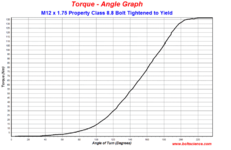
The main variable is the thread pitch. The core purpose of torque to yield to to permanently stretch the bolt beyond the point of elastic deformation. That's why you only get one shot and then you need a new bolt. If you know how much you want the bolt to stretch to get it to yield, and you do if you're an engineer and know the bolt strength, then the pitch of the bolt (threads per inch or threads per mm) determines how far you need to go to achieve that amount of elongation.
 

Odd-job

Well-known member
Joined
Aug 13, 2017
Messages
2,299
Location
SF Bay Area
Interesting charts. Based on this in theory 20 Nm + 90 degrees = ~ 135 Nm which is on the upper end of the range of a typical 3/8 digital torque wrench.

@dnschmidt - does the Eclatorq idiot warning kick in right at the top of the range or is there some cushion?


1677426585651.png

1677426719091.png
 

Zewnten

Well-known member
Joined
Jun 11, 2017
Messages
1,838
First OP good question

I have the 300# tech angle, it gets very unhappy maxing out the torque so you need to get a feel for what the angle is doing to the torque. The Snap On is nice like plinker said it'll show you how much torque you've put in so far and you can see how much you have left.

Now I torque to spec then grab the next drive size breaker bar or ratchet, put a mark on the bolt head, outside of the socket and one on the frame and do the angle torque that way.
 

dnschmidt

Well-known member
Joined
Oct 3, 2014
Messages
7,285
Location
Phoenix, AZ
Interesting charts. Based on this in theory 20 Nm + 90 degrees = ~ 135 Nm which is on the upper end of the range of a typical 3/8 digital torque wrench.

@dnschmidt - does the Eclatorq idiot warning kick in right at the top of the range or is there some cushion?


1677426585651.png

1677426719091.png
You get a maximum of 10% and maybe not that much. Elcatorq's wrenches in 3/8" drive normally max out at 135 N-m which is 100 ft-lb so anything over 110 ft-lb and it's time to bring out the calibration cable to erase the, "you're a dumb ***", ikon. The reason they do this is that over ranging the torque wrench might affect it's calibration so the true purpose is to get you to check the calibration after overtorquing to make sure the wrench is still in calibration. For automotive applications this could be considered overkill but for military and aviation applications where life and death could be on the line it does make sense.
 

dnschmidt

Well-known member
Joined
Oct 3, 2014
Messages
7,285
Location
Phoenix, AZ
That's why I recommend getting the 250 ft-lb angle models. A 3/8” drive shouldn’t be used on anything bigger than an 8mm bolt as an 8mm bolt will break before you go over range. It's damn unlikely that you'll ever exceed 250 ft-lb with a torque to yield application as you'll have either a hernia or bust your nuts trying to get that much torque on a two foot long torque wrench and cheater pipes can’t be used with torque wrenches as they change the fulcrum point making such an arrangement useless. Tightening ARP head bolts (well they are actually studs) on a Powerstroke 6.0 to 210 ft-lb had me speaking a couple of octaves higher than I normally do so I’d say you’re safe with a 250 ft-lb model.
 

silkman

Well-known member
Joined
Feb 23, 2021
Messages
367
Location
Athens
How about using common sense? Meaning, if you are about to torque an engine crank bolt do it with more traditional methods, eg angle gauge than your fancy $1000 snapon electronic torque wrench... ;)
 
OP
F

FSUwelder1212

Well-known member
Joined
Jul 9, 2013
Messages
149
How about using common sense? Meaning, if you are about to torque an engine crank bolt do it with more traditional methods, eg angle gauge than your fancy $1000 snapon electronic torque wrench... ;)
the electronic torque wrench is a torque angle gauge so I’m not sure what your point is. It’s also lower profile than using most other torque angle attachments making them not feasible. Perhaps you should go back to your desk doing your accountant, middle management, or whatever useless task while those of us that actually get things done share knowledge.
 

pbon

Well-known member
Joined
May 14, 2017
Messages
3,498
I just bought the HF Icon 250 lb angle wrench. $349 but I had a 20% coupon so it was $280. I like the lifetime warranty. I broke an out of warranty 3/8 HF Doyle angle wrench due to excess torque — it can happen as someone noted above. I was shopping the Snap On 300 lb techangle but it was more than 2x the price — over $600 and no lifetime warranty. I did like the 300 lb limit though.

More and more stuff on my cars — BMWs — are angles these days. I have regular torque wrenches that go to 400+ lbs and have used mechanical and electronic angle adapters in the past.
 
To avoid these ads, REGISTER NOW!

silkman

Well-known member
Joined
Feb 23, 2021
Messages
367
Location
Athens
More and more stuff on my cars — BMWs — are angles these days. I have regular torque wrenches that go to 400+ lbs and have used mechanical and electronic angle adapters in the past.
Some BMW crank bolts are 100Nm + 3 x 60 degrees. Common sense says you can't use an electronic tool for that and you state that fact and people get excited...
 

dnschmidt

Well-known member
Joined
Oct 3, 2014
Messages
7,285
Location
Phoenix, AZ
Some BMW crank bolts are 100Nm + 3 x 60 degrees. Common sense says you can't use an electronic tool for that and you state that fact and people get excited...
In this case the solution is easy. Use a paint marker to mark the current position of the bolt head at 12:00 o'clock and at somewhere besides the bolt head mark at 60, 120 and 180. You can use the relative position of the bolt points to do this since each is 60 degrees from each other. Mark the socket as well and align the socket's mark to that made on the bolt head. Line up the marks while ratcheting to the 60, 120 and 180 degree marks. The Euro's use some stupid high torque on some fasteners. I've seen it spec'ed as high as 600 N-m.
 

dnschmidt

Well-known member
Joined
Oct 3, 2014
Messages
7,285
Location
Phoenix, AZ
I just bought the HF Icon 250 lb angle wrench. $349 but I had a 20% coupon so it was $280. I like the lifetime warranty. I broke an out of warranty 3/8 HF Doyle angle wrench due to excess torque — it can happen as someone noted above. I was shopping the Snap On 300 lb techangle but it was more than 2x the price — over $600 and no lifetime warranty. I did like the 300 lb limit though.

More and more stuff on my cars — BMWs — are angles these days. I have regular torque wrenches that go to 400+ lbs and have used mechanical and electronic angle adapters in the past.

The ICON wrench is very high quality. At the AAPEX show this year I determined that it was made by KABO and KABO's stuff is the best.
 

Garcky

Well-known member
Joined
Sep 10, 2022
Messages
3,434
Location
Twin Cities Metro Area, Minnesota
All beyond my pay grade and experience. Life has truly changed for technicians. The question I have is: If you're pushing the limits of your tool to get the job done, why not move up to 1/2" drive stuff for this technical work? I might be misunderstanding, but it looks like I'm seeing 3/8" drive tools working outside of their envelopes here.
 

pbon

Well-known member
Joined
May 14, 2017
Messages
3,498
Some BMW crank bolts are 100Nm + 3 x 60 degrees. Common sense says you can't use an electronic tool for that and you state that fact and people get excited...
I guess I have different common sense than you. I could use my electronic tool to do one or 2 fixed torque stages and then 3 successive 60 degree angles pretty easily.
 

dnschmidt

Well-known member
Joined
Oct 3, 2014
Messages
7,285
Location
Phoenix, AZ
All beyond my pay grade and experience. Life has truly changed for technicians. The question I have is: If you're pushing the limits of your tool to get the job done, why not move up to 1/2" drive stuff for this technical work? I might be misunderstanding, but it looks like I'm seeing 3/8" drive tools working outside of their envelopes here.
Correct. See, here is the dilemma. The ½” wrench is two feet long and the 3/8" wrench is 15" long so with space being at a premium there is a natural tendency to try to use the shorter wrench. In many cases there is no way to use the 24" wrench. In a perfect world you would always use the longer wrench both because it's easier to turn the bolt and because the torque will be within the range of the wrench. Sadly, we don't live in a perfect world.
 

Garcky

Well-known member
Joined
Sep 10, 2022
Messages
3,434
Location
Twin Cities Metro Area, Minnesota
Correct. See, here is the dilemma. The ½” wrench is two feet long and the 3/8" wrench is 15" long so with space being at a premium there is a natural tendency to try to use the shorter wrench. In many cases there is no way to use the 24" wrench. In a perfect world you would always use the longer wrench both because it's easier to turn the bolt and because the torque will be within the range of the wrench. Sadly, we don't live in a perfect world.
Far from perfect, yes. I understand the space dilemma, though, for sure. Even in my ancient times, getting a 1/2" drive torque wrench into a tight spot was often an issue. I go back far enough that I didn't even have a clicking torque wrench when I started working. So, you always had to get into a weird position to see and read the torque value on the scale.

The new torque and angle specs are foreign to me, really. I understand the engineering side of it, but it certainly complicates the maintenance side a good bit.

What's the next step? A tag on the engine module that reads, "No serviceable components inside?" I don't think that's actually too far-fetched somewhere down the road.
 

Odd-job

Well-known member
Joined
Aug 13, 2017
Messages
2,299
Location
SF Bay Area
In true GJ fashion this thread has caused me to go down the rabbit hole even more so. Sorry OP for derailing the thread.

How much do you think one of these costs from Atlas Copco or Hytorc? Guessing these make the tech angles seem cheap. This might be one of those instances if you have to ask, you can't afford it....

1677687900812.png

1677688109969.png
1677688253436.png
 

dnschmidt

Well-known member
Joined
Oct 3, 2014
Messages
7,285
Location
Phoenix, AZ
In true GJ fashion this thread has caused me to go down the rabbit hole even more so. Sorry OP for derailing the thread.

How much do you think one of these costs from Atlas Copco or Hytorc? Guessing these make the tech angles seem cheap. This might be one of those instances if you have to ask, you can't afford it....

1677687900812.png

1677688109969.png
1677688253436.png
I'm down for one of those but how do you fit it into the engine bay?
 

RedneckWelder

Well-known member
Joined
Nov 12, 2013
Messages
5,705
Location
The Ghetto Kingdom of Methlandia
In true GJ fashion this thread has caused me to go down the rabbit hole even more so. Sorry OP for derailing the thread.

How much do you think one of these costs from Atlas Copco or Hytorc? Guessing these make the tech angles seem cheap. This might be one of those instances if you have to ask, you can't afford it....

1677687900812.png

1677688109969.png
1677688253436.png

If you have to ask you can’t afford it.

Also the torque guns and hydraulic torque wrench units need suitable surface and arm configuration for reaction. That does hinder them a good bit in many applications.
 

Odd-job

Well-known member
Joined
Aug 13, 2017
Messages
2,299
Location
SF Bay Area
I'm down for one of those but how do you fit it into the engine bay?

Lots of extensions and swivels.

If you have to ask you can’t afford it.

Looks like they run $3-4k. Its not as bad as I thought, but maybe I didn't want one that badly in the first place?


For a poor man with torque multiplier, can one multiply the angle by the ratio? Let's say torque multiplier is 3 to 1. Let's say torque on faster is 100 ft lbs + 90 degrees. So this would be torque the torque multiplier to 33.33 ft lbs on the torque wrench and then 270 degrees of angle to get back to 90 degrees on the fastener?
 

2ndGearRubber

Well-known member
Joined
Mar 24, 2014
Messages
14,185
Location
Pittsburgh
All beyond my pay grade and experience. Life has truly changed for technicians. The question I have is: If you're pushing the limits of your tool to get the job done, why not move up to 1/2" drive stuff for this technical work? I might be misunderstanding, but it looks like I'm seeing 3/8" drive tools working outside of their envelopes here.

Because it physically does not fit. I've taken a 1/2 tool, adapted to a 3/8 extension, back adapted up the 1/2 for the bit socket. Because that clears the strut. And pulling the strut means the upper arm needs to come out. And it's crusty and nasty. And it's my problem to deal with when it all falls apart.

As the guy using a 16" long wrench 5 degrees at a time to hit around 130ft/lb, I'm on your side of wanting to use a 24" long 1/2 drive too if possible.


Far from perfect, yes. I understand the space dilemma, though, for sure. Even in my ancient times, getting a 1/2" drive torque wrench into a tight spot was often an issue. I go back far enough that I didn't even have a clicking torque wrench when I started working. So, you always had to get into a weird position to see and read the torque value on the scale.

The new torque and angle specs are foreign to me, really. I understand the engineering side of it, but it certainly complicates the maintenance side a good bit.

Torque + angle is stupid. Having tightened many angle fasteners, it offers little real world value. Torque 6 torque+angle fasteners, torque spread is +/- 5ft/lb of 145. Just call it 145ft/lb and move on.

Much like all the circle-jerking with new bit fasteners, zero need, just engineering ******** for the sake of ********. Zero need for a caliper bracket to have an e-torx head and torque+angle. It's an M10 bolt. Stick a 17mm on it, torque it to 60ft/lb, no need to reinvent the wheel.

What's the next step? A tag on the engine module that reads,
"No serviceable components inside?" I don't think that's actually too far-fetched somewhere down the road.

I disassembled and rebuilt a wiper motor today, from two DOA cardone junk remans, and the customers original unit with a bad c-clip and park switch. Couldn't get them parking properly, but they work now. Nothing is designed to be serviceable, nothing is designed to be rebuilt, nothing is designed and documented for the tech to actually figure out what's wrong.

EDIT: And unless you can do circuit board work, you're not fixing any modules either. They haven't been serviceable to years and years without a microscope and dedicated equipment.
 

dnschmidt

Well-known member
Joined
Oct 3, 2014
Messages
7,285
Location
Phoenix, AZ
2nd Gear. that mimics what I found as well. On the 6.0 Powerstroke I'm working on the four bolts that hold on the harmonic balancer have a spec of 50 ft-lb + 90 degrees. After I used my torque + angle torque wrench all four the the bolts finished up at 138 ft-lb. Why not just say "Torque to 138 ft-lb?"
 

Garcky

Well-known member
Joined
Sep 10, 2022
Messages
3,434
Location
Twin Cities Metro Area, Minnesota
Because it physically does not fit. I've taken a 1/2 tool, adapted to a 3/8 extension, back adapted up the 1/2 for the bit socket. Because that clears the strut. And pulling the strut means the upper arm needs to come out. And it's crusty and nasty. And it's my problem to deal with when it all falls apart.

As the guy using a 16" long wrench 5 degrees at a time to hit around 130ft/lb, I'm on your side of wanting to use a 24" long 1/2 drive too if possible.


Torque + angle is stupid. Having tightened many angle fasteners, it offers little real world value. Torque 6 torque+angle fasteners, torque spread is +/- 5ft/lb of 145. Just call it 145ft/lb and move on.

Much like all the circle-jerking with new bit fasteners, zero need, just engineering ******** for the sake of ********. Zero need for a caliper bracket to have an e-torx head and torque+angle. It's an M10 bolt. Stick a 17mm on it, torque it to 60ft/lb, no need to reinvent the wheel.


I disassembled and rebuilt a wiper motor today, from two DOA cardone junk remans, and the customers original unit with a bad c-clip and park switch. Couldn't get them parking properly, but they work now. Nothing is designed to be serviceable, nothing is designed to be rebuilt, nothing is designed and documented for the tech to actually figure out what's wrong.

EDIT: And unless you can do circuit board work, you're not fixing any modules either. They haven't been serviceable to years and years without a microscope and dedicated equipment.
Yup. Engineering for engineerings sake is stupid. Technically, it might make sense, but practically it doesn't. You're right on all counts.
 
To avoid these ads, REGISTER NOW!
Top Bottom