To avoid these ads, REGISTER NOW!

Craftsman Drill Press Information Belts, Bearings, Chucks, Keys, etc…1946-1984

To avoid these ads, REGISTER NOW!

TWManson

Active member
Joined
Jan 23, 2023
Messages
36
Location
Rockford, IL
turned it on and just listened to the quite bearings hum
It does not take much to make us smile right??

I ran my drill press today and the belt looks wonky (technical term). It was squeaking and appeared to be trying to run up the motor pulley every few seconds, like climb up it. I have it on low speed, did not try other speeds. The pulleys seem to run true without the belt on. The belt that was on it is Craftsman 9-1644 1/2x44x1459. It looks to me like it does not seat into the pulley groove deep enough, there is belt showing outside the pulley. I looked through my belt stash and found one close in length and it is listed as 15/32 x 5/16, part number is 15431. It fits way better and runs smooth no squeak, no nothing. It is a cog belt. For all I know the motor pulley may not be original??
 

TWManson

Active member
Joined
Jan 23, 2023
Messages
36
Location
Rockford, IL
I made a little aluminum stop collar then cleaned up the depth bar so I could read the numbers a bit better. I used Sea Foam degreaser and a brass wire brush on the depth bar. I thought about using Brake Cleaner but was afraid it may take off whatever paint they used for the numbers.
 

Attachments

  • IMG_1237[1].JPG
    IMG_1237[1].JPG
    533.4 KB · Views: 86

Smokeshow69

Well-known member
Joined
Dec 7, 2012
Messages
8,373
Location
Pacific Northwest
I made a little aluminum stop collar then cleaned up the depth bar so I could read the numbers a bit better. I used Sea Foam degreaser and a brass wire brush on the depth bar. I thought about using Brake Cleaner but was afraid it may take off whatever paint they used for the numbers.
If you are worried about the paint it’s not factory original. But the highlighted numbers are nice
 

FrankLee

Well-known member
Joined
Sep 13, 2010
Messages
3,599
Location
seMI, 48317
I made a little aluminum stop collar then cleaned up the depth bar so I could read the numbers a bit better. I used Sea Foam degreaser and a brass wire brush on the depth bar. I thought about using Brake Cleaner but was afraid it may take off whatever paint they used for the numbers.
You could use a paint pen to highlight the scale.
 

TWManson

Active member
Joined
Jan 23, 2023
Messages
36
Location
Rockford, IL
Thanks Frank, I had contemplated how to brighten them up. I normally would not use the scale, I would set drill depth by eye and tighten the stop according. But I figured if there was an engraved scale I may as well make it look good.
 

FrankLee

Well-known member
Joined
Sep 13, 2010
Messages
3,599
Location
seMI, 48317
Rustoleum 261415 Champagne Mist has always been the go-to, off-the-shelf paint to closely match Craftsman King-Seeley Power Bronze. However, the color formula is no longer the same.

See link.
 
Last edited:
OP
1

11b30b4

Well-known member
Joined
Jul 16, 2020
Messages
1,029
Location
GA
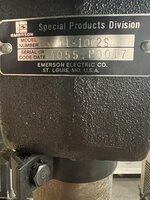
Lafester, nope never seen that. And What is up with that model number? 11-1002S? I would be interested to know what Frank has to say about this drill press. Its Absolutely a 15 1/2" Commercial Gen 3 1971 because it does not have the switch safety lock out but it does have some sort of weird safety lock out under the switch. I wonder if there was an industrial run on the commercial drill presses that are not in the general catalogs? All that white painted parts and the white plastic belt cover all look OEM. I suppose the other possibility is that Emerson may have marketed their own Emerson Brand Drill Press independent from Sears. Actually that makes the most sense but I was never aware of that as a possibility. Thanks for the pics.
 

MarkRas

New member
Joined
Feb 19, 2023
Messages
1
Location
Minocqua, WI
If you have one of these types of drill presses, this thread is for you. Bookmark, subscribe, whatever; so that you can find it when you need it.

full


This thread is primarily targeted at new owners of vintage Craftsman Drill Presses built from 1946-1984. Most of this information is generalized and where it is specific, a model number will be noted. If you need v-belts, ball bearings, Jaocob’s Chucks, or Chuck Keys, this thread has that information for you. Before you can get the stuff you need, you must know what model drill press you have.

This thread will cover all American made Craftsman 15.5” drill presses from 1946-1984. During this period, we saw the 100 series, the 150 series, and the Emerson Generations 1-5. All of the 15.5” drill presses during this time frame were manufactured by King Seeley or Emerson. The 100 series, 150 series and the Emerson Gen 1 series are all considered the Classic Craftsman Drill Press with that art deco look.

full


Although, many of these drill presses were advertised as 15” drill presses, all of them are 15.5” drill presses. During this same time frame there were also 12” and 13” and some other sizes. Many of these were called the 80 series and one year a 12” was also called a 100 series but this thread will stick with the 15.5” drill presses.

So how do you measure a drill press. The size is determined by measuring the distance from the column to the center of the chuck. On all of these drill presses, the measurement is 7 ¾”. This means you can drill to the center of a 15 ½” circle.

full


I own several of these machines from a wide spectrum of the time span; however, I am not an expert of these machines. I have a good amount of experience using and rebuilding these machines and I owe a special thanks to FrankLee, Hoorn, JoCoSawdust, and the many others that have helped me to acquire the knowledge I have of these machines.

I welcome any additional information to this thread, and I hope this thread helps the new owners of these amazing machines.

Which machine do you have?

I will briefly discuss the drill presses covered in this thread; however, for more detailed information see my Classic Craftsman Drill Press Information Thread here:


King Seely Era machines range from 1946-1964.

This will get a little confusing but stick with it. During this 28-year period we see two different models, the 100 series and the 150 series. Although both of these series are very similar, there are some differences, and you need to know what drill press you have.

1946-1957 The Craftsman King Seeley 100 Series Drill Press

full


full


The 100 series is most recognizable by the “engine turned” headstock insert panel, although there was a two-year span (1952-1953) that the insert panel was not included on the drill press. The 100 series was sold in both the bench top and floor standing models with or without motors. For dating purposes, the motor is one of the most likely sources of information. A date code on most Craftsman motors can narrow the year the motor was built and likely the drill press it is attached with.

full


In the example above, the date code is F4 50. The motor was likely manufactured June 4th, 1950. Depending on the motor type, the date code may be stamped on the motor as a MFG. NO. The capacitor may also have a date on it.

There were a few design changes throughout the 11 years the 100 series was manufactured, and these changes can help narrow the date of your machine. The model numbers for the 100 series were:

103.2313xx

103.2330xx

103.2314xx

103.2331xx

103.2481xx

103.24815x

103.2482xx

103.24826x

103.2337xx

103.2169xx

103.2304xx

103.2290xx

1958-1964 The Craftsman King Seeley 150 Series Drill Press

full


full


The 150 series is very similar to the 100 series in appearance and features. The 150 series has several improvements that make it a different model, but the most recognizable feature is the one-piece headstock insert panel with “150” printed on it. The 150 combined the Craftsman Logo into the panel insert and Craftsman dropped the engine turned panel for a colored graphics panel. Other obvious changes are a non-tilting table (although this feature was changed to an optional accessory in 1956 so there are some 100 series with a non-tilting table), a tilting motor mount, and a quick adjusting feed stop.

The King Seeley era 150 series was manufactured from 1958 to 1964 and were sold in both a bench top and floor standing model with or without motors. The model numbers for these drill presses were:

103.2450xx

103.24505x

103.2451xx

103.24515x

103.2452xx

103.24525x

103.2453xx

103.24534x

103.24535x

Emerson Era machines range from 1965-1984

1965-1966 The Craftsman Emerson 150 Series (Emerson Generation 1) Drill Press


full


full


Sometime in 1964 Emerson took over production of King Seeley Drill Presses for Craftsman. The prefix for the drill press changed in 1965 from 103 (King Seeley) to 113 (Emerson). There was some overlap between models but in general an Emerson 150 series (AKA Emerson Gen 1) is the same as the King Seeley late model 150 series. There were a few changes and some of these may even be present on late King Seeley 150s. First, the quill return spring was changed. Tension adjustment was now controlled by pulling and rotating the hub/ pinion assembly. The left side of the feed tension spring was looped on both ends and was now captured internally by hooking it on a roll pin inside the head. This change meant the elimination of the external chrome tension knob. When looking at a 150 machine, if you do not see the external tension knob (see the green circle in the above picture) you know it is a late model 150. Additionally, the tilting motor mount was improved to include a captured adjustment bolt on the bottom that was threaded into the headstock.

full


For the two-year period that Emerson manufactured the 150 series, it was available in both bench top and floor standing models with or without motors. The following model numbers were used for these drill presses:

113.2450xx

113.24505x

113.24506x

113.2451xx

113.24515x

113.24516x

1967-1969 Craftsman Emerson Gen 2 Drill Press

full


full


The Emerson Gen 2 drill press was a completely redesigned headstock 15.5” drill press. Although the headstock and table look very different, the internal parts and functions of the drill press are generally the same as the 150 series. The largest change in this drill press was the longer spindle which resulted in a longer spindle travel from the 4" travel of the 150 to a 6" spindle travel in this Gen 2. The most recognizable feature of the Emerson Gen 2 is the large open gap in the headstock. Often this drill press is referred to as the Emerson skeletonized drill press. The floor base and column are the same as the 150 but the headstock and table were new designs.

The Gen 2 Emerson was produced from 1967 through 1969. It was available in both the bench top and floor standing models with or without motors. The following model numbers were used:

113.2454xx

113.24541x

113.2456xx

113.24561x

1970-1972 Craftsman Emerson Gen 3 Drill Press

full


The Emerson Gen 3 was a complete redesign of the headstock, table and floor base. Additionally, Craftsman marketed a standard version and a beefed-up commercial version of the Emerson Gen 3 drill press. The Emerson Gen 3 and Gen 4 drill presses are very similar in appearance, and the standard model and commercial model are also similar in appearance. Internally, the largest change is the pulley system. The Gen 3 introduced the 6” 8-step pulley that would continue across later generations. The v-belt was changed from ½” to 3/16” wide belt to accommodate the pulley size.

full


The commercial model has a split head. Literally, there is a gap on the front of the headstock nose from the bottom and running vertically up ¾ of the head. There are 3 set screws on the left side of the headstock to adjust take-up in the quill backlash. Additionally, the table was a larger table with T-nut slots and a coolant trough so looking for the split and T-slot table are the easiest way to identify a commercial model.

The standard Emerson Gen 3 was available in both bench top and floor standing models with or without motors from 1970-1972. The Emerson Commercial Gen 3 was available in a floor standing model only with or without motor from 1971-1972. The following model numbers were used for these drill presses.

113.2458xx

113.24581x

113.2459xx

113.24591x

113.2463xx (Commercial Model)

113.24631x (Commercial Model)

1973-1983 Craftsman Emerson Gen 4 Drill Press

full


full


The Emerson Gen 4 drill press was a refinement of the Gen 3 model. As I said they are very similar in appearance. The easiest way to know the difference is the table. A Gen 3 table had a milled surface across the entire top of the table including the area around the column very similar to the Gen 2.

full


On a Gen 4 the table surface and the boss (ring) around the column bore have a milled surface but the area between the table and column was recessed and painted. Another way to say this is that the table and column ring have a boss or are raised about 3/16”.

full


There were some differences in the color of the lock handles and feed knobs, but I do not have all the details to determine which generation has what colors.

Emerson fielded the Gen 4 in a standard and commercial version in floor standing models only with or without motors. The hardest drill presses to determine the differences are the Gen 3 and Gen commercial models.

full


full


As I previously said, identifying a commercial model can be accomplished by observing the split head and T-slot table.

full


However, you are really forced to rely on model numbers to know what generation you are dealing with. The following model numbers were used:

113.2137xx

113.21371x

113.21376x

113.21378x

113.2452xx (Commercial Model)

113.24521x (Commercial Model)

113.24522x (Commercial Model)

113.2461xx (Commercial Model)

113.24613x (Commercial Model)

1984 Craftsman Emerson Gen 5 Drill Press

full


The last year of American made Craftsman drill presses was 1984. After 84 all production was moved to Asia. The final or 5th Generation of the Emerson Drill Press was very similar to the 4th Generation however, the floor base was redesigned and incorporated a tube and table lift system. This table lift system is the easiest way to identify a 5th generation drill press but be advised that Emerson continued to produce this design for many years after production was moved to Asia. The difficulty in determining the year of manufacture on the drill press coupled with the knowledge that this model was only made in America for one year should cause you to avoid any Gen 5 drill press.

The gen 5 was available in both a 15.5” standard version and a 17” commercial version. These were available in floor standing models only and came with motors. If you can date the motor, then you may have some idea what the date of the drill press is. The following model numbers were used for American made 1984 Gen 4 drill presses.

113.21385x

113.21387x (Commercial Model)
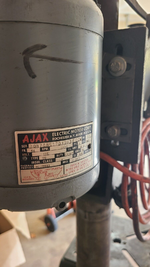
As a new owner of a 100 series this forum is incredibly helpful. Can someone point me to how to decipher info on my DP motor? It's an Ajax brand, so should I presume my DP was purchased without motor and the owner added it separately? (The DP I purchased is said to have been in the family since new but the man who bought it new has long passed). If this Ajax motor is not of similar vintage as my DP (1951-1955 based on 11b Jeff's beautiful break-down of models and features), I would like to replace it with something more appropriate. Appreciate any help identifying my motor's vintage, whether it's a keeper or not, and if not, how to acquire a Craftsman-branded motor. Please forgive me if I posted this in the wrong area - I'm brand new to this forum and still figuring out how it works. Was not able to find a Craftsman DP motor section.

1676839245171.png
 

FrankLee

Well-known member
Joined
Sep 13, 2010
Messages
3,599
Location
seMI, 48317
Has anyone seen an Emerson badged dp? I have not until I saw this on ebay today...

s-l1600 (17).jpgs-l1600 (19).jpgs-l1600 (18).jpg

Lafester, nope never seen that. And What is up with that model number? 11-1002S? I would be interested to know what Frank has to say about this drill press. Its Absolutely a 15 1/2" Commercial Gen 3 1971 because it does not have the switch safety lock out but it does have some sort of weird safety lock out under the switch. I wonder if there was an industrial run on the commercial drill presses that are not in the general catalogs? All that white painted parts and the white plastic belt cover all look OEM. I suppose the other possibility is that Emerson may have marketed their own Emerson Brand Drill Press independent from Sears. Actually that makes the most sense but I was never aware of that as a possibility. Thanks for the pics.
I've never seen that before, but it is very cool! https://www.ebay.com/itm/275615153995

There's a tapmatic 30 tc/dc installed on that machine. Those are $700+ new!

That safety switch requires that the chuck key be inserted before it will power on. It prevents the user from leaving it in the chuck. I've seen another similar switch, but it was not integrated into the machine.

Found another one here:
 
Last edited:

lafester

Well-known member
Joined
Mar 1, 2017
Messages
2,191
Location
Northern CO
As a new owner of a 100 series this forum is incredibly helpful. Can someone point me to how to decipher info on my DP motor? It's an Ajax brand, so should I presume my DP was purchased without motor and the owner added it separately? (The DP I purchased is said to have been in the family since new but the man who bought it new has long passed). If this Ajax motor is not of similar vintage as my DP (1951-1955 based on 11b Jeff's beautiful break-down of models and features), I would like to replace it with something more appropriate. Appreciate any help identifying my motor's vintage, whether it's a keeper or not, and if not, how to acquire a Craftsman-branded motor. Please forgive me if I posted this in the wrong area - I'm brand new to this forum and still figuring out how it works. Was not able to find a Craftsman DP motor section.

1676839245171.png
Ebay usually has a few at any given time. I like the ajax motor though.
 
OP
1

11b30b4

Well-known member
Joined
Jul 16, 2020
Messages
1,029
Location
GA
TWManson, all the Craftsman Emerson Gen 3 and Gen 4 15 1/2” drill presses have the same style belt cover. These are great machines and are fairly easy to find. So, if you are looking for a drill press I would recommend either generation.

MarkRas

That Ajax motor was added to the drill press and likely the drill press was purchased without a motor. That was very common back then, Craftsman offered the drill press with and without a motor. Your Alax motor is a 1/3 hp and I normally recommend a ½ hp motor. A good period correct motor is the Craftsman 115.6962 if you want to replace the Ajax motor. Also, I have a Craftsman Motor thread here:


Whatever you decide to do with the motor make sure you use a 1725-1750 RPM motor the 3650 RPM motors are too fast for a drill press.

Model 103.23141 was a floor model without motor that was manufactured by the King Seeley corporation and was produced between 1947 and 1955 You can eliminate 1952 and 1953 since both years the drill presses shipped without head bands and your drill press has a head band.

From what I can see in the pics the drill press looks fairly complete. I do not know if the lock handle for the table is present since I can not see it. Also, I do not know if the locking pin for the tilt table is present. The table looks to be in good shape with only a few drill holes in it.

Once you get it cleaned up and running you may want to consider replacing the chuck with the safety collar version of the same chuck. I would also recommend you consider getting a 150 series tilting motor mount, that will make belt changes so much easier. Overall, I like the drill press and I think you will enjoy it.

FrankLee, I knew you would have something special to add to this discussion. I missed that tapmatic when I first looked at the pics. The Chuck key lockout is really cool.

Lafester, I agree and if it were anywhere near me I would grab it just to have it. That machine as far as I know is very rare.
 

vanhalo

Member
Joined
Mar 24, 2015
Messages
9
Location
East TN
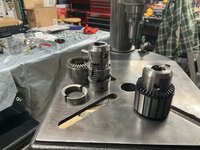
5CD0929F-C8BA-4547-ACEB-D695365E0AD9.jpegCan I replace my "safety collar" Jacobs Chuck with a non threaded Jacobs Chuck on a Craftsman 150 (113.24501)? Having trouble with one of the replacement jaws and I remember how difficult it was to remove the original chuck. According to the beginning of this thread the safety chuck didn't always have a threaded collar.
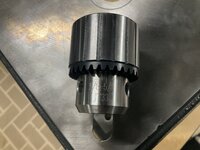
The safety collar was not introduced until 1952 (although there is evidence of its use in 1951) so all previous chucks had a thread protector on the thrust collar. This thread protector looks just like the safety collar but is not connected to the chuck. It is also possible to see chucks and thread protectors where the sleeve is machined with panels and not smooth. Here is a picture of one of these paneled sleeves.


EF96D89D-D0D8-4582-8F69-747EA6849326.jpeg
 
Last edited:
OP
1

11b30b4

Well-known member
Joined
Jul 16, 2020
Messages
1,029
Location
GA
Vanhalo, you can replace the safety collar chuck ( #14451) with the non-safety collar version (#14445). Both of these chucks are exactly the same, but one has the safety collar, and one does not. Both have a Jacob’s #33 taper. The taper on the spindle is a #33 so the chuck must be a #33 taper. If you do replace the safety collar chuck you will likely want to purchase the #6 Wedge Set so that you can remove it when you want to. However, I do not understand why you want to replace the safety collar chuck. If your chuck has damaged jaws and you plan on getting a replacement chuck, I would just get another safety collar chuck.

This video may help you out.


vanhalo

Member
Joined
Mar 24, 2015
Messages
9
Location
East TN
I have already purchased the replacement chuck (seen on the right..drill press table) in the Amazon link.
It does not have the safety collar.

Amazon listed my model specifically.

I have a #6 wedge set here somewhere. I have misplaced it.

A15F38CD-5EB5-4FEC-A0D8-9BC986FEEFF3.jpeg
 
Last edited:

vanhalo

Member
Joined
Mar 24, 2015
Messages
9
Location
East TN
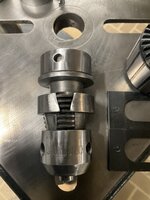
I mischaracterized my issue with the jaws. I bought replacement jaws. They are fine. One of them gets hung as shown in the photo.

D0CB6CDB-7DC4-48E8-B5DD-59DD2D10B28F.jpeg
 
Last edited:
To avoid these ads, REGISTER NOW!
OP
1

11b30b4

Well-known member
Joined
Jul 16, 2020
Messages
1,029
Location
GA
Vanhalo, I would figure out what the jaw is catching on and correct that. I am not familiar with DNLK. I would measure your runout on the spindle taper then mount the new chuck and measure the runout using a dill bit or true rod in the chuck. Do not measure runout on the chuck body as that does not matter. If you are getting good runout then run with the DNLK chuck.
 

vanhalo

Member
Joined
Mar 24, 2015
Messages
9
Location
East TN
Vanhalo, I would figure out what the jaw is catching on and correct that. I am not familiar with DNLK. I would measure your runout on the spindle taper then mount the new chuck and measure the runout using a dill bit or true rod in the chuck. Do not measure runout on the chuck body as that does not matter. If you are getting good runout then run with the DNLK chuck.

It is an American made chuck and seems pretty solid.
 
OP
1

11b30b4

Well-known member
Joined
Jul 16, 2020
Messages
1,029
Location
GA
That retaining ring that holds the safety collar on is a real chore to get out. And putting back in is even worse. I once spent 3 hours trying to get one back in and eventually got it but Wow was that an experience. I do agree with FrankLee that removing it would allow you to put a "thread protector" on the thrust collar.
 

vanhalo

Member
Joined
Mar 24, 2015
Messages
9
Location
East TN
That retaining ring that holds the safety collar on is a real chore to get out. And putting back in is even worse. I once spent 3 hours trying to get one back in and eventually got it but Wow was that an experience. I do agree with FrankLee that removing it would allow you to put a "thread protector" on the thrust collar.

I can’t remember if I removed it before I gave it a bath in the Ultrasonic Cleaner.

I remember the chuck removal was unpleasant.
 
OP
1

11b30b4

Well-known member
Joined
Jul 16, 2020
Messages
1,029
Location
GA
While researching a recent Drill Press, I decided to make an alteration to FrankLee’s nomenclature of the Emerson drill press line.

A complete Emerson Line Spread Sheet with model numbers, years of production, links to owner’s manuals, bearing sizes, some replacement parts with links and a lot of size information can be found here:


Until now we tended to divide the Emerson Line into 4 generations but this nomenclature really did not take the commercial models into consideration. Generally we divided these generations based on design features such as the table design and switch layout. With additional research we discovered that there were two distinct generations of the commercial line (Gen 3 and Gen 4); however, there were some model number changes in both generations and with the model number change we also noticed a different switch layout. Therefore we developed additional nomenclatures for these models. Commercial models can now be categorized as Gen 3, Gen 3.5, Gen 4, and Gen 4.5. Thus, the Craftsman Emerson Line should now look like this:

Emerson Era 1964-1984

In 1964 Emerson assumed production of the 15.5” Drill Press line for Craftsman from King Seeley. In 1964 there were both King Seeley and Emerson Produced 15.5” Drill Press. Both of these machines were 150 series machines available in both the benchtop and floor standing versions. Both King Seeley and Emerson models incorporated the new double loop both ends feed return springs and omitted the external tension adjustment knob. Moth machines were identical and were made with the same parts, the only difference was the model numbers.

1964 King Seeley 150 Models 103.24501 (Bench Top) and 103.24511 (Floor)

Emerson Generation 1 1964-1966 (150 series)

full


Models 113.24501 (Bench Top) and 113.24511 (Floor)


Emerson Generation 2 1967-1969 (Skeletonized Head)


full


In 1967, production on the 150 series was halted and Emerson produced the second generation of their drill press. This Emerson drill press differed from the 150 series primarily in appearance. The head was skeletonized as was the table. The Spindle and Quill were extended for a longer travel which changed from 4” in the 100 and 150 series to 6” in the Gen 2. This is the only generation with this extended spindle travel. Other changes included a built in light, power switch, redesigned motor mount and belt tension system, and a removable belt cover.

Models 113.24540 (Bench Top) and 113. 24560 (Floor)


Emerson Generation 3 1970-1972 (Color Code)


full


In 1970 we see the Emerson Gen 3 Drill Press. This drill press is another complete redesign of the cast iron head that was fully enclosed. Affixed to the head left side was a color code diagram similar to the face panel on the Gen 2. The belt speed diagram was placed on the face of the belt cover and a blank panel was affixed to the right side of the head. The table was slightly improved from the Gen 2 but remained similar in appearance and the single plane design. The pulley and belt system were completely changed. The previous 100, 150 and Emerson Gen 1 and gen 2 series used a 5” 4-step pulley system with a ½” x 45” v-belt; however, the Emerson Gen 3 utilized a 6” 8-step pulley system with a 3/16” x 45” v-belt. This change resulted in 8 speeds ranging from 380 RPM though 8550 RPM and did not require the repositioning of the motor pulley. The Spindle was changed in length from the 19” in the Gen 2 to a 17” Spindle returning the travel from 6” back to 4”. The motor mount and belt tension system were redesigned. The removable belt cover was redesigned and made of plastic rather than steel. All the lock handles were redesigned and included red-orange vinyl non-slip covers. The Feed Stop Rod and Feed Stop Collar were changed and the depth gauge scale was moved from the Feed Stop Rod to the side of the head. Also, a significant change for the Gen 3 included a redesigned rectangular floor base. The Power Panel switch plate was moved from the top of the head in the Gen 2 to the face of the head on the Gen 3. A second switch was added to the switch plate to power the tool light (black) separately from the motor switch (red). Lastly, in the final year of production 1972, the motor switch was changed to a red and yellow safety lock out switch.

Models 113.24581 (Bench Top) and 113.24591 (Floor)


Emerson Generation 3 COMMERCIAL 1971


full


In 1971 Craftsman introduced the Emersion Commercial Drill Press Line that ran concurrent to the standard Gen 3 line. The first in this line was the Gen 3 Commercial Drill Press. This was a 15.5” Drill Press and looked very similar to the standard Gen 3. The largest changes were a spit head design that allowed the user to adjust the take-up in the quill. An eccentric bearing that encompassed the pinion allowing the user to adjust the backlash in the pinion and quill feed. The depth gauge scale on the side of the head was marked in 32nds of an inch rather than the scale on the standard Gen which was in 16ths of an inch. The table was improved to 14” x 14.5” T-slot table with a coolant troth. The two side panels on the head were changed to include the pulley speed diagram and recommended drill speeds and sizes for specific materials as well as tap drill sizes. The cover front panel was changed to a Craftsman banded logo panel with “Commercial” displayed. Several Significant changes were made to the Spindle and Quill assembly. The Spindle was thickened from the 5/8” on the standard Gen 3 to a ¾” Spindle on the Commercial Gen 3. The bore size for both Quill bearings was changed from 5/8” special bore to 17mm. The bottom Quill bearing was changed to an angular contact double row ball bearing and both of the Quill bearings had an OD of 40mm. The Spindle Thrust Collar was changed from a blind hole to through hole and the taper pin was changed to a roll pin. The Quill was thickened and changed in size from 1 5/8” x 9 3/8” to a robust 1 7/8” x 9 ½”. The Feed Stop Bracket was changed from the cast Zinc or Zamak to cast iron and was thickened. All the vinyl lock handle non-slip covers were changed from a red-orange to yellow. The Pinion was lengthened from 4 7/8” in the standard Gen 3 to 6 3/8” in the commercial Gen 3. The Feed Return Spring was also lengthened from 4” to 6 ¼”. Lastly the switch panel only had a single rocker switch.

Model 113.2463x (Floor)


Emerson Generation 3.5 COMMERCIAL 1972


full


In 1972 Emerson made one slight change to the Gen 3 Commercial Drill Press. The single rocker switch was changed to a safety lock out switch and the model number changed. After 1972 production on the commercial models was halted until 1975.

Model 113.2461x (Floor)

Emerson Generation 4 1973-1984 (Final American Line)

full


In 1973 Craftsman offered the fourth and final American Made Generation of the Emerson Drill Presses. The largest changes in this generation from the Gen 3 were reflected in the table design. On the Gen 3, the table was milled as one flat surface across the top from the column to the end of the table. On Gen 4 tables these had a raised boss surface for the table and the remainder of the casting was set 3/16” lower than the milled surface. The table had a reinforced subframe on the bottom of the table. Lastly the table size was reduced from 10 x 12 ½” to 10 x 12”. There was some minor cosmetic differences on the side panels but they contained the same data as the Gen 3. In 1977 Emerson improved the table with a raised boss for the column but otherwise made no other changes to the line. Essentially, the Gen 4 was exactly the same and the final 1972 Gen 3 with the changed dual switch and safety lock out design.

Models 113.2137xx (Bench Top) and 113. 213780 (Floor)


Emerson Generation 4 COMMERCIAL 1975-1977


full


In 1975 Emerson resumed production on the Commercial Drill Press line. These Drill Presses once again ran concurrent with the standard Drill Press line. Since the Gen 4 line was already in production, this line of Commercial Drill Presses was designated as Gen 4 Commercial Drill Presses. Similar to the final year of Gen 3 Production and the Gen 4 standard drill presses, The Gen 4 Commercial Drill Presses were exactly the same as the Gen 3.5 Commercial Drill Presses. These drill Presses even had the same model number. Only the year of production make them a Gen 4 Commercial Drill Press.

Model 113.2461x


Emerson Generation 4.5 COMMERCIAL 1978-1983


full


Like the Gen 4 Commercial Drill Press, the Gen 4.5 Drill Press only experienced a minor design change. The single safety lock out switch was updated to a dual switch with safety lock out. The side panels experienced another minor cosmetic change but retained the same data and the model number changed again.

Model 113.2452x (Floor) 1978

Model 113.24522 (Floor) 1979-1982

Model 113.24520 (Floor) 1983
 

Smokeshow69

Well-known member
Joined
Dec 7, 2012
Messages
8,373
Location
Pacific Northwest
Very nice work Jeff!
Agreed! My back hurts looking at those photos because I can see those are all photographed in the same place and he moved those down there.

Jeff- how many drill presses do you currently own ? I like how you are illuminating some of the later commercial models that were often overlooked. Excellent job as always.
 
OP
1

11b30b4

Well-known member
Joined
Jul 16, 2020
Messages
1,029
Location
GA
Frank and Smokes, thank you. In answer to your question, Four of these are my keeper machines.
1965 Craftsman-Emerson Gen-1 (150) 15.5" Bench Top Drill Press 113.24501
1961 Craftsman-King Seeley (150) 15.5" Floor Drill Press 103.24531
1981 Craftsman-Emerson Gen-4 15.5" Floor Drill Press 113.213780
1977 Craftsman-Emerson Gen-4 Commercial 15.5” Floor Drill Press 113.24611
I plan on replacing the floor standing 150 with a nice 100 once I locate one.
 

Smokeshow69

Well-known member
Joined
Dec 7, 2012
Messages
8,373
Location
Pacific Northwest
Frank and Smokes, thank you. In answer to your question, Four of these are my keeper machines.
1965 Craftsman-Emerson Gen-1 (150) 15.5" Bench Top Drill Press 113.24501
1961 Craftsman-King Seeley (150) 15.5" Floor Drill Press 103.24531
1981 Craftsman-Emerson Gen-4 15.5" Floor Drill Press 113.213780
1977 Craftsman-Emerson Gen-4 Commercial 15.5” Floor Drill Press 113.24611
I plan on replacing the floor standing 150 with a nice 100 once I locate one.
That sounds like a great lineup! You should do a family portrait some time :)
 

Hamfisted

Member
Joined
Jul 28, 2022
Messages
15
I have a request if anyone can oblige. Would someone be willing to post the measurements of the feed stop bracket? Ideally the thickness and distance from the collar opening to the stop rod opening. I’ve come to the conclusion I’ll need to either source one from a different model or make one. It appears to be a simple piece and I’ve seen others that were 3d printed for different models.
 

FrankLee

Well-known member
Joined
Sep 13, 2010
Messages
3,599
Location
seMI, 48317
I have a request if anyone can oblige. Would someone be willing to post the measurements of the feed stop bracket? Ideally the thickness and distance from the collar opening to the stop rod opening. I’ve come to the conclusion I’ll need to either source one from a different model or make one. It appears to be a simple piece and I’ve seen others that were 3d printed for different models.
IMG_0488.JPG IMG_0492.JPG

Based on the center line of the quill,
  • the quill bore radius in the bracket is at 13/16"
  • the center of the 1/4" mounting bolt is at 1-3/16"
  • the center of the feed stop rod is at 2-1/16"
  • the outside edge is 2-1/2" from the quill CL

  • the outside height of the quill portion is 7/8"
  • the inside height of the quill portion is 13/16"
  • the inside shoulder at the bottom of the quill bore is 1/16" x 1/16"
  • the wall thickness of the quill portion is 1/4"
  • the height of the feed stop rod portion is 1/2"
Note: The bracket in my photos was cut in half and the inside shoulder was removed by a previous owner.
 
Last edited:

Hamfisted

Member
Joined
Jul 28, 2022
Messages
15
IMG_0488.JPG IMG_0492.JPG

Based on the center line of the quill,
  • the quill bore radius in the bracket is at 13/16"
  • the center of the 1/4" mounting bolt is at 1-3/16"
  • the center of the feed stop rod is at 2-1/16"
  • the outside edge is 2-1/2" from the quill CL

  • the outside height of the quill portion is 7/8"
  • the inside height of the quill portion is 13/16"
  • the inside shoulder at the bottom of the quill bore is 1/16" x 1/16"
  • the wall thickness of the quill portion is 1/4"
  • the height of the feed stop rod portion is 1/2"
Note: The bracket in my photos was cut in half and the inside shoulder was removed by a previous owner.


Additional photos of a good assembly: https://flic.kr/s/aHBqjA5TwT
Many thanks!
 
OP
1

11b30b4

Well-known member
Joined
Jul 16, 2020
Messages
1,029
Location
GA
Hamfisted, you need to check ebay daily. There was one for 20.00 about a week ago and it was up for several days. One will pop up at some point. they are fairly common unlike many of the other parts. Just do a "Craftsman Drill Press 103" search and you will locate one shortly.
 

craiger

Member
Joined
Nov 17, 2021
Messages
11
Location
SoCal
So I purchased another Craftsman 103 today, this one a floor model. It has an accessory that I haven't seen before, although I must admit, I haven't been involved with the forum that long. Anyways, the previous owner was into woodworking (unfortunately, no longer with us). Can someone help identify what the clamp/hold down accessory is for? Maybe for holding boxes in place? I am not sure if it is aftermarket or Craftsman. As always, thank you for sharing your knowledge!
 

Attachments

  • craftsman 103.jpg
    craftsman 103.jpg
    86.6 KB · Views: 44
  • craftsman 103-.jpg
    craftsman 103-.jpg
    330.2 KB · Views: 48

FrankLee

Well-known member
Joined
Sep 13, 2010
Messages
3,599
Location
seMI, 48317
So I purchased another Craftsman 103 today, this one a floor model. It has an accessory that I haven't seen before, although I must admit, I haven't been involved with the forum that long. Anyways, the previous owner was into woodworking (unfortunately, no longer with us). Can someone help identify what the clamp/hold down accessory is for? Maybe for holding boxes in place? I am not sure if it is aftermarket or Craftsman. As always, thank you for sharing your knowledge!
I've never seen that before. It is definitely not a Sears or Craftsman accessory.

Are there any manufacturer numbers or markings cast into any parts?

The drill press was originally a bench model. That base is too small for a floor standing machine.

Thanks for posting! It's always cool to find new old things.

Please take and post lots of pictures showing how that clamp/hold-down works.
 
Last edited:
To avoid these ads, REGISTER NOW!
Top Bottom