d42jeep
Well-known member
Nice one, Bill!
-Don
-Don

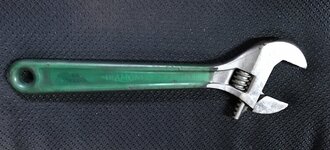
Thanks. Now I need a wrecker, tank, ??? to use it on! Wonder if it was part of a vehicle set or just one of the upper echelon tools. (The opening size itself - 2-9/32 - intrigues me. There must have been a rusty 2-1/4 nut somewhere that it was destined to be used on!)Nice one, Bill!
-Don
It doesn’t appear in the July, 1945 ORD 6 SNL G27 that shows the sets. Might show up in an earlier one. It’s very rare to see an adjustable wrench with a FSN.Thanks. Now I need a wrecker, tank, ??? to use it on! Wonder if it was part of a vehicle set or just one of the upper echelon tools. (The opening size itself - 2-9/32 - intrigues me. There must have been a rusty 2-1/4 nut somewhere that it was destined to be used on!)
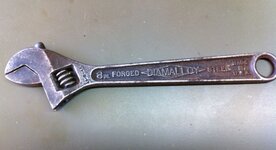

The sets in the ORD 6 SNL G27 are only those issued to specialists' (General Mechanic, Welder, Machinist, etc) and those intended for common use by all mechanics and specialists at 2nd, 3rd, 4th and 5th echelon maintenance depots. Bill's 18-incher could've been issued to an on-board tool-kit, like the 8" adjustable in the jeep kits, before it was removed in 1943. Based on the OAL and capacity, probably one of the larger trucks.It doesn’t appear in the July, 1945 ORD 6 SNL G27 that shows the sets.
That would be my guess. I don't think the Dodge 2.5 Ton emergency wrecker kit (Bonney based) or the Diamond T/PC&F 40-ton M25 "Dragon Wagon" (tank transporter) kit (Blackhawk based) had one, but I will double check. EDIT: Nope. No adjustables. Just big *** wrenches.Wonder if it was part of a vehicle set


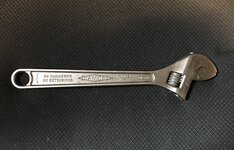
 No hammering and no extensions kind of takes the fun out of it!
I don't know where that feature started (i.e., Europe or here), or when, exactly, but it's not present on prewar, wartime, or immediate postwar vintage US-made adjustables, Don. I see several examples of that design on Crescent and Snap-on wrenches on this thread, but they are all relatively modern. Unfortunately, they are only shown on one side, not the flip side. I do have a BAHCO like that. I am assuming that is the side where the tool wants the adjusting thumb to be placed on the adjusting screw, with the static jaw up, dynamic jaw down.What is odd to me is that the depressed panel runs clear up to the adjuster on one side but not the other.
According to AA around 1983. Here is a picture from their site.Another feature is the arrow showing the proper way to turn the handle. You don't see that on older models, presumably dating from when "everybody knew" how to turn an adjustable wrench. (The splayed jaws on many? most? auto wrenches show that not everybody knew how to use them.)
As an antiquarian interest, when did these arrows start to appear on wrenches? My uninformed hunch is that it's fairly recent — last 5 or 10 years — but I could easily be wrong by decades.

I don't recall ever having seen one where the panel is different on each side like that.What is odd to me is that the depressed panel runs clear up to the adjuster on one side but not the other.

I didn’t remember seeing that either so I checked a couple of Diamond adjustable wrenches with the depressed panels that I had on hand and they were the same from side to side.I don't recall ever having seen one where the panel is different on each side like that.


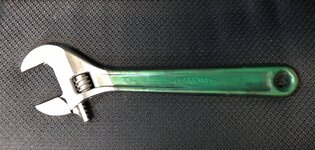
These are undoubtedly 'The Best Adjustable Wrenches', in my opinion!Another feature is the arrow showing the proper way to turn the handle. when did these arrows start to appear on wrenches?


 The wrench is a fairly well known design!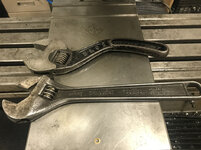
These are undoubtedly 'The Best Adjustable Wrenches', in my opinion!
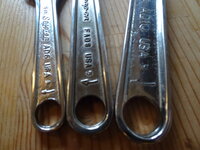
They all have the arrows on the handles.
The 6" is dated 1983, the 10" is 1985 and the 8" is 1995. They were all bought new off the van, and have some hard use in my farm workshop ever since. They haven't been abused, hammered upon or extended but many times they have turned something I just couldn't get with other tools and I have exerted all my strength upon them. The jaws have not spread or deformed, just some nicks and the chrome is worn off on the inside of the jaws. Nobody else is ever allowed to even touch them.
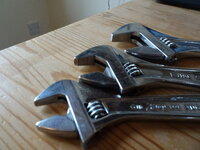
First thing that caught my eye! All my antique adjustables (full set of Westcott "S" minus the 4-incher, H.D. Smith, and a B&C) have a much "finer" mechanism (higher tooth and thumb wheel rib count) than even the oldest vintage adjustable (early J.P. Danielson). Among classic era vintage adjustables, if you compare examples of J.P. Danielson, Crescent and Diamalloy of the same OAL, you will find the BET'R GRIP mechanism to be a tad finer, but all of them, and all modern iterations, cruder in comparison to the antiques.Note the thumb wheel and number of teeth engaged.
I don't know, but I did notice that all three of your wrenches have different throats. The 10-incher is square, the 8-incher is hex, and the 6-incher is basin. I'm not suggesting that's related to the patent. Seems unlikely. Just making an observation.I see my 10" made in 1985 has 'Patent Pending' on it.
I wonder what on earth that particular patent could be for...

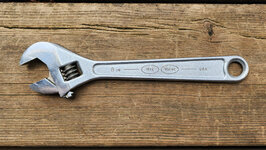

Yup, they're great.Still tight after a century of abuse:

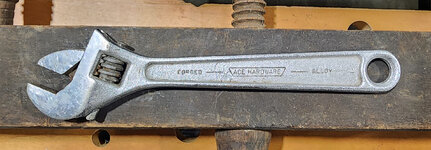


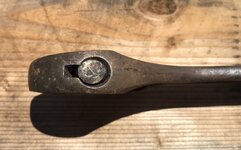


 . I guess some of us have a little catching up to do. I’m only at about 16 total.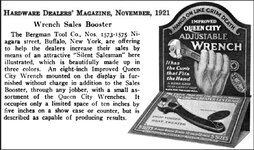

 Both look pretty much brand new.
It cannot be any older than September 22, 1959. That's when Pendleton Tool Industries, Inc. was granted the patent. They claimed "First Use" of the name in their trademark application as December 1957, but yours has the patent number on it.The Proto 12” Clik Stop I have no idea of its age.

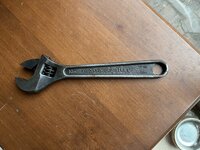
 www.garagejournal.com
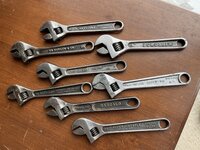

These three were apparently made by Western Forge.I have several different vintage Craftsman adjustable wrenches. Does anyone here know who made them for Craftsman?


Don’t forget Utica. They supplied adjustables to Plomb before Plomb purchased Danielson.I've always been fascinated that Western New York seems to be the epicenter of adjustable wrench production. I went through my collection and found 6" editions by eight manufacturers that were located either in Buffalo or Jamestown. From top to bottom and left to right - Keystone, William Hjorth, Scholler, Crescent, JP Danielson, McKaig-Hatch, Barcalo Buffalo, and JH Williams.
Bill
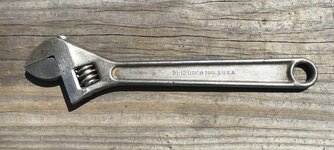
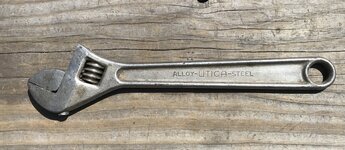


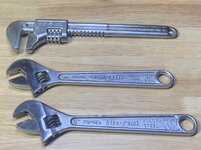

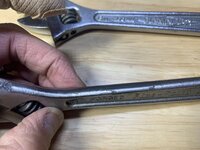
Today, I got three old adjustable wrenches.
Two by Diamond and one Blue Point.
They cleaned up pretty nicely. There was some surface rust that I cleaned off with wire and radial wheels.
The first one is an “automotive wrench”? What is this best used for? Can’t it just be used like a traditional “Crescent” wrench? It has smooth holding faces, not like a pipe wrench.