To avoid these ads, REGISTER NOW!

Filling holes in metal work surface

jives

Well-known member
Joined
Jan 4, 2013
Messages
2,811
Location
Central NY
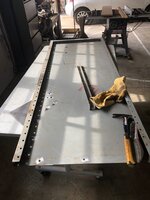
I just picked up a metal table like the one in the picture below. It is 1/8" thick steel. The work surface has a number of holes ranging from 1/4" to about 5/8" (some are from a vise mount). I'd like to fill the holes. I will back up the metal work surface with particle board or MDF to stiffen and add some "bang-ability". Any thoughts on the best way to fill the holes? I am a crappy welder with a 120V flux core welder. I am thinking of creating small metal disks (how?) and tack welding from the underside. I could just fill with JB.
Thoughts?
1351752-1.jpg
 
To avoid these ads, REGISTER NOW!

Zeke

Well-known member
Joined
Aug 13, 2009
Messages
17,176
Location
Long Beach CA, the sewer by the sea.
Use nuts, washers, threaded ends, rods, whatever. If you think you're a bad welder, try welding upside down. Just crank it up, shorten your stick-out and pause a little until you see some flow. It will grind down just fine.

On the 1/4" you can use a penny on the bottom and start at the bottom center of the hole and slightly wiggle your way to a weld.
 

K13

Well-known member
Joined
Oct 24, 2007
Messages
2,233
Location
St. Albert, AB Canada
Make the discs to fit inside the holes and weld them in by tacking a bit at a time. For the smaller holes use a brass/copper backer and just tack with the welder until the hole is filled. Doesn't take a whole bunch of skill when you are dealing with 1/8" material.
 

djjsr

Well-known member
Joined
Sep 4, 2006
Messages
4,796
Location
In the cornfields
You can buy metal discs just for this purpose. Various thickness and diameters. I have some but don't remember where I got them. I know it was online because I could not find them locally.

edit - might have been Speedway Motors.
 
Last edited:

joel_400

Well-known member
Joined
Oct 16, 2022
Messages
405
Location
Nw ohio
A grinder and paint will make you the welder you ain't! Like these guys say use a backer and lay the weld in. Even if you use plugs to fill the holes it doesn't have to be pretty to make it look nice when your done. May just take an extra bit of grinding if necessary.
Joel
 

Chris_Hamilton

Well-known member
Joined
Dec 2, 2012
Messages
1,023
1/8 thick even with a 120v flux core you could fill them if you back them with copper like RaisedByWolves said. Easy enough to do. Would be easier and look better than making any sort of plug.
 

Zeke

Well-known member
Joined
Aug 13, 2009
Messages
17,176
Location
Long Beach CA, the sewer by the sea.
1/8th" steel will not take a lot of heat and still be flat. I'd bevel the plugs and leave them a little loose and do like the OP said, hit them on the bottom and forget it filling the top with JB. Now he could flip this over but that would be too easy. They don't need to be welded like a car panel, just enough to fake it.
 

Chris_Hamilton

Well-known member
Joined
Dec 2, 2012
Messages
1,023
1/8th" steel will not take a lot of heat and still be flat. I'd bevel the plugs and leave them a little loose and do like the OP said, hit them on the bottom and forget it filling the top with JB. Now he could flip this over but that would be too easy. They don't need to be welded like a car panel, just enough to fake it.
IMO 1/8" would take a lot of heat to warp with any significance. If the OP uses copper as a backing pad (which will draw heat out and away from the work) and just works around the hole filling it, it's not going to warp much if any.
 

Chris_Hamilton

Well-known member
Joined
Dec 2, 2012
Messages
1,023
^^^^....OK......
Putting aside your sarcasm :rolleyes: ......He would essentially be doing a plug weld. 1/4"-5/8" plug weld holes in .125 plate are not going to warp much if any. Especially if you back it with copper. Anyone suggesting making 1/4"-5/8" plugs and welding them to the table doesn't sound to me like they have any practical experience doing so because if they did they would not recommend that. If these were large holes then that idea would make sense, but for such small holes? I disagree.
 
Last edited:
To avoid these ads, REGISTER NOW!

mcbane

Well-known member
Joined
Jul 23, 2017
Messages
794
Location
California
FYI, if you want to back up a hole with copper and are going to use a penny, you want a penny minted from 1962 to 1981. Pure zine (82-present pennies) is a lousy backing material and will contaminate the weld. I have never used bronze (pre 1962) to back a weld so no idea how well that will work.
 

Chris_Hamilton

Well-known member
Joined
Dec 2, 2012
Messages
1,023
I mainly work with sheet metal but ideally you want as large a piece as you can fit. With sheet, I've fashioned up backing pads using copper tubing that I flattened. There are also various backing strips available commercially. For something like the OP's table, if you could get some flat copper bar stock that would be ideal. Any copper would work, but it would be nice to have something that would draw some of the heat out of the workpiece.
 

PoorUB

Well-known member
Joined
Mar 29, 2021
Messages
11,701
Location
Fargo, ND
The 1/4" holes, just weld them up and grind smooth. The 5/8" hole I would find something to fill the hole.
As for warping, 1/8" will warp badly so don't pour on the heat in one place. Get it prepped, and move from hole to hole, a second burn and each spot.
 
Last edited:

Zeke

Well-known member
Joined
Aug 13, 2009
Messages
17,176
Location
Long Beach CA, the sewer by the sea.
The 1/4" holes, just weld them up and grind smooth. The 5/8" hole I would find something to fill the hole.
As for warping, 1/8" will warp badly so don't pour on the heat in one place. Get it prepped, and move from hole to hole, a second burn and each spot.
Some people here don't agree about the heat distortion. But moving around definitely will help.
 
OP
J

jives

Well-known member
Joined
Jan 4, 2013
Messages
2,811
Location
Central NY
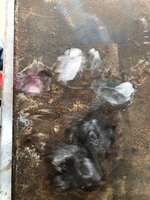
OP here. Thanks all for the advice. Below are the results of the project. I did use mini-plugs to fill the 1/2" holes, cut from a steel rod I had laying around. I had to drill out one hole that was just shy of 1/2". No holes were larger. All the smaller holes, ranging about 1/8 - 3/16 were filled using the penny trick. Some holes came out well, some have pits. On the worst hole the disk did not fit well, leaving a gap. I decided not to fix it with welding to avoid warping. I think I did warp the table in one spot and did overgrind in another.

Underside of table. Flap disked the holes.

Hole Fill 6.jpg

Underside of table.

Hole Fill 5.jpg

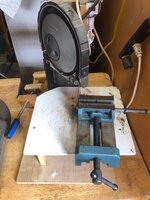
Used the portable bandsaw with homemade stand to cut the 1/2" rod. I chamfered the end of the rod first to provide a welding groove on the underside of the table. The DP vise made a nice guide to cut straight.
Hole Fill 3.jpg

Top side of table after welding and grinding. I went back and filled one of the holes with more weld and warped the table a bit.

Hole Fill 2.jpg

Decided to not try and fill this with weld. Epoxy will work fine.
Hole Fill 1.jpg
 

Attachments

  • Hole Fill 4.jpg
    Hole Fill 4.jpg
    470.3 KB · Views: 5

Zeke

Well-known member
Joined
Aug 13, 2009
Messages
17,176
Location
Long Beach CA, the sewer by the sea.
In case you are wondering, you can remove metal expansion with more heat followed by a cold air blast or a cold wet rag. It's a bit experimental at first, but you can get good at it. So good in fact that there are companies that do this to the .001". It's not a bad practice to cool down welds unless metallurgical changes are a concern. On a bench top that would not be a concern,
 

Chris_Hamilton

Well-known member
Joined
Dec 2, 2012
Messages
1,023
In case you are wondering, you can remove metal expansion with more heat followed by a cold air blast or a cold wet rag. It's a bit experimental at first, but you can get good at it. So good in fact that there are companies that do this to the .001". It's not a bad practice to cool down welds unless metallurgical changes are a concern. On a bench top that would not be a concern,
What thickness of material is this technique used? Sounds like you are describing flame straightening. That is not a technique for the uninitiated.
 
Last edited:

Zeke

Well-known member
Joined
Aug 13, 2009
Messages
17,176
Location
Long Beach CA, the sewer by the sea.
Flame straightening is correct. But I have also done it with a shrinking wheel, large fiber wheel and running a bead with a welder and then grinding it off.

Sure, working to tolerance takes talent, but this is a crusty old WB. Great place to start learning.
 

metalmagpie

Well-known member
Joined
Nov 1, 2011
Messages
799
Location
Seattle
I would have gotten a nice 3/4" plate and dropped it on that sheet metal table. It's good you learned to patch those holes but I bet those patches aren't anywhere near flat.

I have done flame straightening. I can make it work pretty well sometimes. But on thin stuff like 1/8" or thinner, you have no chance. You'd turn that table top into a potato chip in no time and then what are you going to do? Well, of course the answer is you'd have to cut your table up and reweld it flat again. But don't even try flame straightening on 1/8" steel. Trust me.

And by the way if you do, you don't need to hit the hot spot with cold water or a wet rag. It just speeds things up. But the heat straightening will work the same with or without water postcooling.

metalmagpie
 
To avoid these ads, REGISTER NOW!
Top Bottom