To avoid these ads, REGISTER NOW!

Show Your Vintage Knife

To avoid these ads, REGISTER NOW!

Private Lugnutz

Well-known member
Joined
Mar 30, 2012
Messages
30,747
Location
The Authentic Jersey Shore
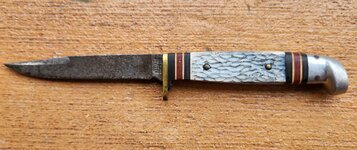
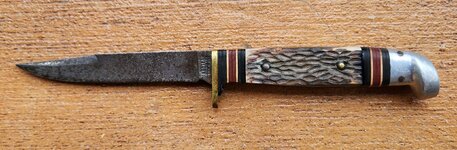
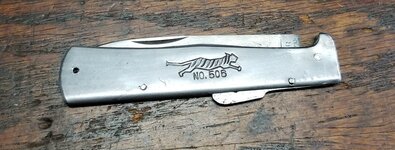
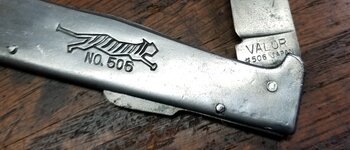
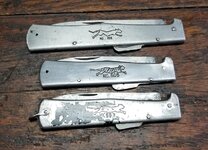
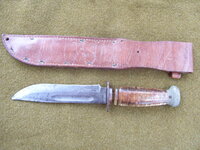
I found another knock-off of the famous Black Cat knife this morning.

20230625_115218.jpg

20230625_115026.jpg

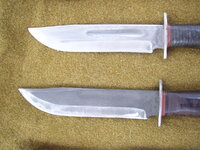
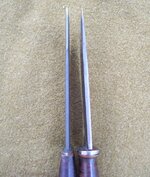
These Japanese "Valor" examples are vintage and very nice knives, but not the real thing, nor are they related to the original Otter Mercator.

20230625_115205.jpg

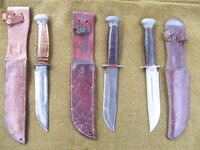
Family photo...

20230625_115503.jpg

G.C.Co. (Gutmann Cutlery) No. 129, US, German import, at the top, missing the bail. Knock-off.
The Valor No. 506 in the middle, missing the bail. Knock-off.
And the authentic original at the bottom, complete, with bail.

If you've never heard of Black Cat, full story upthread here!
 
OP
G

gpw_42

Well-known member
Joined
Apr 24, 2017
Messages
719
Location
NC Sandhills, USA
Mike, this being GJ, don’t let the absence of a tool hamper you - sounds like time to buy a sander! 😉😜

Those Q knives are beasts, and however you go in the restoration, it should be a great user when you’re finished. I’m a traditionalist, so I would encourage you to go back with a leather washer handle, which can (I think!) be more easily tightened down with the **** cap, than a bone or antler grip. It’s also your knife, so do what suits you. Truth in lending though, I’ve never done the work you’re describing, so wish you well, however you chose to proceed. Please post some pics when you’re done, and good luck with your project!
 

jives

Well-known member
Joined
Jan 4, 2013
Messages
2,812
Location
Central NY
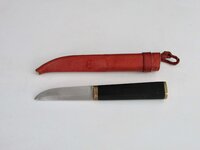
Although this particular pic is not my knife, I have one exactly like it with sheath. It is a Tapio Wirkkala Puukko knife, made in Finland. They are works of art, examples are even in art museums. I inherited mine from my father. I orginally thought he got it from fishermen from the Faroe Islands when my dad when on an Arctic expedition back in 1948, but on further checking I think the knives were first produced in 1961. He may have later got it from one of his Arctic trip buddies.
CEDD908_D560_4B63_8735_343185D69211_1_201_a_master.jpg
 
Last edited:

AreBeeBee

Well-known member
Joined
Sep 17, 2020
Messages
415
Location
Wisconsin
....Those Q knives are beasts, and however you go in the restoration, it should be a great user when you’re finished. I’m a traditionalist, so I would encourage you to go back with a leather washer handle, which can (I think!) be more easily tightened down with the **** cap, than a bone or antler grip. It’s also your knife, so do what suits you. Truth in lending though, I’ve never done the work you’re describing, so wish you well, however you chose to proceed. Please post some pics when you’re done, and good luck with your project!

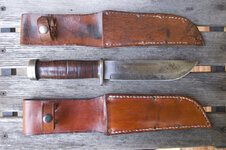
I have an intact Cattaraugus Q knife, bought from ebay. The original sheath had thinner leather than the blade would lead you to expect and it was showing its age more than the knife or its stacked leather handle. I treated both with Limmer Boot Grease, which helped. But deciding that the sheath had earned an honorable retirement, I bought from Bill Goodwin (Blade Forum) a replica sheath out of stouter leather, sending him the orginal sheath to use as the pattern.

The image below shows the original sheath on top, the knife, and the replica sheath.

(The following Thanksgiving we had friends over for the big dinner, and I carved the turkey with the knife, which I had put a good edge onto.)
 

Attachments

  • tumblr_nu0ml9FkAi1r4zf5xo4_1280.jpg
    tumblr_nu0ml9FkAi1r4zf5xo4_1280.jpg
    424.3 KB · Views: 34
Last edited:

AreBeeBee

Well-known member
Joined
Sep 17, 2020
Messages
415
Location
Wisconsin
Although this particular pic is not my knife, I have one exactly like it with sheath. It is a Tapio Wirkkala Puukko knife, made in Finland. They are works of art, examples are even in art museums. I inherited mine from my father. I orginally thought he got it from fishermen from the Faroe Islands when my dad when on an Arctic expedition back in 1948, but on further checking I think the knives were first produced in 1961. He may have later got it from one of his Arctic trip buddies.
CEDD908_D560_4B63_8735_343185D69211_1_201_a_master.jpg

The knife maker Cold Steel made an inexpensive version of this called the Finn Bear, with a stainless blade and plastic handle. The company also made (in Japan) a closer replica called the Sisu, but as far as I know neither is currently in production.

The Tapio Wirkkala puukko is available on ebay, but at prices too steep for me!
 
Last edited:

Mike'smeatshop

Well-known member
Joined
Apr 1, 2023
Messages
1,273
Mike, this being GJ, don’t let the absence of a tool hamper you - sounds like time to buy a sander! 😉😜

Those Q knives are beasts, and however you go in the restoration, it should be a great user when you’re finished. I’m a traditionalist, so I would encourage you to go back with a leather washer handle, which can (I think!) be more easily tightened down with the **** cap, than a bone or antler grip. It’s also your knife, so do what suits you. Truth in lending though, I’ve never done the work you’re describing, so wish you well, however you chose to proceed. Please post some pics when you’re done, and good luck with your project!
Thanks gpw. I am also a traditionalist. I have a few tools with the sanding wheels which may work. I just needed some Insite of someone else. I really have a large respect for military vintage tools.
 

Mike'smeatshop

Well-known member
Joined
Apr 1, 2023
Messages
1,273
I have an intact Cattaraugus Q knife, bought from ebay. The original sheath had thinner leather than the blade would lead you to expect and it was showing its age more than the knife or its stacked leather handle. I treated both with Limmer Boot Grease, which helped. But deciding that the sheath had earned an honorable retirement, I bought from Bill Goodwin (Blade Forum) a replica sheath out of stouter leather, sending him the orginal sheath to use as the pattern.

The image below shows the original sheath on top, the knife, and the replica sheath.

(The following Thanksgiving we had friends over for the big dinner, and I carved the turkey with the knife, which I had put a good edge onto.)
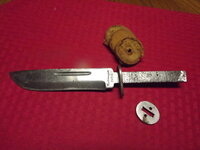
Thanks Bee. Mine only has the one **** plate. I am almost sure that is the way it was designed. Unless someone knows better, any help would be appreciated.
 
OP
G

gpw_42

Well-known member
Joined
Apr 24, 2017
Messages
719
Location
NC Sandhills, USA
AreBeeBee, thanks for the BFO on the sheath for your Q knife (Cattaraugus 225Q). I may work with a sheath shop to see if I can have one made up for (one of?) my Q knife (knives?). Suddenly can't remember how many I have, but have a hope that it's 2. I found one at a flea a few years ago for $35, and didn't let it get past me, so THINK that I may have 2. Anyway, a nice modern sheath would be a good home for one of those knives.

I also have an M3 knife which I found at a different flea, with almost no leather left on it. Removed that and found some replacement leather washers, which are all oversize. Need to punch out 7 of the smaller size, and then put the whole batch on that knife, so that I can buy a sander :lol_hitti and then return it to being a user. They're handy, but that blade isn't near the strength of a Q knife, since it's long and slender. I used a repro to field dress a deer in Virginia once, and it was too much knife inside the body cavity of that deer.
@Mike'smeatshop you're missing a plate off the **** end of your knife. Not sure which plate you're missing, but the rear should be deeply cross-hatched; they were clearly designed to be used as hammers, as well as cutting (and, perish the thought) maybe even as pry bars.

@Lugz that's an interesting little Black Cat collection. Nice find on the newest copy!
 
  • Like
Reactions: 555

Mike'smeatshop

Well-known member
Joined
Apr 1, 2023
Messages
1,273
I think you are right about missing the but plate. I think it had some alterations like my 1961 Wllys Air Force Jeep. They would patch them up with what ever they had laying arround. My sheath is a tad to small, if anyone has one to trade?
 

Attachments

  • DSCF6043.JPG
    DSCF6043.JPG
    602.9 KB · Views: 23

Mike'smeatshop

Well-known member
Joined
Apr 1, 2023
Messages
1,273
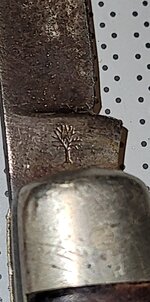
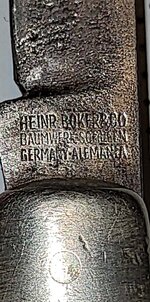
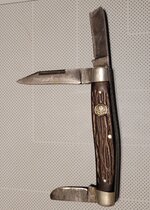
So this is really the only knife that I have that's noteworthy it's a 1930s Böker Stockman made int Solingen Germany, I found it well metal detecting around a rock wall in a cigar box.

20230626_141424.jpg20230626_141437.jpg2457c3a4-1550-48ac-9c54-f0d7f240a6b0.jpgb31904eb-d149-45e8-bce9-7eb2b1cd3ddb.jpg
Those are great knives. Around Ky they are sought after. How long do think it was out in the elements? Was it lodged in the wall? Or under ground? I would like to hear that story.
 

AreBeeBee

Well-known member
Joined
Sep 17, 2020
Messages
415
Location
Wisconsin
I think you are right about missing the but plate. I think it had some alterations like my 1961 Wllys Air Force Jeep. They would patch them up with what ever they had laying arround. My sheath is a tad to small, if anyone has one to trade?

Mike, I have not taken mine apart, but I can see by looking at the **** end that there's three steel layers in all; two below the cross-hatched/waffle finished one.

This Blade Forums post has the patent drawing showing the cutaway details on the ****:
https://www.bladeforums.com/threads...knife-or-others-like-it.1516774/post-17414375

Scroll down for a description of the knife and its history. Post #10 in the same thread has a photo of the **** plate end-on. And on restoration —

https://www.bladeforums.com/threads/trying-to-identify-and-restore.1827809/#post-20940004

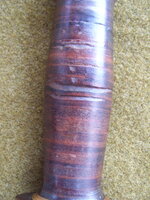
By the way, the roughening/gouging you see in the middle of the leather disk stack on some examples was apparently a factory-done feature to make the handle easier to hold firmly when wet or oily or.....
 

FordMustangKingCobra

Well-known member
Joined
Aug 5, 2022
Messages
89
Those are great knives. Around Ky they are sought after. How long do think it was out in the elements? Was it lodged in the wall? Or under ground? I would like to hear that story.
Well the cigar box I found was made in the 50s and there was a note in the box that was addressed to someone named Bill steiger in 61 but the note was crumbling in my hands so it was probably placed there somewhere in the 61 if I had to say, also the knife i have when I contacted Böker about it the records that they had were actually burned in a fire that burns down the original workshop I believe so they couldn't really tell me anything other than when it was possibly made, but I do still have the information that the lady gave me, also I should mention I found the knife in 2021, so the knife was possibly out in the elements for about 60 years buried in a rock wall

This in quotations is the email I got.

"It can be quite hard to find an exact year as Boker often produced the same models for decades with subtle changes that can easily go unnoticed. The only real way to date a Boker knife is using the tang stamp and emblem which you sent us pictures of earlier. Looking at our history, the best we have at this point is when they started using the tang stamps and emblems (1932 for yours) and when they started/ stopped using the emblems (your emblem was used in the 1930’s-1960’s."
 
Last edited:

Old Radar

Well-known member
Joined
Apr 17, 2019
Messages
2,755
Location
San Antonio, TX
Are you going to attempt to save as many washers as possible or planning an entire fresh stack? Just from the pictures, I'd have to lean toward a fresh stack.
 
To avoid these ads, REGISTER NOW!

Private Lugnutz

Well-known member
Joined
Mar 30, 2012
Messages
30,747
Location
The Authentic Jersey Shore
Are you going to attempt to save as many washers as possible or planning an entire fresh stack? Just from the pictures, I'd have to lean toward a fresh stack.
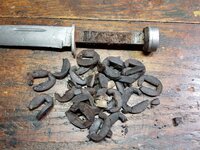
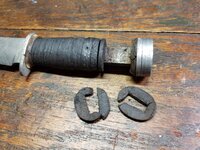
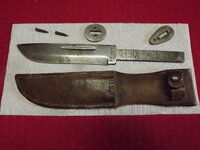
I was thinking about it. As you know, my preference is always preservation first, but these were falling apart with the mildest of handling, and they were permanently stained with what I suspect is the Gutta-percha inside the Chatterton's compound in vintage black cloth "friction" tape that a PO had wrapped around it. I had removed as much as I could, but it had become congealed with the old leather. The first and last rings, against the guard and the pommel, made of some kind of composite, micarta or the like, were also cracked and deteriorated.

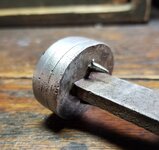
The pommel, made of three stacked steel rings that have a sort of clockwork or locking relationship with the tang, is in very good condition. These knives got used hard and the pommels are often found with dents and divots. I was happy to see the classic waffled face of the **** end and the famous "division sign" were untouched.
 

Attachments

  • 20230703_173903.jpg
    20230703_173903.jpg
    606.4 KB · Views: 34
  • 20230703_174021.jpg
    20230703_174021.jpg
    971.2 KB · Views: 24
  • 20230703_173147.jpg
    20230703_173147.jpg
    1.1 MB · Views: 22
  • 20230703_162626.jpg
    20230703_162626.jpg
    921.8 KB · Views: 25
Last edited:

Private Lugnutz

Well-known member
Joined
Mar 30, 2012
Messages
30,747
Location
The Authentic Jersey Shore
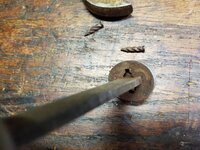
Punched the nails out very easily. And the third pommel ring separated very easily. But the first one and the middle one are fused. I tried driving an old knife blade in between them. I tried to punch it out with a pin through that notch in the second one. Won't budge. The second one is the one that turns 90* to slip off. It's in the lock position right now with the notch in the tang so I can't tap on that too hard. I am going to try soaking it in Evaporust.
 

Attachments

  • 20230703_202855.jpg
    20230703_202855.jpg
    843.2 KB · Views: 26
  • 20230703_202840.jpg
    20230703_202840.jpg
    672.2 KB · Views: 16
  • 20230703_202801.jpg
    20230703_202801.jpg
    739.4 KB · Views: 16
  • 20230703_202757.jpg
    20230703_202757.jpg
    1.1 MB · Views: 31

Private Lugnutz

Well-known member
Joined
Mar 30, 2012
Messages
30,747
Location
The Authentic Jersey Shore
By the way I might as well reveal that I am thinking very strongly about recreating a so-called "theater" knife out of this. It would make a great impression at a Living History show. When the handles deteriorated, especially in the PTO, soldiers and sailors replaced the stacked leather washers with whatever material was handy. Aluminum scrap, micarta insulators, plexiglas, even wood. There is a famous example floating around with actual red and black checkers. They would cut them out coarsely to size, mill the slot, and then sand the whole thing down to form. But they got creative with it. Broad bands or stripes of different colors. Here are some photos. None of these are factory handles.
 

Attachments

  • post-56-0-48238000-1493733915.jpg
    post-56-0-48238000-1493733915.jpg
    206.1 KB · Views: 38
  • post-157481-0-26343600-1493439089.jpg
    post-157481-0-26343600-1493439089.jpg
    24 KB · Views: 40
  • post-157481-0-51702300-1493439352.jpg
    post-157481-0-51702300-1493439352.jpg
    72.5 KB · Views: 58

AreBeeBee

Well-known member
Joined
Sep 17, 2020
Messages
415
Location
Wisconsin
Apologies if this photo has already appeared at GJ, but here's General Omar Bradley awarding the Distinguished Service Cross to Maj. General Norman Cota for his actions on D-Day and after.

Note the Catt 225Q on his right hip.
 

Attachments

  • Cota and Cattaraugus 225Q.jpg
    Cota and Cattaraugus 225Q.jpg
    79.1 KB · Views: 48

Private Lugnutz

Well-known member
Joined
Mar 30, 2012
Messages
30,747
Location
The Authentic Jersey Shore
With the post-factory notches carved by soldiers to give the notoriously smooth handle a little more grip! Cool photo!

I moved my project to its own thread...

 
  • Like
Reactions: 555

AreBeeBee

Well-known member
Joined
Sep 17, 2020
Messages
415
Location
Wisconsin
With the post-factory notches carved by soldiers to give the notoriously smooth handle a little more grip! Cool photo!

I moved my project to its own thread...

Lugz, great idea to move this project to its own thread — thank you!

As to the roughening in the leather handle seen with varying amounts of wear on many Catt 225Qs, it was done at the factory.

Below is a section from the history of the knife ("The 'Q' Knives of WW II") by Frank Trzaska, as posted on Blade Forums. The link goes to the first of the two posts giving the history; the matter of how the stacked leather handles were finished is in the second of the two posts, and I have excerpted it here and added emphasis.

Trzaska's history compares the Cattaraugus Q knife with the Case 337Q knife that was also contracted for by the Quartermaster Corps. He gives the contract numbers, which show that all of the Catt knives went to the Army, while the Case knives were split with some going to the Navy as well as the Army.

"...As for the knives themselves they are about the most robust knives ever made for the military. The myth about opening crates could actually have some truth to it; these knives are capable of doing it. And the thick pommels are more then capable of driving nails although a tent peg is much more likely to be struck by the ****. The Cattaraugus consists of a 1095 steel blade that is 6 inches in length with the knife having an overall length of 10 3/8 inches. The Case knife shares the same blade length but comes in at 10 inches overall. To my hand the longer Case handle is more comfortable but the Catt is adequate to do the job. Both knives have a stacked leather washer handle but the finish is very much different. The typical Catt knife has a smooth leather handle roughed up in the center section with gouges to the leather for a sure grip. The cutting tool intentionally applied the gouges; it is not a mistake. The Case knife is finished on a broaching wheel with 18 circular grooves which produces a much more professional and eye pleasing result. Both knives allow a good grip surface it’s just that the Case knife looks better..."

[emphasis mine]
 
Last edited:
  • Like
Reactions: 555

Private Lugnutz

Well-known member
Joined
Mar 30, 2012
Messages
30,747
Location
The Authentic Jersey Shore
If you turn a fairly original Catt 225Q 90*, there are swales roughed into the tang edges. I always thought that's what Trzaska and others were referring to. Not the gouges, which appear to be more haphazard. But I have no reason to argue. I can believe it.
 

AreBeeBee

Well-known member
Joined
Sep 17, 2020
Messages
415
Location
Wisconsin
If you turn a fairly original Catt 225Q 90*, there are swales roughed into the tang edges. I always thought that's what Trzaska and others were referring to. Not the gouges, which appear to be more haphazard. But I have no reason to argue. I can believe it.
My hunch, based on the varying shape of the roughening on less-worn examples, is that the gouges were put in by freehand. After the overall shaping of the leather disks was done, somebody on the line held the handle up to a spinning abrasive disk and rotated the knife freehand (perhaps while wearing protective gloves like what meat packers wear). And thinking further about safety, the blade sharpening must have come after the handle shaping and abrasion treatment.

Rough-edged tangs may have been left that way, so long as the roughness didn't stop the leather disks being loaded straightforwardly onto the tang?

But this is all post-facto guesswork.
 
Last edited:

Private Lugnutz

Well-known member
Joined
Mar 30, 2012
Messages
30,747
Location
The Authentic Jersey Shore
...the gouges were put in by freehand...
Clearly. The swales I'm talking about were clearly done by the factory on a sanding machine after the handle was stacked, before the gouges. The only discussion or debate has been in the context of whether it was by the factory or in the field. It's not unanimous. I don't have a strong opinion one way or the other. But if you keep reading, you'll discover it's not unanimous.
 

AreBeeBee

Well-known member
Joined
Sep 17, 2020
Messages
415
Location
Wisconsin
Clearly. The swales I'm talking about were clearly done by the factory on a sanding machine after the handle was stacked, before the gouges. The only discussion or debate has been in the context of whether it was by the factory or in the field. It's not unanimous. I don't have a strong opinion one way or the other. But if you keep reading, you'll discover it's not unanimous.
I would expect personalizing to be done by individuals to get a better & more comfortable grip if their hands were smaller than average (say). If a knife got even average field use, it would be hard to prove who-dun-it without assembling a largeish collection of obviously lightly used 225Qs.

That's a project for someone other than me —
 
OP
G

gpw_42

Well-known member
Joined
Apr 24, 2017
Messages
719
Location
NC Sandhills, USA
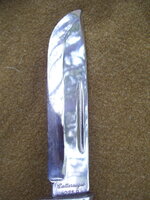
I took some time on the 4th of July to "deep dive" into some foot lockers, to pull out some assorted treasures. First, my Q knife, as it's relevant to the discussion above. Note, I only found one, so either didn't complete an exhaustive search, or my memory failed me. This one is much more shiny what I remembered, so ???

I didn't take any pics of the **** of the knife (drat!), but here are some closeups of the handle, which show how this knife was relieved of some of the leather, right in the middle. Hopefully this helps to inform the discussion above, at least a little.000_1490.JPG
 

Attachments

  • 000_1495.JPG
    000_1495.JPG
    325.1 KB · Views: 33
  • 000_1494.JPG
    000_1494.JPG
    258.5 KB · Views: 18
  • 000_1493.JPG
    000_1493.JPG
    328.8 KB · Views: 16
  • 000_1492.JPG
    000_1492.JPG
    262.4 KB · Views: 19
  • Like
Reactions: 555
OP
G

gpw_42

Well-known member
Joined
Apr 24, 2017
Messages
719
Location
NC Sandhills, USA
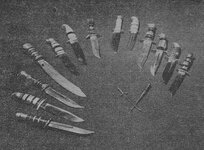
Next is the PAL-36 knife design. The theater knife here was my grandfather's, who served in the "black gang" (engine room) of the aircraft carrier USS LANGLEY, CVL-27, in the Pacific. He signed-in to the ship on 9 DEC 44; this was significant because the ship was part of Halsey's Third Fleet, which sailed through Typhoon Cobra. I've seen Cobra described as "the greatest natural disaster to ever hit the US Navy," as three destroyer escorts sank, with all hands (about 800 officers and men) lost. His knife reflects the crazy environment where he served long hours - a boiler room. I've read that temperatures in there routinely were as high as 140*F - as the leather has been replaced with plexiglass; unfortunately about 4 of the plexi "washers" broke before I received the knife. I replaced the rooty-poot, ill fitting scabbard which came with the knife with a 1943 BOYT USN scabbard.000_1473.JPG
 

Attachments

  • 000_1478.JPG
    000_1478.JPG
    295.5 KB · Views: 11
  • 000_1477.JPG
    000_1477.JPG
    323.9 KB · Views: 8
  • 000_1476.JPG
    000_1476.JPG
    313.6 KB · Views: 8
  • 000_1475.JPG
    000_1475.JPG
    312.5 KB · Views: 17
OP
G

gpw_42

Well-known member
Joined
Apr 24, 2017
Messages
719
Location
NC Sandhills, USA
More PAL-36s (including my grandfather's), but these other two don't have a story. I'd like to know why the one has so little finish on it.

Finally, a pic to compare the Cattaraugus 225Q with the PAL-36, for those of you who don't have them in hand to appreciate the "beefiness" of the Q knife.
 

Attachments

  • 000_1479.JPG
    000_1479.JPG
    316 KB · Views: 22
  • 000_1480.JPG
    000_1480.JPG
    345.9 KB · Views: 22
  • 000_1484.JPG
    000_1484.JPG
    310.6 KB · Views: 18
  • Pal 36 vs Q knife.JPG
    Pal 36 vs Q knife.JPG
    432.9 KB · Views: 18
OP
G

gpw_42

Well-known member
Joined
Apr 24, 2017
Messages
719
Location
NC Sandhills, USA
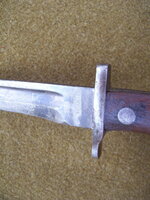
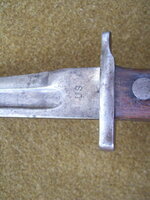
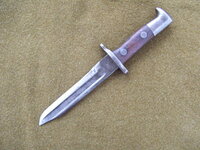
And last, here's a relatively unusual military knife, converted from a bayonet. In this case, a 1908 dated bayonet which I believe to be for a .30-40 Krag-Jorgensen. Though 1908 seems awfully late to be produced for a Krag, it was clearly not an M1905 bayonet; thus my Krag conclusion. The date was partially ground off (I assume when it was shortened, but we know about assumptions).
 

Attachments

  • 000_1499.JPG
    000_1499.JPG
    242.5 KB · Views: 16
  • 000_1498.JPG
    000_1498.JPG
    223.8 KB · Views: 17
  • 000_1497.JPG
    000_1497.JPG
    299.2 KB · Views: 17
  • 000_1496.JPG
    000_1496.JPG
    304.7 KB · Views: 20

Private Lugnutz

Well-known member
Joined
Mar 30, 2012
Messages
30,747
Location
The Authentic Jersey Shore
it would be hard to prove who-dun-it without assembling a largeish collection of obviously lightly used 225Qs.
Unless there were a few examples fresh out of the box, without any gouging, which I believe is the other side's argument. The other part of their argument is why the factory wouldn't just have a big pile of slightly narrower washers to interleave in the stack.
Note, I only found one, so either didn't complete an exhaustive search, or my memory failed me.
Well, if you're only going to have one, having the ne plus ultra one is the one to have! Wow! That thing is perfect.
Finally, a pic to compare the Cattaraugus 225Q with the PAL-36, for those of you who don't have them in hand to appreciate the "beefiness" of the Q knife.
I put a PAL RH-36, an EGW, and the Q I just found in a photo in post #282 for that purpose but I am glad you included a shot of the spines. That shot says it all. The EGW has always been considered the biggest WWII fighting knife, because the blade is just as wide as the Q and two inches longer, but the Q is a few centimeters thicker. That translates to weight, too, of course. It is hefty! The Ka-Bar is a welterweight compared to these bruisers.
 
OP
G

gpw_42

Well-known member
Joined
Apr 24, 2017
Messages
719
Location
NC Sandhills, USA
Well, if you're only going to have one, having the ne plus ultra one is the one to have! Wow! That thing is perfect.
Thanks! I wonder if that knife is "as issued" or if it has been polished somewhere along the way? I don't know.

I put a PAL RH-36, an EGW, and the Q I just found in a photo in post #282 for that purpose but I am glad you included a shot of the spines. That shot says it all.
Indeed! Just needed the "money shot" to demonstrate the descriptions we've used for the Q knife. And, IMO, demonstrate why they have a rep (whether factual or not!) of being used as pry bars.

The EGW has always been considered the biggest WWII fighting knife, because the blade is just as wide as the Q and two inches longer, but the Q is a few centimeters thicker. That translates to weight, too, of course. It is hefty! The Ka-Bar is a welterweight compared to these bruisers.
I'd like to put an EGW side by side with a Springfield Randall (WW2 vintage), to do this type of comparison photos. Or maybe a Zacharias fighter Randall (even earlier production during WW2). Alas, I don't have any of these. The WW2 vintage Randalls are crazy expensive, and I think there are fewer than 4 known Zacharias fighters, so they don't even hit the open market.

That's a handsome knife.
I appreciate it! Wish that I'd gotten info from him about it, but I was little when he died. He was in the Navy from 44-46, and I bet was involved in mothballing the ship in '46 after making several Magic Carpet trips across the Pacific and then to the ETO. Magic Carpet was the name for the intentional movement of the millions of GIs who were all over the world, and needed to be brought back to the USA for discharge, once the war was over, and occupation was winding down. This exchange has me wondering if many of these theater knives were made up during the post-war period. Guys on a ship (like him) had time on their hands, with access to materials and shops to do work barter for work to be done....probably more of all three than during the war itself. Not to say that all were made post-war, but...
 

CFC2

Well-known member
Joined
Jan 29, 2023
Messages
82
Not sure if this new acquisition qualifies as vintage. Camillus New York USA electricians knife with jigged bone handles. I think 1970's to 1980's. Not sure. Also not completely sure if the bone handles are original. It was advertised as custom jigged bone handles on eBay.

IMG_0536.jpg

IMG_0540.jpg

IMG_0539.jpg
 
To avoid these ads, REGISTER NOW!
Top Bottom