To avoid these ads, REGISTER NOW!

WWII "Theater Knife" Recreation Project

Private Lugnutz

Well-known member
Joined
Mar 30, 2012
Messages
30,656
Location
The Authentic Jersey Shore
This idea started on @gpw_42 's 'Show Your Vintage Knife' thread. Now that it's turning into a full-fledged project, I am moving it here so as not to keep bogarting or side-tracking the flow of the general interest thread.

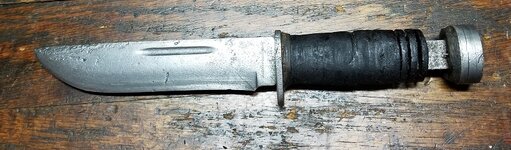
My plan is to recreate a so-called "theater knife" out of this WWII-era Cattaraugus 225Q that I found at a flea market a few days ago.

2023_25.jpg

This is my first Catt Q.

20230702_214523.jpg

It is an extremely beefy fighting/general utility knife, shorter and much wider than the famous Ka-Bar, which appears frail in comparison, with a stouter look that more resembles my favorite WWII knife, the beastly, cultishly classic E.G. Waterman...

EGW 1.jpg

EGW 4.jpg

...and I won't say much more about it than that.

They are not unicorn rare, but they are not grow-on-trees common, either, and still command a healthy buck fifty or more from an avid following when they're in VG to mint-y condition. This one was clearly a disaster, with pitting on the blade, pitting on the guard, and a desiccating handle, and I got it for peanuts.
 
To avoid these ads, REGISTER NOW!
OP
P

Private Lugnutz

Well-known member
Joined
Mar 30, 2012
Messages
30,656
Location
The Authentic Jersey Shore
What is a "theater knife"?

When the handles on knives deteriorated, especially in the PTO, soldiers and sailors replaced the stacked leather washers themselves or with the assistance of their pals in the various maintenance shops, with whatever material was handy. Aluminum scrap, micarta insulators, plexiglas, even wood. There is a famous example using red and black checkers. They would cut out the scavenged material coarsely to size, mill the slot, and then sand the whole thing down to form. But they got stylish and creative with it. They would stack them in patterns of broad bands or alternating stripes of different colors.

Here are some photos for reference. None of these are factory handles.
 

Attachments

  • post-56-0-48238000-1493733915.jpg
    post-56-0-48238000-1493733915.jpg
    206.1 KB · Views: 133
  • post-157481-0-26343600-1493439089.jpg
    post-157481-0-26343600-1493439089.jpg
    24 KB · Views: 130
  • post-157481-0-51702300-1493439352.jpg
    post-157481-0-51702300-1493439352.jpg
    72.5 KB · Views: 120
OP
P

Private Lugnutz

Well-known member
Joined
Mar 30, 2012
Messages
30,656
Location
The Authentic Jersey Shore
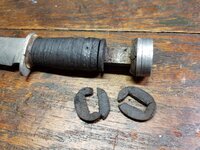
My preference is always preservation first, but this handle was falling apart with the mildest of handling, and the leather spacers were permanently stained with what I suspect is the Gutta-percha inside the Chatterton's compound in vintage black cloth "friction" tape that a PO had wrapped around it. I had removed as much as I could, but it had become congealed with the old leather. The first and last rings, more like spacers, against the guard and the pommel, made of some kind of composite, micarta or the like, were also cracked and deteriorated.

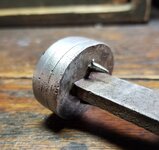
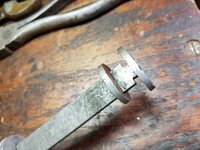
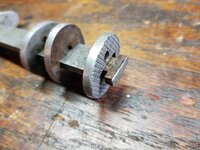
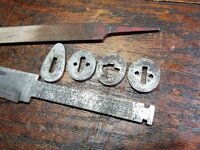
The pommel is made of three stacked steel spacers. Those two twist nails hold the spacers together and secure the entire pommel to the first leather washer in the stack. The middle spacer has an angle cam inside that turns 90* to lock or unlock it with a notch in the through tang. These knives got used hard and the pommels are often found with dents and divots. I was happy to see the classic waffled face of the **** end and the famous "division sign" were untouched.

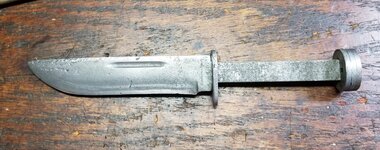
Staring at that empty tang and thinking about "theater knives" inspired the idea to recreate one instead of re-stack it with leather washers.
 

Attachments

  • Resto 1.jpg
    Resto 1.jpg
    921.8 KB · Views: 116
  • Resto 2.jpg
    Resto 2.jpg
    1.1 MB · Views: 74
  • Resto 3A.jpg
    Resto 3A.jpg
    657.3 KB · Views: 67
  • Resto 3B.jpg
    Resto 3B.jpg
    971.2 KB · Views: 63
  • Resto 4.jpg
    Resto 4.jpg
    606.4 KB · Views: 71
Last edited:
OP
P

Private Lugnutz

Well-known member
Joined
Mar 30, 2012
Messages
30,656
Location
The Authentic Jersey Shore
Easier said than done!

There are dozens of YouTube videos of someone re-handling a Catt Q. None of them had the problem I ran into. In each one, after the nails were tapped or pulled or simply fell out (yes, that's how loose some of the survivors are), that 1st spacer came right off, followed immediately by the 2nd, which turns to remove, as I alluded to before, followed immediately by the third, lickety-split.

My specimen was a lot more stubborn!

That first and second locking spacer would not budge. It's as if they were fused together, as I suspected, by a film of interior rust. And, as you can see, there was not any separation between the opening in the 1st spacer and the tang on the **** end. Keep in mind, I could not tap on the 2nd spacer to tap both it and the 1st spacer off the end of the tang, because the 2nd spacer was turned into lock position on that notch.

I soaked it in Evaporust. I tried getting a little separation by tapping an old knife blade in between. I poked a punch through that cam angle opening in the 2nd spacer to try to punch the 1st spacer out. No movement. I tried turning the second spacer. No movement.

This is where I left it last night.
 

Attachments

  • Resto 5A.jpg
    Resto 5A.jpg
    1.1 MB · Views: 81
  • Resto 5B.jpg
    Resto 5B.jpg
    739.4 KB · Views: 68
  • Resto 6.jpg
    Resto 6.jpg
    672.2 KB · Views: 66
  • Resto 7.jpg
    Resto 7.jpg
    843.2 KB · Views: 67
Last edited:
OP
P

Private Lugnutz

Well-known member
Joined
Mar 30, 2012
Messages
30,656
Location
The Authentic Jersey Shore
This morning I woke up more determined. I did not want to marr the exterior surface of the pommel, but I had to, figuring I could fix that later with a file and buffer. So I put the knife in a vise by the tang and clapped a good pipe wrench around only the 2nd spacer and twisted hard.

Voi-friggin'-la!

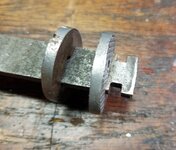
That allowed me to slip that up the tang for better visibility and access to the problematic 1st spacer. It also allowed me to tap the 1st spacer up the tang. Revealing the issue.
 

Attachments

  • Resto 9.jpg
    Resto 9.jpg
    563.5 KB · Views: 75
  • Resto 8.jpg
    Resto 8.jpg
    484.7 KB · Views: 75
  • Resto 10.jpg
    Resto 10.jpg
    490.7 KB · Views: 72
  • Resto 11.jpg
    Resto 11.jpg
    523.9 KB · Views: 73
Last edited:
  • Like
Reactions: 555
OP
P

Private Lugnutz

Well-known member
Joined
Mar 30, 2012
Messages
30,656
Location
The Authentic Jersey Shore
The end of the tang had been peened, either deliberately or in the use of the knife as a hammer.

A hand file and some elbow grease soon resolved that.
 

Attachments

  • Resto 14.jpg
    Resto 14.jpg
    1.1 MB · Views: 66
  • Resto 13.jpg
    Resto 13.jpg
    542.3 KB · Views: 51
  • Resto 12.jpg
    Resto 12.jpg
    569 KB · Views: 44
  • Resto 15.jpg
    Resto 15.jpg
    595.9 KB · Views: 40
  • Resto 16.jpg
    Resto 16.jpg
    897.1 KB · Views: 35
  • Resto 17.jpg
    Resto 17.jpg
    980.6 KB · Views: 34
  • Resto 18.jpg
    Resto 18.jpg
    686.7 KB · Views: 54

alinc100

Well-known member
Joined
May 26, 2013
Messages
3,032
Location
Dearborn,MI
This will be interesting to watch as I have zero knowledge on the subject , but have an old Estwing hammer in similar condition ,and I can't just toss it. I may try to apply what is learned here.
 

whateg01

Well-known member
Joined
Mar 13, 2006
Messages
11,412
Location
doo dah, kansas, usa
I guess I'm not familiar with the term "theater knife". When I think of that, I think of a spring loaded prop that can be used to simulate a stabbing. Clearly that isn't what you are doing.

Is still impresses me that handles for knives and hammers were made of stacked leather discs. I've never owned a tool like that, but can see the merit.
 
OP
P

Private Lugnutz

Well-known member
Joined
Mar 30, 2012
Messages
30,656
Location
The Authentic Jersey Shore
I guess I'm not familiar with the term "theater knife".
I had no idea what a “theater knife” was...
The term is fairly esoteric to the WWII knife collecting community. For the longest time there was a lot of disagreement about them. The predominant line of thought among first and second wave collectors was that they were "take-home" knives and re-handled by veterans at home. Like many things in the WWII collecting community, including jeeps and jeep toolkits, the internet and a third wave of guys who did their research turned up photographs and other evidence that they were actually re-handled in theater, during the war.
I think of a spring loaded prop that can be used to simulate a stabbing.
Like during the perfect denouement to the movie, Knives Out!? (Oops, I hope that wasn't a spoiler!)
...an old Estwing hammer in similar condition ,and I can't just toss it. I may try to apply what is learned here.
I am sure the concept is the same. They are stacked, epoxied, and compressed, squeeze a few more in, then re-clamped with whatever the **** mechanism is. Then finished and stained or oiled.
Is still impresses me that handles for knives and hammers were made of stacked leather discs. I've never owned a tool like that, but can see the merit.
They have a nice feel in the hand, and they're handsome, too!
let alone know how these knives were disassembled
Note that I'm not sure how to disassemble a Ka-Bar, which I don't own, or even my own EGW or PAL RH-36 if I ever had to. It looks infinitely more difficult. The Cattaraugus 225Q is very unique among big WWII fighting knives. Ironic that it's not more popular, because it's very practical to maintain.
 

Attachments

  • 20230704_153131.jpg
    20230704_153131.jpg
    1,014.9 KB · Views: 48
  • 20230704_153057.jpg
    20230704_153057.jpg
    530.9 KB · Views: 81
Last edited:
OP
P

Private Lugnutz

Well-known member
Joined
Mar 30, 2012
Messages
30,656
Location
The Authentic Jersey Shore
I have a perfect pattern in mind. I already have a design for my stack.

Now I have to...
(1) Do some research to figure out what period materials may have been available in those colors, in theater, because I want it to be historically correct, as if found that way.
(2) Locate the vintate period-correct materials
(3) Cut them into washers
(4) Clean up the blade, guard, and pommel spacers
(5) Stack the washers on the tang and re-assemble the pommel
(6) Sand the stacked washers into a smooth conformal handle shape
(7) Finish
 
Last edited:

4xdog

Well-known member
Joined
Aug 18, 2012
Messages
5,623
Location
Santa Fe, NM
Shellac was a fairly common finish back then, Lugz. It was used, for example, to protect and improve grip on cotton cloth-taped handlebars on interwar French cyclotourist bikes. Still is in that community.

That might be a period finish to consider for this interesting restoration.
 

4xdog

Well-known member
Joined
Aug 18, 2012
Messages
5,623
Location
Santa Fe, NM
...For the longest time there was a lot of disagreement about them. The predominant line of thought among first and second wave collectors was that they were "take-home" knives and re-handled by veterans at home. Like many things in the WWII collecting community, including jeeps and jeep toolkits, the internet and a third wave of guys who did their research turned up photographs and other evidence that they were actually re-handled in theater, during the war....

The idea that customized grips would be done after the war makes no sense, frankly. Every WW2 veteran I've known was happy to leave the war behind and get busy with life.

But in theater, with time on their hands and not that much to futz with, sure, why not customize a personal item like a fighting knife? Look at all the trench art from WW1. Nobody thinks that was done when the guys got home, do they?
 
OP
P

Private Lugnutz

Well-known member
Joined
Mar 30, 2012
Messages
30,656
Location
The Authentic Jersey Shore
Shellac was a fairly common finish back then, Lugz.
Indeed.
Every WW2 veteran I've known was happy to leave the war behind and get busy with life.
Well, most anyway. You and I have had this conversation before. My dad was a WWII vet. Navy. Destroyer ******. Never said two words about it. When my brothers or I would find a souvenir squirreled away in the basement, it was "Put that back where you found it, now, and don't touch it again." Same with our uncles. Whereas our other uncle, our aunt's husband, a supply sergeant in Europe, was a blowhard.

But yeah, it is counterintuitive.

I think the first wave were purists and historians. The second was the Army/Navy store crowd where everything goes. The third wave had the benefit of elapsed time, a renewed perspective, and resources and unprecedented access to NARA and other references.
Made in Cattaraugus County, NY?
Yes.

ventotene.jpg
 

misterbill

Well-known member
Joined
Dec 24, 2015
Messages
670
I have a perfect pattern in mind. I already have a design for my stack.

Now I have to...
(1) Do some research to figure out what period materials may have been available in those colors, in theater, because I want it to be historically correct, as if found that way.
...
You can't go wrong with leather. I suspect you're wanting to do something unique and imaginative but leather would have been available from many sources - GI boots, belts, equine harnesses (German transport was not very mechanized). Rubber from spent tires would have been available. (I had a friend who was a mechanic in the 28th ID and he said they had a miserable time with tires in Normandy because of all the shrapnel.) Cork from wine bottles would also have been available ;) Brass from spent shells. Lead could have been easily melted/formed. Bone from farm animals. Wood from any number of sources. Even string or cloth impregnated with aircraft dope could work. If you're thinking more along the lines of trench art maybe a piece of a German medal or some piece of file-able metal with German or Italian writing on it. Or, if you're feeling eclectic, any sort of found item - a pipe bowl, a pair of dice, electric insulator, chrome piece off of a car.

Bill
 
To avoid these ads, REGISTER NOW!
OP
P

Private Lugnutz

Well-known member
Joined
Mar 30, 2012
Messages
30,656
Location
The Authentic Jersey Shore
I suspect you're wanting to do something unique and imaginative...
I thought I was pretty clear here, Bill.
When the handles on knives deteriorated, especially in the PTO, soldiers and sailors replaced the stacked leather washers themselves or with the assistance of their pals in the various maintenance shops, with whatever material was handy. Aluminum scrap, micarta insulators, plexiglas, even wood. There is a famous example using red and black checkers.
I am not taking a prescriptive approach to the materials. I do have a very clear design in mind that will require certain colors. The composition is less important to me, and I am intentionally not choosing them ahead of time. Are you familiar with the concept of found art? Found poetry? I'm not in a hurry on this. I want to enjoy the process as much as the finished product. I don't want to eliminate the joy of finding just the right piece that I didn't preconceive. Certainly I have some ideas of where the material might come from. I mentioned a few possibilities as examples, but there are many more, as you mentioned. I want it to be period correct, though. I plan to use vintage materials if possible. Scavenged from other parts, as the sailors, soldiers and marines would have. I've got a few ideas among my own things already. Extras. Surplus. You've seen my laptop bag, right? Same idea, kinda sorta.
 
OP
P

Private Lugnutz

Well-known member
Joined
Mar 30, 2012
Messages
30,656
Location
The Authentic Jersey Shore
As a matter of interest, the variety of theater-made or -modified knives is quite wide. (Although postwar or recent fakes are doubtless among them, given the market value.)
Indeed. Mine, if I can pull it off, is going to be a strange hybrid. The pattern will leave no doubt it's not authentic, about which I will say no more lest I ruin the surprise, but the eclectic materials (ideally, maybe no two washers alike!) will be hyper-representative, if you will, of the concept of a "theater knife". An homage to their creation.
 

555

Well-known member
Joined
Nov 10, 2007
Messages
2,307
Location
Nomad-Arkansas & Georgia
Years ago I was a member of the Special Operations collector's club called Chutes & Daggers. During that time I attended several shows and saw a lot of uniquely modified knives. One "Q" knife I remember had stacked Japanese coins in place of the leather washers.
 

Lassen Forge

Well-known member
Joined
Apr 26, 2014
Messages
15,375
Location
The romantic hills of central Umbria, Italy,
Years ago I was a member of the Special Operations collector's club called Chutes & Daggers. During that time I attended several shows and saw a lot of uniquely modified knives. One "Q" knife I remember had stacked Japanese coins in place of the leather washers.

I wonder if we were at the same show, as I remember a Q knife with a Japanese coin handle... it was actually an idea I used later for restacking a camping hatchet that had gone to chit, Coins insterspersed with coiled twists of iron ("bailing") wire and other found stuff. Pretty cool effect and grippy as heck, which to me was paramount.
 

Mintgrun

Well-known member
Joined
Oct 7, 2015
Messages
2,141
Location
Kingston, Wa.
Are you planning on making a sheath for your knife? I have an old piece of leather that my grandpa's brother Ted sent back during WWII and it's a nice weight for such things. I used to put handles on knives when I was young and used up a bit of it that way. He said he'd taken the leather off of of the outside of a fuel tank on a German plane that had been shot down. I just Googled and found a Wiki page discussing leather covered tanks and it aligns with his story.

"German aircraft designers used layers of rubber laid over leather hide with a treated fiber inner surface for the self-sealing tanks on the Junkers Ju 88 early in the war.[3]"


I pulled it out and snapped some photos. I'm afraid it isn't nearly as nice as when he gave it to me forty years ago, but I know you have an appreciation for things that show their age. If you'd like, I could cut off a chunk and mail it to you. You could also stack leather washers using this and have a light grey handle on your knife that matches its sheath; but it sounds like you have other ideas. You mentioned having a color scheme in mind and this leather might take dyes nicely. Anyway, here are some photos showing the markings on both sides of the hide.

1688596637610.jpeg

1688596670897.jpeg

1688596711113.jpeg 1688596748909.jpeg

The 'texture' of the leather varies quite a bit. Some of it is stiffer and smoother and other parts are softer and wrinkly.
1688596100376.jpeg 1688596786020.jpeg

I just washed that old knife sheath with a LEXOL product and am looking forward to seeing how it looks once it's dried. I think some of the staining is somewhat superficial.

1688595998719.jpeg

Tom
 
Last edited:
  • Like
Reactions: 555
OP
P

Private Lugnutz

Well-known member
Joined
Mar 30, 2012
Messages
30,656
Location
The Authentic Jersey Shore
Are you planning on making a sheath for your knife?
No. It's going to be mounted.
He said he'd taken the leather off of the outside of a fuel tank on a German plane that had been shot down.
Cool story. Thanks for gracing the thread with it. The Luftwaffe loved their grey.
I know you have an appreciation for things that show their age.
I sure do, and thanks for noticing.
If you'd like, I could cut off a chunk and mail it to you. You could also stack leather washers using this and have a light grey handle on your knife that matches its sheath; but it sounds like you have other ideas.
That's very generous of you, Tom, and if I was accepting, I'd take the piece with the splendid alphanumerical marking...!, but I'm going to pass. :)
You mentioned having a color scheme in mind and this leather might take dyes nicely.
I do have a specific color scheme in mine, but I am planning to use multiple materials for the washers. Some leather, maybe, of which I have plenty of WWII era pieces to salvage.
 
OP
P

Private Lugnutz

Well-known member
Joined
Mar 30, 2012
Messages
30,656
Location
The Authentic Jersey Shore
After careful deliberation, I have decided to do a swift 'About Face!' on myself and my desire to keep my design a secret.

A couple different posts yesterday and a PM early this morning and now Tom's post have convinced me that trying to talk my way around it is confusing, and I am potentially denying myself untold good ideas from the community.

As Tom alluded to, I like aged, faded, and worn on vintage stuff. I like to preserve, not strip and restore. So much so that I actually artificially put the old back into toolboxes that I have to refinish so they don't look new, and I coined a term ("prestorvation") for the process I use, discussed in this thread devoted to the subject here...


That me would probably not touch the pits on the blade, guard, and pommel of this Q knife, and would probably re-stack the handle with old leather, or new leather but then stain and distress it to make it look 70 years old.

But every once in a while I get an uncharacteristic wild hair up my ascot, especially when the item in question is in really rough shape.

This late 1920's vintage Blackhawk 32-CD Quick Disconnect era socket set I glitzed and gussied up and named "Black Hills Gold" back in 2012, where none of the finish was left on the case or the tools, is a good idea...


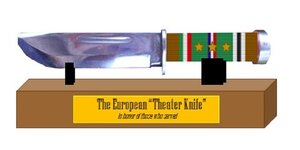
I'm going to file, grind, buff and polish this blade, guard, and pommel to a wallhanger-like mirror shine, and put an award-worthy handle on it to match.

This is what I am going for...

ETO Design 1.jpg

If you don't recognize it, that is the ribbon for the "ETO" campaign medal (technically, the European-African-Middle Eastern campaign medal, awarded from 1942 to 1945, to everyone who served during WWII in Europe, N.A., the Med, and the Middle East), with three campaign stars, often called battle stars, signifying three years.

Quite literally, a theater award handle for a "theater knife."

Screenshot_20230704-134212_Chrome.jpg

And this...

ETO Design 2.jpg

...is just some initial rough Step 1 ideas from above on how I might get there.

I could very easily, quickly, simply and quite inexpensively buy micarta in all those colors from any decent art supply store.

But my idea, instead, is to use SEVERAL different kinds of materials, preferably, ideally, actual vintage materials from the ETO. I want the materials to be as motley as possible, as an homage to the field expedience of the "theater knife" and the various materials they used. My idea, my hope, the stylish approach, is that the unmistakable ETO ribbon design and the battle stars will symbolically pull it all together into an overall stunning display.
 
Last edited:

Provincial

Well-known member
Joined
Sep 21, 2011
Messages
6,874
Location
Near Salem, OR
I've seen a green plastic material that is similar to the green you are looking for. It was used as lining on conveyors carrying bark dust. It was sheets about 3/8" thick.
 
  • Like
Reactions: 555
OP
P

Private Lugnutz

Well-known member
Joined
Mar 30, 2012
Messages
30,656
Location
The Authentic Jersey Shore
Green is my biggest concern. Maybe my only concern. I have a few green TL-122-D filters, but they are wafer thin. That's fine for one of the red bands, one of the white, and even the blue if I had to. I would need dozens for the green bands. If you guys are going to put your thinking caps on, green is the color I'd like to identify something blockier and readily available in theater.
 
OP
P

Private Lugnutz

Well-known member
Joined
Mar 30, 2012
Messages
30,656
Location
The Authentic Jersey Shore
Thanks, Raineman! That's a great idea. All I can say after a quick search is, 'Holy smokes! We thought we were in an expensive collecting hobby?!' :) Honestly, if I was going to have to 'cheat' a little to achieve an admirable effect, by acquiring a more modern and reasonably priced version, with the more authentic backstory, I would. I'm putting that option in backup for now, though. EDIT: Maybe I will run into a few scattered orphans or affordable set at the flea! I'm not a gambling man, but I'll keep my eye out now!
 
Last edited:

Cruzan80

Well-known member
Joined
Jul 22, 2015
Messages
4,290
Location
Denver, CO
Just a quick "devils-advocate"... And please don't read this as me disliking your idea at all! I think it sounds awesome!

Would the ETO campaign medal be known to service members who were operating "in-theater"? Would the stars have the same knowledge and connotation? The reason I am asking is that you are going to the effort of doing a "customization" that would have been possible/plausible during the war, but is the design you picked anachronistic to the period (serving ETO campaign member) it would have been done in?

LH perspective: Is Pvt Lugz doing this as part of his last tour in ETO, and expecting to bring it home and receive matching campaign medal, or would the "then-serving" Pvt. not have known about the design well enough to make it into a handle? Or is this Pvt. creating the handle from leftover materials he knew from friends in '46 (after he got home)?

The reason I am poking at this particular spot is that if the answer is the last version (post-home arrival), could you be inadvertantly adding ammunition for those naysayers who are the "first-wave" purists who argued that any/all customization was post-war?

Sorry if it is hard to read/understand, was trying to use terms up-thread to keep it understandable. If anyone would like clarification, please ask.

And again, I think your design idea with period materials is a great idea. You could look into oxidized brass/bronze/coppr from the era. I have some old razor cases that are slowly turning bright green. Otherwise, earlier than you need, but the original Gillette razor officers cases in WWII were a darker green. May be hand to "clean" without disturbing the color though.
 
OP
P

Private Lugnutz

Well-known member
Joined
Mar 30, 2012
Messages
30,656
Location
The Authentic Jersey Shore
Just a quick "devils-advocate"... And please don't read this as me disliking your idea at all!
No worries, Cruzer. I'm okay with dislike! It's all subjective.
Would the ETO campaign medal be known to service members who were operating "in-theater"? Would the stars have the same knowledge and connotation?
Yes. It was established in 1942, conferred immediately after 60 contiguous days of service in theater, awarded as soon as they could be supplied, and worn on dress uniforms (so-called "pinks and greens") when on leave or for formal occasions. (EDIT: I will add a factoid that gets lost in the mythologizing of WWII, that might help. The average infantryman in WWII experienced 10 days of actual combat in one year.) If you scroll through almost any source of good WWII photographs from Europe (I recommend LIFE or NARA) you'll immediately see what I mean. Ribbons were mandatory, not discretionary. As for it mattering, have you ever seen the scene in Band of Brothers when soldiers who joined the unit near the end of the war who were authorized to wear the unit citation medal for action and obliged to wear it got accosted for wearing it? Theater campaign medals - there's one for the Asiatic as well, are not at all like the Victory medals conferred after the war was over. On the other hand, they are very common. I would not think of using any others (Silver Star, Bronze Star, etc). That would be weird.
Is Pvt Lugz doing this as part of his last tour in ETO, and expecting to bring it home and receive matching campaign medal, or would the "then-serving" Pvt. not have known about the design well enough to make it into a handle? Or is this Pvt. creating the handle from leftover materials he knew from friends in '46 (after he got home)?
First off, I know this wasn't your point, but the way you're using my username for the extended analogy is giving me 'stolen valor' hives. :) While I am a Jeep and motorcycle and surplus guy and I have a large collection of WWII equipment, guns, edged weapons, and tools, I'm not even a Re-Enactment kind of guy. Not that there's anything wrong with that. It's just not for me.

In answer to your questions, though... none of the above!

I am not making this as a reproduction or example or representation or prop of a "theater knife" that could've been made this way or found or been an actual souvenir, etc, to be used in a Living History capacity or a movie etc. (I will quickly add that while I have never seen one, I don't pre-suppose I'm the first or only WWII buff to think of this, and I wouldn't deny the possibility some soldier in WWII thinking of re-stacking his knife wouldn't look at all the other striped examples, be reminded of a ribbon, and get the same idea.) What I am doing is way to pretty and shiny to be passed off as a relic.

Does this help give a better idea of my intention?

ETO Design 1A.jpg

You could look into oxidized brass/bronze/coppr from the era.
I thought about verdigris, but it's not quite right.
Otherwise, earlier than you need, but the original Gillette razor officers cases in WWII were a darker green.
Thanks.
 
Last edited:

Cruzan80

Well-known member
Joined
Jul 22, 2015
Messages
4,290
Location
Denver, CO
All of that sounds great. I was just imagining myself doing a project, only to have someone point out afterwards a reason that would cause me to be upset that it wasn't accurate to the point I was trying to accomplish. So wanted to try and get ahead of that for you.

Easiest way I could think of for a LH analogy was your username...

And who is to sya somebody in their downtime didn't decide to shiny up their knife? Though I get the point you are going for more now.
 
OP
P

Private Lugnutz

Well-known member
Joined
Mar 30, 2012
Messages
30,656
Location
The Authentic Jersey Shore
I was just imagining myself doing a project, only to have someone point out afterwards a reason that would cause me to be upset that it wasn't accurate to the point I was trying to accomplish.
I gotcha! Short answer - not at all anachronistic, and accuracy and authenticity is the reason I want to use valid materials. As a curator, I would make a little card that goes with it, explaining the materials, and the ribbon. but I'm kind of hoping it's obvious.
And who is to sya somebody in their downtime didn't decide to shiny up their knife?
Poseurs! :evil:
 

Marvin Berry

Well-known member
Joined
Jul 15, 2021
Messages
160
Location
Northern NY
What about the rubber from a pair of white 'Mickey Mouse' boots? (Would rubber work, and are the edges white like the exterior?)
 

Mike'smeatshop

Well-known member
Joined
Apr 1, 2023
Messages
1,273
After careful deliberation, I have decided to do a swift 'About Face!' on myself and my desire to keep my design a secret.

A couple different posts yesterday and a PM early this morning and now Tom's post have convinced me that trying to talk my way around it is confusing, and I am potentially denying myself untold good ideas from the community.

As Tom alluded to, I like aged, faded, and worn on vintage stuff. I like to preserve, not strip and restore. So much so that I actually artificially put the old back into toolboxes that I have to refinish so they don't look new, and I coined a term ("prestorvation") for the process I use, discussed in this thread devoted to the subject here...


That me would probably not touch the pits on the blade, guard, and pommel of this Q knife, and would probably re-stack the handle with old leather, or new leather but then stain and distress it to make it look 70 years old.

But every once in a while I get an uncharacteristic wild hair up my ascot, especially when the item in question is in really rough shape.

This late 1920's vintage Blackhawk 32-CD Quick Disconnect era socket set I glitzed and gussied up and named "Black Hills Gold" back in 2012, where none of the finish was left on the case or the tools, is a good idea...


I'm going to file, grind, buff and polish this blade, guard, and pommel to a wallhanger-like mirror shine, and put an award-worthy handle on it to match.

This is what I am going for...

ETO Design 1.jpg

If you don't recognize it, that is the ribbon for the "ETO" campaign medal (technically, the European-African-Middle Eastern campaign medal, awarded from 1942 to 1945, to everyone who served during WWII in Europe, N.A., the Med, and the Middle East), with three campaign stars, often called battle stars, signifying three years.

Quite literally, a theater award handle for a "theater knife."

Screenshot_20230704-134212_Chrome.jpg

And this...

ETO Design 2.jpg

...is just some initial rough Step 1 ideas from above on how I might get there.

I could very easily, quickly, simply and quite inexpensively buy micarta in all those colors from any decent art supply store.

But my idea, instead, is to use SEVERAL different kinds of materials, preferably, ideally, actual vintage materials from the ETO. I want the materials to be as motley as possible, as an homage to the field expedience of the "theater knife" and the various materials they used. My idea, my hope, the stylish approach, is that the unmistakable ETO ribbon design and the battle stars will symbolically pull it all together into an overall stunning display.
Awww. Thats what I was going to do.
 
To avoid these ads, REGISTER NOW!
Top Bottom