To avoid these ads, REGISTER NOW!

Ground Rod Wire Size and Location in Main?

jaw22w

Well-known member
Joined
Dec 28, 2019
Messages
195
Location
indiana
I'm finishing up the wiring in my new pole barn. It is a fairly simple installation. Power comes from a 400 amp distribution box. 200 for the house and 200 for the shop. 15 circuits total. (7) 20-amp circuits, (6) 15-amp circuits for all led lights, a 30-amp circuit for the compressor, and (1) 50-amp circuit for the welder.
Rough in is done. Boxes mounted and wire run between boxes. I am no electrician, but when we wired my son's house, my buddy the professional electrician took on the role of job foreman, and my son and I wired the whole house. 38 circuits if IIRC. Then my buddy wired the main all up. It's purty. My son and I have done all the wiring in the barn just like we did in the house. Today I got all the breakers mounted in the main breaker panel and wired up. I really out did myself making a nice, neat wiring job in the box. Almost as purty as the house main.
The last thing to do in the box is run the wire for the ground rod. I looked in the main in the house but there are so many wires in there I couldn't tell for sure where and what gauge wire was run to the ground rod without rooting around in there with it hot. And it is covered up outside. Before everybody says I need 2 ground rods per code, the inspector was out for the foundation inspection and said my county only requires 1 ground rod. But I don't want to do anything dangerous.
I have 2 questions. #1 What gauge wire should I use for the rod? I think it is 10 ga. bare copper, but not sure.
#2 This is a different box from the house. This is a Square D Homeline 200 amp main. I am not sure where the ground rod wire lands in the box. Does it land on the neutral/ground bar? There is also a smaller ground terminal next to the ground wire at the 200 amp breaker. Could it land there?
Oh! I guess I could ask a related question, too. I didn't pay a lot of attention when my buddy drove the ground rod for the house. He had a tool that looked like a hammer drill. Maybe it was a hammer drill. He drove that thing home in no time. My buddy is not available this time, unfortunately. I have a TS-15 Hilti hammer drill. Will that do it?
As far as inspections go, my county is only going through the motions. There was no wiring yet in the barn at the first inspection. I told her I was going to have it spray foamed and asked her when I needed to call for the next inspection. She said wire it, and spray foam it. Then call for inspection. Well, that is going to cover up every bit of wiring in the barn. She pretty much said all she is going to do is take her GFCI detector and check a couple of circuits. I really don't know why they even bother. It takes 20 minutes to drive to my place from the courthouse. It took 3 minutes for the inspection. I almost feel cheated.
Any info would help.
Thanks!
 
To avoid these ads, REGISTER NOW!

sparky 1971

Well-known member
Joined
Oct 9, 2018
Messages
7,981
Location
Central Iowa
I'm finishing up the wiring in my new pole barn. It is a fairly simple installation. Power comes from a 400 amp distribution box. 200 for the house and 200 for the shop. 15 circuits total. (7) 20-amp circuits, (6) 15-amp circuits for all led lights, a 30-amp circuit for the compressor, and (1) 50-amp circuit for the welder.
Rough in is done. Boxes mounted and wire run between boxes. I am no electrician, but when we wired my son's house, my buddy the professional electrician took on the role of job foreman, and my son and I wired the whole house. 38 circuits if IIRC. Then my buddy wired the main all up. It's purty. My son and I have done all the wiring in the barn just like we did in the house. Today I got all the breakers mounted in the main breaker panel and wired up. I really out did myself making a nice, neat wiring job in the box. Almost as purty as the house main.
The last thing to do in the box is run the wire for the ground rod. I looked in the main in the house but there are so many wires in there I couldn't tell for sure where and what gauge wire was run to the ground rod without rooting around in there with it hot. And it is covered up outside. Before everybody says I need 2 ground rods per code, the inspector was out for the foundation inspection and said my county only requires 1 ground rod. But I don't want to do anything dangerous
Do as you wish, if nobody is going to force you to use two and you don't feel like it, don't do it. I have one thing to say about it, ground rods are cheap.
I have 2 questions. #1 What gauge wire should I use for the rod? I think it is 10 ga. bare copper, but not sure.
#6
#2 This is a different box from the house. This is a Square D Homeline 200 amp main. I am not sure where the ground rod wire lands in the box. Does it land on the neutral/ground bar? There is also a smaller ground terminal next to the ground wire at the 200 amp breaker. Could it land there?
If it's a sub panel, you need to have separate ground bar(s) from the neutral. The ground for the rods as well as the incoming ground wire AND all of the branch circuit grounds will go to those. I like to spend an extra $8 and install a ground bar on each side of the panel. I'm guessing what you are calling the 400 amp distribution box is the main panel with two 200 amp breakers in it. That would make the house and barn both sub panels.
Oh! I guess I could ask a related question, too. I didn't pay a lot of attention when my buddy drove the ground rod for the house. He had a tool that looked like a hammer drill. Maybe it was a hammer drill. He drove that thing home in no time. My buddy is not available this time, unfortunately. I have a TS-15 Hilti hammer drill. Will that do it?
I'm not familiar with that drill. I have a Milwaukee spline drive and just slip the drill with no bit over the rod and drive away. There are ground rod driver bits for SDS and SDS Max drills. The old school way is to poke the rod in the dirt, take it out and dump some water in the hole, then slam the rod up and down. Repeat with the water until you can't do it any longer, finish with a sledge hammer
As far as inspections go, my county is only going through the motions. There was no wiring yet in the barn at the first inspection. I told her I was going to have it spray foamed and asked her when I needed to call for the next inspection. She said wire it, and spray foam it. Then call for inspection. Well, that is going to cover up every bit of wiring in the barn. She pretty much said all she is going to do is take her GFCI detector and check a couple of circuits. I really don't know why they even bother. It takes 20 minutes to drive to my place from the courthouse. It took 3 minutes for the inspection. I almost feel cheated.
Some jurisdictions don't have anyone that has a clue what they are looking at. I prefer it that way.
Any info would help.
Thanks!
 
OP
J

jaw22w

Well-known member
Joined
Dec 28, 2019
Messages
195
Location
indiana
Do as you wish, if nobody is going to force you to use two and you don't feel like it, don't do it. I have one thing to say about it, ground rods are cheap.

#6

If it's a sub panel, you need to have separate ground bar(s) from the neutral. The ground for the rods as well as the incoming ground wire AND all of the branch circuit grounds will go to those. I like to spend an extra $8 and install a ground bar on each side of the panel. I'm guessing what you are calling the 400 amp distribution box is the main panel with two 200 amp breakers in it. That would make the house and barn both sub panels.

I'm not familiar with that drill. I have a Milwaukee spline drive and just slip the drill with no bit over the rod and drive away. There are ground rod driver bits for SDS and SDS Max drills. The old school way is to poke the rod in the dirt, take it out and dump some water in the hole, then slam the rod up and down. Repeat with the water until you can't do it any longer, finish with a sledge hammer

Some jurisdictions don't have anyone that has a clue what they are looking at. I prefer it that way.


Hey thanks! I have a ground rod driving bit ordered for my Hilti hammer drill.
I know my terminology is not correct, but yes what I called the distribution box would be the main panel. It has 2 200-amp breakers in it. So I guess the house and barn would both be considered sub panels.
As to the ground rod wire, is that #6 a stranded insulated wire? I had some #10 bare , so I installed it where I thought it went. I will get some #6 tomorrow. I think Lowe's sells it by the foot. Only need about 5 feet. This is the only place I see in the box that will accept #6 wire. Is the bare #10 in the right place (but wrong wire gauge)?
I hope my box wiring looks up to snuff. I know the inspector will never look at it.
Thanks again for your help!
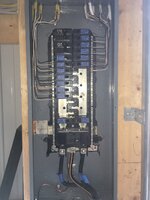
IMG_1025.JPGIMG_1023.JPG
 

sparky 1971

Well-known member
Joined
Oct 9, 2018
Messages
7,981
Location
Central Iowa
Hey thanks! I have a ground rod driving bit ordered for my Hilti hammer drill.
I know my terminology is not correct, but yes what I called the distribution box would be the main panel. It has 2 200-amp breakers in it. So I guess the house and barn would both be considered sub panels.
As to the ground rod wire, is that #6 a stranded insulated wire? I had some #10 bare , so I installed it where I thought it went. I will get some #6 tomorrow. I think Lowe's sells it by the foot. Only need about 5 feet. This is the only place I see in the box that will accept #6 wire. Is the bare #10 in the right place (but wrong wire gauge)?
I hope my box wiring looks up to snuff. I know the inspector will never look at it.
Thanks again for your help!
IMG_1025.JPGIMG_1023.JPG
Oh boy. Is that the panel in the barn? I see you are in Indiana, I've heard they are way behind on the code, but I thought it was the 2008 NEC. In 2008, the code changed and if that is the cycle you are on, there should have been a ground wire run along with the hots and neutral. That didn't happen, and probably won't so you need to bond the panel. A green screw came with the panel and hopefully is laying around there somewhere. It should go through one of the holes in the neutral buss, I think it's the U shaped hole on the left, but could be the square hole on the right. Nevermind my above statement about separate ground bars, the grounds and neutrals are ok the way they are, but if you can't find the bonding screw, you could install a ground bar and jump a piece of #6 form the neutral bar to the ground bar. Where does the bare copper wire go? I would think it goes to the ground rod and looks like a #4 to me, but could be a 6. If it goes to a UFER, a ground rod isn't needed.
 
OP
J

jaw22w

Well-known member
Joined
Dec 28, 2019
Messages
195
Location
indiana
Yes, I think Indiana is 2008 NEC. The house was built in 2015. I used the same feed wire for the barn as we did for the house 4/0-4/0-2/0. That is what my buddy bought for the house. It passed inspection just fine. You are saying it should have been 4/0-4/0-4/0-2/0? So, since it does not have that ground wire, I need to install that green screw (which I have) and install the ground rod with #6 wire and everything will be copacetic or at least not dangerous? Funny thing is that I was given that 100 feet of 4/0-4/0-2/0 for the barn by a guy in another county where it wouldn't pass inspection!
The bare wire is 10 gauge, a little less than 1/4" and goes to the ground rod which is not yet installed. I had to look up a UFER ground. Nope. Don't have that.
I guess I didn't understand. Is the bare #10 in the right place for the ground wire for when I remove it and install the #6 in its place? The rest of the wiring is pretty straight forward for what I am doing, but the service entrance is where I am lacking.
My old buddy has passed. but I may call an electrician to look things over before putting anything into service.
I appreciate your help.
 

sparky 1971

Well-known member
Joined
Oct 9, 2018
Messages
7,981
Location
Central Iowa
Yes, I think Indiana is 2008 NEC. The house was built in 2015. I used the same feed wire for the barn as we did for the house 4/0-4/0-2/0. That is what my buddy bought for the house. It passed inspection just fine. You are saying it should have been 4/0-4/0-4/0-2/0?
2008 is when the code changed. This is what happens with inspectors that do it all. It could have been 4/0-4/0-4/0-2/0 but didn't have to be. Usually, it's 4/0-4/0-2/0-4 MHF. You have URD, which, unless it's dual rated, isn't supposed to be used indoors. If there is a fire, it could give off a toxic gas. I wouldn't worry too much about that though. What's done is done and probably not going to be re-done.
So, since it does not have that ground wire, I need to install that green screw (which I have) and install the ground rod with #6 wire and everything will be copacetic or at least not dangerous? Funny thing is that I was given that 100 feet of 4/0-4/0-2/0 for the barn by a guy in another county where it wouldn't pass inspection!
Yep, install the ground screw and it will be an installation that would have been code compliant up through the 2005 NEC
The bare wire is 10 gauge, a little less than 1/4" and goes to the ground rod which is not yet installed. I had to look up a UFER ground. Nope. Don't have that.
Are you sure that's a #10, sure looks like a 6 or possibly a #4 to me. A little less than 1/4" makes me think it's a #6.
I guess I didn't understand. Is the bare #10 in the right place for the ground wire for when I remove it and install the #6 in its place? The rest of the wiring is pretty straight forward for what I am doing, but the service entrance is where I am lacking. I think I understand that terminal is where the 2/0 would go in a 4 wire entrance cable.
That's where it will go now. It can go anywhere the neutrals are. If you had the four wire cable feeding it, the neutral would be isolated and all of the ground wires would go to the ground bar(s) mounted to the back of the panel that you don't have or need. Those are purchased separately.
My old buddy has passed. but I may call an electrician to look things over before putting anything into service.
I appreciate your help.
I think you'll be fine.
 
OP
J

jaw22w

Well-known member
Joined
Dec 28, 2019
Messages
195
Location
indiana
Yep, install the ground screw and it will be an installation that would have been code compliant up through the 2005 NEC
Yeah, It figures that Indiana would be 15-18 years behind the times.
Are you sure that's a #10, sure looks like a 6 or possibly a #4 to me. A little less than 1/4" makes me think it's a #6.
Hell, I am a retired Ironworker. I'm not sure of anything electrical. :unsure::)

I will measure the diameter of the bare wire when I go out to the barn this morning to verify what I have.
This is what happens with inspectors that do it all.
I think the real problem is that they don't do anything. At least that is my experience with the inspectors on my son's house and barn. When I built my own house in 1980 there were absolutely no inspections by the county, just progress inspections by the bank that held my construction loan. I think there are 5 people in the Area Plan office eating up tax dollars. I know the $150 building permits are not paying their salaries or buying their new trucks.
Will Rogers was right. "Thank heavens we don't get all the government we pay for!"
 
OP
J

jaw22w

Well-known member
Joined
Dec 28, 2019
Messages
195
Location
indiana
A thought just occurred to me. The cable is not trenched in from the barn to the main panel yet. It is not too late, I could add the ground wire to make it a 4 wire installation. Would that be a good thing to do? Or am I OK as is?
 
Last edited:

grounded-b

Well-known member
Joined
Oct 23, 2012
Messages
285
Location
Milwaukee, WI
A thought just occurred to me. The cable is not trenched in from the barn to the main panel yet. Waiting on another buddy to trench it. Probably this weekend. It is not too late, I could add the ground wire to make it a 4 wire installation. Would that be a good thing to do? Or am I OK as is?

Add the separate ground wire from the 400A to your 200A panel.

Be sure to add a separate ground bar ( or two ) in your sub-panel and move all those grounds off the neutral bar and onto the new ground bar(s).

Do not install the green bonding screw from the neutral bar to the enclosure.

Connect your ground rod(s) to the new ground bar.
 

sparky 1971

Well-known member
Joined
Oct 9, 2018
Messages
7,981
Location
Central Iowa
A thought just occurred to me. The cable is not trenched in from the barn to the main panel yet. Waiting on another buddy to trench it. Probably this weekend. It is not too late, I could add the ground wire to make it a 4 wire installation. Would that be a good thing to do? Or am I OK as is?
Adding an aluminum #4 USE cable that should be available at any electrical supply house would be ideal. Then go back to my original post about the ground bars, move all of the ground wires to the ground bars and forget about the green screw.
 

alfredeneuman

Well-known member
Joined
Mar 3, 2011
Messages
4,584
Location
Fullerton, CA
Adding an aluminum #4 USE cable that should be available at any electrical supply house would be ideal.

2017 NEC Article 300.3(B)
"(B) Conductors of the Same Circuit. All conductors of the same circuit and, where used, the grounded conductor and all equipment grounding conductors and bonding conductors shall be contained within the same raceway, auxiliary gutter, cable tray, cablebus assembly, trench, cable, or cord."

The only exceptions are for existing circuits, not new installations.
 

sparky 1971

Well-known member
Joined
Oct 9, 2018
Messages
7,981
Location
Central Iowa
2017 NEC Article 300.3(B)
"(B) Conductors of the Same Circuit. All conductors of the same circuit and, where used, the grounded conductor and all equipment grounding conductors and bonding conductors shall be contained within the same raceway, auxiliary gutter, cable tray, cablebus assembly, trench, cable, or cord."

The only exceptions are for existing circuits, not new installations.
It's an existing circuit and laid on top of the URD in the same trench is good enough for me to be the same cable. I'm not going to state it meets the standards set forth by the code exactly, but it's close enough. Using a drywall screw in place of a 6-32 screw is also a code violation, but we've all done it.
 

alfredeneuman

Well-known member
Joined
Mar 3, 2011
Messages
4,584
Location
Fullerton, CA
The cable is not trenched in from the barn to the main panel yet. Waiting on another buddy to trench it. Probably this weekend. It is not too late, I could add the ground wire to make it a 4 wire installation.
That doesn't sound like an existing circuit to me. What did I miss?
 

wyliesdiesels

Well-known member
Joined
Aug 14, 2012
Messages
20,038
Location
Modesto, CA
That doesn't sound like an existing circuit to me. What did I miss?
the feeder circuit was installed already. the code doesnt state a specific timeline that the circuit has to be installed in order to be allowed to use the exception, adding a ground wire.

furthermore, having the ground wire and an unbonded sub is a lot safer than worrying about a code that prohibits adding a wire to a circuit unless its part of the same assembly. I mean c'mon really now?
 
Last edited:

sparky 1971

Well-known member
Joined
Oct 9, 2018
Messages
7,981
Location
Central Iowa
I have found that there are two types of electricians. Those that admit to code violations and those that lie about it. There is no safety concern with adding a wire that I can think of. The inspection has been done so the OP doesn't have to worry about getting failed, and he already has the majority of the wire. I say roll with it. I'll be damned if I'm going to tell him to scrap it and go with MHF when I can guarantee if I were in the same situation I wouldn't.
 
To avoid these ads, REGISTER NOW!

mm08822

Well-known member
Joined
Jan 13, 2012
Messages
6,004
Location
NJ
Power comes from a 400 amp distribution box. 200 for the house and 200 for the shop.
Just to be certain, does this "distributuion box" have any circuit breakers in it or is it just isolated "distribution blocks" to split the feed?
 

Norcal

Well-known member
Joined
Mar 16, 2008
Messages
13,765
There are a couple of spots where there are 2 neutrals under 1 screw, that is not code compliant.
 

sparky 1971

Well-known member
Joined
Oct 9, 2018
Messages
7,981
Location
Central Iowa
Yes, I think Indiana is 2008 NEC. The house was built in 2015. I used the same feed wire for the barn as we did for the house 4/0-4/0-2/0. That is what my buddy bought for the house. It passed inspection just fine. You are saying it should have been 4/0-4/0-4/0-2/0? So, since it does not have that ground wire, I need to install that green screw (which I have) and install the ground rod with #6 wire and everything will be copacetic or at least not dangerous? Funny thing is that I was given that 100 feet of 4/0-4/0-2/0 for the barn by a guy in another county where it wouldn't pass inspection!
The bare wire is 10 gauge, a little less than 1/4" and goes to the ground rod which is not yet installed. I had to look up a UFER ground. Nope. Don't have that.
I guess I didn't understand. Is the bare #10 in the right place for the ground wire for when I remove it and install the #6 in its place? The rest of the wiring is pretty straight forward for what I am doing, but the service entrance is where I am lacking.
My old buddy has passed. but I may call an electrician to look things over before putting anything into service.
I appreciate your help.
I just read this again. Since you are missing the ground wire to the house, make sure the bonding screw is installed there.
 
OP
J

jaw22w

Well-known member
Joined
Dec 28, 2019
Messages
195
Location
indiana
I just read this again. Since you are missing the ground wire to the house, make sure the bonding screw is installed there.
I thought about this while we were discussing the barn' system. My son's house (the house we are talking about) has a disconnect on the wall outside of the 200 amp subpanel in the garage. I have spent a couple of hours researching this. I read some articles and watched some YouTube videos on bonding the subpanel. I know that doesn't qualify me as an expert. Probably just makes me dangerous! But I think that the disconnect becomes the first point of disconnect making the bond screw unnecessary in the sub-panel. Is that right? I could easily be wrong here.
To eliminate confusion, my home is 1/2 mile down the road from my farm, separated by another farm. When my son got married, I gave him 10 acres to build a house on. I am out of room at home, so I am building my barn at his place. He gets it when my ticket gets punched.
I forgot to take my calipers to get the diameter of that bare ground wire. I pulled some 10 gauge wire yesterday and realized that bare wire for the ground rod is not 10ga. It is more like a 4 or 6. I will measure it today though.
 

wyliesdiesels

Well-known member
Joined
Aug 14, 2012
Messages
20,038
Location
Modesto, CA
I thought about this while we were discussing the barn' system. My son's house (the house we are talking about) has a disconnect on the wall outside of the 200 amp subpanel in the garage. I have spent a couple of hours researching this. I read some articles and watched some YouTube videos on bonding the subpanel. I know that doesn't qualify me as an expert. Probably just makes me dangerous! But I think that the disconnect becomes the first point of disconnect making the bond screw unnecessary in the sub-panel. Is that right? I could easily be wrong here.
thats correct however if you only have a 3 wire feed to the subpanel, you have to bond the neutral.
To eliminate confusion, my home is 1/2 mile down the road from my farm, separated by another farm. When my son got married, I gave him 10 acres to build a house on. I am out of room at home, so I am building my barn at his place. He gets it when my ticket gets punched.
I forgot to take my calipers to get the diameter of that bare ground wire. I pulled some 10 gauge wire yesterday and realized that bare wire for the ground rod is not 10ga. It is more like a 4 or 6. I will measure it today though.
that bare solid cu wire is most likely #6
 
OP
J

jaw22w

Well-known member
Joined
Dec 28, 2019
Messages
195
Location
indiana
thats correct however if you only have a 3 wire feed to the subpanel, you have to bond the neutral.

that bare solid cu wire is most likely #6
See, I told you I only knew enough to be dangerous. I will check his house panel for the bonding screw. It is a Square D QO load center. I saw a video on the location of the bonding screw in the QO, so I know right where to look.
The diameter of that bare ground rod wire is .203". That puts it bigger than a #6 and slightly smaller than a #5. I don't have a clue why I kept thinking that was a 10 ga. I knew better. Must been a senior moment.

OKAY! So the plan is to first check Scotty's house panel for bond screw.
Then for the barn, add a #4 USE wire to the 4/0-4/0-2/0 wires in the trench. Add enough ground bars, attached directly to the panel enclosure, to swap all my ground wires onto. The 4/0-4/0-2/0 will remain terminated where it is now. The new #4 will land at the new ground bars. No bonding screw. Correct?
Question. It will be easiest to add a ground bar to each side. Do the ground bars need to be linked with the #6 bare wire or is that taken care of through the enclosure metal.
How do the ground bars fasten to the enclosure? Screws or nut and bolt or?
Thanks for your help.
There are a couple of spots where there are 2 neutrals under 1 screw, that is not code compliant.
I fixed that! Thank you. Now tell me. Can the ground wires be doubled under one screw?
 

sparky 1971

Well-known member
Joined
Oct 9, 2018
Messages
7,981
Location
Central Iowa
See, I told you I only knew enough to be dangerous. I will check his house panel for the bonding screw. It is a Square D QO load center. I saw a video on the location of the bonding screw in the QO, so I know right where to look.
If it's what I think it is, the 400 amp panel is the main. Since there is only a three wire between there and the house, the house disconnect should be bonded. Without going back and reading it again, I think the panel is back to back with the disco, it should have a ****** between them, install a ground wire between them and ground bars in the panel so you can isolate the neutrals. Two bonded panels in the same structure is a no no.
The diameter of that bare ground rod wire is .203". That puts it bigger than a #6 and slightly smaller than a #5. I don't have a clue why I kept thinking that was a 10 ga. I knew better. Must been a senior moment.

It's a #4, you can use it for the rids, just move it to the ground bar when you get to it.
OKAY! So the plan is to first check Scotty's house panel for bond screw.
Then for the barn, add a #4 USE wire to the 4/0-4/0-2/0 wires in the trench. Add enough ground bars, attached directly to the panel enclosure, to swap all my ground wires onto. The 4/0-4/0-2/0 will remain terminated where it is now. The new #4 will land at the new ground bars. No bonding screw. Correct.
Correct.
Question. It will be easiest to add a ground bar to each side. Do the ground bars need to be linked with the #6 bare wire or is that taken care of through the enclosure metal.
How do the ground bars fasten to the enclosure? Screws or nut and bolt or?
Thanks for your help.

They will be bonded through the metal of the panel.
I fixed that! Thank you. Now tell me. Can the ground wires be doubled under one screw?
You can put two grounds under a screw, but I would get two 23 space ground bars, put one on each side of the panel and use one hole per wire.
 

grounded-b

Well-known member
Joined
Oct 23, 2012
Messages
285
Location
Milwaukee, WI
Question. It will be easiest to add a ground bar to each side. Do the ground bars need to be linked with the #6 bare wire or is that taken care of through the enclosure metal.
How do the ground bars fasten to the enclosure? Screws or nut and bolt or?


Your panel looks like a Sqr D Homeline panel. If you purchase Homeline ground bars, their screws will match up with factory drilled holes in your panel. The ground bar will come with thread forming screws.

Adding a #6 or #8 stranded green wire is optional to bond the 2 bars together. The bar's connection to the enclosure will satisfy the NEC
 
OP
J

jaw22w

Well-known member
Joined
Dec 28, 2019
Messages
195
Location
indiana
Hey! Thanks a bunch, guys. You all have been a tremendous help! This will make a whole lot better system in the barn. I'm learning. Never too old. If I have any more questions I will be sure to come back here, but I think I am all lined out on this project now.

I do have one more dumb question.
Why are 2 white/ neutral wires not allowed to be under the same screw, when they are connected by a ground bar anyway?
 

wyliesdiesels

Well-known member
Joined
Aug 14, 2012
Messages
20,038
Location
Modesto, CA
Hey! Thanks a bunch, guys. You all have been a tremendous help! This will make a whole lot better system in the barn. I'm learning. Never too old. If I have any more questions I will be sure to come back here, but I think I am all lined out on this project now.

I do have one more dumb question.
Why are 2 white/ neutral wires not allowed to be under the same screw, when they are connected by a ground bar anyway?
because if one neutral has a load on it when youre removing the other one that is off, it will arc and cause issues on the live circuit. also, if the live neutral is for an MWBC, it can create dangerous voltage potential for the equipment on the MWBC

a ground bar has nothing to do with it
 
OP
J

jaw22w

Well-known member
Joined
Dec 28, 2019
Messages
195
Location
indiana
Well, my search for a single conductor #4 aluminum direct burial cable has so far been unsuccessful. I have called every supply house within 60 miles. Can't find it. Copper or aluminum. Closest I came was a
THHN cable. I know that is no good. At this point I don't know if anybody even makes it. I think it has to be a UFB cable.
If I can't find it, I will replace the 4/0-4/0-2/0 with a proper 4 wire service entrance. The project was budgeted for the service entrance and since I got the 4/0-4/0-2/0 for nothing I guess the budget can stand it.
 

PCustoms

Well-known member
Joined
Jul 23, 2011
Messages
23,212
Location
VT
Well, my search for a single conductor #4 aluminum direct burial cable has so far been unsuccessful. I have called every supply house within 60 miles. Can't find it. Copper or aluminum. Closest I came was a
THHN cable. I know that is no good. At this point I don't know if anybody even makes it. I think it has to be a UFB cable.
If I can't find it, I will replace the 4/0-4/0-2/0 with a proper 4 wire service entrance. The project was budgeted for the service entrance and since I got the 4/0-4/0-2/0 for nothing I guess the budget can stand it.


mike93lx

ALLIANCE MEMBER
Joined
Dec 9, 2013
Messages
37,723
Location
Richmond, VA
Well, my search for a single conductor #4 aluminum direct burial cable has so far been unsuccessful. I have called every supply house within 60 miles. Can't find it. Copper or aluminum. Closest I came was a
THHN cable. I know that is no good. At this point I don't know if anybody even makes it. I think it has to be a UFB cable.
If I can't find it, I will replace the 4/0-4/0-2/0 with a proper 4 wire service entrance. The project was budgeted for the service entrance and since I got the 4/0-4/0-2/0 for nothing I guess the budget can stand it.
Here you go
 
To avoid these ads, REGISTER NOW!
Top Bottom