To avoid these ads, REGISTER NOW!

The VISES of Garage Journal

To avoid these ads, REGISTER NOW!

PierceA

Well-known member
Joined
Aug 6, 2020
Messages
471
Location
SE Michigan
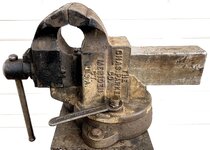
I took possession of my largest vise in my collection today. It is a no name 'Mystery vise'.
There is a similar, but not exactly the same vise in the spreadsheet under the name: Mystery Vise. Owned by Demoman.
Obviously made from the same casting molds. But the nut position and length, the screw/dynamic retraction method are different.

Unfortunately the jaws broke and the vise stayed 'in service'. and under abuse. I will repair, and make new jaws for it.

Specs: 175# [only!].
Jaws: 8-7/8" wide: so a 9" vise.
Opens to 9".
The longest mainscrew nut EVER: 6" of threaded nut! And full length dovetail in the static. Hefty nut retainer pin
The longest continuous machined dynamic slide support surface ever: 14".


32" overall length. Sadly the jaw supports are well-abused. But I will repair, and machine for a set of new Jaws i will make.
Note how the nut fills almost the entire length of the static.
9%22MysteryVise.jpg

this is the longest fully threaded nut I've seen. 6" of threads
9%22ExtraLongNut.jpg

The widest set of jaws in my collection.
9%22Jaw width.jpg


The Dynamic jaw tower is a full 6" wide.
9%22DynamicWidth.jpg


Over 3" diameter hub, and interesting 'sculpted' dynamic.
The mainscrew is retained by a 2" long collar, held in place with setscrews. The handle is new.
9%22SpindleHub.jpg


The dynamic/slide is supported by 14" of machined support surface.
Note the dovetail for the nut running the full length of the static's floor.
9%22FullSurface.jpg

Almost 5" of front jaw/dynamic support.
9%22jawSupport.jpg


If anyone has any ideas about who made and sold this vise, I'd sure like to know more about this beast.
The large pointed mounting ears on the base hint 'Parker' to me.
Demoman's version of this vise has a Parker-like collar retaining the mainscrew hub. But this vise has a simple sleeve with setscrew.

The jaws were apparently like a Desmond Simplex: an inverted 'L' shape. Demoman's vise has a different design jaw insert.
The mainscrew hub is different, but similar to a few other vise makers'.

Anyone have any ideas of the maker?

PierceA
 

454ragtop

Well-known member
Joined
Mar 24, 2008
Messages
5,011
Location
Carver, MA
Nice find Outlaw! I'm not a fan of those anvil vises, not a good vise or a good anvil for the most part, but I like that one and would have picked it up if I came across it,

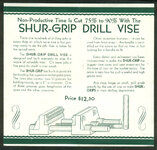
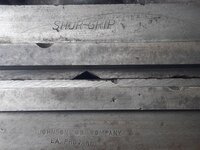
Here's something a little different. I wouldn't normally post a drill press vise here, but this one is a little different, and seems somewhat rare. A google search only turned up that brochure from a cancelled Ebay listing, other than that, crickets. Shur-Grip Drill Vise, made by the Johnson Tool Co. in Ea. Providence, R.I. 5" wide jaws, opens to 5-1/4". Has a clever jaw design with horizontal and vertical vee grooves, and a built in parallel ledges. When I did my search I found ads in old Popular Mechanics (40's) magazines for lead hammer molds to cast your own hammers at home.
 

Attachments

  • ppp0179b.jpg
    ppp0179b.jpg
    179.9 KB · Views: 20
  • ppp0179a.jpg
    ppp0179a.jpg
    72.7 KB · Views: 16
  • 20230821_152501_resized.jpg
    20230821_152501_resized.jpg
    1 MB · Views: 16
  • 20230821_152332_resized.jpg
    20230821_152332_resized.jpg
    740 KB · Views: 17
  • 20230821_152550_resized.jpg
    20230821_152550_resized.jpg
    1.2 MB · Views: 19
  • 20230821_152347_resized.jpg
    20230821_152347_resized.jpg
    1.1 MB · Views: 21

RTM

Well-known member
Joined
May 13, 2019
Messages
13,476
Location
SF Bay Area
Here is another pair of ads for the Shur-Grip Drill


Lots more in Google Books, but only snippet view.
 

F-22

Well-known member
Joined
Jan 23, 2022
Messages
1,830
Back to making Parker jaws and having a ball in my small island shop. I have several more to make and tried out making a set without a CNC and doing all the cuts by hand. Note how I stepped off the top radius on my Bridgeport mill I’ll post a final pic after the vise is done. Restoring 4 different vises at a time. I’ll get them back to work.
The Parker jaws are definitely the most intricate and cool jaws on any vise I've seen.
 

dannyr

Well-known member
Joined
Oct 13, 2019
Messages
284
Location
Sheffield England
I took possession of my largest vise in my collection today. It is a no name 'Mystery vise'.
There is a similar, but not exactly the same vise in the spreadsheet under the name: Mystery Vise. Owned by Demoman.
Obviously made from the same casting molds. But the nut position and length, the screw/dynamic retraction method are different.

Unfortunately the jaws broke and the vise stayed 'in service'. and under abuse. I will repair, and make new jaws for it.

Specs: 175# [only!].
Jaws: 8-7/8" wide: so a 9" vise.
Opens to 9".
The longest mainscrew nut EVER: 6" of threaded nut! And full length dovetail in the static. Hefty nut retainer pin
The longest continuous machined dynamic slide support surface ever: 14".


32" overall length. Sadly the jaw supports are well-abused. But I will repair, and machine for a set of new Jaws i will make.
Note how the nut fills almost the entire length of the static.
9%22MysteryVise.jpg

this is the longest fully threaded nut I've seen. 6" of threads
9%22ExtraLongNut.jpg

The widest set of jaws in my collection.
9%22Jaw width.jpg


The Dynamic jaw tower is a full 6" wide.
9%22DynamicWidth.jpg


Over 3" diameter hub, and interesting 'sculpted' dynamic.
The mainscrew is retained by a 2" long collar, held in place with setscrews. The handle is new.
9%22SpindleHub.jpg


The dynamic/slide is supported by 14" of machined support surface.
Note the dovetail for the nut running the full length of the static's floor.
9%22FullSurface.jpg

Almost 5" of front jaw/dynamic support.
9%22jawSupport.jpg


If anyone has any ideas about who made and sold this vise, I'd sure like to know more about this beast.
The large pointed mounting ears on the base hint 'Parker' to me.
Demoman's version of this vise has a Parker-like collar retaining the mainscrew hub. But this vise has a simple sleeve with setscrew.

The jaws were apparently like a Desmond Simplex: an inverted 'L' shape. Demoman's vise has a different design jaw insert.
The mainscrew hub is different, but similar to a few other vise makers'.

Anyone have any ideas of the maker?

PierceA

!!! - Except for a giant blacksmiths' leg vise, I've never seen a bigger vice - does look like Chas P, but they usually had plenty of lettering - maybe very early (before 1870s) when there were some US vises with no script??

Purely by chance I also snagged a big one last week - totally different - a Geo Herbert of London, England (big weigh-scales outfit, who made some war-effort military vises in 1940s) -- weld fabricated, 6in wide jaws, 1 1/2in diam screw, 4in of nut thread, (welded in), opens to 10ins fully supported and 12ins with enough threads to be safe.


herbert1.JPGherbert2.jpg


I'm sure glad I don't have to do as much work as you, P-Arrow - have neither the tooling nor skills - really look forward to seeing your 'after' shots.

BTW - cost me $25 and just a 50 mile drive - sorry 'bout that.
 
Last edited:

RBarnes

Well-known member
Joined
Mar 2, 2018
Messages
421
Location
Texas
These Reed 406, Reed 405 & Reed 404 rear swivel jaw pins all have the correct opposite taper on the top so they can be placed upside down in the rear jaw hole hole when the jaw is swiveled. Was able to check each one in my 406R , 405 & 404 to make sure they fit correctly.
 

Attachments

  • 20230822_154406.jpg
    20230822_154406.jpg
    1.2 MB · Views: 43

Shiftless

Well-known member
Joined
Mar 9, 2014
Messages
14,883
Location
East Bay SFO
These Reed 406, Reed 405 & Reed 404 rear swivel jaw pins all have the correct opposite taper on the top so they can be placed upside down in the rear jaw hole hole when the jaw is swiveled. Was able to check each one in my 406R , 405 & 404 to make sure they fit correctly.
Looks like you‘re set as far as locking pins go. On user vises, I bet those pins go missing from time to time. I have seen some fellows attach them to the vise body with a lightweight chain.
Does anybody remember back when banks had desks where you could walk up and fill out a deposit or withdrawal slip using one of their long pointy end pens that were attached with a shiny chrome ball chain?
 

master Zoda

Well-known member
Joined
May 31, 2014
Messages
165
Looks like you‘re set as far as locking pins go. On user vises, I bet those pins go missing from time to time. I have seen some fellows attach them to the vise body with a lightweight chain.
Does anybody remember back when banks had desks where you could walk up and fill out a deposit or withdrawal slip using one of their long pointy end pens that were attached with a shiny chrome ball chain?
I hope most of us do or I'm going to feel older than I should.
 

Outlawmws

Well-known member
Joined
Aug 9, 2011
Messages
39,578
Location
The Badlands
Nice find Outlaw! I'm not a fan of those anvil vises, not a good vise or a good anvil for the most part, but I like that one and would have picked it up if I came across it,


Thx 454! Yep, when I see them they are usually the "farmer's anvil/drill vise" and stupid $$ and I'm not a fan, other than as a conversation piece (for cheap...) , I have two better ones that are "hobby shop" class now, but this one really struck my fancy.
 

neophyte

Well-known member
Joined
Apr 23, 2012
Messages
10,031
Location
Pennsylvannia
Looks like you‘re set as far as locking pins go. On user vises, I bet those pins go missing from time to time. I have seen some fellows attach them to the vise body with a lightweight chain.
Does anybody remember back when banks had desks where you could walk up and fill out a deposit or withdrawal slip using one of their long pointy end pens that were attached with a shiny chrome ball chain?
Pens with ball chains attached are still fairly standard at banks.
My local Credit Union and Bank still have the chained pens for filling out deposit forms.
 

RBarnes

Well-known member
Joined
Mar 2, 2018
Messages
421
Location
Texas
Looks like you‘re set as far as locking pins go. On user vises, I bet those pins go missing from time to time. I have seen some fellows attach them to the vise body with a lightweight chain.
Does anybody remember back when banks had desks where you could walk up and fill out a deposit or withdrawal slip using one of their long pointy end pens that were attached with a shiny chrome ball chain?
I remember those pen chains & how a bank use to give you a gift when you opened an account.
 

Shiftless

Well-known member
Joined
Mar 9, 2014
Messages
14,883
Location
East Bay SFO
I remember those pen chains & how a bank use to give you a gift when you opened an account.
No more gifts… now all you get is a letter in the mail saying that they’ve been hacked and your personal information has been compromised.

But enough of that… here is the 3rd coat of dark walnut Watco oil on my Lewis. The porosity in the lettering which was very noticeable in the earlier photos I posted has been almost completely eliminated.

ADEFF75A-D5E3-40DE-954D-1CF087BFEDA3.jpeg
 

PierceA

Well-known member
Joined
Aug 6, 2020
Messages
471
Location
SE Michigan
Outlaw and 454ragtop: I too have several of the 'farmer's Anvil vise'. and they are very poor vises and anvils.
What I like about the Cheney 10 is that the vise could be used carefully as a light duty anvil, AND be a pretty good and precise vise.
The machining on the swivel jaw shows that it is well made.
The sides of the anvil [static] are vertical, and are very rigid with a nice thick bottom edge or foot. I think the Cheney would withstand a great deal more use and hard work than any of the 'farmer's vises' that I have or have seen.

There are not a lot of Detroit tool or vise makers, so I covet the ones I have and am always looking for more..

PierceA.
 

Shiftless

Well-known member
Joined
Mar 9, 2014
Messages
14,883
Location
East Bay SFO
I was using Watco Danish Oil in the 70’s refinishing antique furniture. Try Sculpt Nouveau, this stuff is made for metal. I can see the Natural and Black Walnut might look ok. Can’t beat the Black oil from Sculpt Noveau In my opinion.
Sculpt Nouveaux is an Extremely good product. I heard about it from you a few years ago and watched their videos but I have never tried it. I went with the Watco because I already had most of a quart already on the shelf. I understand it is basically just tinted boiled linseed oil perhaps with some extra Japan drier added.
 
To avoid these ads, REGISTER NOW!

royce

Well-known member
Joined
Jun 22, 2014
Messages
3,112
Location
fairbanks ak
Back to making Parker jaws and having a ball in my small island shop. I have several more to make and tried out making a set without a CNC and doing all the cuts by hand. Note how I stepped off the top radius on my Bridgeport mill I’ll post a final pic after the vise is done. Restoring 4 different vises at a time. I’ll get them back to work.
Sure enough enjoy seeing your work Kevin
Thanks for sharing

Royce
 

Andy FitzGibbon

Well-known member
Joined
Apr 7, 2011
Messages
175
I took possession of my largest vise in my collection today. It is a no name 'Mystery vise'.
There is a similar, but not exactly the same vise in the spreadsheet under the name: Mystery Vise. Owned by Demoman.
Obviously made from the same casting molds. But the nut position and length, the screw/dynamic retraction method are different.

Unfortunately the jaws broke and the vise stayed 'in service'. and under abuse. I will repair, and make new jaws for it.

Specs: 175# [only!].
Jaws: 8-7/8" wide: so a 9" vise.
Opens to 9".
The longest mainscrew nut EVER: 6" of threaded nut! And full length dovetail in the static. Hefty nut retainer pin
The longest continuous machined dynamic slide support surface ever: 14".


32" overall length. Sadly the jaw supports are well-abused. But I will repair, and machine for a set of new Jaws i will make.
Note how the nut fills almost the entire length of the static.
9%22MysteryVise.jpg

this is the longest fully threaded nut I've seen. 6" of threads
9%22ExtraLongNut.jpg

The widest set of jaws in my collection.
9%22Jaw width.jpg


The Dynamic jaw tower is a full 6" wide.
9%22DynamicWidth.jpg


Over 3" diameter hub, and interesting 'sculpted' dynamic.
The mainscrew is retained by a 2" long collar, held in place with setscrews. The handle is new.
9%22SpindleHub.jpg


The dynamic/slide is supported by 14" of machined support surface.
Note the dovetail for the nut running the full length of the static's floor.
9%22FullSurface.jpg

Almost 5" of front jaw/dynamic support.
9%22jawSupport.jpg


If anyone has any ideas about who made and sold this vise, I'd sure like to know more about this beast.
The large pointed mounting ears on the base hint 'Parker' to me.
Demoman's version of this vise has a Parker-like collar retaining the mainscrew hub. But this vise has a simple sleeve with setscrew.

The jaws were apparently like a Desmond Simplex: an inverted 'L' shape. Demoman's vise has a different design jaw insert.
The mainscrew hub is different, but similar to a few other vise makers'.

Anyone have any ideas of the maker?

PierceA

Odd that it weighs so little for the width of the jaws. Most 8" vises of that era are close to 300 lbs. Perhaps it was designed for general shop work, rather than " heavy chipping" cold chisel work that most were intended for.

Very interesting vise. Other than the beaten up jaw supports, it looks to be in pretty good condition.
 

PierceA

Well-known member
Joined
Aug 6, 2020
Messages
471
Location
SE Michigan
Hi Andy F. I've had the same thoughts about it's weight. But when I compare this almost 9" vise to my other very beefy 8" vises, I can see several obvious reasons for the lower weight. One is the length of the slide. The Parker 978, Reed 208 and Morgan 80 all have a much longer slide, and therefor a much wider maximum opening. I think an at least 4"-5" longer slide would be work quite a few pounds of iron, and this would also require a longer mainscrew.
My Parker and Reed are swivel base models and that is another ~30 pounds?
And the interesting 'sculpting' of the sides of the dynamic and static definitely reduce the weight some.
But there is no low-weight characteristics in the mainscrew, hub, or the 50% longer nut on the mainscrew.

I've been wondering if the iron used in the 9" Mystery Vise is nodular iron like used in Columbian and some other later model vises. It can result in a lighter weight vise with strength equal to regular iron.

I do not know if there is a way to test the iron in a vise to determine what type of iron it is. I know the test method to determine steel from iron, but not between different types of iron.

Yes, the vise is in fairly good condition for as ugly as the jaw towers and jaw insert surfaces are.
I'm amazed that the mainscrew and nut are so overbuilt and the result is very little wear and free-play. Even my Parker 978, Morgan 80 and Reed 208 only have about 4" of threaded nut. And the dovetail for the nut is also much shorter, so the nut is not retained in the static's floor as well.
.


PierceA.
 
Last edited:

dieselsmoke

Member
Joined
Jul 25, 2013
Messages
23
Location
North of Pittsburgh PA
Hi Andy F. I've had the same thoughts about it's weight. But when I compare this almost 9" vise to my other very beefy 8" vises, I can see several obvious reasons for the lower weight. One is the length of the slide. The Parker 978, Reed 208 and Morgan 80 all have a much longer slide, and therefor a much wider maximum opening. I think an at least 4"-5" longer slide would be work quite a few pounds of iron, and this would also require a longer mainscrew.
My Parker and Reed are swivel base models and that is another ~30 pounds?
And the interesting 'sculpting' of the sides of the dynamic and static definitely reduce the weight some.
But there is no low-weight characteristics in the mainscrew, hub, or the 50% longer nut on the mainscrew.

I've been wondering if the iron used in the 9" Mystery Vise is nodular iron like used in Columbian and some other later model vises. It can result in a lighter weight vise with strength equal to regular iron.

I do not know if there is a way to test the iron in a vise to determine what type of iron it is. I know the test method to determine steel from iron, but not between different types of iron.

Yes, the vise is in fairly good condition for as ugly as the jaw towers and jaw insert surfaces are.
I'm amazed that the mainscrew and nut are so overbuilt and the result is very little wear and free-play. Even my Parker 978, Morgan 80 and Reed 208 only have about 4" of threaded nut. And the dovetail for the nut is also much shorter, so the nut is not retained in the static's floor as well.
.


PierceA.

To determine if it's nodular for sure, you'd need a sample which can be polished / etched and micrographs taken to look for graphite flakes vs graphite spheres. I don't think you can do it nondestructively and get anything more than "we think," LOL.
 

KMScott

Well-known member
Joined
Feb 14, 2012
Messages
4,656
Location
Daufuskie Island, South Carolina
Here is what I know about Nodular Iron, the rear end housings and Yokes on a Ford 9” were Nodular Iron and when I was racing I had to drill and tap this stuff. Boy was hard to do, did not have carbide taps back in the seventies. I. Was adding jaws to a 2” Miller Falls vise a while back and had the same issue trying to tap the new jaw threads. Maybe try tapping a 10:32 hole underneath the Dynamic, maybe that might let you know. I believe the Nodular Iron work hardens as you run the tap into it. Just my 2cents.
 

Shiftless

Well-known member
Joined
Mar 9, 2014
Messages
14,883
Location
East Bay SFO
Here is a pic of the 100+ year old Lewis #8 I bought from gdocktor3 a few months ago. My son who lives near him in CT picked it up and shipped it to friend and fellow GJ member PierceA who stripped in SG, repaired and brazed the big crack in the swivel jaw including installing 2 threaded screws to reinforce the repair. He also put some weld metal in a busted off corner of one of the jaws as well as welding on a new mounting tab where the old one was broken off. He even straightened the handle with his hydraulic press. Thanks a million for all that work P.A.
It then went again to UPS for the trip from MI to CA. I did some Dremel stone work to fine tune the welds and went on to cosmetics. After scrubbing with Acetone, I experimented with Watco Danish Oil that I burned in with a propane torch for a vintage look. Need less to say, Watco won’t cover up brass or welds so I color matched as best I could with paint in those areas. I didn’t polish the slides and took inspiration for the blackish brown color from those ancient stains.

The second pic is the one the seller posted. Based on that I bought it.
Do you think I’m crazy?
You might be right!

(Yes, I know the swivel lock pin is not there in the back of the swivel jaw, that makes this another display piece unless somebody else wants to take it further than P.A. and I have)

3B139785-8D07-40BA-BDFF-7AF7CB045153.jpeg

998FDB4D-5C23-4644-97D4-2B88FA6CE747.jpeg
 
Last edited:

dieselsmoke

Member
Joined
Jul 25, 2013
Messages
23
Location
North of Pittsburgh PA
Here is what I know about Nodular Iron, the rear end housings and Yokes on a Ford 9” were Nodular Iron and when I was racing I had to drill and tap this stuff. Boy was hard to do, did not have carbide taps back in the seventies. I. Was adding jaws to a 2” Miller Falls vise a while back and had the same issue trying to tap the new jaw threads. Maybe try tapping a 10:32 hole underneath the Dynamic, maybe that might let you know. I believe the Nodular Iron work hardens as you run the tap into it. Just my 2cents.
Nodular is not what you're describing, at all. It's marginally harder, but machines more like a steel with less powdery and more stringy chips. One old name for it is "semi-steel". There are nodular irons with machinability indices from 70 all the way up to 140, so in general, they are very machinable. Work hardening is not really expected, certainly much much less than what you'd find in a 300 series stainless (nasty work hardening). One common ductile iron that a lot of people use these days is slab and rounds from Dura-Bar, and that stuff machines like a dream.

What you ARE describing is quickly solidified cast iron, which when done to the extreme with a chill plate, yields white iron, which is hard, like real hard, like woodpecker lips. Any cast iron that you cool very quickly runs the risk of the carbon not precipitating out as flake or sphere, but stays as iron carbide (cementite). Bad news material!

Now, this is talking garden-variety cast and nodular. If someone adds a bunch of spicy alloy mix into it, both can be manipulated to be less fun to machine.

If you do drill it, you don't need to tap it really. Just look at the chips.
 

KMScott

Well-known member
Joined
Feb 14, 2012
Messages
4,656
Location
Daufuskie Island, South Carolina
Thanks diesel for the describing the quickly solidified cast iron. That must be what I drilled and tapped on my drive shaft yoke and the Miller Falls vise, I was told back in the 70’s that was Nodular Iron they used on reared pumpkins and yokes. I am curious what a chill plate is, maybe water/cooling lines thru the mold?

Maybe you can also shed a light on why many Prentiss and other vises’s have a crack on the center of the tail end of the square slide. My guess is a knit line where the material flows thru the mold and meets up. This is an issue determining where the gate location is in plastic injection molds. Kevin
 

PierceA

Well-known member
Joined
Aug 6, 2020
Messages
471
Location
SE Michigan
Shiftless: you are welcome! I enjoyed repairing your Lewis vise, it was an interesting challenge, and like you, I think it came out as well as it could have.. As long as no one uses it as a mini-anvil, I think it's clamping capabilities are nearly as good as new.
The vise looks quite nice with the Danish oil finish.

Some interesting additional information about Shiftless's Lewis No.8.
As Shift mentioned there is no swivel jaw locking pin. As Shift wrote, it is not there..
Well it was NEVER there! The back of the swivel jaw is solid iron, it was never drilled or machined for the 'Twist, pull, twist to lock' pin.
So the swivel jaw has no machined flat mounting spot or holes for two fasteners or the through-pin.
BUT the static base does have the machined hole to accept a locking pin, if one was installed in the swivel jaw !!

So: what came first: The chicken or the egg? I our case: the drilled static base for a locking pin or the swivel jaw with NO locking pin ever?

My thoughts are that it is possible that the cracked swivel jaw is a factory replacement that was mailed to the owner of the Lewis vise and was installed and put to work as a swiveling jaw without any locking pin.

So it is an odd situation and with as much 'forensic' searching and surmising, the best I can do is guess.
A swivel jaw vise will function just fine without a locking pin. If you put something in the jaws that has parallel sides, it will grip the object just as well with or without a locking pin. So maybe owner/user just didn't need a locking pin assembly?
Unfortunately, on Lewis vises, the locking mechanism is a rather complicated pin/plate assembly. It is NOT a simple single tapered pin like in a typical Reed, Prentiss, Parker, Morgan etc swivel jaw vise uses.
Lewis24inPaint.jpg
You can see the horizontal 't'-handled pin and it's mounting plate on the rear of the swivel jaw. There is another cross pin like the 't' handle visible just outside the mounting plate.. So the parts count for making this locking pin assembly is, 2-cross pins, 1-locking pin, 1- mounting plate, and 2 mounting screws. And it all has to be machined to fit together well to function..

So I think Shift's Lewis is an interesting bit of vise history, in that it apparently was used as a non locking swivel vise, possibly made to order and delivered without a locking pin..

Just guessing at a possible history or explanation.

PierceA
 
Last edited:

PierceA

Well-known member
Joined
Aug 6, 2020
Messages
471
Location
SE Michigan
Dieselsmoke and KScott: Thanks for the discussion about the various types of iron. I will try to do a few 'sample' machining tests on the 'Mystery Vise' to see if i can tell if it is the typical granular/powdery iron or has some strings or curled chips as well, compared to steel that is almost entirely curled string-chips when drilled or machined.

PierceA.
 

dieselsmoke

Member
Joined
Jul 25, 2013
Messages
23
Location
North of Pittsburgh PA
Thanks diesel for the describing the quickly solidified cast iron. That must be what I drilled and tapped on my drive shaft yoke and the Miller Falls vise, I was told back in the 70’s that was Nodular Iron they used on reared pumpkins and yokes. I am curious what a chill plate is, maybe water/cooling lines thru the mold?

Maybe you can also shed a light on why many Prentiss and other vises’s have a crack on the center of the tail end of the square slide. My guess is a knit line where the material flows thru the mold and meets up. This is an issue determining where the gate location is in plastic injection molds. Kevin
A chill can be as simple as a steel plate/block of sufficient size to **** the heat right out of an area quickly. One would just spray some graphite or whatnot carbon on it, and it'll keep it from sticking to the casting. Chill practice is a bit of an art. Later on they would use Chromite or Zirconite sand, which conducts heat away quickly.

Note that all these comments apply to green sand casting. The nodular 9" castings that came way after these antique vises could have been a newer, faster, and much more efficient casting method that I'm guessing would have been centered on "make as many of these as you can per hour" kind of approach because that's automotive production line thinking.

As for the ubiquitous cracking....I have a theory. A few pages back one of the members suggested that the dynamic jaw was cast "down," and I'm not sure that's right. Stare at that jaw long enough and you'll see the axis of symmetry where you would divide the casting between the cope and drag (upper and lower mold halves). If you imagine a vertical plane that slices the dynamic jaw right down it's length (i.e., parallel to the screw), that's the parting plane. You can see it on just about every vise you've ever had. The "rough line" running up and down the jaw faces. So in the mold, you'd have the left half down in the drag and the right half up in the cope (or vise versa, doesn't matter). Point is, it's likely cast on its side. This is also a "easy" position for the core that makes the tunnel for the screw. Going back to another comment I made, that core would be cantilevered out in space, and if the metal would float it or the mold got bounced around on the conveyor line, then core shift could happen, making the top of the slide thinner than intended.

Common gating practice would be to put a riser on the heaviest section - the jaw area itself. The riser is there to feed hot metal into the solidifying casting, and you always use a heavy section to do that because you want to riser to freeze last (otherwise it's of no value). Now, with gray iron, you can get away with a lot because the liquid-to-solid shrinkage is low, relative to other metals like aluminum that shrink 6% or more. So, it could be that the metal was poured into the heavy end of the jaw, and just let run into the back of the mold where the "tail" part of the slide would be. If you poured too cold or too slow or there was no riser applied, then out at the far end of the jaw is relatively speaking, cold metal. I have a vise here that for sure looks like what I would call a "cold shut" with a crack and very rounded edges at the very end. This tells me that the metal didn't stay hot enough to fill that area, which could have been made worse by core shift.

The reason you don't put risers everywhere is that every one has to be removed after the casting is complete, and if one riser does the job, what plant manager would approve two? It's all about efficiency and getting sh*t done in production. Back in those days it would appear that they shipped a lot of "close enough!"
 

F-22

Well-known member
Joined
Jan 23, 2022
Messages
1,830
To determine if it's nodular for sure, you'd need a sample which can be polished / etched and micrographs taken to look for graphite flakes vs graphite spheres. I don't think you can do it nondestructively and get anything more than "we think," LOL.
Could polish up the side of the jaws or the anvil plate and see on the vise itself without cutting off a piece. Or polish up a little part of the underside and see the grain structure with one of those microscope-cameras (I think even ~30x zoom might be enough to distinguish).
Here is what I know about Nodular Iron, the rear end housings and Yokes on a Ford 9” were Nodular Iron and when I was racing I had to drill and tap this stuff. Boy was hard to do, did not have carbide taps back in the seventies. I. Was adding jaws to a 2” Miller Falls vise a while back and had the same issue trying to tap the new jaw threads. Maybe try tapping a 10:32 hole underneath the Dynamic, maybe that might let you know. I believe the Nodular Iron work hardens as you run the tap into it. Just my 2cents.
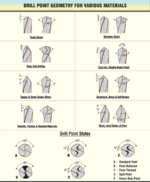
As other said, castings are nasty business and there's a ton of factors involved in it. Drills and taps specifically designed for cast iron definitely exist to make the job easier. The drill is a very unique double-angle design when compared to average drills for steel and other metals.

drill.PNG
 

diman

Member
Joined
Mar 12, 2023
Messages
7
Hi everyone, just picked up my first vintage American vise today.
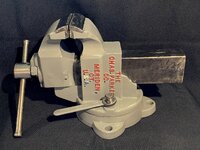
It's a 4" American Scale Co, No 76 with a swivel top jaw and base.

IMG_9201.png

I'm going to proceed with a complete disassembly to clean everything, strip the remains of old gray paint (not sure if it's original paint or not, but there is just one layer I can see) and then repaint.
 

master Zoda

Well-known member
Joined
May 31, 2014
Messages
165
Hi everyone, just picked up my first vintage American vise today.
It's a 4" American Scale Co, No 76 with a swivel top jaw and base.

IMG_9201.png

I'm going to proceed with a complete disassembly to clean everything, strip the remains of old gray paint (not sure if it's original paint or not, but there is just one layer I can see) and then repaint.
Very nice. Looks to be in great shape.
 

antman213

Well-known member
Joined
Nov 19, 2017
Messages
328
Hi everyone, just picked up my first vintage American vise today.
It's a 4" American Scale Co, No 76 with a swivel top jaw and base.

IMG_9201.png

I'm going to proceed with a complete disassembly to clean everything, strip the remains of old gray paint (not sure if it's original paint or not, but there is just one layer I can see) and then repaint.
Was this in NJ by chance?
 

ldg397

Active member
Joined
Jul 17, 2018
Messages
39
Location
College Station, TX
I am working on a vise stand from semi brake drum. I wanted to make the top mounting plate capable of bolting various things to it. I read through the stand threads. Wondering if anyone came up with a slotted hole pattern that would fit most bolt patterns.
 

Shiftless

Well-known member
Joined
Mar 9, 2014
Messages
14,883
Location
East Bay SFO
I’ve seen this strategy before:

1. Figure out what tools you want to bolt to that stand.
2. Attach each of those to a piece of steel or wood with the same dimensions.
3. Drill one set of holes through the top plate of your stand and the various tool mounting plates to match up.
 
To avoid these ads, REGISTER NOW!
Top Bottom