Finallygotit
ALLIANCE MEMBER
Happy belated birthday Bob! 


 .... you're not that old......
John, thank you. Every year it comes as a pleasant surprise.Happy belated Birthday.
I was quite surprised that TigerDirect shutdown a few months ago, I bought several things from them over the years.
Andrew, no worries. I have multiple reminders for my immediate family members and close friends yet I still mail cards late. I need to convince my family Venmo is a caring substitute.Goddamn. I missed your birthday even though I have it on my calendar.
Regardless I hope it was a great one.
Thank you Dan!Happy belated birthday Bob!
Thank you Hewey!Happy birthday Bob!
Roger, thanks for that. Our family seems to be into the 18th day of the month. Liane and I are both born on that day of the month as is one of our granddaughters. Our grandson has scheduled his wedding on the 18th. We're in good company because Don Long's birthday is also on the 18th.Happy, Happy Birthday, Bob! Wishing you all the best. Liane too - even though it's not her birthday.
Thank you @bugnut, my family is encouraging me to continue as well.Well, late to the party. Bob, here's to many more birthdays for you. Your spirit and candor are much appreciated.
Thanks Steve! Should I be expecting a King Charles Fruitcake or trifle, made with Scottish strawberries, Yorkshire Parkin cake, and eggs and dairy from British farmers.Happy birthday Bob.
The cake is in the post.
Steve

Mark, I try to get in that state of mind by counting to 18. I'm seven years into my fifth attempt at adulthood.Dammit @Bob Heine, I missed the date. Well, Happy 29th anniversary of your 50th Birthday
You left out a Spotted ****.Thanks Steve! Should I be expecting a King Charles Fruitcake or trifle, made with Scottish strawberries, Yorkshire Parkin cake, and eggs and dairy from British farmers.
Well happy near-birthday!
Some day I'm going to be able to tell my old PC building stories, too. I lost count, but my guess is that I've built about 50 for myself, friends, and family over the years. It started with my first build, when my brother and I drove down to Seattle to buy one of the first original AMD Athlon chips that we found by scouring the classifieds in the back of a PC Magazine. Shortly after, I got into first 3D CAD and then 4D CAD, and the Sisyphian quest for MOAR POWAH began. I would have bet pretty good money at the time (turn of the century) that I had the fastest computer on my college's campus. I was buying cherry-picked chips (known by serial number to be overclockable to ridiculous lengths under massive coolers that were louder than a vacuum cleaner).
I remember a particular 3D Studio Max scene I was trying to render. It was a maybe 15 second long clip that was raytraced and involved a particle physics simulation with multiple child emitters on collisions. Rendering the scene would take about 36 hours, then I'd watch it, not like it, tweak a setting or two, run it again, wait 36 more hours, rinse, repeat. This went on for about a month, and I never got a scene that I liked.
Things have definitely come a long way since then! I bet my cheap phone is more powerful.

 www.theonion.com

Andrew, it has been one-armed paper hanger time around the Heine home. Monday I took Liane in for pre-op blood tests. Tuesday I took her to the hospital for a Partial Nephrectomy of her right kidney. Robotic surgery took about 4 hours so I was at the hospital before and after the procedure but went home while she was in the operating room. Wednesday was 12 hours at Liane's semi-private bedside except for two trips home for Jasmine feeding and walking and my quicky blood test at the Cancer Center. Thursday was a half day at Liane's bedside. Started the day with a visit to my dentist and once Liane was settled at home, a return visit with the dentist.Kinda quiet around here. All OK Bob?
Scott, a Spotted **** would make my day. As yummy as a suet, dried fruit, flour, sugar, milk, baking powder pudding sounds, a Garage Journal friend of mine and yours topped it by a mile.You left out a Spotted ****.
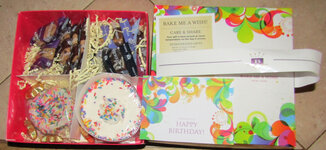
Happy birthday Bob.
The cake is in the post.
Steve
Emil, thank you and don't worry, I actually celebrate every day I get, whethere they are milestones or millstones. Every day is a gift, even when it's a flaming bag of poop. There's a nip in the air today -- it's 79° 98% (it's raining so the humidity might be off by a point or two). Liane is home so the house is currently a balmy 83° but it's a dry (45%) heat!Bob. Happy Belated Birthday. Good call on staying indoors during your heat wave. Our temp tonight is still above freezing but it Is coming But I heard it will be a dry cold when it finally happens.
Thank you Logan! Some years are more fun than others but I try to remember the highs and forget the lows. I've learned not to stomp on the flaming bag of poop days because it doesn't make them go away, it just spreads the mess.Happy belated birthday good sir! Here is to another trip around the sun and another year of hitting out of pocket maximums and beyond while regaling us with your amazing attitude and great stories!
Tom, I never had the fastest home computer but I do remember thinking I was hot stuff running a sort using the dual 5.25" 320 KB floppy disks in my first PC. Program ran on one diskette and you manipulated the data on the second. Mind you, 320KB diskettes were "double density." If you were cheap, the single density diskettes only held 160KB. As painfully slow as the sort was, printing out the results of the sort was at least as painful using a dot-matrix printer with tractor-feed paper. Being a big spender, I went with three-part carbon-less paper (white, yellow, pink).Well happy near-birthday!
Some day I'm going to be able to tell my old PC building stories, too. I lost count, but my guess is that I've built about 50 for myself, friends, and family over the years. It started with my first build, when my brother and I drove down to Seattle to buy one of the first original AMD Athlon chips that we found by scouring the classifieds in the back of a PC Magazine. Shortly after, I got into first 3D CAD and then 4D CAD, and the Sisyphian quest for MOAR POWAH began. I would have bet pretty good money at the time (turn of the century) that I had the fastest computer on my college's campus. I was buying cherry-picked chips (known by serial number to be overclockable to ridiculous lengths under massive coolers that were louder than a vacuum cleaner).
I remember a particular 3D Studio Max scene I was trying to render. It was a maybe 15 second long clip that was raytraced and involved a particle physics simulation with multiple child emitters on collisions. Rendering the scene would take about 36 hours, then I'd watch it, not like it, tweak a setting or two, run it again, wait 36 more hours, rinse, repeat. This went on for about a month, and I never got a scene that I liked.
Things have definitely come a long way since then! I bet my cheap phone is more powerful.
Thanks for checkin' in Drives. Liane was up and walking the morning after her surgery. It wouldn't be a big deal if our next birthdays were not starting with an 8.just checking in to make sure you're still kickin. looks like you are and your bride is too so beat this junk and get back to going to birthday parties and family outings.
here's to another round of 18's.
I'm on my 49th anniversary of my 18th and in a couple months my 50th which is about 30 more than I thought I'd make it. one good day at a time.
hope the hurricanes keep missing you!!
@Squankum, right up there with Westfield Whip.To a future generation, this is going to sound like "Excelsior No. 14 butter churn."
Old Folks At Home
Long life is the ardent desire of many. Indeed, some of you may achieve it, as I have. But once you find your-self out-living your pet Galapagos tortoise, you may do well to question your luck.
Mike, thank you and no worries. They are coming so close to each other I'm thinking it would be nice if I missed a couple.Happy belated Birthday Bob. Sorry I missed it last week.
Hope you had a great day and the misses spoiled ya.
It was a good day but much like every other day Liane spoiled me.
Tom, I never had the fastest home computer but I do remember thinking I was hot stuff running a sort using the dual 5.25" 320 KB floppy disks in my first PC. Program ran on one diskette and you manipulated the data on the second. Mind you, 320KB diskettes were "double density." If you were cheap, the single density diskettes only held 160KB. As painfully slow as the sort was, printing out the results of the sort was at least as painful using a dot-matrix printer with tractor-feed paper.
Mike, I'm finding decades are much shorter as well.And I'm sure you do the same. Glad to hear you had a good birthday.
I agree about them starting to come too close together.
@Squankum, sounds like I was your dad's age. The project I volunteered to do was computerize a state convention for Corvette clubs. I bought some off-brand software package that provided a word processor, spreadsheet, database, graphics presentation and whatever else Lotus and Microsoft were providing but at less than half the price. I had databases for registration, car show judging, drag racing, autocrossing and a bunch of stuff I'm forgetting. The convention took place at Sebring so I set up in the timing tower. Had to drive our Lincoln Town Car to the event to get all the equipment there. I ended up eating and sleeping in the timing tower, waiting for database sorts to finish, spreadsheets to print. In the course of the seven days I may have eaten two hot meals. Someone commented: "It's Monday, pork rinds and beer coming right up!"Bob, you just reminded me of a story of the early days of personal computing. My dad got an Apple II+ for his basement office, also for me to learn Computer Stuff, because it’s The Future. (He was right, but I failed to keep up with technology when I was broke in my early 20’s and that was a bad cycle… also, I was more interested in cars and bicycles. Oh well.)
So in addition to office stuff, he wanted to see if this new computer could do some calculus for him. (Linear regression? I really do forget what it was called.) He was designing ocean-going sailboats for his future self in his spare time, and wanted to calculate the areas of cross sections of various points along the hull. So he ordered some software that said it could do that kind of math for him, from an outfit out in CA, based on a little print ad in the back of a computer magazine.
It arrived,and we put the 5.25” floppy into the drive and thus began the whirring and shuddering and red LED-light lighting. For about 20 minutes. We sat there in the basement (maybe watching TV) and asking each other, “Is this normal?” “I dunno, maybe it’s a big program?” “Yeah, we never bought math software before.”
Eventually it got through our thick skulls that things just weren’t right. He called the software business, and they agreed, this wasn’t right. At some point in the coming months were were headed out west to Palo Alto anyway so we stopped by that office and they took a peek at the disks and gave us the software on new discs. This software company, IIRC, was a few guys in an office. It was the early 80’s.
He never really enjoyed that machine, but a few years later, as I was headed off to college, he bought the first Macintosh, 128K? And he lovvvvvved it. And soon after he was buying the external hard drive rather than shuffle mini discs in and out of it all the time.

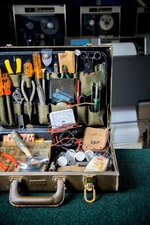
I took this photo a few years ago in the IBM 1401 restoration lab at the Computer History Museum in California. It’s a suitcase with all the tools necessary to operate your computer… in the 1950s. Most of the items are official and branded, even. (With one exception: the hammer. IBM claimed it shouldn’t be necessary; the repairmen knew better.)
Thanks for stopping by Hewey! Liane is recovering slowly but without any setbacks. It's hard to tell there's progress on a day-to-day basis but she says she feels a lot better today than the day after the surgery.Good to see you staying productive between assisting Liane. Hope her recovery goes well.
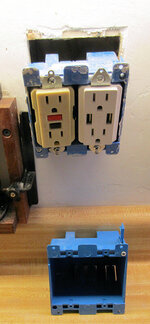
Thanks for visiting Mat! The article is right about us using a hammer but our toolkit didn't come with one. The one in the picture would be very rare because a claw on a hammer was useless at IBM. When I started in 1964, the big insurance companies in New York City, like Metropolitan Life and New York Life, they were using huge IBM 705 tube-based computers, like this one but with six or eight cabinets.Hey Bob,
I was just reading this, for some reason, and a photo caught my eye.
With all this talk of fixing computers, I thought you might appreciate it.



Believe it or not, someone in the computer center probably just stuck your mangled decks into a sorter, and several minutes later had a viable deck. At one time in my career, that was my primary function, fixing bad decks.While we're all hijacking Bob's thread with pre historic computing stories ,,,,
I had a career in government, mostly in the health and human services areas. My first role at the bottom of the public sector food chain in 1973 was in what then called the Department of Social Security which dished out welfare benefits like unemployment benefits, aged pensions etc. My initial duties included transcribing paper benefit application forms onto coding sheets and taking them to a room full of data processing operators (DPO's) who produced computer punch cards – rectangular bits of cardboard with small squares punched out of them - from them.
I'll digress here to note that the DPO's were all young ladies which would have ordinarily lead to 17 year old me kind of hanging around a bit longer than strictly necessary but any ideas I and my colleagues had in this vein were countered by a menacingly fearsome old dragon who supervised these girls and was most intolerant of long haired louts like me taking up space she required for other purposes.
Each afternoon I had to return to the DPO centre and collect these punch cards and deliver them to the computer centre, which consisted of a single computer, the only one DSS had in Victoria, which took up half a floor and probably had less processing power than the thing that opens my car door. The cards were in long metal drawers which were fed into the side of the computer which then ran overnight and produced benefit cheques. It was impressed upon me that there was more than one card for each beneficiary, as well as batch or header cards or something and that these cards had to stay in order and the right way up and the right way round.
One day the inevitable happened. As I traversed “The Link” the bridge that linked the two blocks of the Commonwealth Centre office block across a lino floor that shone like glass as a result of the army of cleaners employed by the Dept of Admin Services. I went **** over and spilled two of these drawers. As the floor had a lower friction coefficient than Bob's Corvette the cards spread a couple of cricket pitches (a local colloquialism, 44 yards) along this corridor in complete disarray. So I scooped them up as quickly as I could and stuffed them back in the drawers without anyone else seeing this disaster, but inevitably in the wrong order and wrong way round and wrong way up. In the absence of any better ideas I delivered them to the computer centre and went back to my desk. I guess I should have reported this disaster to my superiors but didn’t, just waited for the sky to fall in.
It never did. Nothing happened. I have to assume that a bunch of beneficiaries didn’t get their cheque. Part of the process was that I recovered the coding sheets from which the punch cards were generated and filed them in batches for each day. I kept expecting someone to turn up and tell me the coding sheets for the day in question had to be done again but nothing ever happened. It’s inconceivable that anyone would have been able to put the cards back in the proper order in the drawers and I doubt the punch card machines had any memory in those days. So I don’t know what happened.
Later in my career at more senior levels I was responsible for, amongst other things, IT in a large government agency of 3.000 odd people and 180 locations. I knew nothing about IT but fortunately I had some very competent propeller heads as I used to call them at the next management level down. I used to tell new IT staff during induction that I started my career in IT and would then relate this story.
Earlier this year I was trying to do something online in regard to my Mum's aged pension and the system couldn't cope with an unusual, but hardly unique, aspect of Mum's financial affairs. After a fruitless wait on the phone for some assistance I ventured down to the local Centrelink office (Centrelink being the agency that is the current descendent of the DSS in which I started work). After an hour or so waiting for my number to be called I explained my problem to a pleasant lady who initially tried to do online what I had been unable to and ran into the same problem. She went away to consult someone else and came back and said apologetically that the only solution she could offer was a paper form to complete which she would then ensure was processed manually and promptly. I told her I had started my career in basically the same agency 50 years earlier processing paper forms and had now come full circle. She was amused. I didn't include the bit about my punch card disaster.

Well there you go. I always figured it must have been sorted out but never knew how or by whom. The enormous computer produced benefit cheques on big sheets with perforations between each cheque and holes down the sides for some sort of tractor mechanism. We sometimes scored some overtime manually separating and enveloping these cheques when some other magic machine that usually did this broke down.Believe it or not, someone in the computer center probably just stuck your mangled decks into a sorter, and several minutes later had a viable deck. At one time in my career, that was my primary function, fixing bad decks.
Sounds like what I experienced as a reliability engineer at a directional drilling company. We had computer boards that was encased in solid foam that was called Q-Pak Boards among the company. Due to the vibration downhole, the tools would come back with vibration dust between the foam and the metal housing. Per procedure the boards had to be changed out due to the movement of the board/foam under vibration as indicated by the dust. So, one day I was in the shop and before assembly, I applied several layers of kapton tape, similar to the tape that would be used in powercoating to keep bare area from getting coated, to a board in one of the cluster of boards and we sent the tool out the door. When the tool arrived back in the shop it was noticed that there was no dust present on the boards that I applied the tape to and the board that didn't have tape on it was coated in dust. So, it was implemented across the US and the maintenance cost of the tool went down all because of a little tape was used to jam the board tighter in the housing. Reliability of the tool was increased due to lower failures of the boards.Bob, your diagnostic lesson brings back fond memories.
Back in the day, I used to run a Univac computer that was comprised of hundreds of "mini-boards", that were very insufficiently anchored. Temperature fluctuations, due to the entire computer center being offline over night and on the weekends would wreak havoc with it. The temperature changes would slowly inch the boards out of their sockets. It was a massively slow race to death. There were several distinctive patterns to the status lights when a board would disconnect.
For some unknown reason, staff would instantly call the mother-ship, and wait. The tech would only ever set the miscreant board, and then leave. This would delay things for hours, really putting the monkey in the wrench works. And there was no OT or weekend work. The lights went out at the end of the day, and that was it. They were massively behind, and the management was having daily hissy fits.
I was hired, and while watching things happen, figured out what the problem was. One day, I was alone in the machine room, when it died again. I just opened the doors and started slapping boards, discovering that all the boards were working their way out. As soon as the errant board was seated, the status display cleared, and I could initiate restart procedure from the last step, and we were off. Of course, this was unapproved behavior. And was hard to do, because I was rarely alone with the machine.
One day, I was fishing in the dumpster for goodies, and came across some really solid Styrofoam. I had a brain wave. So, over a weekend, when no one was supposed to be there, I cut the foam in strips big enough to wedge the boards in place, but not restrict airflow. And closed the doors. I lit the system, just to see, and all seemed fine. It stayed fine for my entire tenure there, much to the dismay of the rest of the operations staff. We were pretty much caught up by the time I left.
I never told anyone about it, but wrote a letter to Sperry/Univac describing my alterations. Do you know that there was a pricey update to those machines a few months later? It was called a reliability improvement package. It was some really nicely cast foam blocks that restrained the boards.
Sometimes the best fixes are the simplest ones, I'm sure you saving the company millions resulted in a huge bonus too.Sounds like what I experienced as a reliability engineer at a directional drilling company. We had computer boards that was encased in solid foam that was called Q-Pak Boards among the company. Due to the vibration downhole, the tools would come back with vibration dust between the foam and the metal housing. Per procedure the boards had to be changed out due to the movement of the board/foam under vibration as indicated by the dust. So, one day I was in the shop and before assembly, I applied several layers of kapton tape, similar to the tape that would be used in powercoating to keep bare area from getting coated, to a board in one of the cluster of boards and we sent the tool out the door. When the tool arrived back in the shop it was noticed that there was no dust present on the boards that I applied the tape to and the board that didn't have tape on it was coated in dust. So, it was implemented across the US and the maintenance cost of the tool went down all because of a little tape was used to jam the board tighter in the housing. Reliability of the tool was increased due to lower failures of the boards.
HAHAHAHAHAHAHASometimes the best fixes are the simplest ones, I'm sure you saving the company millions resulted in a huge bonus too.
JB
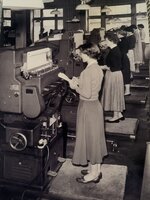
Steve, I love it! I wasn't trained to fix those beasts. Not even sure they are IBM machines but everything back then was relays and gear trains. Thomas J. Watson, IBM's CEO, kept everyone employed (at reduced hours & pay) during the Great Depression. No one was buying IBM's machines so they were put in warehouses in Endicott, New York. When Social Security was first established, IBM won the contract to provide all the tabulating, recording and 'computing' machines because it was the only company with enough equipment to fill the contract. Some of the IBM equipment back then sounded like a meat grinder with all the gears, levers and punches. They also had wiring that would make most of us run screaming from the room. Here, a young lady is wiring up an IBM 405 Accounting Machine.Bob, hope you don’t mind me sharing this photo
It’s the Prudential Insurance company, in central London, computer room c1952 ish.
My aunt is the lady far right, with her team of girls. She was born 1932 and would have been 20 here. She started work for them aged 14
and retired at 60. She’s 91 and has been taking a good company pension for the last 31 years, bet they didn’t see that coming
Steve

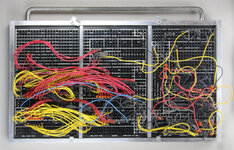
Leonard, I suspect the Program Plug Boards from those old Accounting Machines would fit well in Sci Fi movies. This board was wired to do tax preparation. Some of the boards that did real critical calculations had covers welded to the frame. Moving a wire over one digit could create havoc.
Reminds me of the original Star Trek series set pieces.
Kay, back in the day many of the fixes for problems with computers were bizarre. In New York City they tended to be over the top. Early in 1965 I visited a little shop in lower Manhattan that had lots of really old equipment and quite a few brand new System/360 computers. It also had DC (direct current) power in the building. When the owner was told his new computers needed raised floors and air conditioning, he threw up some walls, installed a wooden raised floor and hung several window air conditioners on the new walls. It was a hot place to work if you weren't in the computer room. Someone pointed to a keypunch machine when I asked what needed to be fixed. I walked over, turned it on and everything went quiet. Apparently every keypunch was powered in series and the limit for how many machines could run at the same time was one less than the total number of keypunches on the floor. Owner of the place, dressed in dirty bib coveralls, came over to give me hell -- turns out the building fuses were real hard to come by and quite expensive.Bob, your diagnostic lesson brings back fond memories.
Back in the day, I used to run a Univac computer that was comprised of hundreds of "mini-boards", that were very insufficiently anchored. Temperature fluctuations, due to the entire computer center being offline over night and on the weekends would wreak havoc with it. The temperature changes would slowly inch the boards out of their sockets. It was a massively slow race to death. There were several distinctive patterns to the status lights when a board would disconnect.
For some unknown reason, staff would instantly call the mother-ship, and wait. The tech would only ever set the miscreant board, and then leave. This would delay things for hours, really putting the monkey in the wrench works. And there was no OT or weekend work. The lights went out at the end of the day, and that was it. They were massively behind, and the management was having daily hissy fits.
I was hired, and while watching things happen, figured out what the problem was. One day, I was alone in the machine room, when it died again. I just opened the doors and started slapping boards, discovering that all the boards were working their way out. As soon as the errant board was seated, the status display cleared, and I could initiate restart procedure from the last step, and we were off. Of course, this was unapproved behavior. And was hard to do, because I was rarely alone with the machine.
One day, I was fishing in the dumpster for goodies, and came across some really solid Styrofoam. I had a brain wave. So, over a weekend, when no one was supposed to be there, I cut the foam in strips big enough to wedge the boards in place, but not restrict airflow. And closed the doors. I lit the system, just to see, and all seemed fine. It stayed fine for my entire tenure there, much to the dismay of the rest of the operations staff. We were pretty much caught up by the time I left.
I never told anyone about it, but wrote a letter to Sperry/Univac describing my alterations. Do you know that there was a pricey update to those machines a few months later? It was called a reliability improvement package. It was some really nicely cast foam blocks that restrained the boards.
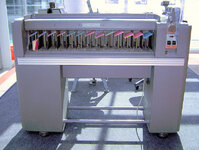
Geoff, your story is not unique and the only salvation back then were some amazing IBM sorters. In 1925 IBM came out with the 080 sorter, which could sort a single colum on a punched card at the rate of 450 cards per minute. I never came across one in the wild but I worked on a bunch of 082 sorters that moved 650 cards a minute. The ultimate sorter was the 084, which moved 2000 cards a minute. It had the same card moving mechanism as earlier models but with vacuum chambers to hold the card on its way into the machine, rather than relying on a card-size weight at the top of the stack of cards. Back in the day movies and TV shows had closeups of Tape Drives whirling and sorters flipping cards to impress viewers with computer technology. The 982 Sorter looked like this.While we're all hijacking Bob's thread with pre historic computing stories ,,,,
I had a career in government, mostly in the health and human services areas. My first role at the bottom of the public sector food chain in 1973 was in what then called the Department of Social Security which dished out welfare benefits like unemployment benefits, aged pensions etc. My initial duties included transcribing paper benefit application forms onto coding sheets and taking them to a room full of data processing operators (DPO's) who produced computer punch cards – rectangular bits of cardboard with small squares punched out of them - from them.
I'll digress here to note that the DPO's were all young ladies which would have ordinarily lead to 17 year old me kind of hanging around a bit longer than strictly necessary but any ideas I and my colleagues had in this vein were countered by a menacingly fearsome old dragon who supervised these girls and was most intolerant of long haired louts like me taking up space she required for other purposes.
Each afternoon I had to return to the DPO centre and collect these punch cards and deliver them to the computer centre, which consisted of a single computer, the only one DSS had in Victoria, which took up half a floor and probably had less processing power than the thing that opens my car door. The cards were in long metal drawers which were fed into the side of the computer which then ran overnight and produced benefit cheques. It was impressed upon me that there was more than one card for each beneficiary, as well as batch or header cards or something and that these cards had to stay in order and the right way up and the right way round.
One day the inevitable happened. As I traversed “The Link” the bridge that linked the two blocks of the Commonwealth Centre office block across a lino floor that shone like glass as a result of the army of cleaners employed by the Dept of Admin Services. I went **** over and spilled two of these drawers. As the floor had a lower friction coefficient than Bob's Corvette the cards spread a couple of cricket pitches (a local colloquialism, 44 yards) along this corridor in complete disarray. So I scooped them up as quickly as I could and stuffed them back in the drawers without anyone else seeing this disaster, but inevitably in the wrong order and wrong way round and wrong way up. In the absence of any better ideas I delivered them to the computer centre and went back to my desk. I guess I should have reported this disaster to my superiors but didn’t, just waited for the sky to fall in.
It never did. Nothing happened. I have to assume that a bunch of beneficiaries didn’t get their cheque. Part of the process was that I recovered the coding sheets from which the punch cards were generated and filed them in batches for each day. I kept expecting someone to turn up and tell me the coding sheets for the day in question had to be done again but nothing ever happened. It’s inconceivable that anyone would have been able to put the cards back in the proper order in the drawers and I doubt the punch card machines had any memory in those days. So I don’t know what happened.
Later in my career at more senior levels I was responsible for, amongst other things, IT in a large government agency of 3.000 odd people and 180 locations. I knew nothing about IT but fortunately I had some very competent propeller heads as I used to call them at the next management level down. I used to tell new IT staff during induction that I started my career in IT and would then relate this story.
Earlier this year I was trying to do something online in regard to my Mum's aged pension and the system couldn't cope with an unusual, but hardly unique, aspect of Mum's financial affairs. After a fruitless wait on the phone for some assistance I ventured down to the local Centrelink office (Centrelink being the agency that is the current descendent of the DSS in which I started work). After an hour or so waiting for my number to be called I explained my problem to a pleasant lady who initially tried to do online what I had been unable to and ran into the same problem. She went away to consult someone else and came back and said apologetically that the only solution she could offer was a paper form to complete which she would then ensure was processed manually and promptly. I told her I had started my career in basically the same agency 50 years earlier processing paper forms and had now come full circle. She was amused. I didn't include the bit about my punch card disaster.
Kay, you'r spot on and the cards in those decks usually had a sequence field with less than a dozen columns needing to be sorted to get everything back in order. The cards themselves had a diagonal cut on the upper left corner so any cards that were backwards or upside down were easy to spot in the stack.Believe it or not, someone in the computer center probably just stuck your mangled decks into a sorter, and several minutes later had a viable deck. At one time in my career, that was my primary function, fixing bad decks.
Geoff, those IBM 1403 printers were amazing. They used a chain of characters that whipped across the page at a phenominal rate and hammers behind the paper hit the paper at the instant a particular character arrived at the right spot. It was a mechhanical beast and very noisy. I think every datacenter that used them had a program that printed gibberish but played a tune. JC Penney had multiple printers so they tried running a chorus at Christmas time. In 1959, IBM leased those printers for $6,500 a month ($68,500 in today's money). Here's one opened up showing the paper, the ribbon (the chain is peeking out the end) and the carriage control tap on the top right.Well there you go. I always figured it must have been sorted out but never knew how or by whom. The enormous computer produced benefit cheques on big sheets with perforations between each cheque and holes down the sides for some sort of tractor mechanism. We sometimes scored some overtime manually separating and enveloping these cheques when some other magic machine that usually did this broke down.

Cody, we had a Suggestion Department at IBM and you could submit those kind of ideas and be rewarded. I never got a monetary reward for my suggestions but I did get a hand-held electronic calculator with a big E logo on it (short for Excellence Award).Sounds like what I experienced as a reliability engineer at a directional drilling company. We had computer boards that was encased in solid foam that was called Q-Pak Boards among the company. Due to the vibration downhole, the tools would come back with vibration dust between the foam and the metal housing. Per procedure the boards had to be changed out due to the movement of the board/foam under vibration as indicated by the dust. So, one day I was in the shop and before assembly, I applied several layers of kapton tape, similar to the tape that would be used in powercoating to keep bare area from getting coated, to a board in one of the cluster of boards and we sent the tool out the door. When the tool arrived back in the shop it was noticed that there was no dust present on the boards that I applied the tape to and the board that didn't have tape on it was coated in dust. So, it was implemented across the US and the maintenance cost of the tool went down all because of a little tape was used to jam the board tighter in the housing. Reliability of the tool was increased due to lower failures of the boards.
Mark, when I was exiled to East Fishkill, New York after my accident, they had an IBM Executive typewriter at my desk. WhiteOut® corrected my mistakes and each draft of a manual involved a whole new typed set of pages. When the manual was finished and approved, I turned it over to an "Editorial Assistant" who typed it up on manuscript pages. Those pages got the final artwork pasted in and eventially it went to the print department. I somehow talked my managers into getting me an MTST (Magnetic Tape Selectric Typewriter) that allowed me to make changes on the fly. It did involve two tape drives so the old version went on the right side tape recorder so I could copy the good text to the left side, stopping each time to record additional or changed text before continuing to copy from the right side tape. I looked like a whirling dirvish running that machine.When I was in College, punch cards were the source of many all-nighter programming assignments. As mainframe time was scarce and took forever to get a program to run, we used to start late in the evenings when usage slowed down so we could de-bug our programs quicker. It could be a royal pain in the *** when your only error was punctuation that you couldn't always spot. Later in my college life, I did a independent study with one of my professors. Of course, he had mainframe terminal priviledges which I took advantage of. It allowed me to type up all the cards on a terminal and send them to an automatic punch card machine. Of course the programming had nothing to do with my independent study, but who was I to complain about the usage of priviledges.....
For another class, we used terminals to work on our programs. It had a messaging function like the old AOL instant messenger, now like we use on Microsoft Teams. I was deep in conversation with a co-ed, but she (I was hoping) was not in the same terminal room. I don't remember how, but figured out where she was located. I ran over to that location and continued the conversation, carefully observing others in the room to figure out who it was. She was a she, but turned out to be "coyote ugly". I did have my standards. On hindsight, I guess I ghosted her, as once I got a look, my fingers got real tired all of a sudden.....
JB, the standard thank you is: "We upped our income because of you, now up yours!"Sometimes the best fixes are the simplest ones, I'm sure you saving the company millions resulted in a huge bonus too.
JB
Cody, you are supposed to be grateful for the interesting and challenging work you've been given. Expecting anything extra is just plain greedy.HAHAHAHAHAHAHA
oh you were serious about the bonus. Naw it was considered my job so it helped everyone get their couple of thousand dollar bonus at the end cause we hit our department goals, while the company made Millions off that year.
Kay, the official name was of the language was Termtext. The Document Composition Facility software subsumed TermText after I left East Fishkill, NY for Boca Raton, FL. Termtext, using a photocomposer system, produced documents on foot-wide glossy Kodak paper. With all the proportional fonts and multi-column capabilities I transformed 500-page manuals into 200-page documents and made them easier to read (50-70 characters per line is easier to read than 132 characters per line).Oh, when you did the manuals, was it DCF that you used? It was one of my favorites, and had a very HTML-ish markup language, GML IIRC.
I used DCF and GML to do automated composition on the state budget document. I had at least half a million lines of VM/REXX and pipes code to convert collections of text files into a gorgeous document ready for a photo negative print process. Then along came PC-based WYSIWYG types of document software, and the fools jumped ship. I won national awards with my auto-compositing, that Turd Ferpect and others could never match.Kay, the official name was of the language was Termtext. The Document Composition Facility software subsumed TermText after I left East Fishkill, NY for Boca Raton, FL. Termtext, using a photocomposer system, produced documents on foot-wide glossy Kodak paper. With all the proportional fonts and multi-column capabilities I transformed 500-page manuals into 200-page documents and made them easier to read (50-70 characters per line is easier to read than 132 characters per line).
Marketing had me do a few presentations to big customers with serious documentation needs, like pharmaceutical and insurance companies. Went to lunch at a fancy restaurant after the presentation. Waitress came to me first to ask what I wanted to drink. Knowing IBM's strict 'no alcoholic beverages' rule I asked for a Diet Coke. Every single IBMer and customer asked for a Manhattan, Martini, Scotch or Bourbon. When she finished going around the table I raised a finger and asked for Scotch on the rocks. This was in the early '70s.