metalmagpie
Well-known member
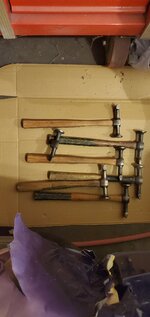
I acquired a pair of auto body hammers from an estate sale some time ago, mostly because they looked cool to me. I know squat about hammering sheet metal. One of these hammers was made by Fairmount and the other by Plvmb aka Plomb aka Proto (as the company was called later). These turned out to be high quality hammers. Also, sometime in the last 15 years a dolly showed up in my shop. I knew what it was but not that it was called a toe dolly.
Over the last few weeks I've become interested in fixing small issues with sheet metal things I'm making, for which auto body techniques are useful. So I started looking for other body repair tools. Yesterday I picked up a used set of 3 hammers and 4 dollies. The guy had banged on some stuff with them and they were a little dented, nicked and corroded, but they only cost $20. Yesterday I worked on dressing all these tools with the idea being to remove all of the dents and restore everything to smooth curves with no flat spots. I started with an 80 grit belt on my belt grinder and was able to make everything look a whole lot better. I will be working my way through finer grits and then polishing them on a buffing wheel.
I still don't have quite the hammers I need. I got some old catalogs from Fairmount and Plvmb and noticed that there are pretty standard numbers for these hammers. I picked out one I could use, number 1427. So I searched on "hammer 1427" and what I saw was surprising. You can buy that shape of hammer and pay anywhere from $12 to about $80, the one being Chinese and the other being one of the premium brands. Now, that's a really big spread. So here's my question:
What do you get for spending six times as much to get the top brand hammer vs. the cheapest one? Are auto body hammers hardened? I'm sure if you drop forged a hammer head from tool steel and then very carefully polished it it would be worth more money than some kind of cast hammer with its working faces quickly sanded to approximate smoothness. But six times more?
I'd like to hear from someone who knows this stuff. Also, am I asking this question in the right place?
metalmagpie
Over the last few weeks I've become interested in fixing small issues with sheet metal things I'm making, for which auto body techniques are useful. So I started looking for other body repair tools. Yesterday I picked up a used set of 3 hammers and 4 dollies. The guy had banged on some stuff with them and they were a little dented, nicked and corroded, but they only cost $20. Yesterday I worked on dressing all these tools with the idea being to remove all of the dents and restore everything to smooth curves with no flat spots. I started with an 80 grit belt on my belt grinder and was able to make everything look a whole lot better. I will be working my way through finer grits and then polishing them on a buffing wheel.
I still don't have quite the hammers I need. I got some old catalogs from Fairmount and Plvmb and noticed that there are pretty standard numbers for these hammers. I picked out one I could use, number 1427. So I searched on "hammer 1427" and what I saw was surprising. You can buy that shape of hammer and pay anywhere from $12 to about $80, the one being Chinese and the other being one of the premium brands. Now, that's a really big spread. So here's my question:
What do you get for spending six times as much to get the top brand hammer vs. the cheapest one? Are auto body hammers hardened? I'm sure if you drop forged a hammer head from tool steel and then very carefully polished it it would be worth more money than some kind of cast hammer with its working faces quickly sanded to approximate smoothness. But six times more?
I'd like to hear from someone who knows this stuff. Also, am I asking this question in the right place?
metalmagpie