To avoid these ads, REGISTER NOW!

Above 1200 Sq/FT Dream realized: my 40 x 80 shop build

Wokspaces above 1200 squarefeet.

BMEP

Well-known member
Joined
May 15, 2011
Messages
89
Location
Placerville, CA
For so many years, I've dreamed of having a dedicated (meaning, not also a garage) shop. Finally, that dream is coming true.

My wife and I bought a 5 acre parcel in the Seirra foothills a few years ago. We're hoping to retire in a couple years so with any luck, this is our last property. We really wanted to get out away from the city (Sacramento, CA in this case) and also have enough space to have a place to build a shop building. It's been a bit of a bumpy road - started with the idea of a custom site-built home (even to the point of having an architect draw up plans, do the engineering work, etc.) but the cost was just too high once we got bids back. So we opted for a manufactured house then COVID happened and everything slowed to a crawl... and the prices seemed to go up daily. But we finally got through it and we're living here and the shop is standing. I'm REALLY excited about it!

It’s a steel 40’ x 80’, 15’ sidewall, 2:12 roof, 4" fiberglass insulation on the walls and roof. 5” slab on grade. The building was made by Metallic and erected by a local contractor called Fabri-Steel West.

I’ll post my build-out as I go. Meanwhile, here are few photos to start the thread.

Day 1 of grading - April 2022. This is after we removed about 60 trees back in 2019.
20220418_164206.jpg

DJI_0141.JPG

Grading done, shop slab marked out (right side), house on left. There will also be a detached garage but it's not marked yet in this photo.
DJI_0260x.jpg

And there's the slab. 5" thick, rebar on 24" centers. I had some plumbing put into place for a future bathroom. This was done in October 2022
20221002_132854.jpgslab and parts.jpg
 
To avoid these ads, REGISTER NOW!
OP
B

BMEP

Well-known member
Joined
May 15, 2011
Messages
89
Location
Placerville, CA
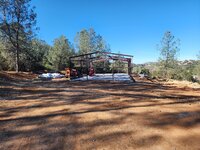
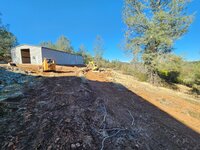
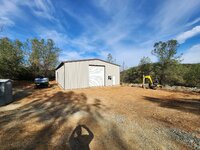
Erecting the building was pretty fast - took them about 3 weeks, part of that being delayed by weather. The did a great job - no surprises. It was completed a the end of November, 2022.
20221024_152328.jpg20221030_113201.jpg20221120_123904.jpg20221122_115557.jpg


Even though the house wasn't ready to occupy (as it turns out, it took until June 2023) we listed our (then) current house for sale in September. The housing market here was red hot but was beginning to cool quickly so we thought it best to not wait until the new house was ready to sell.

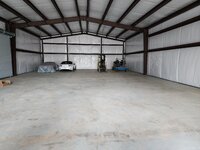
This affected the shop because the original plan was to not move until the new house was completely ready. We sold our house, closing on 12/22 and with no place to live, moved into an apartment. That left us with a bunch of stuff and no place to store it. Shop to the rescue!

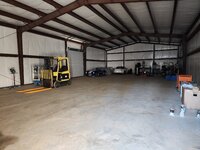
This photo is only about a week after the shop was finished. I'd hoped to have time to do the floor before moving in, but oh well... I feel lucky to have had a place to store this stuff - and truth be told, I'm very happy that we were able to sell our house when we did. Oh, and at this point we still didn't have electric service to the property. It took PG&E 13 months to provide electric service.
20221130_155346.jpg

And here it is a couple weeks later. The stuff to the right is all large tools from the previous garage/shop.
20221213_153517.jpg
 
OP
B

BMEP

Well-known member
Joined
May 15, 2011
Messages
89
Location
Placerville, CA
Here's the shop as of the beginning of 2023... quite a mess but I feel very fortunate to have had a place to put everything while we were in transition...
stuff1.jpgstuff2.jpg
 
OP
B

BMEP

Well-known member
Joined
May 15, 2011
Messages
89
Location
Placerville, CA
First up was to put brush seals on the roll-up doors. I couldn't find any pictures but I will say, I wish I'd bought sectional doors. My plan is to keep this space conditioned (<= 40% relative humidity for one) and these roll-up doors are hard to seal. I have a few ideas, but nothing done yet besides the brush seals. They are good for keeping things the size of a chicken out, but not much good for controlling air leaks.

Meanwhile, I started on electrical. Not being sure exactly what would go where, I just wanted to get a main panel and some receptacles in place. The original plan was to put a 100A panel in the shop but my general contractor said, "Why not do 200A to the house and 200A to the shop?" So that's what I did. 400A service from the utility and the two 200A panels.

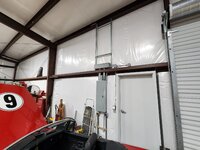
Here's the meter and 2 disconnect panels, plus the entrance to the shop and 200A main panel. I'm doing all the electrical work in the shop, so I didn't do the meter panel but did do the 200A panel in the shop and all work from there. This is the first time I've done conduit work and found it enjoyable.
20230825_143818.jpg20230325_123024.jpg20230811_130453.jpg
 

grant00

Well-known member
Joined
Feb 12, 2011
Messages
205
Location
Littleton, CO
Nice shop! Looking forward to seeing more of this and getting your shop set up.

I grew up east of Sacramento in the foothills as well. Nice place.
 

Bruce 993 SEA

Well-known member
Joined
Oct 22, 2016
Messages
1,033
Location
La Conner, WA
Will be following. I moved from Sacramento in '87 to the Seattle area. My best buddy lives on Folsom Lake and I am familiar with the foothills. Nice wines made up there. Do you have a city or close by area to post up?

Cheers!
 

LXCam

ALLIANCE MEMBER
Joined
Apr 23, 2013
Messages
19,070
Location
AZ
That’s the perfect size for me. I’ve got my shop in a 30x70 commercial building and the width just doesn’t work all that well.

Congrats on the new place and I’m looking forwards to seeing you progress.
 
OP
B

BMEP

Well-known member
Joined
May 15, 2011
Messages
89
Location
Placerville, CA
Before going on with the build, I thought I'd share some things I'd change and things I like in the interest of helping anybody that's considering a similar building.

Overall, I'm thrilled (almost beyond description) to have this shop.

However, there are a few things I would do differently if doing this again:
  • I REALLY wish I'd opted for sectional overhead doors instead of the roll-up type. This is because I intend to condition the shop all the time. At a minimum, relative humidity will be kept to 40% max to keep bare steel from rusting. Also, since this is a space for hobbies and supposed to be fun, I plan to keep it at a comfortable temperature when working inside, regardless of what the weather is doing. Roll-up doors are hard to seal well. I installed brush-type seals, which are better than nothing, but don't seal air leaks well.
  • The driveway didn't end up where I really needed it. It's a challenge to back trailers down to the shop. This isn't the end of the world and is too hard/expensive to change now.
  • #1 I did a 5" slab because I wasn't sure where I was going to mount my 2-post lift. I could've saved some $ by figuring out exactly where the lift would go before the concrete was done.
  • Speaking of the slab, the concrete contractor was hired by my general contractor, not me, so I wasn't working directly with him. I should've inserted myself into that process a little more. Specifically, I would've had them power trowel the floor, rather than hand finish it. Not a big deal, but the smoother surface would've been nice. The contractor also couldn't saw cut the control joints. I did NOT want them tooled (for a very specific reason I'm happy to go into if anybody cares). We ended up with a compromise: He hand tooled the joints but then filled them in with cream while doing the finishing. That turned out ok in some places, but in others, the cracks didn't stay lined up with the tooled joints. I'm going to epoxy some of this floor and have yet to determine what I'm going to do with those cracks.
  • I'd consider specifying a higher roof load. The collateral load on this roof is only 0.5lb per square foot. That's not much - I'll end up using almost all of that with lights, ceiling fans, insulation and the small amount of ductwork I plan. I won't be able to hang much of anything on the ceiling after that.
On the good side, a few of the decisions worked out really well:
  • It was a bit of a stretch financially, but I'm glad I opted for 40x80. My original plan was 40x60.
  • The 15' tall sidewalls are great. I think I can make good use of the vertical space.
  • I'm very glad I got the insulation. Because of California Title 24 requirements, I have to add more insulation before I can heat/cool the space, but that would have been a lot harder w/o the existing 4" of fiberglass.
 
OP
B

BMEP

Well-known member
Joined
May 15, 2011
Messages
89
Location
Placerville, CA
Will be following. I moved from Sacramento in '87 to the Seattle area. My best buddy lives on Folsom Lake and I am familiar with the foothills. Nice wines made up there. Do you have a city or close by area to post up?

Cheers!

I just realized I didn't have the city in my profile - thanks for noticing. We're about 8 miles West of Placerville.
 

mdim

Well-known member
Joined
May 19, 2008
Messages
143
Very cool project. My parents used to own the Hangman's Tree building in downtown Placerville. Neat town.

What did your PGE run look like? I've got their lines on my property but its going to need a transformer and a couple hundred foot run to where I want them. Besides the long timeframe, I've heard it can be tens of thousands of $$ for even relatively simple hookups. Would love some insight on how that all went for you.
 
OP
B

BMEP

Well-known member
Joined
May 15, 2011
Messages
89
Location
Placerville, CA
Very cool project. My parents used to own the Hangman's Tree building in downtown Placerville. Neat town.

What did your PGE run look like? I've got their lines on my property but its going to need a transformer and a couple hundred foot run to where I want them. Besides the long timeframe, I've heard it can be tens of thousands of $$ for even relatively simple hookups. Would love some insight on how that all went for you.
Thanks!

The run is pretty straightforward. PG&E's stuff is above ground here so there's pole right at the corner of my property and another pole about 150' away (toward where I needed it) that is (well, was) on the neighbor's property. My contractor put in a new pole, 80' (max distance according to PG&E for an 400A service) on my property, 80' away from the neighbor's (now our) pole. The new pole is the one with the panels shown in the picture above.

When they did my install, not only did they replace the transformer but the neighbor (on the day of the install, no less) asked them to move the common pole and they did! I'd heard "$10k for a pole from PG&E" but as crazy as it sounds, they didn't charge me (or my neighbor) anything. During the application process, there was a LOT of back-and-forth. Their web site showed a bunch of costs and I got multiple invoices and all sorts of communication. The PG&E project manager said, "Ignore that, it was incorrectly generated, I'm working on it" and much to my surprise, all that went away and they installed the service for no cost. I did have to pay my contractor for the pole/panels you see in the photo, but that's to be expected.

PG&E is incredibly bureaucratic and there are so many departments and people involved, it's really hard to get a straight answer on anything. Figure out who your project manager is and talk to him. My PM came to my property, we walked through the locations, install, etc, I got his card with his email and I probably emailed or talked to him on the phone 15 times. At least I had a human to deal with - and as it turned out, he really did help with the process.

Hope that helps!
 

mdim

Well-known member
Joined
May 19, 2008
Messages
143
Thanks!

The run is pretty straightforward. PG&E's stuff is above ground here so there's pole right at the corner of my property and another pole about 150' away (toward where I needed it) that is (well, was) on the neighbor's property. My contractor put in a new pole, 80' (max distance according to PG&E for an 400A service) on my property, 80' away from the neighbor's (now our) pole. The new pole is the one with the panels shown in the picture above.

When they did my install, not only did they replace the transformer but the neighbor (on the day of the install, no less) asked them to move the common pole and they did! I'd heard "$10k for a pole from PG&E" but as crazy as it sounds, they didn't charge me (or my neighbor) anything. During the application process, there was a LOT of back-and-forth. Their web site showed a bunch of costs and I got multiple invoices and all sorts of communication. The PG&E project manager said, "Ignore that, it was incorrectly generated, I'm working on it" and much to my surprise, all that went away and they installed the service for no cost. I did have to pay my contractor for the pole/panels you see in the photo, but that's to be expected.

PG&E is incredibly bureaucratic and there are so many departments and people involved, it's really hard to get a straight answer on anything. Figure out who your project manager is and talk to him. My PM came to my property, we walked through the locations, install, etc, I got his card with his email and I probably emailed or talked to him on the phone 15 times. At least I had a human to deal with - and as it turned out, he really did help with the process.

Hope that helps!
That is hugely helpful, thank you!
 
To avoid these ads, REGISTER NOW!
OP
B

BMEP

Well-known member
Joined
May 15, 2011
Messages
89
Location
Placerville, CA
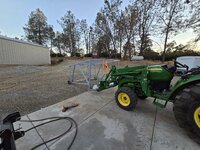
Next step was to cover one side of the ground on one side of the building - it was just dirt with a thin layer of road base over part of it. I ordered 2 transfers of aggregate road base, which is about 48 tons. I spread it with my John Deere 3038E and compacted as much as I could with a plate compactor. I learned something about road base: It needs to be wet the entire time you're working it, not just when you want to compact it. I didn't figure that out until the very end of the project. Lesson learned. Still, it turned out good enough... not as nice as concrete, but a lot cheaper.
20230601_135000.jpg
20230713_200453.jpg
 
OP
B

BMEP

Well-known member
Joined
May 15, 2011
Messages
89
Location
Placerville, CA
At this point, I still hadn't gotten the original building permit finaled. The only thing that remained was to run some initial electrical (a few receptacles, including one 50A 240V), outdoor lights for the doors and a switched receptacle for temporary lights. Got that done and inspected and finally completed that permit. I'll do another permit for more electrical, HVAC, etc. Meanwhile, I at least have enough power to get by. This was the first time I ran conduit - it's actually kind of fun.
20231029_152312.jpg

20231029_151927.jpg
 
OP
B

BMEP

Well-known member
Joined
May 15, 2011
Messages
89
Location
Placerville, CA
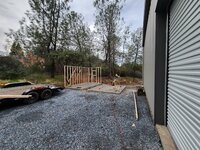
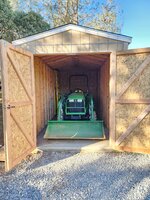
Next was some concrete... did an apron in front of the 12 x 14 door. I also had the contractor pour a pair of 120 sq ft pads for storage buildings. Why two 120 sq ft buildings and not a single larger building? The max size for a building with no building permit is 120 sq ft, so I decided to go that way.

One will be for my tractor and the other for yard/garden equipment like chain saws, generator, etc. I optimized the dimensions for each so the tractor shed is 7.5'W x 16'D

20231110_153056.jpg
20231110_153154.jpg
20240205_152635.jpg
20231122_160028.jpg
20231216_144328.jpg20240205_152709.jpg
 
OP
B

BMEP

Well-known member
Joined
May 15, 2011
Messages
89
Location
Placerville, CA
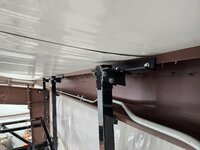
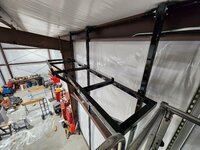
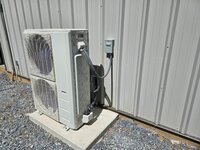
For HVAC, I decided to do a 100k BTU gas (propane) furnace + 5 ton (60k BTU) heat pump. I got the idea in my head that I didn't want to use floor space so I started looking for a place to hang it. The building I have only has a 0.5lb/ft collateral load rating so I'm trying to avoid hanging as much from the roof as possible. I built a CAD model (SolidWorks) of the shop and played around with a bracket design that puts zero vertical load on the roof. The weight is carried through steel tube do the floor and with some horizontal load on the wall headrail. I figured that with the roof R panels screwed every 1 or so to the headrail that this would be a plenty strong area.

To get the bracket uprights connected to the headrail, I made some big clamps. Just for safety, I also screwed the verticals to the headrail in a few places so even if the brackets fail, it can't fall. It's working great, but there's still work to do... I need a return and supply plenum, along with some simple supply ducting. I'm going to keep it simple, running it to the center of the shop with a small splitter.

It's sort of funny fabricating stuff like this when most of my tools are not hooked up... no compressor, CNC plasma table isn't set up, etc. Kind of ironic that the point of this shop is for tools like that to do fabrication and I can't use them for fabrication of the shop build out. lol.

For what it's worth, 100k BTU of heat is plenty for this climate. However, 5 tons of AC is NOT enough - at least the way the shop currently sits. I'm hoping the additional insulation I'm doing will make enough difference... we'll see.

Here's the CAD model. I modeled the HVAC components to make sure it would fit where I wanted it.
hvac-cad-location.jpg

The horizontal part of the bracket, where the HVAC parts sit is 2" 16ga tube
20231227_151636.jpg

Here's the headrail clamp setup. These is all 1/4"
20240115_113627.jpg

The bracket turned out well
20240115_113707.jpg
20240115_170434.jpg

Connected and working
20240614_152636.jpg
20240614_152704.jpg
 

ogdawg

Well-known member
Joined
Nov 11, 2009
Messages
74
Location
Jackson County GA
What is your plan for the extra insulation? I have the same fiber glass with backing and am figuring out how I should add more with out causing moisture issues due to the plastic on the current insulation.
 
OP
B

BMEP

Well-known member
Joined
May 15, 2011
Messages
89
Location
Placerville, CA
What is your plan for the extra insulation? I have the same fiber glass with backing and am figuring out how I should add more with out causing moisture issues due to the plastic on the current insulation.
Good question... I spent quite a bit of time figuring that out (more on that story below). Here's what I'm doing:

Roof: 1" foil faced foam insulation board to the purlins. I'm planning on using the polystyrene stuff from Home Depot.

For the walls, everything about the middle girt (about 7'-6" high on my walls) will be the same foam board. Some of the area below the girt will be foam and in areas where I want more durable walls (work areas, etc) I'm going to do wood studs, fiberglass bats, sheeted with OSB.

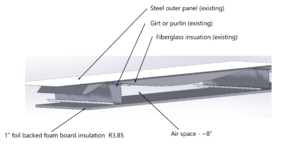
I made this image to explain the idea to the energy consultant and it's also in my building permit.
insulation detail for permit.png

I have gone back-and-forth with whether I need firring strips between the foam board panels. I think I'm going to skip them and instead connect the foam panels with sheet metal strips on the back, screwed through the foam with big washers and then the seams will be taped with aluminum tape. It kind of makes my head spin thinking about how much work this is going to be.

As you pointed out, moisture is definitely a consideration. In my building, they didn't tape all the seams where the factory insulation sections come together - they're just overlapped, but I figure it's still a fairly tight moisture barrier. I've been thinking about taping all those seams... not sure yet. Either way, putting additional insulation on top of the purlins/girts will create another moisture barrier so I feel the space between needs to be vented or it'll trap moisture between. My plan is to put vents in the insulation I'm adding. I don't think it'll take much - I'm figuring on using those little push-in 1" vents you see on eves sometimes. It's very dry here in the summer and in the winter, I run a dehumidifier and keep the shop at 40% (to stop bare steel from rusting) so I'm hoping those small vents + the low humidity level inside will take care of that potential problem.

It took a while to figure out what to do for insulation. I originally started thinking more about ANY way I could attach insulation to the structure. After more research, I discovered that in California, to get a building permit for HVAC, you have to meet Title 24 energy requirements which stipulate a certain R value for roof and walls. You have to hire a licensed Title 24 energy consultant to review/approve your design. They've got software that does calculations.

So I was working around cost, feasibility (can't just stick fiberglass bats on the roof without some way to support it, etc.), and what would pass T24 requirements. I eventually decided that I could use foil-backed foam insulation board which is only R3.85 The T24 guy said, "That won't be enough R value" but when he entered the config into his software, it turned out that the air gap, it is enough. The whole process was a lot of effort. Lots of people around here said, "Why get a permit at all?" I did because I could see a scenario where we try to sell the house and some overenthusiastic inspector/realtor determines the shop buildout wasn't permitted, which might make it harder to sell, or even worse, require a permit at that time.

Also, I actually want the insulation because it'll make it a more comfortable space.

Have you figured out what you're doing for insulation?
 

ogdawg

Well-known member
Joined
Nov 11, 2009
Messages
74
Location
Jackson County GA
I haven’t yet. I’m in North Georgia so have a lot of humidity to deal with. For now focusing on sealing a few openings and installing fans, then will see how it is working in there.

Also looking at options to run a vent fan in the early morning hours to see if that helps keep temperatures comfortable.
 
OP
B

BMEP

Well-known member
Joined
May 15, 2011
Messages
89
Location
Placerville, CA
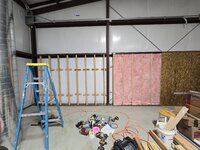
A little update: I started on some of the insulation work. The studs are there only to hold insulation and the OSB. The bottom plates are pressure treated and I used sill seal under them also and are anchored with 3/8 Tapcons. One interesting thing is there's an 4-5" gap between the studs and the OEM insulation so the fiberglass (R-19) bats will just fall into the cavity without doing something. To prevent that, I cut little holders and nailed them to the back of the studs, which you can see in the picture.

I didn't do a top plate and instead just attached the studs to the wall girt. Same for the OSB - I drywall screwed it to the studs and bottom plate and right to girt with drill screws. I do plan to add some vents to the OSB to allow that space to breathe since I've now created a space between two vapor barriers, as mentioned above.
20240705_125143.jpg20240706_131104.jpg
 
OP
B

BMEP

Well-known member
Joined
May 15, 2011
Messages
89
Location
Placerville, CA
My shop build-out has been interrupted by another project that's both house and shop related: Solar power. Those of you not from the lovely parts of California served by the complete monopoly that is Pacific Gas and Electric: I envy your electric rates. For myself and others in the PG&E area, I share your misery. Our current Summer peak rate (4-8pm) is $0.59/kWh. no, that is not a typo. The 5 ton HVAC in my shop costs about $3/hr to run at peak. And, as I'm quickly learning, I DO need all that insulation I have planned.

For cost and also to tolerate the power outages that go with the territory, I decided to do a mostly DIY solar setup. Quick specs are a 17.5 kW PV array, a pair of 15kW Sol-Ark hybrid inverters, a 10kW battery and a 26kW generator. My goals are minimal/no electric bill and the ability to tolerate short and longer grid outages. I'm also looking forward to running the shop HVAC guilt-free. :)

No place on my land is flat so I needed to cut/fill an area for the PV ground mount. I started to dig this my self with my compact tractor but as soon as I hit rock, I knew that was over. There is a ton of rock in the soil at my place. So I hired a contractor to do the digging and pour the footings for the ground mount.

20240624_185108.jpg

I also had the same contractor pour pads for the solar equipment, generator and a propane tank
20240709_202045s.jpg

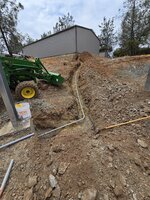
And the trench for the DC electric run to the PV array. I sanded the trench, ran the conduit and backfilled myself. Of course, he hit rock while digging so there's a bit of a jog in the trench about 2/3 of the way up in this photo
20240714_130509.jpg

I'm using bi-facial panels which can also gather light from the back side so I decided to cover the area with the most reflective rock I could find.
20240728_121817w.jpg
 
OP
B

BMEP

Well-known member
Joined
May 15, 2011
Messages
89
Location
Placerville, CA
Due to the way this will be wired, I need to have the inverters, battery and generator close the meter panel (which is also the common wire run point to the shop and house). I didn't want to mount that stuff on wood poles so I built a frame out of 2x2 steel.

I drew it in SolidWorks and unfortunately because lots of my tools are still not usable (because the shop is not done) I had to cut everything by hand. Oh well, got 'er done.

20240809_140955.jpg
20240803_182020.jpg
20240820_194401.jpg
20240820_200152.jpg

I built my own version of the "season adjustable" setup by copying with the original manufacturer did with jacks to tilt the array. These aren't as long travel as the ones they sell, but I did it for about 1/4 the cost.
20240831_113443.jpg20240831_124120.jpg

And with the help of a couple friends, got the racking assembled and about 1/2 the panels installed yesterday.
20240902_191835.jpg
 
OP
B

BMEP

Well-known member
Joined
May 15, 2011
Messages
89
Location
Placerville, CA
I've been busy with the shop buildout but haven't posted updates...

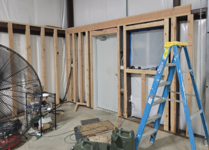
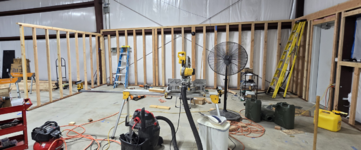
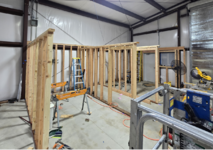
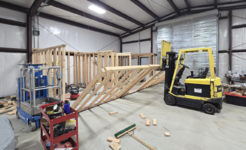
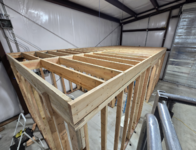
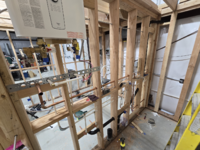
Framed out the rooms (entry, bathroom and (hopefully) future home brewing room)


1758865858759.png1758865906276.png1758865934001.png
1758866001615.png1758866048028.png

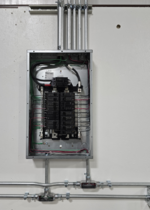
Added a couple 100A sub panels and receptacles. This area is for fabrication so I put steel on the walls and put in a bunch of 240V receptacles for welders.

1758866153142.png 1758866223502.png


2nd 100A subpanel for the built-out rooms and machine tools
1758866288572.png

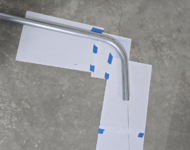
For the 2nd subpanel, I wanted to run the conduit up and over, along the roof line, which meant non-90* bends. I called every rental house in the area and nobody had a bender. After looking a little deeper, I realized that 1-1/4" EMT is juuuust over 1.5" OD and I have a bender with dies for 1.5" round tube so I gave it a shot. Worked great?
1758866430013.png1758866456027.png
 
OP
B

BMEP

Well-known member
Joined
May 15, 2011
Messages
89
Location
Placerville, CA
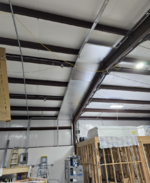
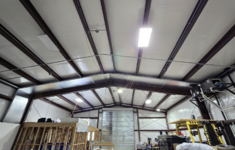
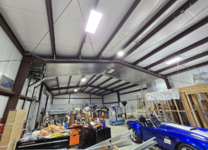
Next up, I started insulating the ceiling. It already has 4" of fiberglass (installed when the building was erected), which is rated at R13. To meet the CA Title 24 regs, I proposed adding 1" of EPS foam board on the bottom of the purlins, which would also have an 8" air space. I ended up going with 1.5" EPS. I came up with the idea of using metal studs attached to the purlins and then attaching the EPS board to the studs. I started with "insulation pins" and those "one way" push washers, but after 3 rows of the stuff, I changed to using 2" sharp point lath screws - much better!
1758866963528.png
First row done
1758867008653.png

Three rows done, man, this is slow
1758867043637.png

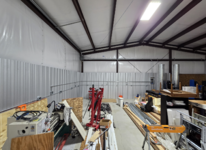
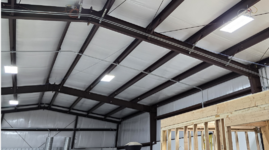
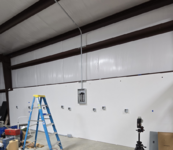
Fast forward 6 or 7 weeks, got most of the ceiling and walls done. The open space on the back wall is for an exhaust fan which I have yet to install. I have about 75% of the ceiling, about 50% of the walls done.

1758867760802.png
 
To avoid these ads, REGISTER NOW!
Top Bottom