You are using an out of date browser. It may not display this or other websites correctly.
You should upgrade or use an alternative browser.
You should upgrade or use an alternative browser.
Tools of Japan
- Thread starter Frankstools
- Start date

Fedwrench
ALLIANCE MEMBER
Did anyone visit the Tone booth at SEMA this year? I'm curious if they showed up and if they're trying to expand their USA presence. Thanks,
rick carpenter
Well-known member
Nice, I've been eyeballing me a set of those for a while. How are you planning on storing them?
Jeff
Well-known member
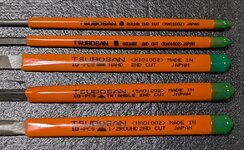
I have one of those cheap $5 needle file sets. Dumped them out and shoved these in!Nice, I've been eyeballing me a set of those for a while. How are you planning on storing them?
Shocker
Well-known member
rick carpenter
Well-known member
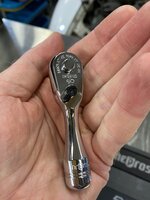
They're ~160mm long (toes included for visual reference) with full-sized shanks. I'll hafta figure out a way to permanently mark them since the paint will wear off with minimal use.

Browens
Active member
Bannik254
Well-known member
I've had a pair of PZ-57s for a year and a quarter. I used them regularly during the work week for about 3/4 of last school year to remove the black screws shown that are sometimes basically forevered (yes, I verbed that word) in place on Chromebook cases with that blue thread lock, and the screw-removal serrations have remained nicely sharp. Keep in mind though that the torque I've had to apply is much less than required on a say an M6 or larger screw.
I've not had to bust them out as often since about mid-Spring of this year but they're still very much in use. I re-use the screws when I can, give some back to IT, and throw away the worst caked-up offenders, so what you see is maybe less than 1/4 of the total removed since Aug 2022.

The trick with any electronics that have thread locker, heat up a soldering iron, press against the head of the screw, and wait for it to heat up, then loosen.I have opened a laptop and these always seem to strip the heads
HannibalLecter
Well-known member
- Joined
- Aug 26, 2023
- Messages
- 420
I see, unfortunately I don't have a soldering iron, maybe I'll get one. Although I really don't want to ever open another. The ram was beneath the motherboard, motherboard needed to come out, meaning removing all ribbon cables, meaning lifting paper thin latches. I destroyed half latch and I almost panicked. And all that in a 2100€ laptop. The cost we pay for thinness.The trick with any electronics that have thread locker, heat up a soldering iron, press against the head of the screw, and wait for it to heat up, then loosen.
Dave455
Well-known member
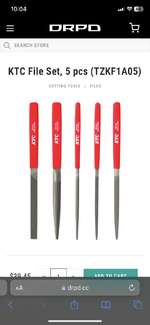
KTC are a huge manufacturer, but of primarily wrenches, socket wrenches, etc!Those Tsubosan files look suspiciously similar to the KTC file set. Good little set if they are, I like mine! The KTCs come in a little roll up pouch.
Tsubosan are probably Japan’s major file manufacturer, and they make nothing else, so I think we know where KTC source them.
Decent files - the small ones have coarser teeth than equivalent size Swiss files, which makes them useful.
Tsubosan make quite a variety though - it’s worth a look on their website. I suspect their biggest customers are Japanese industry though, so availability isn’t great I find.
Edit - Tsubosan call these “Die Sinkers” files. They are deservedly popular.

I have long liked the look of these diamond files, but availability outside Japan seems poor.

Last edited:
HannibalLecter
Well-known member
- Joined
- Aug 26, 2023
- Messages
- 420
I believe they all have a 4 digit code, first is the week of the year, second is the year. At least zeal ratchets do. For example 1210 twelfth week of 2010Is there a way to identify the year of manufacture of a Koken product?
Stubby1743
Well-known member
Tone brand 1/4, 3/8 & 1/2 drive ratcheting spanner adaptors. They fit 10, 13 & 19mm ratcheting spanners respectively. Quick release button for the socket and spring ball bearing for retention in the spanner.
With the 1/4 drive one in a 10mm spanner and a Ko-Ken Zeal 13mm socket, the overall depth is only 24.2mm (7/8").

With the 1/4 drive one in a 10mm spanner and a Ko-Ken Zeal 13mm socket, the overall depth is only 24.2mm (7/8").
bongkar_YES_pasang_NO
Well-known member
As far as i am aware off, there isn't any company in Japan which produces locking pliers domestically. They all buy them somewhere else.
Attachments


Picked up some odds and ends. Vessel hose pull set and the electric screwdriver that was on special earlier. Also a Tsunoda side cutting pliers, a Fujiya nipper, and a IPS slip joint pliers.

Also picked up a mess of Engineer odds and ends. The rapid screw extractor is much larger than I was expecting for some reason...

Also picked up a mess of Engineer odds and ends. The rapid screw extractor is much larger than I was expecting for some reason...
Pinemarten
Well-known member
Hey jgeoffr, how fast does that Vessel electric screwdriver spin out a screw after it is loosened?
moto_ridah
Well-known member
Trusco 50L collapsible totes from Amazon Japan order last week. I still find it amazing how these come with no damage from across the pond but the local Amazon fulfillment packages look like they get kicked the whole way here.

Browens
Active member
Picked up some odds and ends. Vessel hose pull set and the electric screwdriver that was on special earlier. Also a Tsunoda side cutting pliers, a Fujiya nipper, and a IPS slip joint pliers.
Are the IPS pliers bent nose and spring loaded? I have the straight version and are one of my favorites.
I don’t have many Ko-ken tools and it’s all Z-EAL, but they seem to have a three-digit date code. I’m guessing it’s the year followed by the month. So a typical number for recent produciton would be 236 (the number on my 3725Z ratchet).I believe they all have a 4 digit code, first is the week of the year, second is the year. At least zeal ratchets do. For example 1210 twelfth week of 2010
For the third digit, beyond 9 (September) they seem to use J, K, and L to represent October, November, and December respectively.
Have none of you seen this dating system then? Is it fairly new or Japan only or something? I bought my stuff directly from Japan.
I don’t have many Ko-ken tools and it’s all Z-EAL, but they seem to have a three-digit date code. I’m guessing it’s the year followed by the month. So a typical number for recent produciton would be 236 (the number on my 3725Z ratchet).
For the third digit, beyond 9 (September) they seem to use J, K, and L to represent October, November, and December respectively.
Have none of you seen this dating system then? Is it fairly new or Japan only or something? I bought my stuff directly from Japan.
I have some Koken stuff but haven't paid attention looking for date codes. But switching from numbers to letters for months would be very uncommon as it makes no sense - since A can mean January, etc.
In the US, 236 could be 2022, or any year that ends with 2, and 36th week. Or 23rd week of a year that ends with 6.
They are indeedAre the IPS pliers bent nose and spring loaded? I have the straight version and are one of my favorites.
HannibalLecter
Well-known member
- Joined
- Aug 26, 2023
- Messages
- 420
Yeah, its a 3 digit, my mistake. I watched a yt video that mentioned it, but I don't recall the channel. It wasn't lone star mopars neither cp the tool addict. I have one in my hands right now, it says 232 , so makes sense. Its a zeal 1/2 ratchet.I don’t have many Ko-ken tools and it’s all Z-EAL, but they seem to have a three-digit date code. I’m guessing it’s the year followed by the month. So a typical number for recent produciton would be 236 (the number on my 3725Z ratchet).
For the third digit, beyond 9 (September) they seem to use J, K, and L to represent October, November, and December respectively.
Have none of you seen this dating system then? Is it fairly new or Japan only or something? I bought my stuff directly from Japan.
Pinemarten
Well-known member
I just received a Koken 1/4" drive hex bit socket set RS2010M-7. The date codes are:
229, 22K, 233, 237, and 238,
229, 22K, 233, 237, and 238,
IRQVET
Well-known member
I have to ask this question, cause in my youth I lived pretty close to Japan Town in SF. Looking at all these threads (maybe decades later) I’m thinking to myself, “How many awesome tools did I just walk by without noticing.”
So where are you guys buying your tools from?
So where are you guys buying your tools from?
Reed Prince
Well-known member
The few Tsubosans I own also came with pouches.Those Tsubosan files look suspiciously similar to the KTC file set. Good little set if they are, I like mine! The KTCs come in a little roll up pouch.

I've been in a hardware store in JapanTown and it had a ton of MiJ tools. It was a lot of fun - I've been to tools shops in Akihabara, the Don Quixote stores, the tool-floor at Tokyu Hands and others in Tokyo, and it reminded me a bit of that.I have to ask this question, cause in my youth I lived pretty close to Japan Town in SF. Looking at all these threads (maybe decades later) I’m thinking to myself, “How many awesome tools did I just walk by without noticing.”
So where are you guys buying your tools from?
There doesn’t seem to be an A, just J, K, and L like I said.I have some Koken stuff but haven't paid attention looking for date codes. But switching from numbers to letters for months would be very uncommon as it makes no sense - since A can mean January, etc.
Not that I understand your complaint, since what would be the problem if A meant January?
The benefit of using a digit or letter for the month, rather than letters only, is that at least for January to September you get an intuitive number that we all understand as a month (e.g. 8 is August without thinking; but if I said H, you’d be counting the alphabet on your fingers to translate it to a number to link it to a month). But obviously our decimal counting system doesn’t stretch to 12 months in one digit, so we can’t use numbers only either.
How would that be an improvement? Because it resolves weeks rather than months? (But at the expense of useful year precision.)In the US, 236 could be 2022, or any year that ends with 2, and 36th week. Or 23rd week of a year that ends with 6.
All the codes on my recently acquired Ko-ken tools are 22x or 23x (except one socket that is 17x). Your suggestion would put everything I own as manufactured in weeks 2x or 3x or, even less likely, in weeks 22 and 23 of years stretching back a decade. So clearly the first two digits are the year.
If anyone can produce a three-digit Ko-ken date code that has a letter other than J, K, or L, or a letter in any position other than the third, I’ll reconsider my guesswork. Because it is just guesswork. I’ve not read anything about Ko-ken’s date codes and only own a small amount of Ko-ken tools.
Stubby1743
Well-known member
My 1/4 drive Zeal metric sockets are 236, 237, 238 & 22J. I agree that it seems that Ko-Ken wanted to limit the date codes to three characters and therefore used J, K & L instead of 10, 11 & 12.
There doesn’t seem to be an A, just J, K, and L like I said.
Not that I understand your complaint, since what would be the problem if A meant January?
The benefit of using a digit or letter for the month, rather than letters only, is that at least for January to September you get an intuitive number that we all understand as a month (e.g. 8 is August without thinking; but if I said H, you’d be counting the alphabet on your fingers to translate it to a number to link it to a month). But obviously our decimal counting system doesn’t stretch to 12 months in one digit, so we can’t use numbers only either.
How would that be an improvement? Because it resolves weeks rather than months? (But at the expense of useful year precision.)
All the codes on my recently acquired Ko-ken tools are 22x or 23x (except one socket that is 17x). Your suggestion would put everything I own as manufactured in weeks 2x or 3x or, even less likely, in weeks 22 and 23 of years stretching back a decade. So clearly the first two digits are the year.
If anyone can produce a three-digit Ko-ken date code that has a letter other than J, K, or L, or a letter in any position other than the third, I’ll reconsider my guesswork. Because it is just guesswork. I’ve not read anything about Ko-ken’s date codes and only own a small amount of Ko-ken tools.
I'm not complaining, just an observation on how date codes work in the US. I've never seen a date code here on automotive parts that switches from number to letter for the same place in the code. I didn't say it was impossible, I said it would be uncommon and makes no sense. And it is uncommon and does make no sense. It was just my observation and that's all it was.
It might be uncommon, but it makes plenty of sense. I thought I explained that part.I'm not complaining, just an observation on how date codes work in the US. I've never seen a date code here on automotive parts that switches from number to letter for the same place in the code. I didn't say it was impossible, I said it would be uncommon and makes no sense. And it is uncommon and does make no sense. It was just my observation and that's all it was.
No big deal, though.
Its funny u say this I noticed 236 on a Tone driver I got recently. Its next to the actual part number.I don’t have many Ko-ken tools and it’s all Z-EAL, but they seem to have a three-digit date code. I’m guessing it’s the year followed by the month. So a typical number for recent produciton would be 236 (the number on my 3725Z ratchet).
For the third digit, beyond 9 (September) they seem to use J, K, and L to represent October, November, and December respectively.
Have none of you seen this dating system then? Is it fairly new or Japan only or something? I bought my stuff directly from Japan.
 So your thought are likely correct, but
  I don't know for sure.
superautobacs
Well-known member
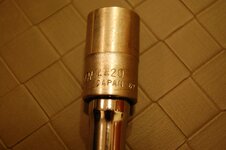
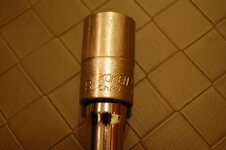
Ko-ken has been using a three-digit date code at least from the 90's.
As for the use of letters, @Samuel D was close.
October = O
November = J
If November is J, like "Jack", then you'd think December would be Q for "Queen", but "Q" can be easily mistaken for "O" so they decided on:
December = K
My oldest socket is from 1967 and they appear to have been using a 2-digit date code: "67" so, just the year.
Also note the Ko-ken "no-hyphen-logo"

As for the use of letters, @Samuel D was close.
October = O
November = J
If November is J, like "Jack", then you'd think December would be Q for "Queen", but "Q" can be easily mistaken for "O" so they decided on:
December = K
My oldest socket is from 1967 and they appear to have been using a 2-digit date code: "67" so, just the year.
Also note the Ko-ken "no-hyphen-logo"
I wasn't there, but I do know that they were there and doing exactly that.Did anyone visit the Tone booth at SEMA this year? I'm curious if they showed up and if they're trying to expand their USA presence. Thanks,
Last edited:
Fedwrench
ALLIANCE MEMBER
I found a brief segment in a shop tools review Sema 2023 video that showed the Tone Booth. I'd like to see Tone become more available here.Ko-ken has been using a three-digit date code at least from the 90's.
My oldest socket is from 1967 and they appear to have been using a 2-digit date code: "67" so, just the year.
Also note the Ko-ken "no-hyphen-logo"
I wasn't there, but I do know that they were there and doing exactly that.
rick carpenter
Well-known member
Looking for a pair of small pointy-tip garage scissors. Anyone have experience with either the 5" Olfa SCS-4 or 135mm/5.31" Kai 5135? Sometimes stated scissors measurements are not OAL. The shorter of the two would be preferable unless that one is a dud. I like my 7" Olfa scissors but everyone's seems to like Kai really well.
65’Comet5.0
Active member
- Joined
- Oct 14, 2023
- Messages
- 42

First Japanese tools. Was looking for pliers when I came across this thread and for the price figured I’d give them a try. Typically I only buy knipex so see how I end up liking these. Quality seems good and price was a lot cheaper.
rick carpenter
Well-known member
I've got the same Tsunoba King TTC FR-150s and CN-130s as you plus a pair of PL-150 slip joint pliers, and really like them. You will too. @superautobacs said a while back that a Japanese tool-seller told him that Tsunoba was more of a DIY/hobby line in Japan compared to Keiba etc. The quality of my three Tsunobas is way above that of typical Western DIY/hobby lines. At the end of next month a fat man in a red suit might bring me more. Let me know how you like the two linemen pliers please.
First Japanese tools. Was looking for pliers when I came across this thread and for the price figured I’d give them a try. Typically I only buy knipex so see how I end up liking these. Quality seems good and price was a lot cheaper.
Dave455
Well-known member
Tsunoda offer quite an extensive line.I've got the same Tsunoba King TTC FR-150s and CN-130s as you plus a pair of PL-150 slip joint pliers, and really like them. You will too. @superautobacs said a while back that a Japanese tool-seller told him that Tsunoba was more of a DIY/hobby line in Japan compared to Keiba etc. The quality of my three Tsunobas is way above that of typical Western DIY/hobby lines. At the end of next month a fat man in a red suit might bring me more. Let me know how you like the two linemen pliers please.
Some of their pliers are made in Thailand I think, and probably are aimed more at the DIY market.
However, the “King TTC” range with the yellow handles appear to be first rate tools to me. I’ve been using their cable cutters for years.
I have these long reach pliers and they are a superb design, and of the highest quality. I rate these much higher than the Stahlwille / VBW ones I own.

I don’t have their linemans pliers, but I do have a pair of 180mm combination pliers which seem to be as good as the others.
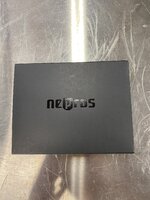
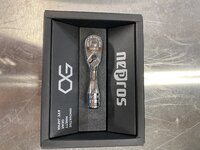
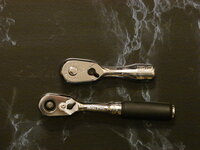
I recently bought pair of short 3/8" drive ratchets at Amazon-US: A 3" long 90T Nepros ($68) and a 4.5" long 72T Koken ($47). Both of them shipped from Amazon-Japan. The Nepros head is wider than the Koken head by 1.6mm, and thicker by 1.4mm. The Nepros has low backdrag, the Koken has extra low backdrag. The Nepros weighs 94.4 gram, and the Koken weighs 82.0 gram. The chrome on the Nepros is more highly polished than on the Koken. I like both of them.

HannibalLecter
Well-known member
- Joined
- Aug 26, 2023
- Messages
- 420
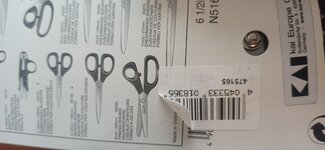
KAI N5165 scissors. Unfortunately, although the quality seems pretty good, these are made in Vietnam instead of Japan. They will be returned