To avoid these ads, REGISTER NOW!

Heat pump power draw ramp up

mike93lx

ALLIANCE MEMBER
Joined
Dec 9, 2013
Messages
38,398
Location
Richmond, VA
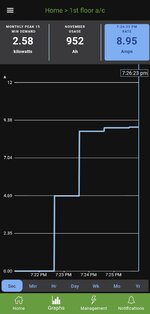
Curious if this is normal. System is 1 year old and performing fine, no concerns, just curious. Not variable speed, just a basic 14seer system.

This is an example of a recent run from my emporia. First full minute averaged about 8.5a, ramping up to about 10.3a. Is that just from pressure increasing with run time? Something else?
1000003257.jpg
 
To avoid these ads, REGISTER NOW!

micromind

Well-known member
Joined
Sep 24, 2023
Messages
3,127
Location
Fernley, Nevada, about 30 miles east of Reno.
A lot of compressors these days are the PSC (Permanent Split Capacitor) type. These are known for high efficiency, low starting current and very low starting torque.

This is quite likely why you have.

A typical A/C compressor will have lower amps at first and go up as the system stabilizes.
 

dcg9381

Well-known member
Joined
Jun 20, 2018
Messages
11,968
Location
Austin, TX
I'm not home, but here's mine.. Likely this draw is from the garage apartment. Note the green is energy production from solar, so you can see the start up swings on a 1.5T - 2T SEER unit.. (could be one of the larger units in the house, no remote control over thermostats)


1700841013014.png
1700840982132.png
 

American Locomotive

Well-known member
Joined
Jan 8, 2017
Messages
11,109
Location
Rhode Island
The work a compressor has to do is proportional to the mass flow rate of refrigerant and compression ratio (pressure difference between the hot side and cold side). As condenser temperatures increases and evaporator temperatures decrease, the compression ratio increases and the mechanical work the compressor will need to do increases.
 
To avoid these ads, REGISTER NOW!
OP
M

mike93lx

ALLIANCE MEMBER
Joined
Dec 9, 2013
Messages
38,398
Location
Richmond, VA
The work a compressor has to do is proportional to the mass flow rate of refrigerant and compression ratio (pressure difference between the hot side and cold side). As condenser temperatures increases and evaporator temperatures decrease, the compression ratio increases and the mechanical work the compressor will need to do increases.
Makes sense, thanks
 

TRWham

Well-known member
Joined
Aug 11, 2017
Messages
2,004
Location
East Cobb County, Georgia
The work a compressor has to do is proportional to the mass flow rate of refrigerant and compression ratio (pressure difference between the hot side and cold side). As condenser temperatures increases and evaporator temperatures decrease, the compression ratio increases and the mechanical work the compressor will need to do increases.
But mass flow decreases as evaporator pressure decreases, so the work done may be less depending on exactly how high the compression ratio is.
 

TRWham

Well-known member
Joined
Aug 11, 2017
Messages
2,004
Location
East Cobb County, Georgia
Depends on the type of metering device. On a cap tube or fixed orifice system, condensing pressure has a big influence on mass flow rate.
Mass flow is entirely dependent on suction gas density and compressor displacement. If a metering device flows more or less refrigerant, then suction pressure will balance accordingly to match mass flow.
 
To avoid these ads, REGISTER NOW!
Top Bottom