Outlawmws
Well-known member
If you have the nut, springs can be made.



That is sweet!Made a woodworking bench. Added 2 Rockler woodworking vises
I let it soak in WD40/PBB and scrub with steel wool then spray and scrub until i like the look. I hit the parts i want shiny with a wire wheel.Hey Willy, what is your method for nakedness? Wd40 then BLO? Always looking for ideas from others on how they finish their vise!
I’m wanting one of those myself. Care to share the details? Or is it in another thread?Made a woodworking bench. Added 2 Rockler woodworking vises
Wood is ash with walnut pegs. Vises are from Rockler. top is 4" thick. Size is 25"x48"x34" tall.I’m wanting one of those myself. Care to share the details? Or is it in another thread?
Awesome work thanks for sharing!Wood is ash with walnut pegs. Vises are from Rockler. top is 4" thick. Size is 25"x48"x34" tall.
I made a YouTube video of the build
Let me know if you need more info.
@Willy Wilson. I thought the application of BLO required a throughly clean surface? Like clean with acetone before applying BLO.I let it soak in WD40/PBB and scrub with steel wool then spray and scrub until i like the look. I hit the parts i want shiny with a wire wheel.
I wipe on BLO with a brush and let it soak for a bit the wipe off.
I use BLO quite frequently on old vises as well as garden shovels. You don’t have to get the surface particularly clean. You probably don’t want to seal in loose dirt, but anything close to clean Is OK. Make sure surfaces are dry though. For vises, I dry freshly washed surfaces with a heat gun not only to make sure the water is gone, but to help the BLO soak in better. I have found that if you heat the surface to the point where it is almost too hot to touch with your bare fingers, the BLO thins out and soaks into the pores of the cast iron much better. The warm BLO is easier to wipe off the excess after a few minutes too.I thought the application of BLO required a throughly clean surface? Like clean with acetone before applying BLO.
Beautiful job Ed!Here a Record No. 23 quick release vice I picked up from a fellow GJ member a while back. A nice stout 4-1/2" vice. I finally got around to cleaning it up a bit and giving it a fresh coat of paint. It's still curing on the wood stove in the pics. I had to straighten the handle and the jaws were rough so I made a new set out of some track drill carriage guide bars. I think they are a manganese bronze alloy. It's the right thickness and has worked well on a couple other vises I've used that material on.
I really like the the quick release feature on this vise and the buttress thread on the spindle screw works well with the system. I may have to build a stand for this one or find some open bench for a mount. I want to work it a bit and see if it is as handy as I expect it will be. Ed.

I want to work it a bit and see if it is as handy as I expect it will be.
That thing is a beauty. I really like the base.I am trying to paint a vise this color. Have been to at least 6 stores, bought paint that was way too dark despite the color on the cap. Anyone have any ideas? It is just a medium metalic blue. Everything I am finding is either very light blue or a dark cobalt blue.
I believe I painted my user Record Ford Tractor Blue from TSC stores. Not metallic though and looks lighter than the Wilton you show...I am trying to paint a vise this color. Have been to at least 6 stores, bought paint that was way too dark despite the color on the cap. Anyone have any ideas? It is just a medium metalic blue. Everything I am finding is either very light blue or a dark cobalt blue.
you don't know what you painted it
My humble contribution, a leg vice given to me by a friend, a machining vice given to me from work and a little one I made in schoolWe have seen everyone's toolboxes so let's see the vises! (no, not vices)
I'm sure there are some really cool ones out there.
Large or small, let's see them all!
Here's my Charles Parker 107 and my Wilton 1780:
The Wilton has an 8" jaw and weighs about 110 lbs.
The CP has a 6" jaw and weighs about 140 lbs.


Include COO and DOM if you know it!
Love that little vise you made.My humble contribution, a leg vice given to me by a friend, a machining vice given to me from work and a little one I made in school


@liliysdad What are those cabinets please? They look pretty nice.
@Junker more pics of that sweet little vise you made!
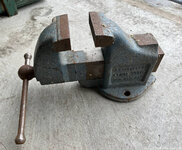
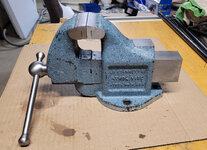


That whole line are beautiful. Great work.Snagged an L.S. Starrett 923 recently, and disassembled and cleaned it up today. I'm so impressed with how well-made these vises are. I was fortunate to get it, since these are super-rare to find here in Canada - in fact this is the first one I've ever seen for sale locally.
The as-found condition was a bit rusty and dusty.
But it cleaned up nicely with minimal effort. The original "car trunk liner" paint was in pretty decent shape, so just scrubbed it with soap and water and polished the unpainted areas using some non-woven abrasive buffing wheels.
The jaws were in almost immaculate condition. The only dirt I found inside the vise when cleaning was some sawdust, so it was probably not used for much other than holding pieces of wood steady while sawing.
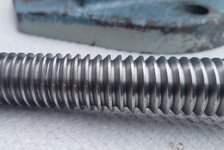
I was quite surprised to find out that the screw was threaded with a "buttress" thread rather than the normal acme thread. I've only ever seen buttress threads on my quick-release style Made-in-England vises where it works nicely to engage tightly in the half-nut when tightening but slides easily across the nut when using the quick release feature. Wonder why Starrett used this thread type?
Thanks for looking,
Tom
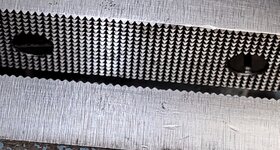
Buttress threads are supposedly a stronger thread design, and better to use, unless a vise needs to clamp in both directionsSnagged an L.S. Starrett 923 recently, and disassembled and cleaned it up today. I'm so impressed with how well-made these vises are. I was fortunate to get it, since these are super-rare to find here in Canada - in fact this is the first one I've ever seen for sale locally.
The as-found condition was a bit rusty and dusty.
But it cleaned up nicely with minimal effort. The original "car trunk liner" paint was in pretty decent shape, so just scrubbed it with soap and water and polished the unpainted areas using some non-woven abrasive buffing wheels.
The jaws were in almost immaculate condition. The only dirt I found inside the vise when cleaning was some sawdust, so it was probably not used for much other than holding pieces of wood steady while sawing.
I was quite surprised to find out that the screw was threaded with a "buttress" thread rather than the normal acme thread. I've only ever seen buttress threads on my quick-release style Made-in-England vises where it works nicely to engage tightly in the half-nut when tightening but slides easily across the nut when using the quick release feature. Wonder why Starrett used this thread type?
Thanks for looking,
Tom