

You are using an out of date browser. It may not display this or other websites correctly.
You should upgrade or use an alternative browser.
You should upgrade or use an alternative browser.
Tools of Japan
- Thread starter Frankstools
- Start date
Andres26tnt
Well-known member
- Joined
- May 11, 2018
- Messages
- 994
It's why I stopped buying Tone, most are made in Taiwan, and for the price(they aren't cheap) you can buy a real Japanese-made brand. It definitely hurts when you see the same(similar) item for a cheaper from example Blackhawk/proto for 23$Ahhh folks secretly like being lied too, buy a Nepros or Koken extra long flexhead and the price alone will tell u where it's made. But TONE tickles the soul. One feels like they are buying a high quality tool with a price that feels even better. But deep down in the depths of their bowels they know that Amazon $39 price tag that includes delivery is way to silly to be true. But it resembles the real thing, it kinda looks like it and it's absolutely not from HF or China. I'm happy to let those enjoy a little ignorant bliss, it's not hurting anyone. I nearly bought some genuine Bose speakers out of a white van one time.
The facts I posted are correct, you are misunderstanding the documents. The labelling requirements apply to all products sold in the US. While the specific examples refer to government procurement, those examples are the de facto standards companies use, since they are objective standards that can be referenced.It dictates what the Gov and its partners can buy to abide by the law. So an item that is 50% made in the USA will qualify as Made in the USA for "procurement purposes".
If you want to continue the discussion, let's take it to a more appropriate thread. I'm always happy to help others learn and share my knowledge and experience, but it had drifted off-topic for this thread.
Andres26tnt
Well-known member
- Joined
- May 11, 2018
- Messages
- 994
no need to discuss this. I have current experience in GOV contracts and procurement, especially military contracts, it is one of the biggest issues we are currently facing, especially with aircraft parts. but doesn't matter its off topic and we will never reach a consensus. A misunderstanding of this document is what leads to companies getting slapped with fines and such. in the topic of Japan, they have weird rules with their products, one can stamp a product from Japan for the Japanese market, but I feel like that's disingenuous.The facts I posted are correct, you are misunderstanding the documents. The labelling requirements apply to all products sold in the US. While the specific examples refer to government procurement, those examples are the de facto standards companies use, since they are objective standards that can be referenced.
If you want to continue the discussion, let's take it to a more appropriate thread. I'm always happy to help others learn and share my knowledge and experience, but it had drifted off-topic for this thread.
mobiledynamics
Well-known member
On the Vessel Bit Extension holders, EXH Series, - have this in my new next order cart
Is there anything better in the world of 1/4 bit extensions. Granted this like bits are consumables so they do get used and then tossed once slop in the driving comes into play
Is there anything better in the world of 1/4 bit extensions. Granted this like bits are consumables so they do get used and then tossed once slop in the driving comes into play
I just spend 3 weeks around Tokyo/Yokohama area. I needed some tools to service my mountain bike suspension so my purchases reflect that.
Got myself some 'Asahi' Crowsfoot, Koken spinner ratchets, KTC Electric Torque Wrench, swivel head ratchet and screwdriver set, and Tone mini 1/4" and 3/8" ratchets from Factory Gear Tokyo and some of it from Factory Gear Yokohama.
Ko-Ken Z-series 1/4" semi-deep socket set I bought from World Import Tools.
'Eight' long allen keys, Tohnichi torque screwdrives and Pink Engineer Neji-Saurus pliers from akiba-kougu.jp. Love the place.
Other Engineer pliers from some random electronics store in Akihabara.
Anex T6 and T8 drivers and vessel bits from Tokyu Hands.
Tone T-handle Allen keys from Astro Products.
Old Mitutoyo Micrometer I bought from one Act tool location.

Got myself some 'Asahi' Crowsfoot, Koken spinner ratchets, KTC Electric Torque Wrench, swivel head ratchet and screwdriver set, and Tone mini 1/4" and 3/8" ratchets from Factory Gear Tokyo and some of it from Factory Gear Yokohama.
Ko-Ken Z-series 1/4" semi-deep socket set I bought from World Import Tools.
'Eight' long allen keys, Tohnichi torque screwdrives and Pink Engineer Neji-Saurus pliers from akiba-kougu.jp. Love the place.
Other Engineer pliers from some random electronics store in Akihabara.
Anex T6 and T8 drivers and vessel bits from Tokyu Hands.
Tone T-handle Allen keys from Astro Products.
Old Mitutoyo Micrometer I bought from one Act tool location.
Jeff
Well-known member

mobiledynamics
Well-known member
Thread Brump. Any feedback on the Vessell Extension Bit Holders ?
Last edited:
Stubby1743
Well-known member
I have this one a couple of months and have only lightly used it. It is nicely made and finished as you would expect from Vessel. My only slightly adverse comment is that the in and out movement of a bit is slightly more than that in some of the visually similar but unbranded bit holders that I have.

I remember my father having Yokohama Super Diggers on his LandCruiser in the 90's growing up. That's a super nice little haul, those Anex Torx look grippy, the Tone T-handles look way similar to those made by Sunflag which are pretty nice. Would love to shop at Factory Gear one day in Japan, I think they do tool stores better than anyone.I just spend 3 weeks around Tokyo/Yokohama area. I needed some tools to service my mountain bike suspension so my purchases reflect that.
Got myself some 'Asahi' Crowsfoot, Koken spinner ratchets, KTC Electric Torque Wrench, swivel head ratchet and screwdriver set, and Tone mini 1/4" and 3/8" ratchets from Factory Gear Tokyo and some of it from Factory Gear Yokohama.
Ko-Ken Z-series 1/4" semi-deep socket set I bought from World Import Tools.
'Eight' long allen keys, Tohnichi torque screwdrives and Pink Engineer Neji-Saurus pliers from akiba-kougu.jp. Love the place.
Other Engineer pliers from some random electronics store in Akihabara.
Anex T6 and T8 drivers and vessel bits from Tokyu Hands.
Tone T-handle Allen keys from Astro Products.
Old Mitutoyo Micrometer I bought from one Act tool location.
So for a while Ive been looking for some high quality micro drivers suitable for mobile phone repair. To open an iPhone and remove a battery you'll need a Pentalobe 0.9mm and a Y-driver 1.2mm or '00' and some pry tools etc. Buying single Pentalobe micro drivers from Wiha are like $50 or $30 from Wera! Eventually I caved and bought a $7.99 20pc Chinese special off eBay which got the job done. But today I found this Vessel 1/8" drive mobile/gaming bit set. Looks nice, albiet made in Taiwan  . Taiwan has upped their game in the last few years with bits but if it's Vessel... I'd like Japan.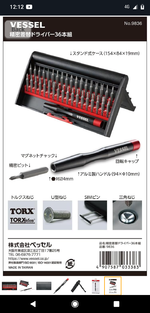
. Taiwan has upped their game in the last few years with bits but if it's Vessel... I'd like Japan.Jackmugen02
Member
- Joined
- Dec 13, 2022
- Messages
- 14
I just ordered one from Amazon US(ships from Amazon Japan): https://www.amazon.com/gp/product/B0CN6M3GZ3/?tag=atomicindus08-20
Stubby1743
Well-known member
I've just watched this video. Bzeug agrees with me that the in and out movement is excessive, but mine was smooth and not at all "crunchy".I have this one a couple of months and have only lightly used it. It is nicely made and finished as you would expect from Vessel. My only slightly adverse comment is that the in and out movement of a bit is slightly more than that in some of the visually similar but unbranded bit holders that I have.
mobiledynamics
Well-known member
How one you rate KTC's pink rubbish handles. Just got an order in. Haven't taken a deep dive - wasn't sure @ time of order if it was hard handle or a mix of softer. I will say, the handles are alot -smaller- than expected.
kyrbz
Well-known member
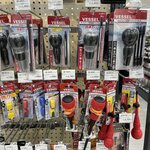
Some pics from the tool aisles at Tokyu Hands in the Shinjuku district of Tokyo



rick carpenter
Well-known member
Vessel +2x150mm bits

Go watch some YT videos Bzeug did on various extensions. The Vessel ones have a bit to much play/wobble for my liking. Anex makes similar ones that are a bit better but not perfect. They also make heavy duty extensions suitable for 40v impact driver use.On the Vessel Bit Extension holders, EXH Series, - have this in my new next order cart
Is there anything better in the world of 1/4 bit extensions. Granted this like bits are consumables so they do get used and then tossed once slop in the driving comes into play
mobiledynamics
Well-known member
I'm still using my Rapidators short and Long....just was seeing if there was a better replacement out there.
I mainly use 1/4 bits of correct length, but sometimes I have those oddball 1" that needs a holder
I've been thinking I just **** it up, go to the box box store, buy me a Mikwaukee, Dewalt, Diablo and Makita and compare and contrast..
Won't have buyers remorse on paying for shipping for something unseen
I mainly use 1/4 bits of correct length, but sometimes I have those oddball 1" that needs a holder
I've been thinking I just **** it up, go to the box box store, buy me a Mikwaukee, Dewalt, Diablo and Makita and compare and contrast..
Won't have buyers remorse on paying for shipping for something unseen
Interesting.
I found this on amazon.jp concerning VAT. I don't see the US listed for additional VAT.
Do you have a source that shows where they collect VAT from US customers?
Tax on Low-Value Imported Goods (LVIG) - Amazon Customer Service
Amazon.co.jp is obligated to calculate, collect, and remit Sales Taxes including Value Added Tax (VAT), Goods and Services Tax (GST), and others, on low-value imported goods (LVIG) classified as taxable for each relevant jurisdiction.www.amazon.co.jp
You're overthinking it. In most of the world, VAT is built into the consumer sales price unless there is clear language that a price is ex-VAT. Amazon prices in the rest of the world include VAT.
Previously, if you had something in your azon.jp cart that was say 300 JPY, to be shipped to the US, on your final payment screen, the price used to be like 286 JPT or something like that. Now it's 300 JPY.
Try it on azon.de. For example, I just loaded a Hazet Assi in my cart, with a posted price of 836.55 EUR. When I go to the kasse, it shows a price of 702.98 EUR, because it is being exported out of the EU. That is how azon.jp also used to work. Note Azon.de charges my local sales tax (here 10.25%, or 86.64 EUR) though.

Looks familiar. I went to the same one.Some pics from the tool aisles at Tokyu Hands in the Shinjuku district of Tokyo
....

I forgot I also got these during my trip. Might not all be Japan made, but from Japanese Brands.
Old peacock caliper. It was 110 Yen. Pretty sure it had the glass, but when I got back to hotel it was missing.
Deen magnet and allen sockets. Ko-ken Torx sockets.
W.I.T. (World import tools house brand) allen key set. Esco PH1 screwdriver was freebie from World Import tools.
KTC nylon brush and SK11 wire brush.

Old peacock caliper. It was 110 Yen. Pretty sure it had the glass, but when I got back to hotel it was missing.
Deen magnet and allen sockets. Ko-ken Torx sockets.
W.I.T. (World import tools house brand) allen key set. Esco PH1 screwdriver was freebie from World Import tools.
KTC nylon brush and SK11 wire brush.
Makes me wonder - is there any made-in-japan multitool?Looks familiar. I went to the same one.
kyrbz
Well-known member
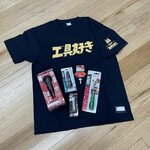
From my visit to the Factory Gear tool store in Tokyo. The shirt says "I like tools". I'll do a big photo dump of the inside of this amazing tool store in the future.



Jackmugen02
Member
- Joined
- Dec 13, 2022
- Messages
- 14
Yep, you can swap out the rings on all the nepros tools that have them. I installed red ones on all my nepros tools. Stick with the black ones, if you don't want to see dirt. I found the smaller the ring, the softer/less durable they are. I found a plastic iFixit spudger pointed end was the safest way to remove/install them.didn't know you could do that!
rick carpenter
Well-known member
Anyone know where to source Vessel Ball Torsion bits in +1 and +3 in packs of preferably quantity 5-15? Length is not really an issue (let the jokes commence) as long as they're 50mm or more. I have two 25pc packs of +1x50 and +3x50 and two +1/+2/+3 x50 five pc assortment packs in my Amazon cart right now.
They have +3x90 in five pc assortment packs, so I know they make these too.
They have +3x90 in five pc assortment packs, so I know they make these too.
Not sure you'll find what you're looking for, but here's the catalog with all of the different torsion bits and the part numbers.Anyone know where to source Vessel Ball Torsion bits in +1 and +3 in packs of preferably quantity 5-15? Length is not really an issue (let the jokes commence) as long as they're 50mm or more. I have two 25pc packs of +1x50 and +3x50 and two +1/+2/+3 x50 five pc assortment packs in my Amazon cart right now.
They have +3x90 in five pc assortment packs, so I know they make these too.
Attachments
four.cycle
Well-known member
rick carpenter said:Anyone know where to source Vessel ...
I would send an email to [email protected] and ask him to get you a quote. Give him ALL the specifics in an email. (He doesn't have time for phones.)
Be sure to note in the email that you live in the State of Texas.

rick carpenter
Well-known member
Not sure you'll find what you're looking for, but here's the catalog with all of the different torsion bits and the part numbers.
Thanks y'all. I'm trying to upgrade my impact bit kit from SAE to all Vessel if possible, and the Tatara flyer covers the bits I'd want. I can buy +2's in various lengths & quantities, but fewer options for +1's and +3's. Guess I'll go with a few of the 5pc packs, and as many more +2 lengths as I need. @four.cycle, Bowers tools is one of the Amazon US shippers and I'm looking at his web site too. Thanks again.I would send an email to [email protected] and ask him to get you a quote. Give him ALL the specifics in an email. (He doesn't have time for phones.)
Be sure to note in the email that you live in the State of Texas.
four.cycle
Well-known member
^ you want to deal with Nelson directly on HIS website. otherwise he has to give a cut to amazon or ebay.
way mo' betta dealing directly with him.
he does not stock a LOT of Vessel, but he can GET IT.
last back-and-forth I had with him he indicated delivery of product from Vessel was an issue. (low fill rate on orders.)
YMMV
way mo' betta dealing directly with him.
he does not stock a LOT of Vessel, but he can GET IT.
last back-and-forth I had with him he indicated delivery of product from Vessel was an issue. (low fill rate on orders.)
YMMV
kyrbz
Well-known member
Kinda stretching the boundaries of the definition of "tools" (brushes are tools?) but I thought some of you might appreciate these pics from a high end art store in Tokyo called "Pigment Tokyo". The 2 pics with the big glass jars and samples in frames are animal parts that are bought dried and ground up to make different natural hide glues. The wall of colored jars are raw granular watercolor pigments that can be purchased by the gram.

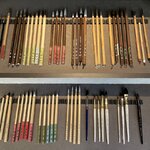



CHI_Tool&Die
Well-known member
To each and every trade/craftsman there is a unique set of tools. I’d definitely consider brushes as tools. Just like I consider knives tools for chefs. If you need to use it to do a job then it’s definitely a tool.Kinda stretching the boundaries of the definition of "tools" (brushes are tools?) but I thought some of you might appreciate these pics from a high end art store in Tokyo called "Pigment Tokyo". The 2 pics with the big glass jars and samples in frames are animal parts that are bought dried and ground up to make different natural hide glues. The wall of colored jars are raw granular watercolor pigments that can be purchased by the gram.
Kinda stretching the boundaries of the definition of "tools" (brushes are tools?) but I thought some of you might appreciate these pics from a high end art store in Tokyo called "Pigment Tokyo". The 2 pics with the big glass jars and samples in frames are animal parts that are bought dried and ground up to make different natural hide glues. The wall of colored jars are raw granular watercolor pigments that can be purchased by the gram.
OMG, that is absolutely insane. And beautiful. I am not an artist, but you don't need to be to appreciate that absolutely magnificent insanity! Unfortunately, I doubt such a place exists in the US; most of us are too busy eating Big Macs
Dave455
Well-known member
A fascinating place!Kinda stretching the boundaries of the definition of "tools" (brushes are tools?) but I thought some of you might appreciate these pics from a high end art store in Tokyo called "Pigment Tokyo". The 2 pics with the big glass jars and samples in frames are animal parts that are bought dried and ground up to make different natural hide glues. The wall of colored jars are raw granular watercolor pigments that can be purchased by the gram.
Although not Japanese, many British towns have traditional artists suppliers, a lot of which sell traditional pigments, as well as oil paints, water colours, pastels etc.
L. Cornelissen in London have remained relatively unchanged since the 1850’s, and my home town has a similar shop only 20 years younger.


toddmorr
Well-known member
Wow, there's probably only a handful of shops like that on the planet
Shop supplies . . .

Some of my pencil addiction:


All metal made in Japan pencil sharpener, the Carl Angel-5 Royal. Super high quality, and does the job. Take care - there is a US market model called Carl Angel-5 that is made in China. Also all metal, but somewhat lesser quality overall. The Royal-5 Angel model is made in Japan for the Japanese market but you can get it on their amazon website for about the same money as the chinese model.

Point before using the Carl, just made with a German hand-sharpener - very off centre and short:

Point after using the Carl - centered and long:
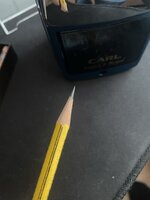
Really want to try some US pencils as well. But paying 3-4 times as much on amazon seems crazy for the quality Mitsubishi offers. Blackwings are cool but so overpriced. I heard Musgrave is cool to try out.
Last edited:
Also, have a few Mitsubishi Uni Kuru-Toga mechanical pencils. Here is my all metal variant:
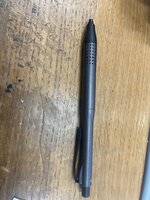

These use what they call the kurutoga "engine". It has a special complex mechanism that rotates the lead a little bit every time it is pressed down and released. This makes for a very consistent writing experience.

Works quite well. It feels just a little bit different to write with and you need to get used to it, but it works nice at work for quick technical sketches.
These use what they call the kurutoga "engine". It has a special complex mechanism that rotates the lead a little bit every time it is pressed down and released. This makes for a very consistent writing experience.
Works quite well. It feels just a little bit different to write with and you need to get used to it, but it works nice at work for quick technical sketches.
Is there a way to identify the year of manufacture of a Koken product?
I believe they all have a 4 digit code, first is the week of the year, second is the year. At least zeal ratchets do. For example 1210 twelfth week of 2010
I don’t have many Ko-ken tools and it’s all Z-EAL, but they seem to have a three-digit date code. I’m guessing it’s the year followed by the month. So a typical number for recent produciton would be 236 (the number on my 3725Z ratchet).
For the third digit, beyond 9 (September) they seem to use J, K, and L to represent October, November, and December respectively.
Have none of you seen this dating system then? Is it fairly new or Japan only or something? I bought my stuff directly from Japan.
There doesn’t seem to be an A, just J, K, and L like I said.
Not that I understand your complaint, since what would be the problem if A meant January?
The benefit of using a digit or letter for the month, rather than letters only, is that at least for January to September you get an intuitive number that we all understand as a month (e.g. 8 is August without thinking; but if I said H, you’d be counting the alphabet on your fingers to translate it to a number to link it to a month). But obviously our decimal counting system doesn’t stretch to 12 months in one digit, so we can’t use numbers only either.
How would that be an improvement? Because it resolves weeks rather than months? (But at the expense of useful year precision.)
All the codes on my recently acquired Ko-ken tools are 22x or 23x (except one socket that is 17x). Your suggestion would put everything I own as manufactured in weeks 2x or 3x or, even less likely, in weeks 22 and 23 of years stretching back a decade. So clearly the first two digits are the year.
If anyone can produce a three-digit Ko-ken date code that has a letter other than J, K, or L, or a letter in any position other than the third, I’ll reconsider my guesswork. Because it is just guesswork. I’ve not read anything about Ko-ken’s date codes and only own a small amount of Ko-ken tools.
Ko-ken has been using a three-digit date code at least from the 90's.
As for the use of letters, @Samuel D was close.
October = O
November = J
If November is J, like "Jack", then you'd think December would be Q for "Queen", but "Q" can be easily mistaken for "O" so they decided on:
December = K
My oldest socket is from 1967 and they appear to have been using a 2-digit date code: "67" so, just the year.
Also note the Ko-ken "no-hyphen-logo"
I wasn't there, but I do know that they were there and doing exactly that.
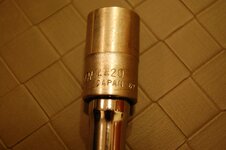
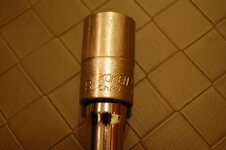

This is one of the ones I am interested to know how old it is. There is only a "J" on it. There are a few other ones I have, one of them I think had a 47 but I don't believe that would be the year.

These would've been purchased used sometime between 1978 and 2004.
SouthVA
Well-known member
A really nice set of ARS pruning shears, which I bought almost a year ago. Expensive, but worth every penny imho.

 www.amleo.com
And a Silky Bigboy folding saw. This cuts through most anything I need to cut.
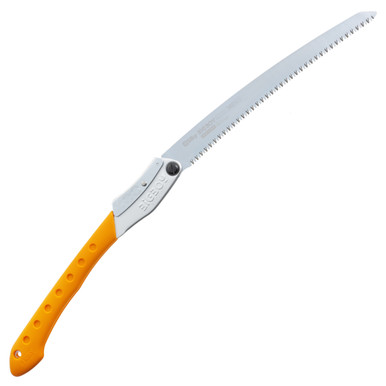
 silkysaws.com
ARS V Series Heavy Duty Pruners
These pruners stay sharp longer!ARS makes their Heavy-Duty Pruners to last. They make the blades using a high-carbon steel with a hard chrome plating. These blades stay sharp longer and resist both rust and sap! These pruners feature ARS? unique squeeze-action latch. This latch opens with a...
www.amleo.com
And a Silky Bigboy folding saw. This cuts through most anything I need to cut.
BigBoy 2000 (360mm) Folding Saw
Multi-purpose folding saw with a 14-1/5-inch curved blade for a greater reach. It is equipped with a perfectly-balanced uniquely-shaped low angle curve (2,000 mm radius of the blade), hard ..
silkysaws.com
Last edited: