To avoid these ads, REGISTER NOW!

Best way to split this air line.

penright

ALLIANCE MEMBER
Joined
Dec 27, 2016
Messages
618
Location
SW of Mustang, OK
When I was doing the air system in the new shop, the suggestion was to just temporarily do some "in hose" until you know for sure how you are going to use it.
In the Words of "Watch Wes Work", it is only temporary unless it works.
Four years later there is one small change I want to make. My thought is to split the line before the air regulator. Most of the air tools I use most of the time need the regulator. Now and then when I want to use the air impact, I hate moving the regulator and hopefully put it back.
Right now my thought is to screw the whip into the real and the maie onto the air regluator. Then T the inlet some how.
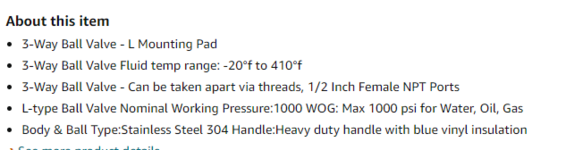
Below the picture of my setup are two different things that I have found. My conceren is none of them have any spec's on pressure. Every thing in the system so far is rated at 175psi+.
One way is the blue manifold, with a niple that is long enough that I can support it on the bar to the right. Then plug off one of the holes
Right now I am leaning toward the blue Y. Screw the feed line into one of the couplers, short ****** between it and the regulator. with a female on the regulator output. Then move the whip with the male end between regulated and unregulate.
Thoughts?


1703258646579.png

1703259261689.png
1703259297526.png
1703260347153.png

1703260932655.png
 
To avoid these ads, REGISTER NOW!

2ndGearRubber

Well-known member
Joined
Mar 24, 2014
Messages
14,185
Location
Pittsburgh
That's basically what you want to do. I can't comment on the quality of the stuff you're buying, normally I just by brass fittings drilled in the required thread I need. Although I cannot imagine many situations where basically any quality level of air manifold would be a liability.

Rather than buying the Y shaped adapter, just by couplers with NPT male attachment and screw them directly into the manifold.
 

2ndGearRubber

Well-known member
Joined
Mar 24, 2014
Messages
14,185
Location
Pittsburgh
I am not an engineer, nor do I have any engineering related experience. However I doubt 1000psi capable valves/seals for $21 on Amazon. I don't doubt it could hold air pressure from a compressor.
 
OP
P

penright

ALLIANCE MEMBER
Joined
Dec 27, 2016
Messages
618
Location
SW of Mustang, OK
I am not an engineer, nor do I have any engineering related experience. However I doubt 1000psi capable valves/seals for $21 on Amazon. I don't doubt it could hold air pressure from a compressor.
But, did you stay at a Holiday Inn last night? :)
That was my exact thought.
 
Last edited:

The Cobbler

Super Moderator
Staff member
Joined
Oct 24, 2013
Messages
25,991
Location
Niagara Region, Ontario, Canada
almost anything you do would be sufficient if you're using NPT fittings. no need to get all fancy with stuff. a regular NPT tee would work fine for splitting your air supply. most hose is rated for 300psi so you're good there too . brass hose ferrules with regular hose clamps would work if you splice the hose . it all depends on the look you're after I would say .
 

Leaflessshadetree

Well-known member
Joined
Aug 1, 2013
Messages
7,176
Location
Don't ask.
I'd mount a couple brass or iron Tees and some *******, along with ball valves to shut of or direct air and probably a drip leg.. Do you want the reel regulated or the ability to open close valves to give you the option? I'd also put a quick coupler there as well. Is that a quick couple going to the reel?
 
To avoid these ads, REGISTER NOW!
OP
P

penright

ALLIANCE MEMBER
Joined
Dec 27, 2016
Messages
618
Location
SW of Mustang, OK
Is that a quick couple going to the reel?
Yes. I remember that I had to have it so I could screw the line together. I was able to spin it all including the regulator before mounting it.

or the ability to open close valves to give you the option?
The ability to shift from unregulated to regulated.

I was just going to move a coupler until someone mentioned the 3-way valve. I don't need unregulated that often, so moving a coupler would not be the end of the world. But the valve would be handy. :)
 

ipgenie

Well-known member
Joined
Jan 29, 2020
Messages
562
Location
Idaho
You could put a T on each side of the regulator, one with a shut off valve. Then connect them with a bypass hose.
Open the valve to allow high pressure to go around the regulator and close to switch back.
 

ipgenie

Well-known member
Joined
Jan 29, 2020
Messages
562
Location
Idaho
Many/most regulators bleed air when the regulated side is higher than the set PSI is. so you would need to put a valve on each side of the regulator to alleviate this.

That's good info I wasn't aware of. Would using just a single valve on the high pressure side of the regulator prevent the bleeding?
 

The Cobbler

Super Moderator
Staff member
Joined
Oct 24, 2013
Messages
25,991
Location
Niagara Region, Ontario, Canada
That's good info I wasn't aware of. Would using just a single valve on the high pressure side of the regulator prevent the bleeding?
yes it would stop the backflow of air into the regulator. but when opened it would basically allow air to by pass the regulator , making the regulator useless . you still need to be able to isolate the regulated air from the non regulated air
 

Leaflessshadetree

Well-known member
Joined
Aug 1, 2013
Messages
7,176
Location
Don't ask.
I'd either set it up like a bypass one would use on plumbing commonly done at water softeners. The other possibility would be to put a single valve parallel with the regulator. Open the valve and the regulator would be bypassed. Close the valve and the regulator would be functional.
 
To avoid these ads, REGISTER NOW!
Top Bottom