To avoid these ads, REGISTER NOW!

Finally broke my trusty Harbor Freight breaker bar

All

Well-known member
Joined
Mar 28, 2013
Messages
607
First time taking the wheels off my new to me Chevy Colorado….evidently Hercules decided to run the lugs down as tight as possible. Busted the impact adapter….finally got them off. 140ft/lbs seems a little overkill to me

Metric wheel lug studs of M14 x 1.50 (fine, distance in mm between thread crowns) call for 140 ft lbs.
 
To avoid these ads, REGISTER NOW!

whateg01

Well-known member
Joined
Mar 13, 2006
Messages
12,057
Location
doo dah, kansas, usa
I can't resist telling my favorite cheater bar story;
I needed to remove the dampener from a Buick V-8 many year ago to replace the timing set. I removed the crank bolt and put on the puller which uses three bolts through a yoke threaded into the hub of the dampener where the pulley would attach, a central acme screw then bears against the crank snout.
I was struggling to get it to move so tried a longer bar but still it would NOT budge. My father in law(God bless him) came up with a heavy wall pipe about 5' long which I applied along with all my weight hanging and bouncing on it. It finally let loose with a tremendous bang.
I had missed the washer under the bolt which was buried in dirt and grease so I was pushing against the washer, not the crank. The dampener had exploded with the forces applied against itself. My Buick parts man had a good laugh.
Well, we've all done that before! Right? Haven't we? I think we have.
 

whateg01

Well-known member
Joined
Mar 13, 2006
Messages
12,057
Location
doo dah, kansas, usa
Anybody ever think maybe they make them flex on purpose, vs making them super rigid and brittle? The alternative is to make the handle thicker but then the anvil has to be stronger.
 

Bulldog13

Well-known member
Joined
Sep 20, 2007
Messages
1,793
Location
Cape Coral ,FL
Metric wheel lug studs of M14 x 1.50 (fine, distance in mm between thread crowns) call for 140 ft lbs.
Think they were 7/8 standard lugs….not sure…my full size Tundra was like 95 lbs…drove it for over 200k …never had a issue.
 

All

Well-known member
Joined
Mar 28, 2013
Messages
607
Think they were 7/8 standard lugs….not sure…my full size Tundra was like 95 lbs…drove it for over 200k …never had a issue.

7/8? As in 7/8th of an inch?

I can BET THE FARM that the wheel studs of a Chevy Colorado, for any model year, are not 7/8" in diameter.

Now, if you had a Chevy Silverado 6500 medium duty truck with a GVWR of 23,500 lbs, then you would have Metric M22 studs, which are near enough to 7/8" diameter not to quibble about a rough recollection.

But the torque specifications of a 7/8" x 14 threads per inch wheel lug nut are between 350 to 400 ft lbs.

And the torque specifications of an M22 x 1.5 mm per thread wheel lug nut are between 450 to 500 ft lbs.

There is no possible way that the little Colorado mid size pickup has 7/8" wheel studs.

On the odd chance that maybe you were referring to size of wrench or socket used to loosen or tighten the lug nuts, wheels studs and lug nuts have torque specifications determined by the diameter of the fasteners, not their wrench size.

This is a subtopic well within my wheel house. :)
 

Steve_P

Well-known member
Joined
Sep 15, 2010
Messages
5,240
I always feel compelled to post this when people start talking about how the Pittsburgh Pro breaker bar is a wet noodle:

466.jpg

Ok, but did anyone in this thread say that the 1/2 HF didn't deflect about the same as the 1/2 SO, Mac, Matco.... ? And that the HF was inferior? If so, I missed it. Most said to move up to a 3/4+ drive for extreme usage. That's what I did.

In this scenario, elastic deflection of steel is based on the diameter of the bar and the length. Which is why they all appear to deflect the same in the pics above. That's just mechanics of materials.
 

Bulldog13

Well-known member
Joined
Sep 20, 2007
Messages
1,793
Location
Cape Coral ,FL
7/8? As in 7/8th of an inch?

I can BET THE FARM that the wheel studs of a Chevy Colorado, for any model year, are not 7/8" in diameter.

Now, if you had a Chevy Silverado 6500 medium duty truck with a GVWR of 23,500 lbs, then you would have Metric M22 studs, which are near enough to 7/8" diameter not to quibble about a rough recollection.

But the torque specifications of a 7/8" x 14 threads per inch wheel lug nut are between 350 to 400 ft lbs.

And the torque specifications of an M22 x 1.5 mm per thread wheel lug nut are between 450 to 500 ft lbs.

I was referring to the socket size

There is no possible way that the little Colorado mid size pickup has 7/8" wheel studs.

On the odd chance that maybe you were referring to size of wrench or socket used to loosen or tighten the lug nuts, wheels studs and lug nuts have torque specifications determined by the diameter of the fasteners, not their wrench size.

This is a subtopic well within my wheel house. :)
 

Rabid Badger

Well-known member
Joined
Apr 2, 2018
Messages
1,338
Ok, but did anyone in this thread say that the 1/2 HF didn't deflect about the same as the 1/2 SO, Mac, Matco.... ? And that the HF was inferior? If so, I missed it. Most said to move up to a 3/4+ drive for extreme usage. That's what I did.

In this scenario, elastic deflection of steel is based on the diameter of the bar and the length. Which is why they all appear to deflect the same in the pics above. That's just mechanics of materials.
I'm not interested in pointing fingers, but there was a post hinting at the inferiority of Taiwanese tools.
 

2ndGearRubber

Well-known member
Joined
Mar 24, 2014
Messages
14,185
Location
Pittsburgh
7/8? As in 7/8th of an inch?

I can BET THE FARM that the wheel studs of a Chevy Colorado, for any model year, are not 7/8" in diameter.

Now, if you had a Chevy Silverado 6500 medium duty truck with a GVWR of 23,500 lbs, then you would have Metric M22 studs, which are near enough to 7/8" diameter not to quibble about a rough recollection.

But the torque specifications of a 7/8" x 14 threads per inch wheel lug nut are between 350 to 400 ft lbs.

And the torque specifications of an M22 x 1.5 mm per thread wheel lug nut are between 450 to 500 ft lbs.

There is no possible way that the little Colorado mid size pickup has 7/8" wheel studs.

On the odd chance that maybe you were referring to size of wrench or socket used to loosen or tighten the lug nuts, wheels studs and lug nuts have torque specifications determined by the diameter of the fasteners, not their wrench size.

This is a subtopic well within my wheel house. :)

They mean 7/8, actually 22mm, nut size. You're right it's typically m14. You won't find nearly ANY vehicles made in the last 20 years without M12, M14, or 1/2 thread wheel hardware.

M22 is what a small FWD car uses for the axle shaft. LOL
 
  • Like
Reactions: All

All

Well-known member
Joined
Mar 28, 2013
Messages
607
Ok, but did anyone in this thread say that the 1/2 HF didn't deflect about the same as the 1/2 SO, Mac, Matco.... ? And that the HF was inferior? If so, I missed it. Most said to move up to a 3/4+ drive for extreme usage. That's what I did.

In this scenario, elastic deflection of steel is based on the diameter of the bar and the length. Which is why they all appear to deflect the same in the pics above. That's just mechanics of materials.

"That's just the mechanics of materials."

And that's just it.

We don't know the materials, or the heat treatment, of importieum, from countries with an industrial culture of dishonesty, or at best, non-disclosure.

If the material is inferior, the mechanical properties will be inferior.

That is why we are comparing brands.

Part of what we are comparing is the integrity of the manufacturer, as a presumed proxy for the expected integrity of the material, which we are really not able to know until we compare experiences with our results.

Who knows if the mechanics of importieum match the mechanics of the material that is claimed and engraved on the bar. That is why people are testing deflection. Where we cannot assume what material something is made of, we can at least see some results.
 
To avoid these ads, REGISTER NOW!

1320stang

Well-known member
Joined
Dec 28, 2006
Messages
4,609
Location
Edmond, OK
Was it this one?

Screenshot_20231226_163123.jpg

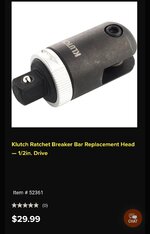
I don't have the HF verion, but a similar 18" one. The head broke many years ago and I kept the bar for some reason (yes, pakrat). My son started at Northern Tool and I found this.

Screenshot_20231226_163241_Samsung Internet.jpg


Fit perfectly (I have a 24" 1/2 drive Snap-On).
 

ez-duzit

Well-known member
Joined
Jun 24, 2013
Messages
5,109
Location
Marina del Rey
Occasionally I am required to become involved with challenging tasks. The 16" diameter exhaust risers on this large superyacht needed to be rebuilt. The cheater pipe leveraged HF 3/4-drive breaker bar (in background) could only be used to loosen the retaining bolts AFTER using a striking wrench and 4lb hammer to break them free.

IMG-0430-1.jpg
 
  • Like
Reactions: All

Olafur

Well-known member
Joined
Jun 2, 2011
Messages
2,578
Location
Iceland
"That's just the mechanics of materials."

And that's just it.

We don't know the materials, or the heat treatment, of importieum, from countries with an industrial culture of dishonesty, or at best, non-disclosure.

If the material is inferior, the mechanical properties will be inferior.

That is why we are comparing brands.
The flex in this case and so many others is calculated (dictated) by young's modulus for steel. It has only small variation for different blends of steel, you won't notice the difference, it's even difficult to measure. So - with same dimensions, one should expect bottom and top brands to flex the same within limits. That's the short version of it - as long as the bar returns to it's original shape (straight). Steve is correct.
 

Gurp

Well-known member
Joined
Jun 12, 2014
Messages
366
Location
So.Ohio
Only breaker bar I've ever broken was a 90s craftsmen 18in bar. I had a 4 or 5 foot bar on it bouncing.

When it broke I hit the ground my dad and my buddy who were working with me laughed. that was probably 17 years ago now.
 

whateg01

Well-known member
Joined
Mar 13, 2006
Messages
12,057
Location
doo dah, kansas, usa
I've had the same harbor freight 1/2" breaker bar for probably 20 years. It hasn't failed me yet. I recall all of the ones Dad ever had having the handle split around the anvil at the pivot. I have a couple smaller ones like that too. But the hf one is the one with the bulky anvil that goes around the handle. Has anybody ever done a test to determine which is a better design? Clearly, the one I have is bulkier
 
OP
R

rust in the eye

Well-known member
Joined
Oct 2, 2017
Messages
2,906
Location
Chicagoland
Was it this one?

Screenshot_20231226_163123.jpg

I don't have the HF verion, but a similar 18" one. The head broke many years ago and I kept the bar for some reason (yes, pakrat). My son started at Northern Tool and I found this.

Screenshot_20231226_163241_Samsung Internet.jpg


Fit perfectly (I have a 24" 1/2 drive Snap-On).
Yes, that is the one I had. The bar broke on mine, right at the neck where it attaches to the head.
HF exchanged it for a new one. A couple of days later I went back with the unused replacement and asked if I may upgrade to the Icon 25" bar. No problem, I simply paid the difference in price and now have a much sturdier bar.1703772082722.png
 
Last edited:

619DioFan

Well-known member
Joined
Apr 9, 2013
Messages
3,617
Location
San Diego , Ca.
I put one of the HF breaker bars in each vehicle in case of a tire change . along with the right socket. I also added a speed handle to make the change faster ( loosen with the breaker remove with the spinner handle ) for 10.00 each for the breaker bars , good investment IMO. When I go on longer trips I take a cordless impact.
 

All

Well-known member
Joined
Mar 28, 2013
Messages
607
full
 

toyotadriver

Well-known member
Joined
Dec 30, 2010
Messages
1,586
Have a couple 25 year old Harbor Freight breaker bars still going strong.


Nothing in this post should be misunderstood, interpreted, misinterpreted, or construed to be of a political nature.
 

All

Well-known member
Joined
Mar 28, 2013
Messages
607
See the picture that 1320 posted. The yoke is on the drive end, the bar necks down where it attaches at the pivot point, that is where mine broke. The yoke/drive end remained intact.

Thank you for responding, which I very much appreciate.

I apologize for being so dense, which I very much regret.

But as of this writing, after having re-read this entire thread, including your post quoted above several times, as well as the picture that 1320stang posted, I still as yet do not understand where exactly the HF breaker bar broke.

Then again, maybe I shouldn't try so hard to be prepared for where it might break. It would spoil the surprise.
 
OP
R

rust in the eye

Well-known member
Joined
Oct 2, 2017
Messages
2,906
Location
Chicagoland
I'd post a picture as I still have a shorter version of that same bar but my computer and camera are at odds right now.
The bar broke at the point where it is narrowed to attach to the pivot point. Maybe someone else could make an illustration . Mine gave plenty of warning, it was permanently bent there before it finally gave up. I knew it was going to break and it was no surprise but pressed on because as I told in my original post some numbnuts had tightened the lugs well beyond reasonable.
It broke at the weakest point which is apparent looking at it.
When it went it was still a big shock so if you plan on pressing yours to the limit remember all the force you apply will be suddenly released when it goes. Be positioned so you don't hurt yourself. Better yet if you see this thing getting permanently bent get a stronger bar.
 
To avoid these ads, REGISTER NOW!
Top Bottom