To avoid these ads, REGISTER NOW!

Compressor leaks and runtime

rszimm

Member
Joined
Sep 25, 2019
Messages
11
Location
tucson
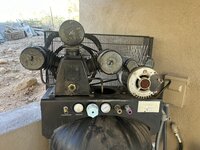
I've got a Kobalt 80 gallon 4.5HP (the motor is only 4HP though) compressor. I have two issues: #1, it's got a leak. I have a ball valve on the side so i can isolate the compressor. I can fully charge the system, turn off the ball valve, then come back in a few days and the compressor will have lost enough volume to kick on again.
I've sprayed so much soapy water on this thing that the whole thing is sticky. Every fitting has been covered (including the drain at the bottom). No bubbles.

So where are the most likely culprits for a leak in this thing?

IMG_2674.jpeg
Question #2: How do I know if my compressor seals are getting worn out or my pump needs to be replaced? I would think that I should be able to time how long it takes to go from Pressure A to Pressure B and know I'm within specs, but I can't find any data like that. Anyone have a similar compressor and knows how long it takes from when it first kicks in to when it kicks out?
 

Attachments

  • IMG_2673.jpeg
    IMG_2673.jpeg
    1.4 MB · Views: 3
To avoid these ads, REGISTER NOW!

The Cobbler

Super Moderator
Staff member
Joined
Oct 24, 2013
Messages
25,959
Location
Niagara Region, Ontario, Canada
for leaks , I would disconnect the pipe from the head to the tank( before the check valve) and test the check valve to see if it's leaking.
the air outlets are a culprit for leaking too a,d they can be a bit tricky as the seal is way back inside. you could take them off & plug them to see if that makes a difference .
have to fully ruled out gauges , pressure regulator and all that stuff?
 
OP
R

rszimm

Member
Joined
Sep 25, 2019
Messages
11
Location
tucson
I'll check the check valve. I suppose if that's the culprit, I'd never find it with soap/water.

I have not ruled out gauges, pressure regulator, etc as I'm not entirely sure how to test them other than to soak them with soapy water (which I have done, but I'm not sure if that's sufficient).
 
OP
R

rszimm

Member
Joined
Sep 25, 2019
Messages
11
Location
tucson

GeoBruin

Well-known member
Joined
May 5, 2018
Messages
3,750
This calculator can't be right, can it? I put my parameters in and it says I should go from 0 to 160psi in 1 minute flat... that's WAY off from what I'm seeing.
What flow rate did you use?

I actually don't even know what flow rate you would use. The pump output over time is a curve based on the pressure in the tank. Maybe the calculator is assuming a curve of some kind?

Here's a different calculator that gives a very different answer. I checked it against the next couple hits and this seems to be consistent with those. Sounds like a little over 8 minutes.
 
OP
R

rszimm

Member
Joined
Sep 25, 2019
Messages
11
Location
tucson
if you rule out the check valve ( which very well may be the culprit ) ,can you isolate the manifold that hols the gauges , couplings etc?
That would be difficult (impossible?). The manifold holds the pressure relief valve as well as the pressure switch. If I were to disconnect/cap the manifold, the compressor would never stop and there would be no safety relief. I’m guessing that would end badly.
 
OP
R

rszimm

Member
Joined
Sep 25, 2019
Messages
11
Location
tucson
I was just wondering if it was easy to take out of circuit to check it . not to remove it & run the compressor. just trying to think of ideas to help find your leak(s)
Hmm. Maybe with a lot of work. I wonder if I could remove the manifold, then pressurize it with a different compressor and maybe put the whole thing underwater or something to check for leaks.
 
To avoid these ads, REGISTER NOW!

Citation

Well-known member
Joined
Jan 20, 2016
Messages
3,223
Location
Indy
Assuming you are around sea level my CFM calculator says it should take about 8 min to go from 0 to 155 psi given a 14 CFM rate and 80 gallon tank. I would assume a bit longer in real life since 14 cfm is @ 90 psi. As you get higher things will slow down. If it fills in under 10 min I would say it's likely fine.

I also will vote for the check valve. When they leak the air comes out the unloader valve near the pressure switch. You can try to clean the old one or just replace it as they aren't expensive.
 

Jswain

Well-known member
Joined
Apr 26, 2013
Messages
2,465
Location
Calgary, AB

Use this one, or post back with how long in minutes and seconds to go from 0psi to full psi, and let us know what full psi is.

Did you check the bottom of the tank very carefully for leaks? If the tank is rusting out and leaking(not from a fitting) then drain the tank and scrap it immediately.

I agree with the check valve, you should be able to check it from the unloader area as well, with the power off

If you still can't find it disconnect the outside hose from your ball valve and make sure the ball valve isn't leaking into some leaky air lines
 

Sumboodie

Well-known member
Joined
Mar 20, 2021
Messages
10,729
Location
AK
I wouldn't consider losing 50psi in several days to be much of a leak.

The shop compressor here runs every few hours just from leaks. It's I think 120 or 180 gallon, 175psi, 35cfm
 
OP
R

rszimm

Member
Joined
Sep 25, 2019
Messages
11
Location
tucson
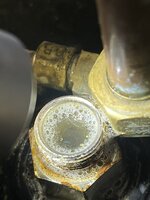
I thought I'd update you guys on what I've done. First, I pulled the pipe off the check valve and filled it with soapy water. No bubbles:
IMG_2677.jpeg
So check valve is OK. (the photo is a bit misleading. Those bubbles on the surface were from me filling the check valve and eventually disappeared)

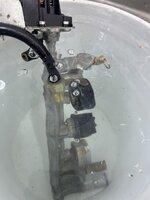
Next I pulled the manifold off, jerry rigged up a fitting and compressed it with a different compressor (thanks to The Cobbler for suggesting this). Then I dunked the whole thing underwater:

IMG_2679.jpeg
So you can't totally tell from the image, but I got a good lot of bubbles from the two pressure gauges and a couple (one per second) out of the regulator. So those will have to get replaced (good thing, as dunking them in water is probably not super good for them).
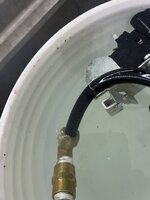
I also got a leak at the nylon hose that connects the tank to the manifold:
IMG_2680.jpeg

So I guess I'll be replacing some parts here. I figure the gauges I can get just generic 2" diameter 1/8" NPT gauges. Any clue as to what to buy for that 1/2" nylon tube and fitting? It kinda looks like a plumbing compression fitting, but I don't want to get the wrong thing.
 

Firstram

Well-known member
Joined
May 16, 2017
Messages
1,392
For the nylon hose, tighten the nut. If that doesn't work, just replace the olive, they're available in 5 packs for a few bucks.
 
OP
R

rszimm

Member
Joined
Sep 25, 2019
Messages
11
Location
tucson
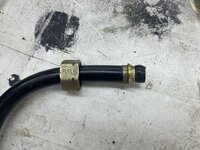
I tightened the nut quite a bit... no joy. I'm thinking the tubing is just 1/2" DOT air brake tubing (??). The "olive" seems odd. It's not a standard brass one you see for copper tubing. It's sort of flared with a shoulder.IMG_2683.jpeg
 
OP
R

rszimm

Member
Joined
Sep 25, 2019
Messages
11
Location
tucson
I thought I would give an update. I replaced the two pressure gauges. I used quality gauges, liquid filled this time. I recall that one of them I replaced just 3 years ago with a cheapo and it's already leaking, so this seemed like a good investment.

The airline I replaced with a DOT 1/2" nylon air line and got some plastic "olives" for it. I tried to use copper, but even with annealed 1/2" refrigerant tubing I couldn't make the turn without kinking the tubing.

I also had to replace the pressure switch as the old one had a plastic part break off as I was putting the thing back together.

Charged it up to 160psi and by morning it was down to 140psi. This worried me until I used the ideal gas law and calculated this is expected based on the temperature delta. For the past three days it's varied from 140psi in the morning to 145 psi in the middle of the day.

My 80 gallon, 4.5HP compressor takes 8 minutes 43 seconds from zero to the 160psi cutout. The label says 16.1CFM@40psi and 14CFM@90psi. By my calculations, I think I'm a little slow, but not really enough to worry about. Here's a chart for how long it took to fill:

Screenshot 2024-03-06 093702.png
 

Citation

Well-known member
Joined
Jan 20, 2016
Messages
3,223
Location
Indy
I thought I would give an update. I replaced the two pressure gauges. I used quality gauges, liquid filled this time. I recall that one of them I replaced just 3 years ago with a cheapo and it's already leaking, so this seemed like a good investment.

The airline I replaced with a DOT 1/2" nylon air line and got some plastic "olives" for it. I tried to use copper, but even with annealed 1/2" refrigerant tubing I couldn't make the turn without kinking the tubing.

I also had to replace the pressure switch as the old one had a plastic part break off as I was putting the thing back together.

Charged it up to 160psi and by morning it was down to 140psi. This worried me until I used the ideal gas law and calculated this is expected based on the temperature delta. For the past three days it's varied from 140psi in the morning to 145 psi in the middle of the day.

My 80 gallon, 4.5HP compressor takes 8 minutes 43 seconds from zero to the 160psi cutout. The label says 16.1CFM@40psi and 14CFM@90psi. By my calculations, I think I'm a little slow, but not really enough to worry about. Here's a chart for how long it took to fill:

Screenshot 2024-03-06 093702.png
If your location is correct remember that you are well above sea level. Those CFM numbers assume sea level air pressure. Not at all surprising that you are slower than the factory numbers.
 
To avoid these ads, REGISTER NOW!
Top Bottom