To avoid these ads, REGISTER NOW!

GFCI issue still feeding voltage when tripped

RobbieG

Member
Joined
Mar 22, 2024
Messages
11
Ok, EE/Controls engineer here, but I'm not electrician and I've been doing mostly automation for 30 years.

I'm having a little issue with our home that we had built about 6 years ago. We did a lot of the work ourselves, but the electrical was done 100 percent by a large local electrical company.

We have surface mounted outlets under our upper kitchen cabinets rather than in the wall in our backsplash. A few weeks ago, I unmounted them (but did not un-wire them, left them dangling), and installed a tile backsplash.

For whatever reason, when they wired these outlets they installed remote GFCI units in a closet, then ran the power from there to the kitchen outlets.

As I was re-installing the outlets, I got a pretty good zap from one of them even though I had intentionally tripped all the GFCI's. Confused, I grabbed my meter. With the GFCI still tripped, I read ~90VAC from line to neutral, and 120VAC from line to ground! What in the world.... There are 3 outlets run from this GFCI and they all read the same.

So I went back and turned off the breaker supplying that GFCI and pulled the GFCI out of the wall. I disconnected two black wires connected to the hot "Load" terminal, and turned the breaker back on. With the GFCI tripped still, I am getting 120VAC from the hot load terminal to neutral and ground! Can a GFCI unit really fail in an unsafe manner like that, or do I have a more complicated wiring issue going on?

Thanks for any ideas.
 
To avoid these ads, REGISTER NOW!

Gutman

Well-known member
Joined
Jan 10, 2019
Messages
294
Location
ENC
Did you check the voltage when the breaker was open?
Often, kitchen receptacles are split between several circuits, so you may not have isolated the correct ckt.
 
OP
R

RobbieG

Member
Joined
Mar 22, 2024
Messages
11
typically GFCIs are fail safe.

What brand GFCIs do you have? can you take a picture of the wiring?
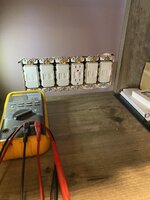
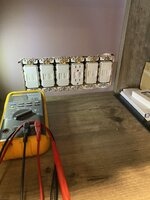
It's a basic Legrand Pass/Seymore. I can't really get a pic of the wiring, other than it has a red and white on the line side (shares a neutral with another circuit) and (2) blacks and (2) whites on the load side. They really did a dis-service installing it this way. It's a 6-gang box that seems to be fed by 6 circuits, 3 double pole circuits with each sharing a neutral. In the box there are 6 GFCI units installed, feeding a bunch of outlets all over our kitchen. If I wasn't crazy (I actually am a little crazy), I would pull everything back into the basement and just feed the kitchen outlets directly, then install the GFCI units in the kitchen like I've seen in every other house. That seems like way too much work though.
Did you check the voltage when the breaker was open?
Often, kitchen receptacles are split between several circuits, so you may not have isolated the correct ckt.
I did check that, it was 0V as expected when I turned the breaker off. That was the first thing I did was identify each of the circuits feeding that 6 gang box.
 

wssix99

Well-known member
Joined
Mar 2, 2011
Messages
5,160
Location
Chicago, IL
Very small chance the GFCI is bad. Very high chance your outlet is on another circuit or things are not wired properly. (We've all had issues with the latter at one time or another!)

Can you post a picture of the wiring on the GFCI? You might also turn off the breaker and trace the wires to make sure everything is really connected in the walls as you think it is.
 
OP
R

RobbieG

Member
Joined
Mar 22, 2024
Messages
11
I mean I flipped the breaker and checked the power on the load side and it was 0V.... Seems like a pretty reasonable test. Don't get me wrong, everything done by my general in this house was a damn mess so I wouldn't doubt if something was done wrong, I'm just not seeing anything. Without pulling out the other 5 GFCI's, it would be really tough to get a picture.
 

rlitman

Well-known member
Joined
Oct 18, 2010
Messages
24,600
Location
Long Island
typically GFCIs are fail safe.

What brand GFCIs do you have? can you take a picture of the wiring?
My understanding is that the fail-safe requirement has been around for decades. I've replaced some truly ancient (1970's) GFCIs that were sketchy, but I am still a bit surprised to read that a tripped GFCI purchased in the last decade could measure 120V load side L-N and L-G. I'd plug a load into the receptacle (like a 60W light), and see what you get. Modern digital multimeters have such high impedance that you could easily see 120V phantom voltage on the terminals, but still not get a Wiggy to buzz.
 

justsam

Well-known member
Joined
Aug 20, 2010
Messages
1,267
Location
Penngrove, California
Sounds like kitchen is wired as MWBC, (Multi Wire Branch Circuits), ie, shared neutral. Just how was this wired in 6 gang group of GFCI's. You mention two black wires connected to the hot load terminal. Are these two wires on one screw terminal or pig tailed or using press in termination? I assume since we are talking kitchen this is all 12 gauge wire, and 20 Amp breakers. Breakers should be handle tied if MWBC.
 

The Cobbler

Super Moderator
Staff member
Joined
Oct 24, 2013
Messages
25,895
Location
Niagara Region, Ontario, Canada
chance your outlet is on another circuit or things are not wired properly.
I would pull the load wires off the GFI, see if you have voltage at the terminals and/or the wires /the outlet they serve .
that will rule in or out a possible second source of line
 
Last edited:

sparky 1971

Well-known member
Joined
Oct 9, 2018
Messages
7,972
Location
Central Iowa
Sounds like kitchen is wired as MWBC, (Multi Wire Branch Circuits), ie, shared neutral. Just how was this wired in 6 gang group of GFCI's. You mention two black wires connected to the hot load terminal. Are these two wires on one screw terminal or pig tailed or using press in termination? I assume since we are talking kitchen this is all 12 gauge wire, and 20 Amp breakers. Breakers should be handle tied if MWBC.
Nevermind. Guilty of not reading every post completely...again.
 
Last edited:

sparky 1971

Well-known member
Joined
Oct 9, 2018
Messages
7,972
Location
Central Iowa
It's a basic Legrand Pass/Seymore. I can't really get a pic of the wiring, other than it has a red and white on the line side (shares a neutral with another circuit) and (2) blacks and (2) whites on the load side. They really did a dis-service installing it this way. It's a 6-gang box that seems to be fed by 6 circuits, 3 double pole circuits with each sharing a neutral. In the box there are 6 GFCI units installed, feeding a bunch of outlets all over our kitchen. If I wasn't crazy (I actually am a little crazy), I would pull everything back into the basement and just feed the kitchen outlets directly, then install the GFCI units in the kitchen like I've seen in every other house. That seems like way too much work though.

I did check that, it was 0V as expected when I turned the breaker off. That was the first thing I did was identify each of the circuits feeding that 6 gang box
Is this only happening with one GFCI? If so, it's probably just a bad one. I've never heard of a GFCI failing that way in recent years, but I have seen it happen.
 

mm08822

Well-known member
Joined
Jan 13, 2012
Messages
5,921
Location
NJ
I would pull the load wires off the GFI, see if you have voltage at the terminals and/or the wires /the outlet they serve .
that will rule in or out a possible second source of line
First thing I would do.

Don't be surprised if initial wiring is screwed up. Sounds odd right out of the gate.
 

wssix99

Well-known member
Joined
Mar 2, 2011
Messages
5,160
Location
Chicago, IL
I would pull the load wires off the GFI, see if you have voltage at the terminals and/or the wires /the outlet they serve .
that will rule in or out a possible second source of line

Yes, this is a great plan and will give a lot of info and rule out a lot of things. I would also test the Line outlet and make sure its receptacles cut off when the test buttons are pressed. If the outlet itself is working, it should be protecting the Load terminals.

I also highly recommend having one of these in the toolbox. https://www.homedepot.com/p/Power-Gear-3-Wire-Receptacle-Tester-50542/206212329#overlay It really makes finding issues easy and also has a GFCI test button on it.
 
OP
R

RobbieG

Member
Joined
Mar 22, 2024
Messages
11
My understanding is that the fail-safe requirement has been around for decades. I've replaced some truly ancient (1970's) GFCIs that were sketchy, but I am still a bit surprised to read that a tripped GFCI purchased in the last decade could measure 120V load side L-N and L-G. I'd plug a load into the receptacle (like a 60W light), and see what you get. Modern digital multimeters have such high impedance that you could easily see 120V phantom voltage on the terminals, but still not get a Wiggy to buzz.
I actually am reading 120V line to ground, but 90V line to neutral. That's what is really odd. If I plug something into the outlet, (I plugged in my wife's hair dryer), it does not run- But, when I touched the hot terminal to disconnect it, I definitely got a zap. Not a full out 120V hit, but I was also standing on a wood floor with tennis shoes on and did not touch the ground at the same time.

I would pull the load wires off the GFI, see if you have voltage at the terminals and/or the wires /the outlet they serve .
that will rule in or out a possible second source of line
Yup, actually did this after replying to the last post- Same readings on the output of the GFI. 120VAC line to ground, 90VAC line to neutral. I'm gonna grab a new GFCI at Menards today to see if that's the problem. I hope so, because taking all 6 of those GFCI's out of the box to see what's up with that mess of wiring behind it won't be fun.
 
To avoid these ads, REGISTER NOW!
OP
R

RobbieG

Member
Joined
Mar 22, 2024
Messages
11
Yes, this is a great plan and will give a lot of info and rule out a lot of things. I would also test the Line outlet and make sure its receptacles cut off when the test buttons are pressed. If the outlet itself is working, it should be protecting the Load terminals.

I also highly recommend having one of these in the toolbox. https://www.homedepot.com/p/Power-Gear-3-Wire-Receptacle-Tester-50542/206212329#overlay It really makes finding issues easy and also has a GFCI test button on it.
I actually had one similar to that but without the test button, and for the life of me haven't been able to find it in a couple years. Just ordered this yesterday :) Long overdue. https://www.amazon.com/gp/product/B09WJKKBP2/?tag=atomicindus08-20
 
OP
R

RobbieG

Member
Joined
Mar 22, 2024
Messages
11
Sounds like kitchen is wired as MWBC, (Multi Wire Branch Circuits), ie, shared neutral. Just how was this wired in 6 gang group of GFCI's. You mention two black wires connected to the hot load terminal. Are these two wires on one screw terminal or pig tailed or using press in termination? I assume since we are talking kitchen this is all 12 gauge wire, and 20 Amp breakers. Breakers should be handle tied if MWBC.
Yes, this seems to be (3) dual pole 20A breakers feeding 6 remote GFCI units (no outlets) which feed a bunch of regular outlets in the kitchen. (All wiring in my county has to be 12ga or larger.. what a pain). These are all pushed in from the back although they don't seem to be spring clips, you still have to loosen the screw on the side to remove the wires.
 

wssix99

Well-known member
Joined
Mar 2, 2011
Messages
5,160
Location
Chicago, IL
It sounds like your outlet is not on the 'line'/GFCI that you thought it was, then. Having/finding that tester will be great because you can hit the test button and the line that your outlet is on should go off.
 

justsam

Well-known member
Joined
Aug 20, 2010
Messages
1,267
Location
Penngrove, California
When you replace the suspect GFCI and prove that it was passing current in a failed mode, it would be good to disassemble it and see if the contacts welded them selves together or what happened.

The difference voltage between ground and neutral is a concern. Can you measure from the suspect neutral to a different receptacle hot and see what voltage you get? Then reverse it and see what you get from the suspect hot to a different neutral? May need to extend meter leads. There may be an issue with the neutral conductor to the suspect receptacle.
 
OP
R

RobbieG

Member
Joined
Mar 22, 2024
Messages
11
It sounds like your outlet is not on the 'line'/GFCI that you thought it was, then. Having/finding that tester will be great because you can hit the test button and the line that your outlet is on should go off.
I've had all 6 in the box tripped at once, still had the odd voltages at the plug in the kitchen. Also, removed the hot side of the load of the GFCI, still have voltage on the terminal.
 
OP
R

RobbieG

Member
Joined
Mar 22, 2024
Messages
11
When you replace the suspect GFCI and prove that it was passing current in a failed mode, it would be good to disassemble it and see if the contacts welded them selves together or what happened.

The difference voltage between ground and neutral is a concern. Can you measure from the suspect neutral to a different receptacle hot and see what voltage you get? Then reverse it and see what you get from the suspect hot to a different neutral? May need to extend meter leads. There may be an issue with the neutral conductor to the suspect receptacle.
I'm about to replace the suspect GFCI so we'll find out soon.

The difference in voltage also concerns me, but now that both black wires are removed from the load side of the GFCI, I'm now getting 120V on the hot wire of the load side to ground and neutral. I wonder if there is just a little bit of leakage voltage getting through somehow.... enough to give me a tingle at the receptacle but not enough to maintain voltage over a longer run of wire.
 

rlitman

Well-known member
Joined
Oct 18, 2010
Messages
24,600
Location
Long Island
I actually am reading 120V line to ground, but 90V line to neutral. That's what is really odd. If I plug something into the outlet, (I plugged in my wife's hair dryer), it does not run- But, when I touched the hot terminal to disconnect it, I definitely got a zap. Not a full out 120V hit, but I was also standing on a wood floor with tennis shoes on and did not touch the ground at the same time.
Clearly the device is defective and should be replaced. Once you've got it fully disconnected, I'd be curious about resistance readings between line and load side.

I'm about to replace the suspect GFCI so we'll find out soon.

The difference in voltage also concerns me, but now that both black wires are removed from the load side of the GFCI, I'm now getting 120V on the hot wire of the load side to ground and neutral. I wonder if there is just a little bit of leakage voltage getting through somehow.... enough to give me a tingle at the receptacle but not enough to maintain voltage over a longer run of wire.
Yes, exactly. I'm betting the resistance is pretty high. Even 1 M-ohm could still show close to 120V on most digital multimeters, while it might only show a couple of volts on an analog Simpson. Even so, I wouldn't suggest going full Mehdi (Electroboom) and checking for voltage with your fingers. ;)
 
OP
R

RobbieG

Member
Joined
Mar 22, 2024
Messages
11
Clearly the device is defective and should be replaced. Once you've got it fully disconnected, I'd be curious about resistance readings between line and load side.


Yes, exactly. I'm betting the resistance is pretty high. Even 1 M-ohm could still show close to 120V on most digital multimeters, while it might only show a couple of volts on an analog Simpson. Even so, I wouldn't suggest going full Mehdi (Electroboom) and checking for voltage with your fingers. ;)
Good points. Just finished replacing it and all is well, and now I have an outlet in the closet as a side bonus. It's nice when the simplest answer is the solution, but it doesn't usually seem to work that way. I've been working with redundant self checking Cat 3 / PLd machine safety circuits for robots and automation at work the past few years, and having something fail in an unsafe state is just kinda mind boggling. Then I have to remember this is a $15 device. So there's that. But I'm really surprised it allowed a reset.

The whole reason I found it is because I used the GFCI as a disconnect and got a little tickle while unwiring the external outlet. But I saved 20 steps to the basement and back. :rolleyes: And in actuality, I'm glad I found it I guess.

Just checked resistance between the hot line and hot load side.... 0.6 ohms regardless if tripped or not!
 

Attachments

  • IMG_6383.jpeg
    IMG_6383.jpeg
    775.6 KB · Views: 46
OP
R

RobbieG

Member
Joined
Mar 22, 2024
Messages
11
1711221072599.png

What the heck, is every GFCI for the whole house in this one box in a closet?
I have no clue why they did it this way. I think they felt they couldn't fit the GFCI outlets in the undercabinet boxes for the kitchen so they remote mounted them. Had I realized what they were doing I would have stopped them. But it is what it is. We had GFCI's in those same boxes in our old house.
 
OP
R

RobbieG

Member
Joined
Mar 22, 2024
Messages
11
Clearly the device is defective and should be replaced. Once you've got it fully disconnected, I'd be curious about resistance readings between line and load side.


Yes, exactly. I'm betting the resistance is pretty high. Even 1 M-ohm could still show close to 120V on most digital multimeters, while it might only show a couple of volts on an analog Simpson. Even so, I wouldn't suggest going full Mehdi (Electroboom) and checking for voltage with your fingers. ;)
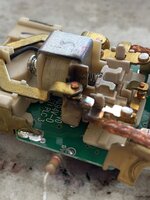
Also, the contact on the hot side was definitely stressed. It wasn't still welded when I took it apart but I'm sure it was stuck. Still can't believe with all the circuitry on that thing it would allow it to be reset while the output was hot.
 

Attachments

  • IMG_6384.jpeg
    IMG_6384.jpeg
    564.5 KB · Views: 40

welder4956

Well-known member
Joined
Apr 8, 2010
Messages
3,070
Location
Birmingham, AL USA
I've had all 6 in the box tripped at once, still had the odd voltages at the plug in the kitchen. Also, removed the hot side of the load of the GFCI, still have voltage on the terminal.
So, can you start opening breakers one at a time and checking each GFI to see where the voltage source is?
 
To avoid these ads, REGISTER NOW!
Top Bottom