I have an older Atlas lathe 9 or 10 and I'm looking to add other machines in a similar scale to match as I'm severely limited on space. I know the lathe has chatter do to its size but I'm not looking to machine parts for engines just things like brass bushings, v-belt pulleys etc. I'm assuming similarly sized machines would also have this issue? I've found an older gentleman cleaning out his shop and he has an Atlas bench-top drill press and bench-top horizontal mill. Would the horizontal mill be up to cutting key ways in a shaft? What kind of tolerances would this be able hold? Is the drill press accurate for what they are? Are they noticeably better than a hand drill in controlling the bit? Again I don't need industrial grade machines that can last working hard everyday all day. If it takes 30-50% longer to do something that's fine I'm learning anyways and going slow.

You are using an out of date browser. It may not display this or other websites correctly.
You should upgrade or use an alternative browser.
You should upgrade or use an alternative browser.
DIY/Garage Metal Working Machines
- Thread starter Zewnten
- Start date
jsaw
Well-known member
A drill press is definitely better than a hand drill. I would be lost without one.
LopezBart
Well-known member
This could certainly cut keyways in a shaft. Note that these machines are light and not particularly rigid;Would the horizontal mill be up to cutting key ways in a shaft? What kind of tolerances would this be able hold?
plan on using HSS tooling. Modern carbine tooling is designed for heavier machines. I used a 10" Atlas lathe
and a Rong Fu mill drill to make a steam engine that pushed our little 19' launch around for years.
These are lovely old lightweight machines. Don't force them, though.
If you can find a mill drill, they serve nicely as both somewhat crude milling machines and heavy duty drill presses.

MushCreek
Well-known member
A vertical mill is a lot more versatile than a horizontal mill. You can cut keyways on a vertical mill, as well as all the other things it can do. They also work well as a drill press.
A vertical milling machine will have maximum benefit if you have collets to hold the cutters. You would need the accuracy of a collet to cut a key way in my opinion. Keep in mind that tooling can cost you more than your initial investment on the machine. The machine cost is the tip of the iceberg. I have not been in the market for a drill mill, but I would buy the heaviest machine I could afford. If you can find a used machine with additional tooling you will be money ahead in the long run.
LopezBart
Well-known member
Collets are only suitable for light duty milling... if pushed, the milling cutter will work its way slowly out of the collet, milling a deeper cut than intended. Use an end mill holder if possible.A vertical milling machine will have maximum benefit if you have collets to hold the cutters. You would need the accuracy of a collet to cut a key way in my opinion. Keep in mind that tooling can cost you more than your initial investment on the machine. The machine cost is the tip of the iceberg. I have not been in the market for a drill mill, but I would buy the heaviest machine I could afford. If you can find a used machine with additional tooling you will be money ahead in the long run.
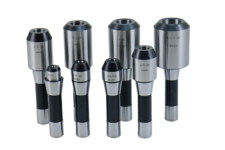
I have heard of end mills slipping in R8 collets but have not experienced it myself. I have a set of Lyndex R8 collets for my Bridgeport and a set of 5C collets for my 12 inch Clausing precision lathe. In addition I have some tool holders for large end mills. During my career as a Test Engineer for a large Aerospace company the R8 collets served me well. There are a lot of variables that will affect machining results, such as the quality of the tooling, feed rate, RPM, and lubrication. Knowing the capability of your machines is key. Light weight machines such as the Atlas lathe are going to have limitations as would a bench top milling machine. Stay away from the import stuff if you possibly can.
Attachments


MushCreek
Well-known member
R8 collets have to be TIGHT. When I was training apprentices, they would tighten it up, then I'd go back and tighten it more- often a half turn. I have seen them pull out under very heavy side loads. I rarely have a problem with it.
f150skidoo
Well-known member
Since your tight on space I would get a bench top vertical mill since it will do the same thing as a the drill press and mostly the same as a horizontal mill but all in one machine.
PhantomEB
Well-known member
my Biggest WANT but will probably never come Is a combo Mill/Lathe. Conversations with our machinist (and buddy I have beers with) highly recommends them over seperate units For my usage.
cvairwerks
Well-known member
As long as your part will essentially fit in the volume of a grapefruit and is going to be made of aluminum, brass, bronze or plastic, they are fine. Once you start trying to work steel, or larger items, the limitations of that type machine show up in a hurry. Easiest thing to do is imagine the biggest part you want to make, add 25% to the envelop dimensions and then look for machinery that will handle that size.my Biggest WANT but will probably never come Is a combo Mill/Lathe. Conversations with our machinist (and buddy I have beers with) highly recommends them over seperate units For my usage.
BTW, with separate machines, you don't have to tear down the milling setup to run a lathe part and vise versa.
RoninB4
Well-known member
-I've never been a fan of the combo machines as they're a compromise of both, usually in the least useful ways. If you're working on anything larger (in diameter) than a can of soup, longer than bottle of beer, or expect tolerances better than +/- .002 than you may find the combo machines lacking. I understand the extra space/money that individual machines require but it's all about the frequency of needing the machines as well as the results you're expecting. Yes, even the crappy little mini machines from Horrible Freight can produce acceptable quality work but I avoid using mine unless the Weiler is loaded. I bought good quality industrial (used) machinery for far less than buying a new machine from Chi-Wan, and got better machinery. I have purchased new machinery from Chi-Wan had short lived electric motors, exploding plastic gears, partial mating surfaces, and tiny handles. That was 25 years ago and perhaps they're making better machinery now but like many things you get what you pay for. I'm not a machinery snob but most machinery from Chi-Wan that's imported here from Horrible Freight or Northern Tool is just ****. Search the used market and don't be afraid to drive 150 miles for it. JMOmy Biggest WANT but will probably never come Is a combo Mill/Lathe. Conversations with our machinist (and buddy I have beers with) highly recommends them over seperate units For my usage.
MushCreek
Well-known member
In my experience (45 years in the trade) it takes a LOT of lathe to do 2" diameter work and above. I have a very stout 11" Summit lathe, and it struggles on anything of any size. You can do it, by taking very small bites, but there's nothing like a 17", 10 hp lathe to really peel metal off. Almost all of my stuff is under 1", other than plastic or aluminum.
I could not agree more. I have driven over 500 miles to buy a lathe. I had a combination mill and lathe that I gave away because it wasn't worth anything. It is important to know that parts are available for whatever you buy. Buy nice or buy twice.-I've never been a fan of the combo machines as they're a compromise of both, usually in the least useful ways. If you're working on anything larger (in diameter) than a can of soup, longer than bottle of beer, or expect tolerances better than +/- .002 than you may find the combo machines lacking. I understand the extra space/money that individual machines require but it's all about the frequency of needing the machines as well as the results you're expecting. Yes, even the crappy little mini machines from Horrible Freight can produce acceptable quality work but I avoid using mine unless the Weiler is loaded. I bought good quality industrial (used) machinery for far less than buying a new machine from Chi-Wan, and got better machinery. I have purchased new machinery from Chi-Wan had short lived electric motors, exploding plastic gears, partial mating surfaces, and tiny handles. That was 25 years ago and perhaps they're making better machinery now but like many things you get what you pay for. I'm not a machinery snob but most machinery from Chi-Wan that's imported here from Horrible Freight or Northern Tool is just ****. Search the used market and don't be afraid to drive 150 miles for it. JMO
LopezBart
Well-known member
You can do a lot with a 10" Atlas, but the lack of rigidity and limited strength of the Zamak gearing means one needs to be cautious to avoid damaging the machine. I used one for many years. Some hints:
- Avoid carbide tooling. Even with positive rake tools, the contact forces are higher and the machine was never designed for it. HSS is also much cheaper since they can be resharpened so readily.
- Take light cuts. Recommended depth of cut & speeds and feeds found in Machinery's Handbook are oriented towards production on sturdier machines.
- Learn to sharpen HSS tooling (and drill bits) really well. Use cutting oil/fluid on steel.
- Ditch the stock lantern-style tool post and buy a good-quality quick change tool post like Phase 3 in size A. This will reduce frustration and help improve rigidity.
- Cut-off tools are hard to use on these light machines, esp. on anything tough or large. Don't be too proud to use a hacksaw in the lathe.
- Lubricate and maintain the machine as per the manual. The ways are not hardened; keep them oiled. Parts can be hard to find.
That horizontal mill can cut keyways if you take it slow, but tolerances will be loose compared to a full-size mill—think a few thousandths, not fractions. The bench drill press is definitely better than a hand drill for accuracy and repeatable holes. I ended up using a little ERP setup for my small Manufacturing projects to track what I made and what tools I had—it helped keep everything organized.
Last edited:
Pics? Drawings? Video?I built my own brake and shear using scrap steel and cheap bottle jacks—worked better than I expected for small projects and saved a ton over buying one.