To avoid these ads, REGISTER NOW!

Dual Battery Sump Pump Setup?

D45

Well-known member
Joined
Mar 21, 2014
Messages
4,842
Location
NW INDIANA
I have one Die Hard Deep Cycle Marine/RV 27M powering my battery back up sump

Can I add a second battery to help with longer back up time, in the event of a power failure?

Anyone running a dual battery setup?
 
To avoid these ads, REGISTER NOW!
OP
D

D45

Well-known member
Joined
Mar 21, 2014
Messages
4,842
Location
NW INDIANA
I would also hook up each battery in parallel right?

This way it won't double the volt to 24V

Positive to Positive
Negative to Negative

Now, what about the trickle low amp charger? Can the charger just be connected to one battery or should it be branched off and ran to/connected to both batteries?
 

Skyman

Well-known member
Joined
Nov 9, 2021
Messages
1,244
Location
Central Maryland
This doesn't answer the question you asked, so feel free to disregard it. If you have public water supply to your house, consider installing a water-powered venturi sump evacuator. Check out Basepump.com

I installed one of these and it saved me from basement floods several times when either the power was out or the main electric pump failed. No battery required.
 

nadogail

Well-known member
Joined
Jan 23, 2009
Messages
32,197
Location
Coronado, CA
A bank of two batteries, connected in Parallel will add to your reserve run time. In theory the same charger can be connected to both batteries at the same time. I am going out on a limb and assuming that the two batteries are equal in both size and characteristics.

Any Technical Information you get from me is GUARANTEED to be worth exactly what you have paid me for it.
 

Shiftless

Well-known member
Joined
Mar 9, 2014
Messages
14,739
Location
East Bay SFO
I also have a battery back up for my sump pump. I have 2 group 27 lead acid batteries but I charge them independently. I only hook up one at a time. The second one acts as a reserve in case the power outage and rainstorm lasts more than a few hours. The second battery can be used with an inverter to run other stuff around the house. I have a few 12 volt LED bulbs that are good to use during power failures. No inverter necessary and very low current drain.

Two batteries will give you twice the capacity. But heed this caution, I found this warning on the Optima battery website.

We would strongly discourage anyone from connecting batteries in series or parallel applications, if the batteries are not identical in age, size and type. It sounds like your batteries are different in each of those ways. Different brands of batteries can have different charging and discharging characteristics, with some accepting a charge or delivering current faster than others. That can be true even if the batteries are the same size. Different types of batteries (flooded or AGM) also can have different charge/discharge characteristics. When you connect two or more batteries that don't charge and discharge at the same rate, one battery will probably end up overcharged and/or one battery will end up undercharged. Neither is a scenario you want to have happen to your batteries, as it will probably shorten the lifespan of both and could create a potentially create a dangerous situation, if one battery gets severely overcharged.

The same is also true of batteries that are identical in every way, except that one battery is older than the other. As batteries age (or get used), their charge/discharge profile changes. As such, they essentially charge and discharge at a different rate a year later, than they did when they were brand-new. That means you shouldn't connect batteries together that aren't the same age or haven't been used in the same application since they were new, even if they are the exact same make and model.
 

RegeSullivan

Well-known member
Joined
Mar 30, 2014
Messages
695
Location
Canonsburg Pennsylvania (South of Pittsburgh)
Yes you can connect two (or more) batteries of the same type and voltage in parallel (negative to negative, positive to positive). Even better the same specifications and age. Use a good quality battery maintainer of the correct voltage and you should get many years out of it. RV/Trolling type batteries should give you the best longevity.
 
OP
D

D45

Well-known member
Joined
Mar 21, 2014
Messages
4,842
Location
NW INDIANA
Yes I'm using a Group 27 Marine deep cell battery

I would add the same size for a second one
 

GrayFlattop

Well-known member
Joined
Jan 18, 2018
Messages
1,053
Location
Chicago
Yep, I have two AGM marine batteries in parallel. Both were installed / replaced at the same time. No issues, works great when the pump controller does a self test. I’ve also manually tested everything several time by simulating an outage.

Funny thing is, since I installed this setup, we have not had a power outage
combined with a rain event, so from that standpoint it REALLY works.

The combination unit I bought was a pro series PS-C33. The product documentation specifically states that the control / pump may be used with one or two batteries (in parallel) for longer run time. It works great!
 

larry4406

Well-known member
Joined
Jan 27, 2006
Messages
20,030
Location
Northern Virginia
When I was reading about parallel batteries for inverter setups, they said it was important that the battery cables be the same length.

I assume that applies here.

🤷‍♂️
 
OP
D

D45

Well-known member
Joined
Mar 21, 2014
Messages
4,842
Location
NW INDIANA
What guage cables should I find to connect both?

Standard diameter or anything special needed?
 

Shiftless

Well-known member
Joined
Mar 9, 2014
Messages
14,739
Location
East Bay SFO
What guage cables should I find to connect both?

Standard diameter or anything special needed?

What is the inrush amperage draw on the sump pump motor you are considering?

I use a 1/3 HP sump pump normally powered by house current but in a blackout rainstorm situation it runs on an inverter hooked up to a single group 27 deep cycle lead acid battery.
When I was setting it up I first tried the cables provided with the 1000 watt inverter. With a fully charged new battery the pump wouldn’t run because the inverter saw a low voltage situation and sounded a built in alarm. Too much voltage drop. So I visited my local electrical supply house and got some heavy AWG2 wire and some terminals and made my own hookup. That did the trick. No problems.
I don’t have a meter to measure instantaneous inrush current but I bet it might be 100 amps.
So even over a few feet, the voltage drop is enough to make a difference.

Edit…
I ran the numbers comparing 4 feet of cable at 100 amps. 12 volts.

10 ga. wire causes a voltage drop of almost 1 volt. That’s the difference between a fully charged battery and one that is nearly dead.

2 ga. wire under the same conditions causes a voltage drop of .16 volts.

Big difference.
 
Last edited:

RegeSullivan

Well-known member
Joined
Mar 30, 2014
Messages
695
Location
Canonsburg Pennsylvania (South of Pittsburgh)
What is the inrush amperage draw on the sump pump motor you are considering?

I use a 1/3 HP sump pump normally powered by house current but in a blackout rainstorm situation it runs on an inverter hooked up to a single group 27 deep cycle lead acid battery.
When I was setting it up I first tried the cables provided with the 1000 watt inverter. With a fully charged new battery the pump wouldn’t run because the inverter saw a low voltage situation and sounded a built in alarm. Too much voltage drop. So I visited my local electrical supply house and got some heavy AWG2 wire and some terminals and made my own hookup. That did the trick. No problems.
I don’t have a meter to measure instantaneous inrush current but I bet it might be 100 amps.
So even over a few feet, the voltage drop is enough to make a difference.

Edit…
I ran the numbers comparing 4 feet of cable at 100 amps. 12 volts.

10 ga. wire causes a voltage drop of almost 1 volt. That’s the difference between a fully charged battery and one that is nearly dead.

2 ga. wire under the same conditions causes a voltage drop of .16 volts.

Big difference.
I'm

I'm surprised a 1000 watt inverter reliably starts a 1/3 hp motor. Most electric backup sump pumps I've seen used a 12v unit to provide redundancy from a simple 12v battey power supply. I'll bet even if you went to 00 cable you get more voltage drop than .16 when it starts.
 

engineer2

Well-known member
Joined
Dec 13, 2009
Messages
11,846
Location
Chicago burbs
I grew up in ground zero of flooded basements in northeastern DuPage County, IL. The first backup sump pump system (Trusty Warns) originated in the town I grew up in. Common failures are power outages, pump failures, and more water than the system can handle. Other failures are long power outages, a frozen line, and backup system failure.
A few tips:
Landscape and drain to keep water out in the first place.
Put in a tee where it exits the house and remove the cap if your line freezes or put in a tandem line.
Use a sump pump appropriate for the amount of water you get. If it can't keep up, you need a bigger pump or two.
Some backup systems have crappy charging systems that will kill your battery in a year or two.
Many backup systems use a low capacity marine bilge pump which won't keep up with a deluge.
Test you backup battery every few months with one of those battery testers.
Right now I have a crappy Basement watchdog modded with a smart battery charger.
Main 1/3 HP Zoeller pump is on a 1500VA computer UPS. I need to test it to see how it works.
If it works OK, I'll ditch the Basement Watchdog and add a second 1/3HP pump and another UPS.
Second pump will be above the primary pump.
Put a plastic viewing window in your sump pump lid.
There are companies that make sensors the will send you a text message if you have high water in the sump, a power outage, or backup battery low voltage.
 
Last edited:
To avoid these ads, REGISTER NOW!

Shiftless

Well-known member
Joined
Mar 9, 2014
Messages
14,739
Location
East Bay SFO
I'm

I'm surprised a 1000 watt inverter reliably starts a 1/3 hp motor. Most electric backup sump pumps I've seen used a 12v unit to provide redundancy from a simple 12v battey power supply. I'll bet even if you went to 00 cable you get more voltage drop than .16 when it starts.
You might be right. I don’t have a meter to measure start up current draw and voltage. My point one six number just came from plugging in a guess of 100 amps flowing through 4 feet of #2

And the 1/3 HP rating is just the manufacturer claimed horsepower. We all know how manufacturers routinely overstate HP ratings.
 

u3b3rg33k

Well-known member
Joined
Dec 18, 2017
Messages
4,057
two identical lead acid batteries, properly paralleled should MORE than double ACTUAL runtime, because lead acid's usable amp-hours/watt-hours declines with an increase in discharge rate.

1/3HP pump on 1kW inverter should be fine, especially since fans/pumps have no real load until they've spun up. I've done a 1HP air compressor on a single 12V battery + 1500W inverter.
 

RegeSullivan

Well-known member
Joined
Mar 30, 2014
Messages
695
Location
Canonsburg Pennsylvania (South of Pittsburgh)
You might be right. I don’t have a meter to measure start up current draw and voltage. My point one six number just came from plugging in a guess of 100 amps flowing through 4 feet of #2

And the 1/3 HP rating is just the manufacturer claimed horsepower. We all know how manufacturers routinely overstate HP ratings.

I'm curious as to the runtime you are getting with the overhead of the inverter.
 

Innovate1

Well-known member
Joined
Jul 28, 2014
Messages
4,316
Location
Illinois near St. Louis, Missouri
This doesn't answer the question you asked, so feel free to disregard it. If you have public water supply to your house, consider installing a water-powered venturi sump evacuator. Check out Basepump.com

I installed one of these and it saved me from basement floods several times when either the power was out or the main electric pump failed. No battery required.
This seems like a really good idea. I didn't scan all the posts carefully but I think you have a utility powered pump (with maybe a gas powered generator if the utility goes out?) and a battery powered pump. Both those have limited run times if utility goes out). A natural gas powered generator would be another source of power that is less likely to go out (if you have NG).
 

Shiftless

Well-known member
Joined
Mar 9, 2014
Messages
14,739
Location
East Bay SFO
I'm curious as to the runtime you are getting with the overhead of the inverter.
Long answer:

The battery has never failed to do the job but the job is not extreme. My 1/3 HP pump takes about 10 seconds to pump the pit from about 10 inches deep down to 1 inch deep. I’d estimate that amounts to about 10 gallons of water. Total lift is about 4 feet through inch and a quarter pipe. The pit only fills with water durning heavy rain which doesn’t usually last all that long, the ground more slowly drains into the pit for a couple more hours. During the heaviest rain, the pump runs once every 10 minutes or so, and then afterwards once or twice an hour. Storm related power failures only last a few hours.
I check the battery’s state of charge once a month and recharge as necessary but of course recharge immediately after an event.

I realize that the vulnerability of my setup is that I must be home and aware of the need to unplug the pump form the nearby receptacle and plug the cord into the inverter and switch the inverter to ON. The best setup would be to install another pump (12 volt) with the float switch trigger level above the other pump. To accomplish that I’d have to dig out my old installation and put in a bigger and deeper pit. Digging in that location is quite awkward.

So for now, I’ll just continue with what I have. I do have an alarm in the bedroom that screeches at me if the power goes out.
 
Last edited:

couch67

Well-known member
Joined
Mar 18, 2016
Messages
1,420
Location
Ontario Canada
Long answer:

The battery has never failed to do the job but the job is not extreme. My 1/3 HP pump takes about 10 seconds to pump the pit from about 10 inches deep down to 1 inch deep. I’d estimate that amounts to about 10 gallons of water. Total lift is about 4 feet through inch and a quarter pipe. The pit only fills with water durning heavy rain which doesn’t usually last all that long, the ground more slowly drains into the pit for a couple more hours. During the heaviest rain, the pump runs once every 10 minutes or so, and then afterwards once or twice an hour. Storm related power failures only last a few hours.
I check the battery’s state of charge once a month and recharge as necessary but of course recharge immediately after an event.

I realize that the vulnerability of my setup is that I must be home and aware of the need to unplug the pump form the nearby receptacle and plug the cord into the inverter and switch the inverter to ON. The best setup would be to install another pump (12 volt) with the float switch trigger level above the other pump. To accomplish that I’d have to dig out my old installation and put in a bigger and deeper pit. Digging in that location is quite awkward.

So for now, I’ll just continue with what I have. I do have an alarm in the bedroom that screeches at me if the power goes out.
Does your sump pump have a standalone float switch that the pump plugs into at the wall? If you wanted to switch the inverter on/on only when the sump needs to be cleared, you could plug the inverter into the float switch, and plug the pump into the inverter. The inverter would have to be robust enough to cold start and supply inrush to the pump as soon as it starts up. And of course, the inverter could only be used for the sump pump.
 

Shiftless

Well-known member
Joined
Mar 9, 2014
Messages
14,739
Location
East Bay SFO
Does your sump pump have a standalone float switch that the pump plugs into at the wall? If you wanted to switch the inverter on/on only when the sump needs to be cleared, you could plug the inverter into the float switch, and plug the pump into the inverter. The inverter would have to be robust enough to cold start and supply inrush to the pump as soon as it starts up. And of course, the inverter could only be used for the sump pump.
Your Idea would work if I still had my old pump with my old standalone switch. But it was a tethered mercury switch that would sometimes get hung up and not function. That’s really bad. My new pump has a vertical float which of course is integral to the pump.

This thread has me thinking about the standby current drain of the inverter. I think I’ll go check what that number is and get back to this post when I get an answer.

Answer here sometime later…

________ amperes
 

theoldwizard1

Well-known member
Joined
Feb 22, 2011
Messages
43,487
Location
SE MI
If lead acid batteries are connected in parallel, they should be replaced at the same time. Otherwise, the weaker will pull down the stronger.

Marine/RV batteries are a scam, especially if you are using them NOT to start an engine !

The rating you should be interested in is Reserve Capacity (RC). The best batteries for this type of installation are 6V golf cart batteries (GC2). Obviously you need 2 wired in series. Two GC2 batteries will have a much higher RC than one Marine/RV battery ! Almost as much as 2 of them, at a much lower cost ! Buy at Costco or Sam's Club.

You can use your current charger. TIP ! Connect your charger to a cheap mechanical lamp timer. Only charge for a couple hours per day. Your batteries will live MUCH LONGER !
 

Skyman

Well-known member
Joined
Nov 9, 2021
Messages
1,244
Location
Central Maryland
Long answer:

The battery has never failed to do the job but the job is not extreme. My 1/3 HP pump takes about 10 seconds to pump the pit from about 10 inches deep down to 1 inch deep. I’d estimate that amounts to about 10 gallons of water. Total lift is about 4 feet through inch and a quarter pipe. The pit only fills with water durning heavy rain which doesn’t usually last all that long, the ground more slowly drains into the pit for a couple more hours. During the heaviest rain, the pump runs once every 10 minutes or so, and then afterwards once or twice an hour. Storm related power failures only last a few hours.
I check the battery’s state of charge once a month and recharge as necessary but of course recharge immediately after an event.

I realize that the vulnerability of my setup is that I must be home and aware of the need to unplug the pump form the nearby receptacle and plug the cord into the inverter and switch the inverter to ON. The best setup would be to install another pump (12 volt) with the float switch trigger level above the other pump. To accomplish that I’d have to dig out my old installation and put in a bigger and deeper pit. Digging in that location is quite awkward.

So for now, I’ll just continue with what I have. I do have an alarm in the bedroom that screeches at me if the power goes out.

If you have public water supply, take a look here:

www.basepump.com

You'd likely not need to enlarge your pit, and it will operate as a reliable backup regardless of why it's needed -- power outage, or failure of the electric pump or float switch. No battery required. It'll run as often as needed, without human intervention, and won't run out of power to operate. For those who have public water service, it really is the ideal solution. You would need only enough space within the pit for the float and associated valve, and the draw tube. The device itself mounts above.

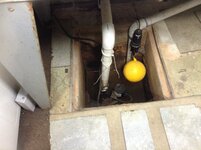
Here's the one I installed. Electric pump is at the bottom of the pit, discharges via the PVC on the left. If the electric pump fails to keep up with the inflow, the yellow sphere and black valve actuate the venturi evacuator via the tiny black tube, and the venturi ***** the water up the PVC on the right, and discharges outdoors.

Second photo is of the venturi evacuator, mounted to a floor joist overhead. A 3/4-inch copper line from the public water supply feeds the device. The white PVC entering from the bottom is the draw tube from the pit, and it discharges through the exterior wall.

IMG_0413.jpgIMG_0402.jpg
 
Last edited:

Shiftless

Well-known member
Joined
Mar 9, 2014
Messages
14,739
Location
East Bay SFO
Here's the one I installed
cool idea
I‘ve never seen one of those.
Question: How does a quarter inch of water in the bottom of that tiny black hose somehow start the flow of water from the house water supply through the Venturi to start the suction of water out of the pit? No electronics I’m sure.
 

Skyman

Well-known member
Joined
Nov 9, 2021
Messages
1,244
Location
Central Maryland
There's nothing electrical or electronic associated with the unit, thus there's no wiring involved. The flow valve is essentially the same as is used in a commercial urinal. The float valve in the pit simply relieves pressure on one side of the flow valve via the tiny black tube, opening the flow valve to allow pressurized water from the public water supply to rush through the venturi, which then creates a low pressure at the draw tube port. Atmospheric pressure then forces the water up the pipe out of the sump pit, and it mixes with the water from the public water supply and is then discharged to the exterior in the same manner as occurs with an electric pump. It's a remarkably simple and effective device. It emptied the pit in my installation at about the same rate as the electric pump was able to do.

I've gotta say, this thing greatly exceeded my expectations. I have no affiliation with the manufacturer or seller. I'm just a satisfied customer who bought one and is damned glad he did.
 

u3b3rg33k

Well-known member
Joined
Dec 18, 2017
Messages
4,057
If lead acid batteries are connected in parallel, they should be replaced at the same time. Otherwise, the weaker will pull down the stronger.

Marine/RV batteries are a scam, especially if you are using them NOT to start an engine !

The rating you should be interested in is Reserve Capacity (RC). The best batteries for this type of installation are 6V golf cart batteries (GC2). Obviously you need 2 wired in series. Two GC2 batteries will have a much higher RC than one Marine/RV battery ! Almost as much as 2 of them, at a much lower cost ! Buy at Costco or Sam's Club.

You can use your current charger. TIP ! Connect your charger to a cheap mechanical lamp timer. Only charge for a couple hours per day. Your batteries will live MUCH LONGER !
i bought the biggest two marine/trawling batteries the farm store had for a 900W max 24V UPS. they're usually built with thicker plates to withstand deep cycle use better than a typical starting battery.

Reserve Capacity is a relatively meaingless number at high draw. 25A*12V = 300W. double that to 600W and you'll get less than half the RC time. double it again to 1200W and you'll see WAY less than half the 2nd number.

not sure how they calculate RC at 6V, but if it's the same 25A that's why the number is bigger. lower voltage, same size battery, amperage test = low voltage battery always "wins".

There's nothing electrical or electronic associated with the unit, thus there's no wiring involved. The flow valve is essentially the same as is used in a commercial urinal. The float valve in the pit simply relieves pressure on one side of the flow valve via the tiny black tube, opening the flow valve to allow pressurized water from the public water supply to rush through the venturi, which then creates a low pressure at the draw tube port. Atmospheric pressure then forces the water up the pipe out of the sump pit, and it mixes with the water from the public water supply and is then discharged to the exterior in the same manner as occurs with an electric pump. It's a remarkably simple and effective device. It emptied the pit in my installation at about the same rate as the electric pump was able to do.

I've gotta say, this thing greatly exceeded my expectations. I have no affiliation with the manufacturer or seller. I'm just a satisfied customer who bought one and is damned glad he did.
only downside is the MASSIVE water consumption to run it. a high water bill beats a flooded basement but you wouldn't want to pay for running one if you don't have to.
 

Skyman

Well-known member
Joined
Nov 9, 2021
Messages
1,244
Location
Central Maryland
only downside is the MASSIVE water consumption to run it. a high water bill beats a flooded basement but you wouldn't want to pay for running one if you don't have to.

That's really not an issue. It's useful to bear in mind that this device is customarily installed as a secondary mechanism that only operates in the event of a failure of the primary pump. IIRC, the device uses approximately two gallons of city water for each gallon of water it extracts from the sump. It kicks in and flows for only a short duration, then shuts off until the next time its float valve activates again.

You'd have to have the electric pump fail for an extended timeframe, with a very fast fill-rate of the pit, in order for the water bill to get ugly. And, IMHO, even an ugly water bill beats the hell out of the ugliness of a flooded basement.
 

theoldwizard1

Well-known member
Joined
Feb 22, 2011
Messages
43,487
Location
SE MI
i bought the biggest two marine/trawling batteries the farm store had for a 900W max 24V UPS. they're usually built with thicker plates to withstand deep cycle use better than a typical starting battery.
I have research this topic A LOT and I do not believe your statement ! The only batteries that have ticker plates are golf cart or industrial batteries.

Duracell 6V GC2 (2 required for 12V, 4 for 24V) : $120 at Sam's Club (prices have gone up a lot in a year)
Reserve Capacity - 215 (so 430 for a pair)
(RC - This is a standard test accepted by by all battery manufacturers. It is the amount of time, in minutes, that a 12V/6Vbattery can supply 25 amps, before dropping to 10.5V/5.25V)
Weight : 60.5 lbs (heavier weight means more lead !)

Duracell 12v Marine Group 31 (largest marine battery they make) : $118 at Sam's Club
Reserve Capacity - 190
Weight : 59 lbs

430 RC vs 190 RC ! 120 lbs vs 59 lbs ! 221% more capacity for 200% more cost !!


Remember, for MAXIMUM LIFE, lead acid batteries should NEVER BE DISCHARED TO MORE THAN 80% (roughly 10.5V).

If you want a battery that has a long life (many discharge/charge cycles) and can safely be discharged to below 10%, buy a LiFePO4 battery. "Buy once, cry once". Get an appropriate charger.
 
Last edited:

u3b3rg33k

Well-known member
Joined
Dec 18, 2017
Messages
4,057
I have research this topic A LOT and I do not believe your statement ! The only batteries that have ticker plates are golf cart or industrial batteries.

Duracell 6V GC2 (2 required for 12V, 4 for 24V) : $120 at Sam's Club (prices have gone up a lot in a year)
Reserve Capacity - 215 (so 430 for a pair)
(RC - This is a standard test accepted by by all battery manufacturers. It is the amount of time, in minutes, that a 12V/6Vbattery can supply 25 amps, before dropping to 10.5V/5.25V)
Weight : 60.5 lbs (heavier weight means more lead !)

Duracell 12v Marine Group 31 (largest marine battery they make) : $118 at Sam's Club
Reserve Capacity - 190
Weight : 59 lbs

430 RC vs 190 RC ! 120 lbs vs 59 lbs ! 221% more capacity for 200% more cost !!


Remember, for MAXIMUM LIFE, lead acid batteries should NEVER BE DISCHARED TO MORE THAN 80% (roughly 10.5V).

If you want a battery that has a long life (many discharge/charge cycles) and can safely be discharged to below 10%, buy a LiFePO4 battery. "Buy once, cry once". Get an appropriate charger.
ok if the RC test is 25A for both, a 6V battery of the same general design as an equivalent 12V battery will have 2x the rating, but the same stored energy (Wh). obviously you need 2x 6V batteries to get 12V, so you get double the runtime (and mass) on 6V.

so a 6V @ 215RC (89Ah) == 12V @ 108RC (45Ah). both would have about 550Wh in them, drawn to "dead".

a 12V battery has more plastic than a 6V, (more boxes to put lead in), so a slight penalty as you add voltage.

I used something bigger from the local farm store but here's an example:

they list all the specs.

Even the AGM battery in my car lists the specs. you have to tell the car what Ah it is for the car to manage the battery properly.
 
To avoid these ads, REGISTER NOW!
Top Bottom