To avoid these ads, REGISTER NOW!

220v wiring, right or wrong?

strength_and_power

Well-known member
Joined
Apr 26, 2015
Messages
1,426
And if wrong, what is the right way.

History:
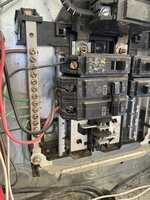
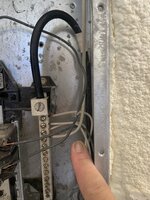
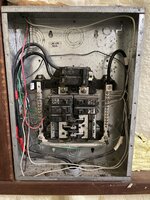
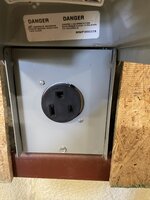
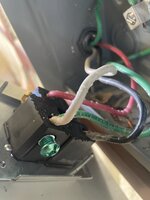
When we moved in, there was a 4 prong outlet. I had an electrician out to do a few other things and asked him to swap the 4 prong for a 3 prong which is what all my welders have. The wiring at the outlet is what he did. The wiring at the panel was not touched. I sent these pictures to a friend who said the plug wiring wasn’t to code ( he didn’t specify what code) and also that it works because the white and ground end up at the same place and it’s a good way to overload the neutrals. My understanding of wiring is basic, I can swap an outlet or a switch and that’s about it. The panel will be getting replaced and my plan is to have someone with more knowledge do that part, I will run the wires and terminate at the outlets.
I’m attaching pics of the back of the 220v outlet and inside the panel. No need to guess which circuit it is, there is only one 220v circuit.
Thanks in advance for the replies.
Scott
 

Attachments

  • IMG_5331.jpeg
    IMG_5331.jpeg
    517 KB · Views: 203
  • IMG_5332.jpeg
    IMG_5332.jpeg
    902.3 KB · Views: 203
  • IMG_5333.jpeg
    IMG_5333.jpeg
    827.4 KB · Views: 190
  • IMG_5334.jpeg
    IMG_5334.jpeg
    797.5 KB · Views: 185
  • IMG_5275.jpeg
    IMG_5275.jpeg
    993.6 KB · Views: 193
To avoid these ads, REGISTER NOW!

mm08822

Well-known member
Joined
Jan 13, 2012
Messages
6,053
Location
NJ
And 2 wires landed where only 1 permitted.

Hacker x2!!

Call him back and have him fix it. Just to bust his chops.

What else did he do?
 

dcg9381

Well-known member
Joined
Jun 20, 2018
Messages
11,927
Location
Austin, TX
Someone that does **** like this will just say it's fine and tell you not to worry.
Someone who does **** like this and has been paid isn't going to return your call. I wonder what the other fixes look like?

I probably would have built a "pig tail" adapter for my welder... I've got a bunch of them for working with various scenarios in other people's homes/shops.

OP: You can fix this in a few minutes.
 

mm08822

Well-known member
Joined
Jan 13, 2012
Messages
6,053
Location
NJ
The fix is easy and simpler to do it yourself than involving the clown.

Calling the guy out is important. You know does **** work. Now he knows you know.

If there is an ounce of professionalism in him, he would fix it. (Big IF.)
 

mm08822

Well-known member
Joined
Jan 13, 2012
Messages
6,053
Location
NJ
If that's a sub-panel, I'm pretty sure the bus-bar connecting the grounds and neutrals should be removed.
I'm assuming a sub panel as there is a bonding screw in use. Never hurts to ask.

EDIT: I had a brain-fart. You are correct, the horizontal jumper across (not connected to) the hot busses connecting ground bar on the left to the neutral bar on the right has to be removed to make them both function as described.
 
Last edited:

dcg9381

Well-known member
Joined
Jun 20, 2018
Messages
11,927
Location
Austin, TX
Probably.....but at least let him know he's a POS doing work like that.
Just tell him you had his work inspected and would like to discuss a few "items" on the bill. :)

I don't think calling him a "POS" has any up-side. If he's got an advertised business, you could always post a photo of his work in your review, which would let other people know he's a POS and that has value.

Was this actually a "licensed" electrician? I'd find that difficult to believe.
 

Packard V8

Well-known member
Joined
Mar 16, 2009
Messages
7,380
Location
Spokane, WA
Can't believe we got this far into this thread without someone flatly stating, "three wire is not to code1"

Answer, it depends. Some local electrical codes require four-wire for any 240-volt outlets in a garage. OTOH, my local utility wired the ESVE for my EV with a three-wire outlet and the city inspector passed it. When I questioned it, referring to all the GJ experts, I was told four-wire is only required when there is an appliance with a 120-volt leg inside it.

jack vines
 

mike93lx

ALLIANCE MEMBER
Joined
Dec 9, 2013
Messages
37,939
Location
Richmond, VA
Can't believe we got this far into this thread without someone flatly stating, "three wire is not to code1"

Answer, it depends. Some local electrical codes require four-wire for any 240-volt outlets in a garage. OTOH, my local utility wired the ESVE for my EV with a three-wire outlet and the city inspector passed it. When I questioned it, referring to all the GJ experts, I was told four-wire is only required when there is an appliance with a 120-volt leg inside it.

jack vines
I have never heard of these shenanigans.
 

dcg9381

Well-known member
Joined
Jun 20, 2018
Messages
11,927
Location
Austin, TX
Answer, it depends. Some local electrical codes require four-wire for any 240-volt outlets in a garage. OTOH, my local utility wired the ESVE for my EV with a three-wire outlet and the city inspector passed it. When I questioned it, referring to all the GJ experts, I was told four-wire is only required when there is an appliance with a 120-volt leg inside it.
There are 3-wire and 4-wire 240V EVSEs. Can't find a code cite on that changing the requirements for a garage though.
 

KenC

Well-known member
Joined
Dec 20, 2009
Messages
2,598
Location
oklahoma
I'm surprised no one has asked for a pick of the receptacle front. Not all 3 wire are wired the same. Old dryer had a neutral, not ground. What did he install? One of the current 3 wire standard or one he had on the truck?
 

mike93lx

ALLIANCE MEMBER
Joined
Dec 9, 2013
Messages
37,939
Location
Richmond, VA
I'm surprised no one has asked for a pick of the receptacle front. Not all 3 wire are wired the same. Old dryer had a neutral, not ground. What did he install? One of the current 3 wire standard or one he had on the truck?
Considering it is for a welder I think it's fair to assume a 6-50, two hots and a ground
 

75gmck25

Well-known member
Joined
Jul 21, 2014
Messages
1,328
Location
Alexandria, VA
I ran four wire 6/3 copper in anticipation of installing my EVSE, and then found it only required a three wire circuit. It's hard wired and the white remains capped at both ends.

I considered more complicated solutions (sub panel and plug-in EVSE, etc.) and finally decided that all I needed for now was to properly wire it with 3 wire. Sometime in the future I may have a need for the four wire circuit, but you never know.
 

American Locomotive

Well-known member
Joined
Jan 8, 2017
Messages
11,014
Location
Rhode Island
Can't believe we got this far into this thread without someone flatly stating, "three wire is not to code1"

Answer, it depends. Some local electrical codes require four-wire for any 240-volt outlets in a garage. OTOH, my local utility wired the ESVE for my EV with a three-wire outlet and the city inspector passed it. When I questioned it, referring to all the GJ experts, I was told four-wire is only required when there is an appliance with a 120-volt leg inside it.

jack vines
I think you might be might be confusing "two hots and a ground" 3-wire, with "two hots and a neutral" 3-wire. There are two different "3 wire" 240v outlets. NEMA "6" series outlets and NEMA "10" series. One is code compliant, the other is not.

NEMA 6-** series outlets (The 6-50 being the most common "welder" plug) all have two hots and a ground. These series of three wire outlets are perfectly code compliant, and are still commonly installed.

The NEMA 10-** series outlets (The 10-30 being the classic "dryer plug", and the 10-50 being the classic electric range plug) are two hots and a neutral. These are not code compliant anymore, as any connected device is effectively ungrounded. These haven't been NEC compliant since at least 1996.
 
To avoid these ads, REGISTER NOW!
OP
S

strength_and_power

Well-known member
Joined
Apr 26, 2015
Messages
1,426
And 2 wires landed where only 1 permitted.

Hacker x2!!

Call him back and have him fix it. Just to bust his chops.

What else did he do?
He replaced a few outlets, a breaker in the house and installed a cover plate in the house panel where a breaker used to be.

I won’t call him and obviously won’t use him again. He was referred to me by my realtor who is a very close almost sister to me friend. I’ll let her know his work was sub par and she’ll stop referring him.
 

sparky 1971

Well-known member
Joined
Oct 9, 2018
Messages
8,017
Location
Central Iowa
I'm surprised no one has asked for a pick of the receptacle front. Not all 3 wire are wired the same. Old dryer had a neutral, not ground. What did he install? One of the current 3 wire standard or one he had on the truck?
Since I can clearly see the ground (green) screw in the receptacle, I'm going to go out on a limb and say it's not a 10-30 or 10-50.
 

sparky 1971

Well-known member
Joined
Oct 9, 2018
Messages
8,017
Location
Central Iowa
This panel is in the shop. There is a 100amp breaker in its own box at the house which I assume feeds the shop, should be easy to figure that out.

Luvtheheat was correct, you have to remove the jumper. Refer to post #10 and #12.
I don't see a ground in the feeder. Is this a pre 2008 detached garage?
 

mm08822

Well-known member
Joined
Jan 13, 2012
Messages
6,053
Location
NJ
Can't believe we got this far into this thread without someone flatly stating, "three wire is not to code1"

Answer, it depends. Some local electrical codes require four-wire for any 240-volt outlets in a garage. OTOH, my local utility wired the ESVE for my EV with a three-wire outlet and the city inspector passed it. When I questioned it, referring to all the GJ experts, I was told four-wire is only required when there is an appliance with a 120-volt leg inside it.

jack vines
I don't see a ground in the feeder. Is this a pre 2008 detached garage?
It's there. But it looks like only #10. Should be #8.
 
OP
S

strength_and_power

Well-known member
Joined
Apr 26, 2015
Messages
1,426
The 4 prong receptacle was what is there originally and the 3 prong is what replaced it.

Adjacent to the 220 box was a single 110 outlet that was tied into one leg? Of the 220 circuit. The “electrician” recommended that be disconnected as an overload on the 110 would not trip the breaker which I had home do. At least he had a tiny bit of sense. He quoted me a ridiculous price to add outlets to the shop ( shop had 1-220 and 2-110 outlets). Ridiculous enough that I decided it was time for me to learn basic electrical.
 

Attachments

  • IMG_5339.jpeg
    IMG_5339.jpeg
    1,013.2 KB · Views: 116
  • IMG_5340.jpeg
    IMG_5340.jpeg
    651.4 KB · Views: 129
OP
S

strength_and_power

Well-known member
Joined
Apr 26, 2015
Messages
1,426
If that's a sub-panel, I'm pretty sure the bus-bar connecting the grounds and neutrals should be removed.

I'm assuming a sub panel as there is a bonding screw in use. Never hurts to ask.

EDIT: I had a brain-fart. You are correct, the horizontal jumper across (not connected to) the hot busses connecting ground bar on the left to the neutral bar on the right has to be removed to make them both function as described.
This panel will be replaced in the next 30 days with a larger panel so I can have individual 220 runs for welder, compressor, fan, band saw and belt sander, 3-4 20amp circuits for outlets and 4-20 amp circuits for lights.

Can the main breaker be at the bottom of the panel? The inbound wires look like they may be a touch short if the breaker is at the top.

Any specific breakers? Standard or GFCI?
No time like the present to do it right

I heard mention of the ground wire being the wrong size, if I wanted to upsize it, would it need to be ran back to the house or to a ground rod just outside the shop?

I will be using 12/2 mc and 8/3mc for my runs, 20amp switches and outlets

I’d like to do it right, the life it may save would probably be mine.

Thanks all
 

Cruzan80

Well-known member
Joined
Jul 22, 2015
Messages
4,320
Location
Denver, CO
The 120V line utilizing one hot is kind of true, but not how he explained it. IF it pulls enough amperage (over the breaker rating) it will trip the double breaker, even pulling thru only one line. This will kill both hot lines. The "issue" he may have meant is if it is a 15A outlet, but won't trip until over 30A (breaker size), which would be dangerous to whatever is plugged in there. The 120V line would need a defined neutral and ground to be correct, along with one of the "hot" wires.

Don't remember the rules for oversizing breakers compared to outlets, so can't help if it is code or not.

However, if you were running a double 20A breaker, and 12/3 wire, you could have both a 240V outlet and 120V outlet on the same run (just use one of the hots @ 120V, and cap the other).


Edit:Crossed posts. Re outlets/breakers, You would need to check which version of NEC you are on, the most recent requires all GFCI protection for everything, IIRC.
 
OP
S

strength_and_power

Well-known member
Joined
Apr 26, 2015
Messages
1,426
The 120V line utilizing one hot is kind of true, but not how he explained it. IF it pulls enough amperage (over the breaker rating) it will trip the double breaker, even pulling thru only one line. This will kill both hot lines. The "issue" he may have meant is if it is a 15A outlet, but won't trip until over 30A (breaker size), which would be dangerous to whatever is plugged in there. The 120V line would need a defined neutral and ground to be correct, along with one of the "hot" wires.

Don't remember the rules for oversizing breakers compared to outlets, so can't help if it is code or not.

However, if you were running a double 20A breaker, and 12/3 wire, you could have both a 240V outlet and 120V outlet on the same run (just use one of the hots @ 120V, and cap the other).


Edit:Crossed posts. Re outlets/breakers, You would need to check which version of NEC you are on, the most recent requires all GFCI protection for everything, IIRC.
Im on county land so i have some wiggle, obviously I want to be safe within reason.
 

Bert_

Well-known member
Joined
Dec 24, 2016
Messages
9,777
Location
NW Iowa
If that's a sub-panel, I'm pretty sure the bus-bar connecting the grounds and neutrals should be removed.

Luvtheheat was correct, you have to remove the jumper. Refer to post #10 and #12.

Better back up and figure out if there's an equipment ground ran with the feeder.

If you remove the jumper on a 3 wire feeder you are creating a major issue because you will have NO ground.
 

wyliesdiesels

Well-known member
Joined
Aug 14, 2012
Messages
20,074
Location
Modesto, CA
I sent these pictures to a friend who said the plug wiring wasn’t to code ( he didn’t specify what code) and also that it works because the white and ground end up at the same place and it’s a good way to overload the neutrals.
you wont overload the neutral in this case because its a 240v receptacle so the neutral isnt needed and further, no current flows on the ground terminal or EGC under normal operation.
 
To avoid these ads, REGISTER NOW!
Top Bottom