To avoid these ads, REGISTER NOW!

Hydraulic Cylinder Convert to Electric Pump

123iflyfish

New member
Joined
Aug 2, 2024
Messages
3
Hello,
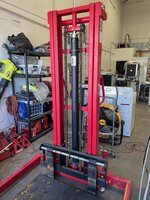
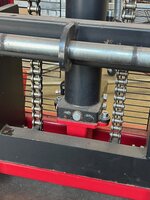
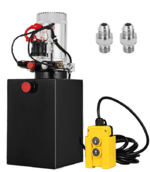
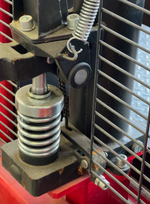
I'm new to this forum but not to the Garage Journal, I've utilized many topics through the years. I'm an adamant do-it-yourselfer, probably to the extent of getting in over my head. My latest project: I purchased a manual fork lift (DAYTON Manual Straddle Stacker: 2,000 lb Load Capacity) I'm trying to determine if I can convert the original cylinder to accommodate an electric pump. There are multiple ports on the cylinder, not sure how to determine if any can be utilized for an aftermarket electric pump, something like a cheap Vevor pump. Any help would be appreciated

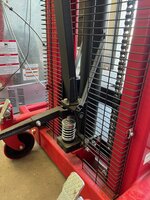
IMG_0250.jpgIMG_0249.jpgIMG_0247.jpgIMG_0245.jpgIMG_0246.jpg

1722612847590.png
 
To avoid these ads, REGISTER NOW!

txvwnut

Well-known member
Joined
Jan 1, 2015
Messages
7,631
Location
Bedford, Texas
I've seen it done with a bottle jack and that's basically what you have there. If you really want to convert it over it'd be way easier to get a new dedicated cylinder and pump. Just "tapping" one of the ports isn't going to do it as the manual pump and valve circuitry has to be removed and altered to accept an external pump.
 

firebirdparts

Well-known member
Joined
Jun 8, 2016
Messages
10,637
Location
Kingsport, TN
I bought several crown stackers years ago and kept one. They are 12v so as to be mobile but that adds additional problems. If I had to plug one in, obviously, I could. I would want it to be 120v in that case.

The controls on them are super basic. You have power up, a valve down, and there's an E-stop which is just a big ol' blade switch with a knob on the outside that pushes the blades apart. Check valves are critical but they're built into the pump. There's a little oil tank built into mine.

so yeah, super simple and easy. You need a way to get plumbing into that cylinder and that's all it takes. You could even tee in and keep your manual pump as a backup. I've never seen a pump like that.

On yours, is there a fluid reservoir, or is it built in? I see what I think is the fill plug. If it's built in to the pump/cylinder assembly, it makes it a lot harder to keep your original cylinder without creating any problems. You may not have access to the actual cylinder the way you'd like. I see a lot of plugs so you need to figure out for sure where they're going. Your aftermarket pump is probably not designed to share a second reservoir (i.e. no way to plumb into the tank directly) and the cylinder of course is not designed for 100% foolproof prevention of leakback to that original reservoir under load. So you'll expect to get some oil in there. Would be nice to plumb the old reservoir to drain into the new one or parallel with the new one.
 
Last edited:

andyvh1959

Well-known member
Joined
Feb 15, 2020
Messages
2,598
Location
Green Bay WI
Not an easy coversion at all, if you want to use what is already there. The lever action has a ratio built in so the actual lift force you provide is far less than the force created at the pump piston, again just like a bottle jack. IF you could rig an electric motor to turn a rotary cam that pushes down the same distance as the pump handle, to make it work to provide the action at the lever (like if you were manually lifting the load), the cam would have to operate directly onto that shaft at the top of the pump piston. Good luck with that.

1722626954560.png

The issue is, this device uses a small hand operated pump to convert the lever force to something easy to produce versus the lift force produced at the cylinder. If you can find an electric power unit (Enerpac for instance) that can produce, say, 3,000 psi output, you'd plumb the power unit hose into the port at the front side of the main cylinder base.
1722627349651.png
Assuming you buy an electric/hydraulic power unit, like an Enerpac, with the table fully down, take out that plug at the front of the cylinder base. Connect the power unit hose into that port. You will loose some oil during that process, but the power unit will likely have its own revervoir, most do. Then the power unit creates the flow/pressure to move the main cylinder. You can just strap the lever up in a position to be out of the way, and mount the power unit on the back side of the base. You should be able to use the same control valve on the unit to control the descent of the table, or use the control valve handle on the Enerpac (Enerpac power units are what I'd buy). I have a 10,000 psi Enerpac unit in my shop that luckily I got for nothing. I use it to run a hydraulic hose crimper. There are many of them on Ebay, used for $1000 to maybe $5000. Most of them produce hydraulic pressure far in excess of what you need here, and flow rates easily high enough to run this lift. If you can find an Enerpac for less than $1000, grab it.

The base of your current lift has the oil capacity built into it to provide the full lift range. So an electric/hydraulic power unit with a reservoir just adds to that oil volume. Your lift is rated to a 2,000lb lift. So lets assume the main cylinder is a 2" bore, so the area in the cylinder is 3.14 sq in. That means the pressure in the cylinder to lift 2,000lbs would be 2,000 divided by 3.14, or 636.62 psi, well within the range of even smaller Enerpac units.
 
Last edited:
OP
1

123iflyfish

New member
Joined
Aug 2, 2024
Messages
3
Not an easy coversion at all, if you want to use what is already there. The lever action has a ratio built in so the actual lift force you provide is far less than the force created at the pump piston, again just like a bottle jack. IF you could rig an electric motor to turn a rotary cam that pushes down the same distance as the pump handle, to make it work to provide the action at the lever (like if you were manually lifting the load), the cam would have to operate directly onto that shaft at the top of the pump piston. Good luck with that.

1722626954560.png

The issue is, this device uses a small hand operated pump to convert the lever force to something easy to produce versus the lift force produced at the cylinder. If you can find an electric power unit (Enerpac for instance) that can produce, say, 3,000 psi output, you'd plumb the power unit hose into the port at the front side of the main cylinder base.
1722627349651.png
Assuming you buy an electric/hydraulic power unit, like an Enerpac, with the table fully down, take out that plug at the front of the cylinder base. Connect the power unit hose into that port. You will loose some oil during that process, but the power unit will likely have its own revervoir, most do. Then the power unit creates the flow/pressure to move the main cylinder. You can just strap the lever up in a position to be out of the way, and mount the power unit on the back side of the base. You should be able to use the same control valve on the unit to control the descent of the table, or use the control valve handle on the Enerpac (Enerpac power units are what I'd buy). I have a 10,000 psi Enerpac unit in my shop that luckily I got for nothing. I use it to run a hydraulic hose crimper. There are many of them on Ebay, used for $1000 to maybe $5000. Most of them produce hydraulic pressure far in excess of what you need here, and flow rates easily high enough to run this lift. If you can find an Enerpac for less than $1000, grab it.

The base of your current lift has the oil capacity built into it to provide the full lift range. So an electric/hydraulic power unit with a reservoir just adds to that oil volume. Your lift is rated to a 2,000lb lift. So lets assume the main cylinder is a 2" bore, so the area in the cylinder is 3.14 sq in. That means the pressure in the cylinder to lift 2,000lbs would be 2,000 divided by 3.14, or 636.62 psi, well within the range of even smaller Enerpac units.
andyvh1959,
Thanks for the input. What you are describing with the enerpac is exactly what I was hoping could be done, I wanted to try and utilize the original ram if I could. I didn’t really want to purchased a replacement ram that was set up for an external pump. with me not knowing anything about the design of this cylinder, how sure are you on using the front port on my existing ram, that seems too easy for one of my projects:) do you know of any functional breakdown drawings of a manual operated hydraulic ram such as the one I have?
Thanks again
 

andyvh1959

Well-known member
Joined
Feb 15, 2020
Messages
2,598
Location
Green Bay WI
Per the parts diagram detailed in the link below its clearly a single acting cylinder. The port plug way at the top of the main cylinder is there to bleed out the air in the cylinder when first filling the system. The pump raises the cylinder, and gravity or load causes the cylinder to retract/come down. Looking at the maunal it confirms the base of the main cyinder and pump piston form the reservoir. The plugs on the sides of the base are likely to access the control valve built into the base. Per the parts diagram in the link below, it looks like plug part number 24, on page 24 of 84, "should" be the port to access. I have not worked on a lift like this but the hydraulics are pretty basic.

I found this online:


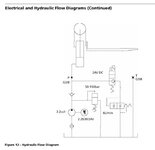
The hydraulic circuit in the lift is basically like this:
Elec lift.JPG
This diagram shows the electric lift, but the cylinder connection does confirm is it a single acting cylinder. I sketched in where the Enerpac power unit would plumb into the system. This shows an electric lift pump, but on your lift the hand pump does what the Dayton electric pump does. Just below where the Enerpac would tee into the system is an internal "check" valve, so when the Enerpac pump runs the flow cannot go into the main resevoir or operate the hand lever pump. Now, all that said, if I were you I'd contact the Dayton customer service, ask for a service technician, and describe what you want to do. They "may" direct you how best to do it. or may tell you it can't be done, liability wise.
 

Attachments

  • Elec lift.JPG
    Elec lift.JPG
    32.4 KB · Views: 64
Last edited:
OP
1

123iflyfish

New member
Joined
Aug 2, 2024
Messages
3
I found a parts diagram for my lift, looking from the front the right side port is a drain plug. Would you think this port would work for connecting a single acting pump?
 

Attachments

  • 4VMF1.pdf
    507.2 KB · Views: 9

Firebrick43

Well-known member
Joined
May 12, 2015
Messages
14,125
Location
West central Indiana
I found a parts diagram for my lift, looking from the front the right side port is a drain plug. Would you think this port would work for connecting a single acting pump?
Probably not. It’s likely to fill the reservoir up around the cylinder instead of the cylinder itself.

There is a LOT more to converting a jack cylinder into a single acting cylinder than just hooking up a hose.

There are ports to plug either by tapping and install pipe plugs or brazing the passage shut.

There are checks to remover and the pump/valve as well


There are other videos as well, just two of the first on the search results.
 
To avoid these ads, REGISTER NOW!

andyvh1959

Well-known member
Joined
Feb 15, 2020
Messages
2,598
Location
Green Bay WI
Once you can determine the port opposite the circuit that feeds the base of the cylinder, that should be all you need to plumb into. In essence the Enerpac then provides the flow/pressure you'd be doing by using the hand lever. The other circuits have check valves/check balls in them to prevent the higher pressure pump side to charging the wrong path, or just pumping into the base reservoir. The Enerpac control valve then becomes the control for lift/lower because the Enerpac is plumbed in as a parallel power circuit to the original lever pump. Once you determine the port to use, then plumb the power unit to that port on the base of the cylinder. Then the operation would probably be:
1. The original control valve on the lift can remain in the closed position. This prevents the Enerpac from sending flow/pressure into the original control valve and also avoids applying pressure into the original base reservoir.
2. Turn on the Enerpac power unit
3. Turn the Enerpac control handle to raise and the ram should extend. Also, the control valve on the Enerpac will control the lift speed.
4. To lower the lift, turn off power at the Enerpac, turn the Enerpac control valve to lower and it will control the rate of lowering the load
 

andyvh1959

Well-known member
Joined
Feb 15, 2020
Messages
2,598
Location
Green Bay WI
A what? I searched Harbor Frieght and nothing came up for "air conversion cylinder." I searched "power unit", "air over hydraulic" and "conversion" and found nothing. You'll have to connect a link of what Harbor Freight has to explain that one.
 

tomuchjunk

New member
Joined
Sep 16, 2008
Messages
3
Did you ever resolve this conversion? I am trying to figure it out as well with the Same stacker.
 

RPH

Well-known member
Joined
Dec 17, 2006
Messages
4,190
Location
Michigan Thumb
A what? I searched Harbor Frieght and nothing came up for "air conversion cylinder." I searched "power unit", "air over hydraulic" and "conversion" and found nothing. You'll have to connect a link of what Harbor Freight has to explain that one.
They do have them. It stops at 20 ton but I needed a 30 ton unit. Vevor ain’t suppling it! The emergency room fees eat up the savings quickly.IMG_6380.jpeg
 

andyvh1959

Well-known member
Joined
Feb 15, 2020
Messages
2,598
Location
Green Bay WI
That makes sense, it is an air or lever operated hydraulic bottle jack. A decription "Air Conversion Cylinder" makes no sense whatsoever, but an Air over Hydraulic Cylinder would be a converntional description as that implies air power to convert to hydraulic power.

Hmm, I may have to buy one of those for my vertical hydraulic press from Harbor Frieght. Right now its only a hand pump 20ton bottle jack to operate it. An air powered bottle jack would allow me to operate it with a foot control and use both hands to hold an item in the press.
 
Last edited:

brando0275

New member
Joined
Jan 12, 2025
Messages
1
I have the same stacker. I would love to convert to air over hydraulic and use a battery operated compressor to operate it.
 
To avoid these ads, REGISTER NOW!
Top Bottom