To avoid these ads, REGISTER NOW!

Bookshelf thickness/wood type

Wreckster23

Well-known member
Joined
Aug 15, 2014
Messages
369
Location
Newburgh, NY
I'm starting my bookshelves in the office today. 12" deep cabinets on the bottom, 1x14 on top (I think) that can be cut down a little on top of those cabinets, 12" shelves on top of that.

I wanted to have 3 sections, each 36" long, but no backer. I have the mind to use furing strips vertically to tack into the plywood (I think 3/4 plywood for the boxes will be plenty, oak so I can stain it all to match?) but I wanted to leave it with no backer, no strips on the shelves.

Judging by the sagulator calculator, I should be able to get away easily with using 3/4 solid hardwood spanning that 36" with practically no sag. Does that seem correct? Or should I plan on 1" thick shelves for that span? Poplar might be my choice (match plywood facing) or I may just spring for oak. Red oak seems to be the readily available here.

I'm not a carpenter, but I'm handy enough I know I can make this all work beautifully. I just don't want to worry about having to fix sag later on. Shelves won't be totaly loaded and certainly not with all heavy books.
 
To avoid these ads, REGISTER NOW!

ZRX61

Well-known member
Joined
Aug 15, 2006
Messages
28,716
Location
Solar Blight Valley, SoCal
3/4 over 36in should be fine. I have one with that size shelves...but it has so many books crammed into it that it has two 3/4 x 4in pieces across the back to stop the sides bowing out & the shelves falling off the pins.
 

MoonRise

Well-known member
Joined
Nov 5, 2010
Messages
4,030
Location
NJ
Run some numbers with the Sagulator and see what the options give you.

Note: "fixing" (hard permanent attachment) of a shelf to the carcass gives much less deflection on the shelf because the carcass is mechanically connected to the shelf board. There is 6x or 8x more sag if the shelf is free-floating and not structurally fixed/attached to the carcass.

Which easily changes a shelf from OK for deflection when it is screwed/glued to the carcass to No-Good if the shelf is free-floating with everything else the same except for whether the shelf is attached to the carcass or not.

If the shelf is not glued and screwed (or glued with biscuits, or floating tenons, or any other permanent structural attachment) to the carcass sides AND back, then it is not as strong and WILL sag more.

A shelf resting on shelf pins or a strip of wood on the sides and back of the carcass is NOT structurally attached to the carcass. Shelf pins do enable you to (possibly) adjust the shelf spacing but you pay for that ability in a shelf that WILL sag more than a shelf that is permanently and structurally attached to the carcass.

Rule: You ALWAYS end up putting more onto the shelf than you thought you would. Make it stronger to begin with.

A front lip/edge to increase the vertical dimension of the shelf makes a BIG difference in strength and sag on a shelf. Use it if at all possible.

Nominal 3/4" thick solid hardwood is NOT actually 3/4" thick. If you want/need an actual dimension of .75" thick (the Sagulator uses ACTUAL dimensions of the wood and NOT 'nominal' dimensions, see Note #6 on the Sagulator page), then you have to buy/use 4/4 lumber. 4/4 lumber if planed smooth (S2S) is nominally 13/16" thick so that counts as 3/4" thick. Just like a nominal 2x4 is NOT 2" x 4" when you buy it. Just an FYI in case you weren't aware of lumber sizing.

I'll go against the other posters and say the a 36" long bookshelf at a nominal 3/4" thick and 12" deep and sitting on shelf support or shelf pins or otherwise NOT structurally attached to the bookcase carcass is NOT acceptable in the real world. Initial sag may be ok, but wood "creeps" with load over time and a shelf often gets more stuff put on it over time and it WILL sag more over time.

Put a lip/edge on the front of the shelf board to increase the vertical dimension there helps a LOT with stiffening the shelf board front and reducing sag (initial and long-term). Structurally attaching the shelf board to the bookcase carcass helps a LOT-LOT-LOT with making the shelf stronger and sag less (initial and long-term) compared to putting the shelf on shelf pins/supports/whatever.

Nominal 3/4" plywood bookshelf carcass sides and no carcass back panel and nominal 3/4" 36" long and 12" deep shelf boards is going to be rather wobbly and saggy IMNSHO.
 
Last edited:
OP
W

Wreckster23

Well-known member
Joined
Aug 15, 2014
Messages
369
Location
Newburgh, NY
Alright, so let’s change the plan up.

3/4 ply carcass(box) x3 screwed together once all sat on top of the base
1x12 hardwood (3/4 once planked)
Shelves screwed/glued to the carcass.

Sounds like this is going to handle the job.
 

MoonRise

Well-known member
Joined
Nov 5, 2010
Messages
4,030
Location
NJ
Do you have a pic or sketch of what you are planning?

What I'm hearing is that you want to make 3 individual plywood 'boxes' and stack them on a base to make your bookshelf?

That can work, but is not necessarily the most material or process efficient.
 
OP
W

Wreckster23

Well-known member
Joined
Aug 15, 2014
Messages
369
Location
Newburgh, NY
IMG_3440.jpeg

Three boxes right next to each other on top of those cabinets. Figured I can build the cabinets in the garage and put them there one at a time. The cabinet in the middle will have maybe one shelf and display area underneath.
 

Skyman

Well-known member
Joined
Nov 9, 2021
Messages
1,204
Location
Central Maryland
Back in the early 1970s, my parents had built-in bookshelves installed in an addition to the house that was being constructed at the time. The shelves were adjustable, and were made using stair treads. Most of them were fully loaded with books when the construction was completed. Any sag, even decades later, was imperceptible to my eyes. Shelves were supported with this type of standards and supports: https://www.mcmaster.com/11865A11/
 
To avoid these ads, REGISTER NOW!

Tostal

Well-known member
Joined
Feb 1, 2020
Messages
893
Location
The Emerald Isle
OP could also use sheet metal with folded edges similar to shelves in an office stationery cupboard (do these still exist in a 'modern' paperless office?) and add a wood finishing strip to the front edge - you won't see any metal when books fill the shelves.

A friend who works in aircraft overhaul used discarded aircraft floor? composite panels when making shelves for his 'shop - these had 2 thin sheets of aluminum with a bonded honeycomb core - very strong, very light (plus he got them for free :)).
 
OP
W

Wreckster23

Well-known member
Joined
Aug 15, 2014
Messages
369
Location
Newburgh, NY
The bookcases I built for our house are all built from 3/4" birch plywood for the body & for the shelves. They are 36" wide by 12" deep. I also put a piece of pine edgings on the front edge of the shelves to make them stronger.

100_1866.JPG
I might just end up doing it this way. It’s never moving again, so why not do a little more.
 

Stuart in MN

Well-known member
Joined
Sep 8, 2005
Messages
23,138
Location
Minneapolis
You will be fine with poplar or oak.

3/4 plywood also works fine at that span with an applied lip.
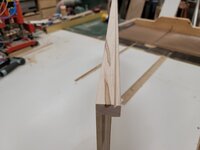
I've done this with success, although I didn't get as elaborate with joinery - I used strips of hardwood 1" high by 3/4" thick, and simply glued them and fastened them with brads to the plywood. It stiffened up the shelves considerably as well as covering up the edge of the plywood, and even with a lot of heavy books the shelves didn't sag.
 

Shiftless

Well-known member
Joined
Mar 9, 2014
Messages
14,553
Location
East Bay SFO
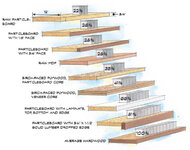
Just to help put things into perspective, these shelves I built from 3/4 inch thick particle board are reinforced with “1x2” pine furring strips glued onto the fronts with no individual attachment to the drywall in back. The cases are screwed to the wall studs for stability. They are holding a lot of weight but the spans are only around 2 feet instead of the 3 feet Wreckster 23 is proposing.

Particle board is just about the weakest material to use for shelves. I used it because it is inexpensive and I always planned to paint it. With short spans and front reinforcement it is quite strong.

This is in a basement room shared with a chest freezer, a table saw on wheels, and a 12 inch surface planer mounted on a stand with wheels.

5ACE2CC3-083E-4007-81E1-80B6D835E39F.jpeg
 
Last edited:

jar944

Well-known member
Joined
Jul 26, 2010
Messages
5,935
Location
Northern VA

Lol

I've done this with success, although I didn't get as elaborate with joinery - I used strips of hardwood 1" high by 3/4" thick, and simply glued them and fastened them with brads to the plywood. It stiffened up the shelves considerably as well as covering up the edge of the plywood, and even with a lot of heavy books the shelves didn't sag.

As you point out some glue and clamps work fine without the tongue and groove.
 

My Old Tools

Well-known member
Joined
Jun 4, 2014
Messages
5,442
Location
Hamrick Lake, TX
I used maple 3/4" cabinet plywood with 1" maple strip glued front and back. Guaranteed not to sag when fully loaded with hardback books. I wood never use particle board for a shelf.
 

PCustoms

Well-known member
Joined
Jul 23, 2011
Messages
23,195
Location
VT
Nominal 3/4" thick solid hardwood is NOT actually 3/4" thick. If you want/need an actual dimension of .75" thick (the Sagulator uses ACTUAL dimensions of the wood and NOT 'nominal' dimensions, see Note #6 on the Sagulator page), then you have to buy/use 4/4 lumber. 4/4 lumber if planed smooth (S2S) is nominally 13/32" thick so that counts as 3/4" thick. Just like a nominal 2x4 is NOT 2" x 4" when you buy it. Just an FYI in case you weren't aware of lumber sizing.


:headscrat

Where are you buying nominal 3/4" hardwood that measures undersized?

Around here it's sold as 1"x W" and measures 3/4"x W". For example. 1x4 is 3/4 x 3.5"
 

manwithtools

ALLIANCE MEMBER
Joined
Aug 24, 2015
Messages
13,983
Location
Lebanon, TN
:headscrat

Where are you buying nominal 3/4" hardwood that measures undersized?

Around here it's sold as 1"x W" and measures 3/4"x W". For example. 1x4 is 3/4 x 3.5"
Any reputable hardwood lumber supplier sells boards by the 1/4. 4/4, 5/4, 6/4. 8/4, etc. 4/4 is nominally 1" in thickness but is rough surfaced (sawn faces and edges). To achieve finished thickness, it will be approximately 13/16" thick after planning both sides smooth (not 13/32 as @MoonRise had indicated). Some folks will plane it to a finished dimension of 3/4" just to make layout and math easier.
 

PCustoms

Well-known member
Joined
Jul 23, 2011
Messages
23,195
Location
VT
Any reputable hardwood lumber supplier sells boards by the 1/4. 4/4, 5/4, 6/4. 8/4, etc. 4/4 is nominally 1" in thickness but is rough surfaced (sawn faces and edges). To achieve finished thickness, it will be approximately 13/16" thick after planning both sides smooth (not 13/32 as @MoonRise had indicated). Some folks will plane it to a finished dimension of 3/4" just to make layout and math easier.
Yeah, I understand how quarter measurements and surfacing work (I've sawn and planed plenty).

@MoonRise seems to be combining several things into one misconstrued post.

Based on the original question, I'm assuming the OP isn't going out and buying rough sawn lumber to finish himself. If they walk into a store and buy finished 3/4" (nominal 1") then it is going to measure, for all intents and purposes, 3/4".
 

MoonRise

Well-known member
Joined
Nov 5, 2010
Messages
4,030
Location
NJ
Yup, typo by me on the size of S2S 4/4 hardwood. s/b 13/16" I'll go back and edit my post to correct that.
 
To avoid these ads, REGISTER NOW!
Top Bottom