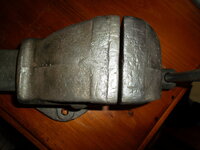
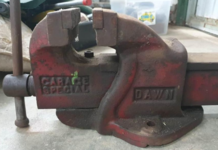
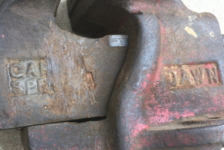
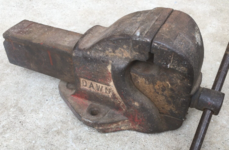
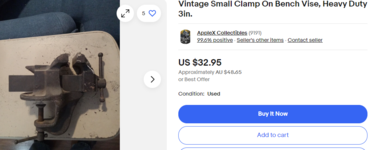
I have it on watch out of curiosity, just got an offer of US$26.95 for it, is that an acceptable amount ? I like them and would take a punt on it if was in OZ. But a AUS $154 postage don't really work for me-it's in PA, USA whatever that means.Uh, so I went looking for the US Dawn universal that was on sale a week or 2 ago, couldn't find it.
But anyone interested in a Stanley Victor 746 ?
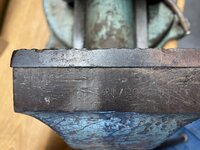
Of course I could be wrong, but I got mine for same reason seller couldn't see markings on top of Slide.
A sample for comparison


You are using an out of date browser. It may not display this or other websites correctly.
You should upgrade or use an alternative browser.
You should upgrade or use an alternative browser.
The VISES of Garage Journal
- Thread starter mjozefow
- Start date


micahd1997
Well-known member
- Joined
- Apr 27, 2022
- Messages
- 275
Thanks! And yes it is, I was thrilled to find the pair togetherVERY nice! Is that the fixed to swivel base adapter I see???
akasrick
Well-known member
That's on the yellow brick road up from where I live, Pennsylvania, USA.I have it on watch out of curiosity, just got an offer of US$26.95 for it, is that an acceptable amount ? I like them and would take a punt on it if was in OZ. But a AUS $154 postage don't really work for me-it's in PA, USA whatever that means.
I imagine at those shipping prices someone would really want to acquire one of those.
akasrick
I’m hoping anyone might share of expertise with me here. I have an athol 614 that I cleaned up, and it doesn’t have a flat base—it’s designed to sit on the edge of a bench with part of the base hanging over the edge. But I see other Athol 614 vises for sale that do have a flat base and also say “4-6” on the side of the dynamic jaw. Also the same thing with the 614 1/2, I have one that is shaped like my 614 but am seeing others for sale with a flat base. Does anyone know about the history of this? They are both Athol 614 but seem to have a different design for the base. Is one of them a newer version of that model? Also, I’m wondering if anyone can direct my to information on the history of Athol and/or Starret?
Thanks everyone!
Thanks everyone!
Attachments


RTM
Well-known member
Vintage catalogs here. One of them shows the 614, and the next column says same as 614, but w swivel base.They are both Athol 614 but seem to have a different design for the base. Is one of them a newer version of that model? Also, I’m wondering if anyone can direct my to information on the history of Athol and/or Starret?
This one has the 614

Athol Vises : 1930 : Athol Machine & Foundry Co. : Free Download, Borrow, and Streaming : Internet Archive
4 p., illus., 26.0 cm, trade catalog
archive.org
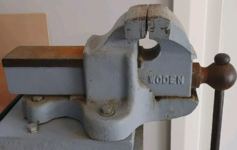
Hmmm, was a bit interested in maybe a Woden, after looking thru here, one is up for sale, good price, but it doesn't do anything for me.
Only thing I like is the handle as I have yearned for a Dawn example, but have only ever seen 2, at prohibitive prices.
Probably won't put a bid on the Woden unless I come across some way to inject a bit of character in it-normally I can visualize the end product but not on this.
 No 2
No 2
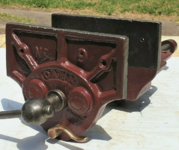 1923 example, would like, but AUS $800- nah-advertised a couple of years-still unsold.
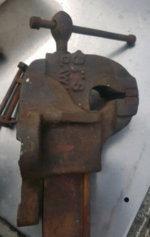
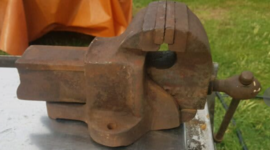 Also 1920's, been advertised for 4/6 years AUS $500, also Nah.
I have the same vice- handle been replaced thou and at a slightly better price
 Going to keep looking, as while I'd like the 2 early Dawn, I'd feel stupid for paying what is asked.
Only thing I like is the handle as I have yearned for a Dawn example, but have only ever seen 2, at prohibitive prices.
Probably won't put a bid on the Woden unless I come across some way to inject a bit of character in it-normally I can visualize the end product but not on this.
No 2 1923 example, would like, but AUS $800- nah-advertised a couple of years-still unsold. Also 1920's, been advertised for 4/6 years AUS $500, also Nah.I have the same vice- handle been replaced thou and at a slightly better price
Going to keep looking, as while I'd like the 2 early Dawn, I'd feel stupid for paying what is asked.I'm probably annoying the **** out of you all by now. but you can always tell me to piss off.
Until that happens
Decided I would look into an Old Samsonia, I passed up last year, - before I knew anything-just like now I suppose, can't find the pics, but I did put a smile on my face from seeing a few before pics.
Easy to forget how the vices turn up sometimes.
This is the 3 1/2 Dawn I posted a little while ago.

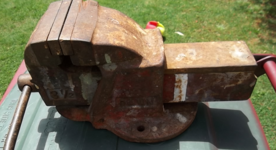

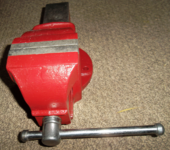

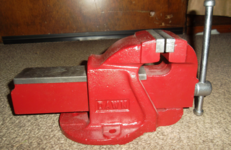
Until that happens
Decided I would look into an Old Samsonia, I passed up last year, - before I knew anything-just like now I suppose, can't find the pics, but I did put a smile on my face from seeing a few before pics.
Easy to forget how the vices turn up sometimes.
This is the 3 1/2 Dawn I posted a little while ago.
Last edited:
Not annoying, I watch this thread to look at pictures and read about vises. Nice to see what the selection is like on the other side of the world.I'm probably annoying the **** out of you all by now. but you can always tell me to piss off.
Until that happens
KMScott
Well-known member
Colmal. Keep posting Dawn pics. I need pics for the spreadsheet. Thanks Kevin
I am fairly new to vise collecting/restoration, and would appreciate any input from the forum about replacing the jaws on a Craftsman 506-51820, 3.5” jaws, that I picked up at an estate sale. (I believe it may be a Columbian?) from around the 60s or so:
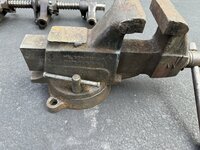
The jaws look like replaceable T-jaws, which are each held in place by two pins. However, the pins are only visible from below, as seen in this pic:
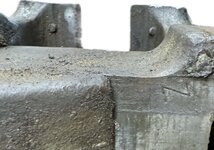
Unfortunately, it doesn’t look like the pins go all the way through to the top. After taking the pic below, I sanded to remove a bit of material from the top of the throat/jaws, and still don’t see that end of the pins.

My understanding is that the pins should go all the way through, and would normally be removed by punching them out from the top. My thought right now is that the prior owner may have done some repair/modding/welding that covered up the top of the pins. I also figured maybe there is a design that uses pins that can only be accessed from the bottom (not sure how/if that would work).
The rest of the vise is complete and seems like it will clean up and work nicely, but the jaw faces are pretty rough and chipped/worn down in a few spots. If I can remove the jaws, I would probably replace with wood, but not sure it’s possible or practical.
Thanks!
The jaws look like replaceable T-jaws, which are each held in place by two pins. However, the pins are only visible from below, as seen in this pic:
Unfortunately, it doesn’t look like the pins go all the way through to the top. After taking the pic below, I sanded to remove a bit of material from the top of the throat/jaws, and still don’t see that end of the pins.
My understanding is that the pins should go all the way through, and would normally be removed by punching them out from the top. My thought right now is that the prior owner may have done some repair/modding/welding that covered up the top of the pins. I also figured maybe there is a design that uses pins that can only be accessed from the bottom (not sure how/if that would work).
The rest of the vise is complete and seems like it will clean up and work nicely, but the jaw faces are pretty rough and chipped/worn down in a few spots. If I can remove the jaws, I would probably replace with wood, but not sure it’s possible or practical.
Thanks!
Last edited:
One thing that has been bugging me, the restored vices I've posted look a bright red.
Dawn seemed to change there colour slightly whenever they felt like it and probably have 20 shades.
I have 14 vices, clamps, tools in original colour (6 different reds) and have the colour fairly close to the shade I like, it's a lot darker than what it appears in my photo's-and I'm sure a few of you would be familiar with it as a USA product- 'Satin Claret wine"
This is a good condition 1978 on, 7" woodworking vice -took me a few hours to remove the rust, but that is all I've done with it.
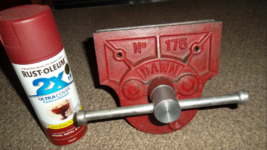 15.6 lb/7.1kg
Dawn seemed to change there colour slightly whenever they felt like it and probably have 20 shades.
I have 14 vices, clamps, tools in original colour (6 different reds) and have the colour fairly close to the shade I like, it's a lot darker than what it appears in my photo's-and I'm sure a few of you would be familiar with it as a USA product- 'Satin Claret wine"
This is a good condition 1978 on, 7" woodworking vice -took me a few hours to remove the rust, but that is all I've done with it.
15.6 lb/7.1kgAttachments
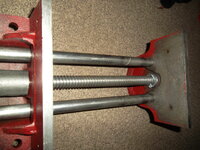

Last edited:
I will. and glad your taking care of it. I'm putting down what I know to be right about them as well, if I don't know for sure I'll say it.Colmal. Keep posting Dawn pics. I need pics for the spreadsheet. Thanks Kevin
I have another one set up with the wood fixed onto the jaws, and use it to reassemble the vices, as it protects better than a normal vice and with a approx 9" opening, haven't yet found anything it won't take-really useful, use a wood block on bottom to lift as needed also.One thing that has been bugging me, the restored vices I've posted look a bright red.
Dawn seemed to change there colour slightly whenever they felt like it and probably have 20 shades.
I have 14 vices, clamps, tools in original colour (6 different reds) and have the colour fairly close to the shade I like, it's a lot darker than what it appears in my photo's-and I'm sure a few of you would be familiar with it as a USA product- 'Satin Claret wine"
This is a good condition 1978 on, 7" woodworking vice -took me a few hours to remove the rust, but that is all I've done with it.
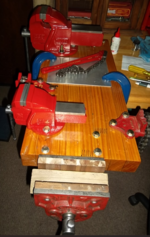
Last edited:
KMScott
Well-known member
Scoob. Here is a blog I wrote about the removal and making of T-Style Columbian jaws. Good luck.I am fairly new to vise collecting/restoration, and would appreciate any input from the forum about replacing the jaws on a Craftsman 506-51820, 3.5” jaws, that I picked up at an estate sale. (I believe it may be a Columbian?) from around the 60s or so:
The jaws look like replaceable T-jaws, which are each held in place by two pins. However, the pins are only visible from below, as seen in this pic:
Unfortunately, it doesn’t look like the pins go all the way through to the top. After taking the pic below, I sanded to remove a bit of material from the top of the throat/jaws, and still don’t see that end of the pins.
My understanding is that the pins should go all the way through, and would normally be removed by punching them out from the top. My thought right now is that the prior owner may have done some repair/modding/welding that covered up the top of the pins. I also figured maybe there is a design that uses pins that can only be accessed from the bottom (not sure how/if that would work).
The rest of the vise is complete and seems like it will clean up and work nicely, but the jaw faces are pretty rough and chipped/worn down in a few spots. If I can remove the jaws, I would probably replace with wood, but not sure it’s possible or practical.
Thanks!
https://wiltonviseparts.wordpress.com/2021/12/23/columbian-tee-style-jaws-how-i-make-them/
RichRiddle
Well-known member
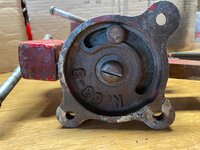
Here are two recently purchased vises in the farm garage, a medium sized Wilton with number 110004 stamped on the side and 111028 stamped on the bottom along with 13-845. The vise feels like a light duty vise. The Wilton has no visible casting on the bottom to see a country of origin, but the casting on the left side indicates USA. It is missing one half of the portion needed to grip pipe, and I am not sure where to locate that. Any input concerning this Wilton Vise will be appreciated.
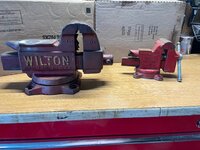
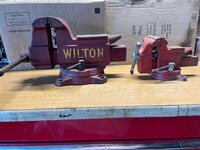
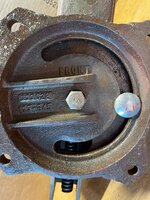
The Columbian vise is small and is stamped "Made in USA" on the right side and No 3-63 on the bottom.
The Columbian vise is small and is stamped "Made in USA" on the right side and No 3-63 on the bottom.
This is incredibly detailed—thank you so much!Scoob. Here is a blog I wrote about the removal and making of T-Style Columbian jaws. Good luck.
https://wiltonviseparts.wordpress.com/2021/12/23/columbian-tee-style-jaws-how-i-make-them/
Viser’s,
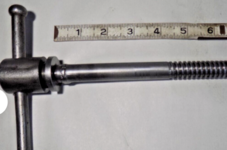
Been looking for a replacement acme screw for an early No. 3 fishhook patent pending Wilton.
Question: does this look like its been welded or has anyone run across any early wilton’s that have a acme screw with a casting raised area like shown in these pictures?
Buying something over the web is a crapshoot, just looking for anyone that might have knowledge on these early No.3’s and have seen the acme screws. Also not lost on me actual vice body likely got damaged otherwise seller would not be parting it out..
Been looking for a replacement acme screw for an early No. 3 fishhook patent pending Wilton.
Question: does this look like its been welded or has anyone run across any early wilton’s that have a acme screw with a casting raised area like shown in these pictures?
Buying something over the web is a crapshoot, just looking for anyone that might have knowledge on these early No.3’s and have seen the acme screws. Also not lost on me actual vice body likely got damaged otherwise seller would not be parting it out..
Attachments

Last edited:
neophyte
Well-known member
No competent manufacturer would cast the vise screw.Viser’s,
Been looking for a replacement acme screw for an early No. 3 fishhook patent pending Wilton.
Question: does this look like its been welded or has anyone run across any early wilton’s that have a acme screw with a casting raised area like shown in these pictures?
Buying something over the web is a crapshoot, just looking for anyone that might have knowledge on these early No.3’s and have seen the acme screws. Also not lost on me actual vice body likely got damaged otherwise seller would not be parting it out..
I’m not sure how that would have originally been manufactured, but forging the shape and then machining the forging down and round,
Or welding the larger diameter section onto a narrower screw might be a possibility.
Welding is possible for the time period.
The other possibility is just poor machining with a cutter skipping or vibrating.
The machining marks don’t look “home made” to me though.
Would most likely assume it is forged and then turned down on a lathe.No competent manufacturer would cast the vise screw.
I’m not sure how that would have originally been manufactured, but forging the shape and then machining the forging down and round,
Or welding the larger diameter section onto a narrower screw might be a possibility.
Welding is possible for the time period.
The other possibility is just poor machining with a cutter skipping or vibrating.
The machining marks don’t look “home made” to me though.
Somehow doubt welding would be a very economic solution considering the volume of vises they were already starting to make at the time - plus weaker than a forging.
Actually does seem like an application where rotary friction welding could be very useful. I'm not sure if that was already a consideration back then.
Viser’s,
Question: does this look like its been welded or has anyone run across any early wilton’s that have a acme screw with a casting raised area like shown in these pictures?
My initial thought, on seeing your pictures, was that someone had machined a new screw and welded it to the old handle...
But I checked my oldest Wilton bullet... early '50s, so not a fish hook, but not far from it... and mine has that same raised area...

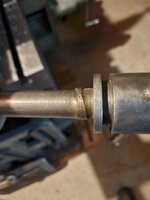
I don't think it's weld... it looks like it was forged like that... it may 'locate' in a diameter in the nose of the dynamic jaw to reduce radial play in the screw.
Hope that helps...
-Bear
KMScott
Well-known member

Chas Parker 955
I recently picked up the 955 vise. Today I started working on the vise just to find out what was wrong with it. Nothing major missing s a couple thrust washers on the screw also missing the screw for the handle tension no biggie I can fix that I plan on leaving all the battle scars to show it was well used I little more cleaning and paint then I can put the vise to good use. Nice vises posted in this thread
I recently picked up the 955 vise. Today I started working on the vise just to find out what was wrong with it. Nothing major missing s a couple thrust washers on the screw also missing the screw for the handle tension no biggie I can fix that I plan on leaving all the battle scars to show it was well used I little more cleaning and paint then I can put the vise to good use. Nice vises posted in this thread
Attachments
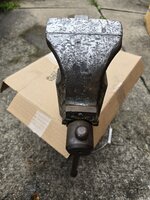
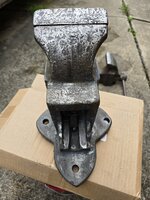
Thanks. Based on the catalogs, it looks like the older ones did not have the flat bottom and then later they switched the 614 to a flat bottom. Because as late as the 1958 catalog the base of thr 614 still had the piece that hangs over the edge of the bench, but then the catalog that is in color must be newer than the black and white catalogs and that one shows the 614 with a flat bottom. I’ll keep looking into the history and try to get a production timeline and what changes were made over time. CheersVintage catalogs here. One of them shows the 614, and the next column says same as 614, but w swivel base.
This one has the 614
Athol Vises : 1930 : Athol Machine & Foundry Co. : Free Download, Borrow, and Streaming : Internet Archive
4 p., illus., 26.0 cm, trade catalogarchive.org
micahd1997
Well-known member
- Joined
- Apr 27, 2022
- Messages
- 275
So…many…questions.
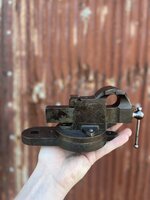
As a lover and researcher of the Prentiss Vise Company, I can’t help but keep my eye out for unique pieces. I purchased this vise not long ago because it looked like a fascinating ugly duckling of sorts. I expected nothing more than to clean off the grime to reveal the half-hearted efforts of a long-gone craftsman to repair his broken little bench vise. I was wrong…partly.
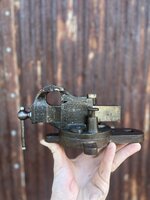
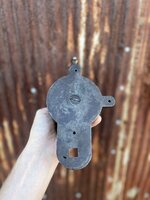
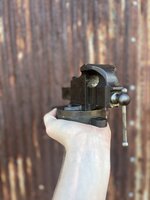
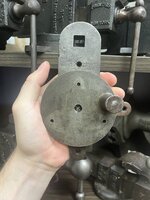
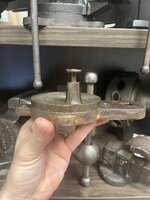
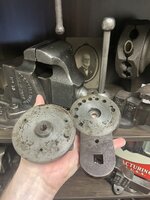
Under the grime I found THIS…a pin-striped Prentiss № 32 (2” jaws) sitting atop a factory original, japanning-coated, one-piece, cast, custom swivel base bearing the James F Hall-patented swivel-lock plunger. I have never seen anything like it. I will stress again that down to the japanning, this base appears in all respects to be factory-original. There are ZERO welds, and the casting is seamless. Let the questions begin…
#1: Could it just be a swivel base from a larger vise that was machined down? - Nope. That wouldn’t explain the uniquely-shaped feet OR the square hole.
#2: Couldn’t someone have cast it themselves later? - I don’t believe so. That wouldn’t explain the presence of the patented, Prentiss-owned swivel lock plunger that’s cast (not screwed or welded) into the base. On top of that, why would someone take an inordinate amount of time and money to cast and machine a Prentiss copy cat swivel base?
#3: Why would Prentiss specially cast this base when they were already regularly producing dedicated, swivel-base vises of the exact same style? - Excellent question…
I personally have two theories. #1 The vise and base were built specially for a customer (perhaps at different times), and the square hole allowed the customer to mount the vise in a unique manner. #2 Given that the vise itself was ornately pinstriped, the pair could’ve been made as a stationary/swivel base advertising combo, and the square hole held some type of sign or advertisement. Whatever the case, I am thrilled to own this exceptionally unique piece of Prentiss Vise Company history, and I would love to hear your thoughts.
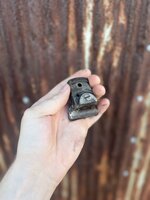
Lastly - the first thing that many of you will notice is that the swivel jaw has been drilled through and anchored by two screws into the static. While most would view this as a bummer, it was something that attracted me to the vise in the first place, especially given how cleanly and carefully the holes had been machined. More amazingly though, I didn’t realize until I was cleaning off the swivel jaw that the chin had been repaired by a skilled machinist at some point (see pictures). The tight fit and tolerances of the teeny pins that dovetail into the swivel jaw and the screw that sits flush against the underside are fascinatingly exact.
To finish it all off, the faint but undeniable letters of the “Prentiss Vise Co, NY” stamp are visible on the slope of the dynamic jaw.
As a lover and researcher of the Prentiss Vise Company, I can’t help but keep my eye out for unique pieces. I purchased this vise not long ago because it looked like a fascinating ugly duckling of sorts. I expected nothing more than to clean off the grime to reveal the half-hearted efforts of a long-gone craftsman to repair his broken little bench vise. I was wrong…partly.
Under the grime I found THIS…a pin-striped Prentiss № 32 (2” jaws) sitting atop a factory original, japanning-coated, one-piece, cast, custom swivel base bearing the James F Hall-patented swivel-lock plunger. I have never seen anything like it. I will stress again that down to the japanning, this base appears in all respects to be factory-original. There are ZERO welds, and the casting is seamless. Let the questions begin…
#1: Could it just be a swivel base from a larger vise that was machined down? - Nope. That wouldn’t explain the uniquely-shaped feet OR the square hole.
#2: Couldn’t someone have cast it themselves later? - I don’t believe so. That wouldn’t explain the presence of the patented, Prentiss-owned swivel lock plunger that’s cast (not screwed or welded) into the base. On top of that, why would someone take an inordinate amount of time and money to cast and machine a Prentiss copy cat swivel base?
#3: Why would Prentiss specially cast this base when they were already regularly producing dedicated, swivel-base vises of the exact same style? - Excellent question…
I personally have two theories. #1 The vise and base were built specially for a customer (perhaps at different times), and the square hole allowed the customer to mount the vise in a unique manner. #2 Given that the vise itself was ornately pinstriped, the pair could’ve been made as a stationary/swivel base advertising combo, and the square hole held some type of sign or advertisement. Whatever the case, I am thrilled to own this exceptionally unique piece of Prentiss Vise Company history, and I would love to hear your thoughts.
Lastly - the first thing that many of you will notice is that the swivel jaw has been drilled through and anchored by two screws into the static. While most would view this as a bummer, it was something that attracted me to the vise in the first place, especially given how cleanly and carefully the holes had been machined. More amazingly though, I didn’t realize until I was cleaning off the swivel jaw that the chin had been repaired by a skilled machinist at some point (see pictures). The tight fit and tolerances of the teeny pins that dovetail into the swivel jaw and the screw that sits flush against the underside are fascinatingly exact.
To finish it all off, the faint but undeniable letters of the “Prentiss Vise Co, NY” stamp are visible on the slope of the dynamic jaw.
Attachments
-
 IMG_9042.jpeg398.6 KB · Views: 56
 -
 IMG_9021.jpeg357.5 KB · Views: 55
 -
 IMG_9023.jpeg319.6 KB · Views: 50
 -
 IMG_9024.jpeg423.9 KB · Views: 49
 -
 IMG_9027.jpeg278.5 KB · Views: 47
 -
 IMG_9032.jpeg287.1 KB · Views: 46
 -
 IMG_9029.jpeg378.8 KB · Views: 44
 -
 IMG_9048.jpeg876 KB · Views: 44
 -
 IMG_9050.jpeg643.7 KB · Views: 43
 -
 IMG_9051.jpeg796.5 KB · Views: 44
Still got more Dawn to come and a some Joplin, Carter, Silex, and some Durham/other Aussie vice info.
Just doing this has helped me work out a few Eras so been good,
Such as Dawn added a cast Australia under The Dawn on Bench vises -100% 72 on, not sure on 70/71, but not on 69 and before. Some other products Hand operated Drilling machines, Open mouth Pipe vices, maybe clamps etc had Australia or Made in Australia on them in 1960's and before.
And changed to metric in 1978, pretty easy to tell a 72-77ish example.
They have been selling a few lower end vices recently, from 2020(Overseas models, still better than most others) -no Australia on them but the higher end Aussie built stuff still has it.
The pipe vise never changed apart from the added Australia- still imperial - C2, C4, C6, The 78 framing vice no Australia or size just a small Dawn( copy of a Joplin, which was wound up in 1977, Dawn started making them in 78-both owned by Sidchrome)
Stanley bought Sidchrome in 1991, sold Dawn 1n 1998-Aussie owned again since then.
And Dammit, just realised my 4" universal is not complete, it's missing the front Pipe jaw, noticed the 1" recess when restoring it, but didn't click-looked closer at the illustrations today, and Dammit !
Just doing this has helped me work out a few Eras so been good,
Such as Dawn added a cast Australia under The Dawn on Bench vises -100% 72 on, not sure on 70/71, but not on 69 and before. Some other products Hand operated Drilling machines, Open mouth Pipe vices, maybe clamps etc had Australia or Made in Australia on them in 1960's and before.
And changed to metric in 1978, pretty easy to tell a 72-77ish example.
They have been selling a few lower end vices recently, from 2020(Overseas models, still better than most others) -no Australia on them but the higher end Aussie built stuff still has it.
The pipe vise never changed apart from the added Australia- still imperial - C2, C4, C6, The 78 framing vice no Australia or size just a small Dawn( copy of a Joplin, which was wound up in 1977, Dawn started making them in 78-both owned by Sidchrome)
Stanley bought Sidchrome in 1991, sold Dawn 1n 1998-Aussie owned again since then.
And Dammit, just realised my 4" universal is not complete, it's missing the front Pipe jaw, noticed the 1" recess when restoring it, but didn't click-looked closer at the illustrations today, and Dammit !
Last edited:
RichRiddle
Well-known member
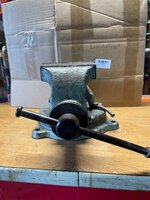
Picked up this Polish-made "bullet" vise manufactured by FPU (with rear-moving jaw).
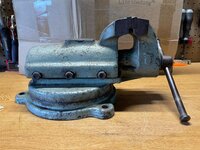
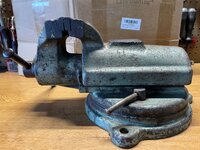
Mr. Wonderful
Well-known member


Parker 88-1/2. Plenty of work in on this one. Bubba put in overtime with some “mods” that needed to be undone. Overall it is in pretty good shape though.
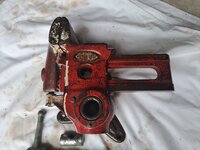
Outlawmws
Well-known member
Handy vises! I'm still looking for a retractable bench mount for one.
GraniteDragon
Member
- Joined
- Sep 23, 2023
- Messages
- 11
Picked up this Chas parker 25x vise a few months back. Love it but am having a time finding a replacement collar. I'm starting to think milling one is going to be my best bet. Any advice is welcome! Posting pictures is hard.
PghJKB
Well-known member
Never heard of these guys referred to as "bullets". My Polish cousins call them zolws (turtles). With the moving rear jaw it looks like a turtle moving it's head out from under its shell.Picked up this Polish-made "bullet" vise manufactured by FPU (with rear-moving jaw).
Very fine vises.
JKB
ricleh
Well-known member
Very nice work Mr. WonderfulParker 88-1/2. Plenty of work in on this one. Bubba put in overtime with some “mods” that needed to be undone. Overall it is in pretty good shape though.
micahd1997
Well-known member
- Joined
- Apr 27, 2022
- Messages
- 275
Howdy, GD - I might know a guy. Sending you a PMPicked up this Chas parker 25x vise a few months back. Love it but am having a time finding a replacement collar. I'm starting to think milling one is going to be my best bet. Any advice is welcome! Posting pictures is hard.
RichRiddle
Well-known member
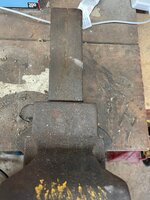
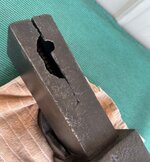
The primary vise in the farm garage came with the farm, a Prentiss #54 Bull Dog. The vintage is unknown, but it shows quite a bit of patina and appears very old. The Prentiss #54 has five inch wide jaws and extends about 8" or so. There is a crack down the center of the slide at the tail end, most likely a defect but there is a slight chance it was manufactured that way. A retired welder who is a neighbor could repair it if it's a defect. The reason it might be manufactured that way is there is a Prentiss @#54 Bull Dog listed on eBay with not only the split but a piece missing.
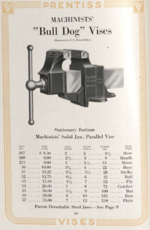
An older thread in Garage Journal offers some information here...Prentiss #54 Vise. Big Caddy said, "Prentiss went out of business/purchased in the late 50s by Parker/union tool so it's not any newer then that time frame." Carla stated, "The old catalogue specs on the No. 54 are 5" jaw width, 8" jaw opening, and 72lbs. weight."
Authors offered other comments, but it was specific to the vise posted and dating it, not this vise. The Prentiss #54 in the old thread also had the maker's writing on the front of the slide; this one does not.
Any information you might offer is appreciated.
Side view of the Prentiss #54 Vise in the farm garage....

Front view of the Prentiss #54 vise in the farm garage...
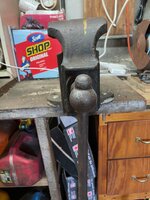
Below is the crack in the center of the tail of the slide on the Prentiss #54 Vise in the farm garage.
Below is the Prentiss #54 vise listed on eBay with a similar crack although it has a missing piece next to the crack:
An older thread in Garage Journal offers some information here...Prentiss #54 Vise. Big Caddy said, "Prentiss went out of business/purchased in the late 50s by Parker/union tool so it's not any newer then that time frame." Carla stated, "The old catalogue specs on the No. 54 are 5" jaw width, 8" jaw opening, and 72lbs. weight."
Authors offered other comments, but it was specific to the vise posted and dating it, not this vise. The Prentiss #54 in the old thread also had the maker's writing on the front of the slide; this one does not.
Any information you might offer is appreciated.
Side view of the Prentiss #54 Vise in the farm garage....
Front view of the Prentiss #54 vise in the farm garage...
Below is the crack in the center of the tail of the slide on the Prentiss #54 Vise in the farm garage.
Below is the Prentiss #54 vise listed on eBay with a similar crack although it has a missing piece next to the crack:
Last edited:
tool_scrounge
Well-known member
The Parker Union vises I have owned are marked Parker Union. But in the ownership transition I would not be surprised if they were using existing castings if any are were available. SoI would expect your vise to be pre Union ownership.The primary vise in the farm garage came with the farm, a Prentiss #54 Bull Dog. The vintage is unknown, but it shows quite a bit of patina and appears very old. The Prentiss #54 has five inch wide jaws and extends about 8" or so. There is a crack down the center of the slide at the tail end, most likely a defect but there is a slight chance it was manufactured that way. A retired welder who is a neighbor could repair it if it's a defect.
An older thread in Garage Journal offers some information here...Prentiss #54 Vise. Big Caddy said, "Prentiss went out of business/purchased in the late 50s by Parker/union tool so it's not any newer then that time frame." Carla stated, "The old catalogue specs on the No. 54 are 5" jaw width, 8" jaw opening, and 72lbs. weight."
Authors offered other comments, but it was specific to the vise posted and dating it, not this vise. The Prentiss #54 in the old thread also had the maker's writing on the front of the slide; this one does not.
Any information you might offer is appreciated.
Sadly, the cracked casting on the center top of the slide is somewhat common on Prentiss vises. It could be a design issue combined with hammering on the slide. I suspect it is also a mold design issue where the metal was cooling too much as it was flowing through the mold and does not bind completely together.
Outlawmws
Well-known member
As said, the crack is from a poor design right there, possibly compounded with abuse.
KM Scott has posted how he approaches the fix, and its a good fix. Essentially its burying several socket head bolts, stop drilling the crack, grinding a Vee, and welding with nickle rod. preheating is required and slow cooling.
KM Scott has posted how he approaches the fix, and its a good fix. Essentially its burying several socket head bolts, stop drilling the crack, grinding a Vee, and welding with nickle rod. preheating is required and slow cooling.
micahd1997
Well-known member
- Joined
- Apr 27, 2022
- Messages
- 275
@RichRiddle Congratulations, Rich! Despite the crack in the slide which, as @tool_scrounge and @Outlawmws pointed out, is not original, it's still a beautiful, functional Prentiss. Prentiss vises with that specific font were offered roughly from 1920-1925 (with likely a couple years added on to account for overstock). Company-issued catalogues were (and still are) the best indication of what styles, models, and prices were offered during a certain time period. With the publication of Prentiss catalog #52 in 1920 came your design (referred to as the "graffiti script" design by most collectors/enthusiasts today). By the time that Prentiss' catalog #53 rolled off the presses in 1925, the design had changed once again.
Your vise would appear to've received a coat of black paint at some point in the past. While the day-to-day operations of a factory environment aren't always perfect and while room for error always exits, Prentiss didn't routinely paint the slides or main screws of their vises. The residual, chippy black paint on both the slide and the meatball tell me that it was repainted at some point. That said (barring the crack), the vise is in good enough condition that I wouldn't be at all surprised if a sizeable amount of the original finish still exists under the outer layer of paint. As a researcher of the company, I'm still trying to hone my understanding of the years that Prentiss changed up their vise finishes. During their early days, they finished all their vises in either japanning for the larger vises or nickel-plating/maroon paint for their jeweler's. Eventually they switched to paint (I believe in the 1920s).
If you're willing to invest the time to repair it the best way possible, I would certainly recommend Kevin's process as already mentioned. He's the best of the best: https://wiltonviseparts.wordpress.com/2020/08/30/restoring-a-prentiss-58/
Your vise would appear to've received a coat of black paint at some point in the past. While the day-to-day operations of a factory environment aren't always perfect and while room for error always exits, Prentiss didn't routinely paint the slides or main screws of their vises. The residual, chippy black paint on both the slide and the meatball tell me that it was repainted at some point. That said (barring the crack), the vise is in good enough condition that I wouldn't be at all surprised if a sizeable amount of the original finish still exists under the outer layer of paint. As a researcher of the company, I'm still trying to hone my understanding of the years that Prentiss changed up their vise finishes. During their early days, they finished all their vises in either japanning for the larger vises or nickel-plating/maroon paint for their jeweler's. Eventually they switched to paint (I believe in the 1920s).
If you're willing to invest the time to repair it the best way possible, I would certainly recommend Kevin's process as already mentioned. He's the best of the best: https://wiltonviseparts.wordpress.com/2020/08/30/restoring-a-prentiss-58/
Attachments
Last edited:
One thing that has been bugging me, the restored vices I've posted look a bright red.
Dawn seemed to change there colour slightly whenever they felt like it and probably have 20 shades.
I have 14 vices, clamps, tools in original colour (6 different reds) and have the colour fairly close to the shade I like, it's a lot darker than what it appears in my photo's-and I'm sure a few of you would be familiar with it as a USA product- 'Satin Claret wine"
This is a good condition 1978 on, 7" woodworking vice -took me a few hours to remove the rust, but that is all I've done with it.
Last edited:
I have problems, having withdrawal symptoms, haven't bought a vice for 2 weeks, so I thought I'd finish my 4" examples.
This is just a quick side-track, am I allowed to say it's cute ? Just a comparison with the 7" posted earlier.
6" 1978 on, 6.2lb
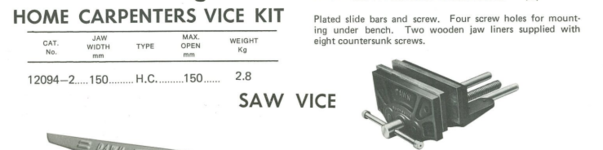
This is just a quick side-track, am I allowed to say it's cute ? Just a comparison with the 7" posted earlier.
6" 1978 on, 6.2lb
Attachments

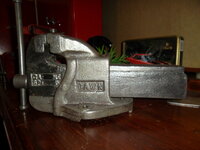
This is my largest 4" by size and weight, 2nd largest by Jaw.
4 1/4" Dawn, 56lb/25.4kg Built from at least 1932 to 69 and maybe unchanged during that period-has slight offset jaws.
My example looked to have a 50yr old repair, rewelded front jaw, bought it very cheap as uncommon, wanted to practise some cutting/restoring name/something to do basically-have/will weaken it by grinding the welds smooth, but won't sell it as its a display piece for me.
Needs some more work, just trying out different methods on other scrap. The jaws have become one with the vice also, but I'll get em off before painting-have a few more ideas how to do that from here (Thankyou) will try a few before I drill out the screws, I have spares.

4 1/4" Dawn, 56lb/25.4kg Built from at least 1932 to 69 and maybe unchanged during that period-has slight offset jaws.
My example looked to have a 50yr old repair, rewelded front jaw, bought it very cheap as uncommon, wanted to practise some cutting/restoring name/something to do basically-have/will weaken it by grinding the welds smooth, but won't sell it as its a display piece for me.
Needs some more work, just trying out different methods on other scrap. The jaws have become one with the vice also, but I'll get em off before painting-have a few more ideas how to do that from here (Thankyou) will try a few before I drill out the screws, I have spares.