Yes welded, not removeable.Is that Tommy bar welded?


You are using an out of date browser. It may not display this or other websites correctly.
You should upgrade or use an alternative browser.
You should upgrade or use an alternative browser.
The VISES of Garage Journal
- Thread starter mjozefow
- Start date
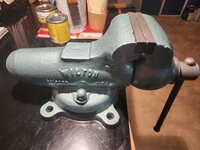
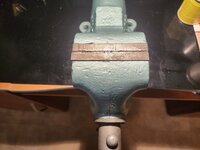
Finally got around to painting a Wilton 940 I picked up a few years ago. I didn't go crazy with it and just cleaned it up and painted the "anvil" surface, which had a few deep dings. Figured too much metal would have needed to be removed to restore face. Overall is in pretty good shape. Date code is 1-47.

CRSINMICH
Well-known member

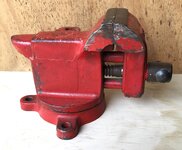

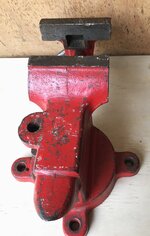


Old Radar
Well-known member
Since you're inviting comment, if it was me, I'd take the paint off the swivel nuts.What do you think?
Thanks I was actually thinking about buying stainless for it. I need another screw for the plate that retains handle as well as new cap screws for the jaws.Since you're inviting comment, if it was me, I'd take the paint off the swivel nuts.
I posted it up on ebay for (a ridiculous) $650 OBO. Hey, I love old school Wiltons but could use the cash and if somebody wants to spend that much I'll let it go. I sold a 5" for $750 a while back we'll see how it goes.
TxSteve
Well-known member
Yeah - I don't understand the pricing on some of these old vises (or anvils for that matter)..... Yes - they're cool and they were made well in the good 'ol US of A, but I've beat on my 'cheaper' vises pretty heavily for a lot of years and they've held up surprising well......Thanks I was actually thinking about buying stainless for it. I need another screw for the plate that retains handle as well as new cap screws for the jaws.
I posted it up on ebay for (a ridiculous) $650 OBO. Hey, I love old school Wiltons but could use the cash and if somebody wants to spend that much I'll let it go. I sold a 5" for $750 a while back we'll see how it goes.
I think alot of the value is driven by the collectibility and nostalgia vs a tool to beat on.Yeah - I don't understand the pricing on some of these old vises (or anvils for that matter)..... Yes - they're cool and they were made well in the good 'ol US of A, but I've beat on my 'cheaper' vises pretty heavily for a lot of years and they've held up surprising well......
TxSteve
Well-known member
I know. I guess after cleaning out 2 houses my parents had and trying to figure out what to do with all the collections and nostalgia things, I have no desire to purchase things that aren't useful just because they're cool.I think alot of the value is driven by the collectibility and nostalgia vs a tool to beat on.
CRSINMICH
Well-known member
Small Vises from Big Name Makers Series
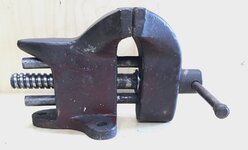
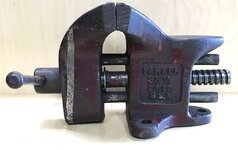
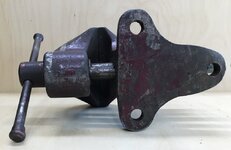
PARKER #33 1/2
Not much is known about this model but it is on the Spreadsheet.PARKER #33 1/2
Triangular base and no Parker collar.
Jaw's 3.5" Opens to 3"
Attachments

PeterPeter
Well-known member
Wilton prides itself on quality, but this one slipped by. Bought a C0 (mid 70?) on a flyer for $160. Locked-up slide. Screw spins. Broken ear on base. Missing dust cap.
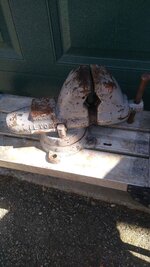
Poor thing sat in the bed of a repair truck in NH for a few decades. But most of that time, it was painted , but wasn’t used. When I got it apart, I found out why. The nut wasn’t properly drilled. One side was not drilled through
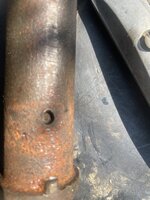
and the shallow hole didn’t hold enough of the tapered pin, and so the pin sheared off. I’m guessing someone tried taking it apart, and did this to the end cap. Edit: looking at it, the screws on the horseshoe washer were all stressed, and bent, too. I bet the slide froze, but not the screw, and they jammed the handle until the nut broke free. So maybe the half drill hole actually saved the nut.

Thinking this can have a washer welded to it, and then machined down. But first, I have to get the slide unstuck, to see if I can even use it. Contemplating tossing it into a 400° oven for a 1/2 hour, spray Dust-Off down the screw hole, then whacking with a wooden dowel as a punch.
.
This has not been my most successful purchase so far.
Peter
Poor thing sat in the bed of a repair truck in NH for a few decades. But most of that time, it was painted , but wasn’t used. When I got it apart, I found out why. The nut wasn’t properly drilled. One side was not drilled through
and the shallow hole didn’t hold enough of the tapered pin, and so the pin sheared off. I’m guessing someone tried taking it apart, and did this to the end cap. Edit: looking at it, the screws on the horseshoe washer were all stressed, and bent, too. I bet the slide froze, but not the screw, and they jammed the handle until the nut broke free. So maybe the half drill hole actually saved the nut.
Thinking this can have a washer welded to it, and then machined down. But first, I have to get the slide unstuck, to see if I can even use it. Contemplating tossing it into a 400° oven for a 1/2 hour, spray Dust-Off down the screw hole, then whacking with a wooden dowel as a punch.
.
This has not been my most successful purchase so far.
Peter
Last edited:
Patrickm82
Well-known member
That ***** @PeterPeter, I almost made an offer on that one.
12vx2
Well-known member
I haven't had one apart in a while. Is it possible to rotate the end 90 degrees and drill for the pins. the tail would need to be ground and recontoured.Wilton prides itself on quality, but this one slipped by. Bought a C0 (mid 70?) on a flyer for $160. Locked-up slide. Screw spins. Broken ear on base. Missing dust cap.
Poor thing sat in the bed of a repair truck in NH for a few decades. But most of that time, it was painted , but wasn’t used. When I got it apart, I found out why. The nut wasn’t properly drilled. One side was not drilled through
and the shallow hole didn’t hold enough of the tapered pin, and so the pin sheared off. I’m guessing someone tried taking it apart, and did this to the end cap. Edit: looking at it, the screws on the horseshoe washer were all stressed, and bent, too. I bet the slide froze, but not the screw, and they jammed the handle until the nut broke free. So maybe the half drill hole actually saved the nut.
Thinking this can have a washer welded to it, and then machined down. But first, I have to get the slide unstuck, to see if I can even use it. Contemplating tossing it into a 400° oven for a 1/2 hour, spray Dust-Off down the screw hole, then whacking with a wooden dowel as a punch.
.
This has not been my most successful purchase so far.
Peter
PeterPeter
Well-known member
That might be an option. It is pretty beefy. I’ve also heard welding this steel can be problematic.I haven't had one apart in a while. Is it possible to rotate the end 90 degrees and drill for the pins. the tail would need to be ground and recontoured.
KMScott
Well-known member
If I was fixing it I would weld or braze the hole on the Static and drill either a new pin hole or tap for a 5/6:18 set screw thru the nut support and nut below or above the closed up hole without rotating the nut support. Be sure to aim toward center when drilling. I’ve rotated the nut support before and the nut ended up not being on center and bound up the spindle. I had to float the nut more by opening up the slots that keeps the nut from rotating. Not an easy fix, good luck.
Turned on Ebay this morning I usually have a quick look at what is selling in Vintage bench vises before I tick the Australia only box.
My curiosity is piqued, has there been a fire sale on these ?, the first 19 were Craftsman 506, and if they are so common why are they selling up to US $300 ?

Did one sell for a ridicules amount ?
It's always astonished me how a NOS, still in it's box with a one of one unique features can sell for a high price (and correctly so) and out of the woodwork come all these examples that have been used as a boat anchor in sea water for 30 years pop up- "ooh I have one of those, mine is worth more thou - I mean, can't people see the difference between a good item and scrap metal ? just boggles my head sometimes.
My curiosity is piqued, has there been a fire sale on these ?, the first 19 were Craftsman 506, and if they are so common why are they selling up to US $300 ?
Did one sell for a ridicules amount ?
It's always astonished me how a NOS, still in it's box with a one of one unique features can sell for a high price (and correctly so) and out of the woodwork come all these examples that have been used as a boat anchor in sea water for 30 years pop up- "ooh I have one of those, mine is worth more thou - I mean, can't people see the difference between a good item and scrap metal ? just boggles my head sometimes.
Outlawmws
Well-known member
I have an unusual one I picked up today - and not much to go on for an ID:
got it at a Collage Flea - a solid brass/bronze vise - only a couple parts are steel. Only $10 so I grabbed it:
1-3/4" wide jaws and a 2-1/4" open. Weight is just under 3 lbs as is.
The star washer on this side is steel, and the square head bolt and spring are:

The "Cable clamp" and screws on this side are also Steel.
Everything else is "Non Sparking" and I suspect some of the steel parts were added after it left the factory.

It mounts to a round post and that post has to have one end available to feed the vise onto the post. The clamping ring is about 13/16" and no; 1/2" pipe is too big..

got it at a Collage Flea - a solid brass/bronze vise - only a couple parts are steel. Only $10 so I grabbed it:
1-3/4" wide jaws and a 2-1/4" open. Weight is just under 3 lbs as is.
The star washer on this side is steel, and the square head bolt and spring are:
The "Cable clamp" and screws on this side are also Steel.
Everything else is "Non Sparking" and I suspect some of the steel parts were added after it left the factory.
It mounts to a round post and that post has to have one end available to feed the vise onto the post. The clamping ring is about 13/16" and no; 1/2" pipe is too big..
Last edited:
micahd1997
Well-known member
- Joined
- Apr 27, 2022
- Messages
- 275
Definitely a mystery (and a neat one at that). The red paint leads me to believe either Reed or RIDGID (though the paint might be after market), but I can’t find it in any of their catalogues. I might be seeing things, but is there faded stamping along the handle here?I have na unusual one I picked up today - and not much to go on for an ID:
got it at a Collage Flea - a solid brass/bronze vise - only a couple parts are steel. Only $10 so I grabbed it:
1-3/4" wide jaws and a 2-1/4" open. Weight is just under 3 lbs as is.
The star washer on this side is steel, and the square head bolt and spring are:
The "Cable clamp" and screws on this side are also Steel.
Everything else is "Non Sparking" and I suspect some of the steel parts were added after it left the factory.
It mounts to a round post and that post has to have one end available to feed the vise onto the post. The clamping ring is about 13/16" and no; 1/2" pipe is too big..
Attachments

Outlawmws
Well-known member
I might be seeing things, but is there faded stamping along the handle here?
I forgot to mention that - yes the only marking it has:
X - X 8
Pretty meaningless to me.
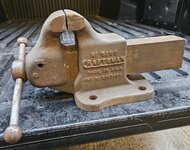
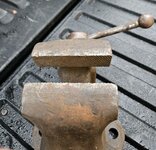
I picked up a couple of vises in antique shops today...
First I found a Reed-Craftsman 5180...

And a rough Prentiss Bulldog no. 56 with a non-original handle and a badly broken slide...
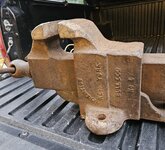
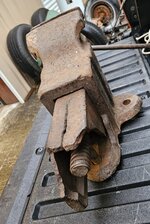
I'm planning to attempt to rebuild the slide... if for no other reason, just as a learning experience. If it doesn't work out, I'll use it as a door stop...
-Bear
First I found a Reed-Craftsman 5180...
And a rough Prentiss Bulldog no. 56 with a non-original handle and a badly broken slide...
I'm planning to attempt to rebuild the slide... if for no other reason, just as a learning experience. If it doesn't work out, I'll use it as a door stop...
-Bear
Garagegho5t
Member
- Joined
- Jan 8, 2024
- Messages
- 20
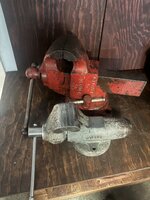
Hello, reaching out to any vise experts here, I picked these up recently;
5” Parker Eclipse 206-5 patent 1910, weighs 104lbs
4” Wilton bullet dated 1945
Are these the original paint?
Was the bullet ever sold without swivel base in the 40s?
5” Parker Eclipse 206-5 patent 1910, weighs 104lbs
4” Wilton bullet dated 1945
Are these the original paint?
Was the bullet ever sold without swivel base in the 40s?
Outlawmws
Well-known member
No on the Parker for sure, Parker never painted the slides. Back them I think the only two colors were black and green
I have a Parker 49x that looks very similar it doesn't have any paint but not sure if that's original or not. It looks like there is a light green under the red but maybe that's primer? Not sure about Wilton either but have seen other wiltons with similar color. I just painted a 4" wilton marked 1-47 and it had Chicago USA on it as well would have expected similar markings but they could have done things differently during WWII. Both look great.
Garagegho5t
Member
- Joined
- Jan 8, 2024
- Messages
- 20
Bare metal under the red. My guess is that it was painted by one of the owners, a long time agoI have a Parker 49x that looks very similar it doesn't have any paint but not sure if that's original or not. It looks like there is a light green under the red but maybe that's primer? Not sure about Wilton either but have seen other wiltons with similar color. I just painted a 4" wilton marked 1-47 and it had Chicago USA on it as well would have expected similar markings but they could have done things differently during WWII. Both look great.
Bare metal under the red. My guess is that it was painted by one of the owners, a long time ago
Maybe just the pic but sure looks like green paint.

CRSINMICH
Well-known member

Anyone have an older Wilton 800 bullet, 1960s, maybe 70s date code, with original swivel base and original paint (paint can be worn) for sale in the North Eastern United States? Looking for something in used decent original condition.
Please private message me if you have one for sale.
Please private message me if you have one for sale.
Outlawmws
Well-known member
PeterPeter
Well-known member
If you ever find yourself doing this to a vise you just bought, you probably paid too much.

Peter, who understands bottom feeders sometimes just eat ****.
Peter, who understands bottom feeders sometimes just eat ****.
micahd1997
Well-known member
- Joined
- Apr 27, 2022
- Messages
- 275
If you ever find yourself needing to do that with a vise, that certainly looks like the bearing puller to do it with!If you ever find yourself doing this to a vise you just bought, you probably paid too much.
Peter, who understands bottom feeders sometimes just eat ****.
PeterPeter
Well-known member
Bought the vise Friday, I picked up the puller this morning at a flea market for $5.If you ever find yourself needing to do that with a vise, that certainly looks like the bearing puller to do it with!
 At this point, the puller is probably worth more than the vise. 🫤
Garagegho5t
Member
- Joined
- Jan 8, 2024
- Messages
- 20
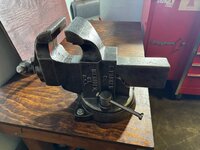
Maybe just the pic but sure looks like green paint
I dunno. I just finished removing all of it and nothing underneath
12vx2
Well-known member
It looks similar to the old style of Bonding cable clamps I had used in the 1970s on electrical substations or steel towers when establishing safety grounds for conductors or personal protection. The bonding conductor is very welding cable like in appearance and it would be clamped to the bronze lug. The conductor jacket clamps under the 2 screw clamp for strain relief. The jaws clamp onto the angle iron or braces o the V groove would clamp onto smaller conductor wires. Pushing down and rotating the spring tensioned threaded screw and nut may present a differently configured camp profile.I have an unusual one I picked up today - and not much to go on for an ID:
got it at a Collage Flea - a solid brass/bronze vise - only a couple parts are steel. Only $10 so I grabbed it:
1-3/4" wide jaws and a 2-1/4" open. Weight is just under 3 lbs as is.
The star washer on this side is steel, and the square head bolt and spring are:
The "Cable clamp" and screws on this side are also Steel.
Everything else is "Non Sparking" and I suspect some of the steel parts were added after it left the factory.
It mounts to a round post and that post has to have one end available to feed the vise onto the post. The clamping ring is about 13/16" and no; 1/2" pipe is too big..
Maui
Well-known member
I just finished restoring a Hollands 13 1/2 that was coated head to toe in rust. It came out rather nice.
micahd1997
Well-known member
- Joined
- Apr 27, 2022
- Messages
- 275
Beautiful, MauiI just finished restoring a Hollands 13 1/2 that was coated head to toe in rust. It came out rather nice.
micahd1997
Well-known member
- Joined
- Apr 27, 2022
- Messages
- 275
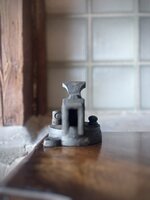
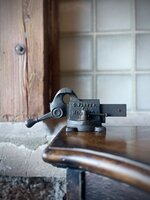
As a lover of American history generally and vise history specifically, I don’t mind admitting that when I saw this vise amid other photos of a local estate sale, I took off work early and spent the night on the front stoop of the home in order to be first in line the next morning. As you can see, the rest is history.
I’m in utter disbelief at the condition of this vise. With 2” jaws and 99% of the original japanning, it is an exquisite, museum-level piece of history. The gentleman who previously owned it was, among other things, a photographer for Life Magazine.
Thomas Hall, a resident of Florence, MA, patented his “Improvement in Vises” on June 24, 1873. Thomas clearly wasted no time or money in advertising his invention, because less than a year later on February 1st, 1874, the Daily Herald of Dallas, TX writes (regarding the 1873 World’s Fair in Vienna), “Thomas Hall of Massachusetts exhibited a new and superior vise which received no recognition, while one ten years old, and which had been exhibited at the Paris Exhibition received a “medal for progress’.”
As a side note, I’m not yet clear on which patentor’s vise it was that received the aforementioned “medal for progress”. While I wish I could be convinced that the mysterious other vise was Mason Prentiss’, his was patented only five years prior in 1868, not ten. Additionally, the Paris exhibition was held in 1876, a year prior to Mason’s patent
While one might be tempted to pity Thomas Hall for his lack of recognition at the Vienna World’s Fair, one would only have to skim their copy of the August 21st, 1875 publication of the Scientific American to see not only a completely different story but also further information on the progress of Hall’s business dealings. The publication states while describing Hall’s vise, “This implement gained the medal of progress and a diploma of honor at the Vienna Exposition, such awards being, we are informed, higher than those given to any other vise. It also took the highest premium at the Fair of the Franklin Institute in Philadelphia in 1874…For further particulars relative to sale of rights, etc., address Mr Thomas Hall, 411 Fulton Street, Brooklyn, NY or Mr Charles Parker, manufacturer, Meriden, Conn.
Talk about being on the same planet but two worlds apart. And before you ask - no. There was only one Vienna World’s Fair/Exposition, and it was in 1873. Given the specificity of the Dallas’ Daily Herald comparison of Hall’s vise with the mystery vise that received a medal for progress, my suspicion is that the writers of the Scientific American accidentally either confused the two vises or attributed the medal to Hall when, in fact, he might’ve only received the diploma of honor. Either way, the contrast couldn’t be more stark between the two stories.
Ultimately, we know from these (and later mentions) that the Charles Parker Co was manufacturing Hall’s vises as early as August, 1875, and only a few years later the company would begin producing Hall’s vises bearing the Parker name. Given the Scientific American’s referral to write to Charles Parker regarding the sale of rights, I also imply that Parker had already purchased the patent by 1875.
I’m in utter disbelief at the condition of this vise. With 2” jaws and 99% of the original japanning, it is an exquisite, museum-level piece of history. The gentleman who previously owned it was, among other things, a photographer for Life Magazine.
Thomas Hall, a resident of Florence, MA, patented his “Improvement in Vises” on June 24, 1873. Thomas clearly wasted no time or money in advertising his invention, because less than a year later on February 1st, 1874, the Daily Herald of Dallas, TX writes (regarding the 1873 World’s Fair in Vienna), “Thomas Hall of Massachusetts exhibited a new and superior vise which received no recognition, while one ten years old, and which had been exhibited at the Paris Exhibition received a “medal for progress’.”
As a side note, I’m not yet clear on which patentor’s vise it was that received the aforementioned “medal for progress”. While I wish I could be convinced that the mysterious other vise was Mason Prentiss’, his was patented only five years prior in 1868, not ten. Additionally, the Paris exhibition was held in 1876, a year prior to Mason’s patent
While one might be tempted to pity Thomas Hall for his lack of recognition at the Vienna World’s Fair, one would only have to skim their copy of the August 21st, 1875 publication of the Scientific American to see not only a completely different story but also further information on the progress of Hall’s business dealings. The publication states while describing Hall’s vise, “This implement gained the medal of progress and a diploma of honor at the Vienna Exposition, such awards being, we are informed, higher than those given to any other vise. It also took the highest premium at the Fair of the Franklin Institute in Philadelphia in 1874…For further particulars relative to sale of rights, etc., address Mr Thomas Hall, 411 Fulton Street, Brooklyn, NY or Mr Charles Parker, manufacturer, Meriden, Conn.
Talk about being on the same planet but two worlds apart. And before you ask - no. There was only one Vienna World’s Fair/Exposition, and it was in 1873. Given the specificity of the Dallas’ Daily Herald comparison of Hall’s vise with the mystery vise that received a medal for progress, my suspicion is that the writers of the Scientific American accidentally either confused the two vises or attributed the medal to Hall when, in fact, he might’ve only received the diploma of honor. Either way, the contrast couldn’t be more stark between the two stories.
Ultimately, we know from these (and later mentions) that the Charles Parker Co was manufacturing Hall’s vises as early as August, 1875, and only a few years later the company would begin producing Hall’s vises bearing the Parker name. Given the Scientific American’s referral to write to Charles Parker regarding the sale of rights, I also imply that Parker had already purchased the patent by 1875.
Attachments




Last edited:
Patrickm82
Well-known member
I have to ask did you pay up or was it a $10 estate sale deal?As a lover of American history generally and vise history specifically, I don’t mind admitting that when I saw this vise amid other photos of a local estate sale, I took off work early and spent the night on the front stoop of the home in order to be first in line the next morning. As you can see, the rest is history.
I’m in utter disbelief at the condition of this vise. With 2” jaws and 99% of the original japanning, it is an exquisite, museum-level piece of history. The gentleman who previously owned it was, among other things, a photographer for Life Magazine.
Thomas Hall, a resident of Florence, MA, patented his “Improvement in Vises” on June 24, 1873. Thomas clearly wasted no time or money in advertising his invention, because less than a year later on February 1st, 1874, the Daily Herald of Dallas, TX writes (regarding the 1873 World’s Fair in Vienna), “Thomas Hall of Massachusetts exhibited a new and superior vise which received no recognition, while one ten years old, and which had been exhibited at the Paris Exhibition received a “medal for progress’.”
As a side note, I’m not yet clear on which patentor’s vise it was that received the aforementioned “medal for progress”. While I wish I could be convinced that the mysterious other vise was Mason Prentiss’, his was patented only five years prior in 1868, not ten. Additionally, the Paris exhibition was held in 1876, a year prior to Mason’s patent
While one might be tempted to pity Thomas Hall for his lack of recognition at the Vienna World’s Fair, one would only have to skim their copy of the August 21st, 1875 publication of the Scientific American to see not only a completely different story but also further information on the progress of Hall’s business dealings. The publication states while describing Hall’s vise, “This implement gained the medal of progress and a diploma of honor at the Vienna Exposition, such awards being, we are informed, higher than those given to any other vise. It also took the highest premium at the Fair of the Franklin Institute in Philadelphia in 1874…For further particulars relative to sale of rights, etc., address Mr Thomas Hall, 411 Fulton Street, Brooklyn, NY or Mr Charles Parker, manufacturer, Meriden, Conn.
Talk about being on the same planet but two worlds apart. And before you ask - no. There was only one Vienna World’s Fair/Exposition, and it was in 1873. Given the specificity of the Dallas’ Daily Herald comparison of Hall’s vise with the mystery vise that received a medal for progress, my suspicion is that the writers of the Scientific American accidentally either confused the two vises or attributed the medal to Hall when, in fact, he might’ve only received the diploma of honor. Either way, the contrast couldn’t be more stark between the two stories.
Ultimately, we know from these (and later mentions) that the Charles Parker Co was manufacturing Hall’s vises as early as August, 1875, and only a few years later the company would begin producing Hall’s vises bearing the Parker name. Given the Scientific American’s referral to write to Charles Parker regarding the sale of rights, I also imply that Parker had already purchased the patent by 1875.
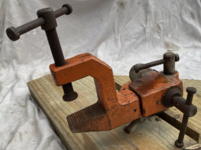
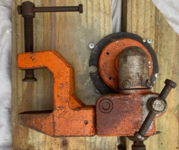
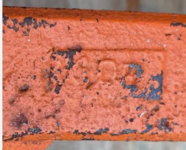
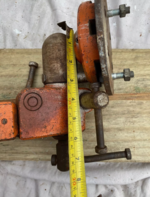
Anyone seen something like this ? can't make out the letters and wouldn't think it is a one off with the cast in ID,
6.85kg/ 19.5 lb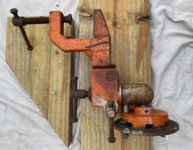

6.85kg/ 19.5 lb
Attachments
-
 Screenshot 2024-09-18 115527.png376.4 KB · Views: 32
 -
 Screenshot 2024-09-18 115544.png757.1 KB · Views: 26
 -
 Screenshot 2024-09-18 115552.png660.1 KB · Views: 15
 -
 Screenshot 2024-09-18 115612.png810.2 KB · Views: 15
 -
 Screenshot 2024-09-18 115627.png799.9 KB · Views: 14
 -
 Screenshot 2024-09-18 115636.png547.4 KB · Views: 14
 -
 Screenshot 2024-09-18 115645.png441.2 KB · Views: 14
 -
 Screenshot 2024-09-18 115656.png493.3 KB · Views: 11


Outlawmws
Well-known member
Haven't seen one but looks to be a holding clamp fixture.