Maui
Well-known member
Thanks micahd1997 and everyone else. It is for sale. If any of you are interested feel free to PM me.



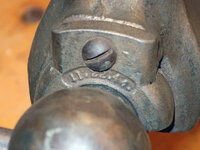
Thank you Micahd, I found the date stamp before loading on the truck. 1047.Congrats, Fly! Reeds are some of the best, and once you get into the 6"-n-up range, they certainly dwarf anything smaller. I might be telling you something you already know, but if you check the cheek right here, there's a 3-digit date code that will tell you when it was manufactured (ex. "751 = July, 1951). Congrats on both!
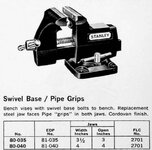
Maybe this ?This is bugging me. I just found this 1971 Stanley catalog cut and I know I've seen a vise very like Stanley's 035 model somewhere recently. Where was that?
Thanks for the info. I have one of these that I inherited from my grandfather. The only difference is that mine has a Wilton decal where yours is cast. I wonder if mine is a bit newer. My grandfather passed in 1988, so it would be older than that.Small Vises from Big Name Makers Series
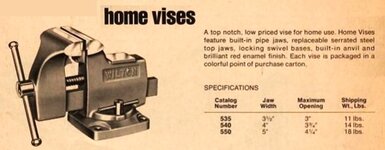
WILTON 535 Home Vise
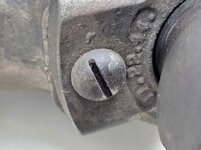
The 1972 ad mentions built in pipe jaws and replaceable jaw faces. The view of the bottom of the base shows the number 633 1/2 which is a model number for WILTON Shop King vises.


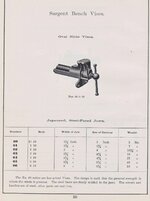
Great! Thanks for the info, @micahd1997! Any idea when that catalog is from?That’s a clean one, @bliorg . The collar tells me either Parker or Sargent, but the 64 on the side, several other features, and this catalog page confirm Sargent.
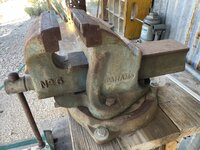
As far as value, this style of vise was made by many different manufacturers as a lower quality, low budget utility/farm vise. Because of that, they’re fairly common. I personally wouldn’t put market value above $50, but value depends on the buyer ultimately.
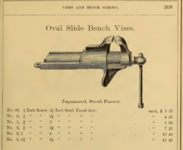
You bet! The catalog is from 1911, so it's possible that it dates back that far (though it seems Sargent produced these same vises for years after/prior to 1911 albeit with different model numbers in the late 1800s - #1, #2, #3, etc. rather than #60, #61, #62, etc.)Great! Thanks for the info, @micahd1997! Any idea when that catalog is from?
FWIW, I picked it up about an hour ago. It’s in really nice shape. Light bloom of rust, but not bad. Need to figure out how to finish it. I am NOT going to paint it (no problem with that, just not for this). Catalog said it was jappaned; I’ve jappaned tools before but I’m not sure how that would work for something this size, seems like it would chip pretty easily on a vise, and my wife would kill me if I baked it in our oven! Probably some kind of oil (raw/boiled LO) but need to learn more. Maybe Boeshield?
Regarding value/offer, I negotiated a bit with the seller (nice guy). Ended up a little north of you suggestion, and I’m sure I overpaid at least a bit, but this is what I wanted. Love the look and design, will be great for the work I am planning on doing, and is going to be a fun project in itself. It’s in fantastic condition, and I’m really happy! Pics forthcoming…
Btw: You might be able to find a large enough used toaster oven in a resale shop or online for japanning.




Btw: You might be able to find a large enough used toaster oven in a resale shop or online for japanning.
I think it would only take a gentle nudge to start down the slope at this point...


Love the copper jaw inserts. I've made a couple, but those look like they would stay on the jaws way better than mine. The tabs are a great idea for removing and re-installing.Boiled linseed oil would be my choice. Knock that light rust off with some 4-0 steel wool and hit it with BLO thinned 50-50 with mineral spirits.
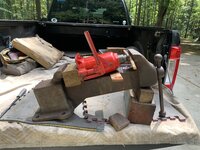
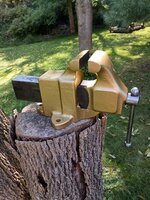
I did that old Reed back in February. It's seen plenty of use since.
Those were @Outlawmws idea and my implementation. Made from off-cuts of 2" Type L copper pipe, flattened, shaped and then formed on the vise using soft mallets. They stay on well, but can still be removed without bending them. I'm finding I rarely need to remove them and much prefer "soft jaws" for about 90% of what I do.Love the copper jaw inserts. I've made a couple, but those look like they would stay on the jaws way better than mine. The tabs are a great idea for removing and re-installing.
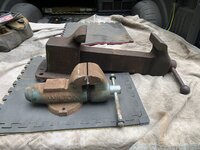
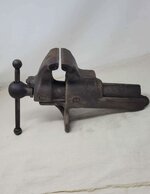
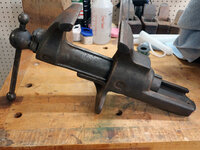
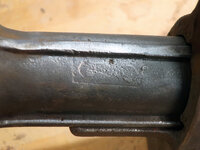
As promised, some as-found starter photos.
In good shape - can't find any cracks, etc., and everything moves smoothly with no binding. Seems well used enough, but not abused. Very happy with it; I haven't been able to find anything worthwhile on marketplace in ages. Again, I'm sure it's not gloat-worthy, but I'm good with it, especially with how infrequent my old tool purchases have become.
Now... The big question most directly is whether to clean and oil it, or do a full resto. I haven't japanned anything in like 15 years, and then only a Stanley spokeshave. Nothing to this scale. I did look on FB, though, and found a huge toaster oven for $40. So, doable. Have no idea what asphaltum costs these days. And I'm not sure if it can be mixed thin enough that the vise wouldn't have a big, gloppy coating on it (technique issue as well, I'm sure). Sounds like a hellluva a fun side project, though. 'Cause I need more projects in the queue. I think it would only take a gentle nudge to start down the slope at this point...
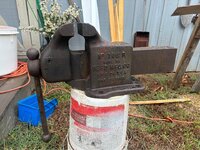
Hey, Ant! Yes. That is a Sargent, and an older model at that. At least as late as the mid 1870s, Sargent was using the #1, #2, #4, etc. numbering scheme for their oval slide vises that I referred to @bliorg above before they switched to #60, #61, #62, etc. the 1920s (at the latest). Here is a snippet of an 1874 Sargent catalog. Yours appears to still have most of the original japanning intact as well!I have an identical vise to this (with the collar 11.22.44) but it has the number 1 on the side.
I wonder if that would make it a Sargent aswell?

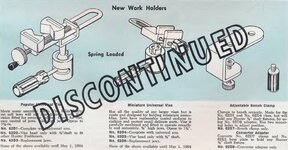
I think I have it's brother. Panavise wide grip competitor? Marked DVxxx Products, Lawndale CAPANAVISE #366DISCONTINUED items one of which was a positioner with a slot-and-handle adjuster. On the other side of the page was the Adjustable Bench Clamp.
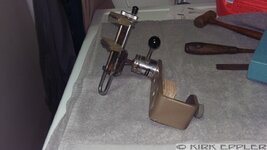
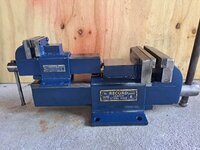
hadn't seen those from Record before.record leader steel vices

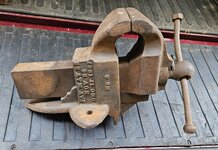
I found a Parker No. 4 today...
I don't think the handle is original... and I know the screw retaining plate isn't original... I'll see if I can machine replacements for both.
Is there anyone out there that might know how long the handle should be?
Otherwise, it is pretty tight with very little play in the slide or screw.
-Bear
Nice early find! I have a No.3, - 4-3/4" jaws, so likely similar age. The newest catalog I'm aware of is 1897 your No. 4 should be 5-3/8 wide jaws?
Both have the same 3 patent dates so based on a 17 year span from the earliest in 1854, should be no newer than 1871?
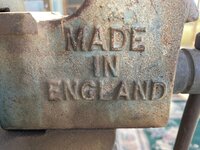
Sorry for the delay, but in England it's vice, not vise - Paramo is a WW2 brand - https://calumgillies.com/portfolio/restoring-a-1940s-paramo-vice/comment-page-1/Good question. I couldn't find anything searching the web. Maybe the model is in a catalog image file that isn't text searchable- I didn't check for those.
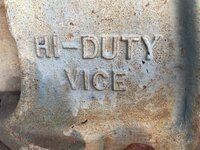
but surely, vise/vice is spelled/spelt viceAnother estate sale find, a Paramo No. 6. It was still bolted to the workbench in the garage, and I asked one of the gals working the sale if it was for sale. She said she would have to go ask. She came back and apologetically said "Well, we would have to get at least $20 for it."
Well, OK then...
Note the English spelling of vice.
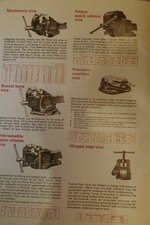

trying to attach other page but won't uploadbut surely, vise/vice is spelled/spelt vice
back to Paramo (Parramore and Sons (1924) Ltd of Chapeltown) - toolmaker who got into vise-making about 1940 --- as with several other English vise-makers the main designs were very much based on those of J Parkinson of Shipley -eg your No6 is v like the 'improved' version of the Parkinsons' Handy (G-series, sizes 2in to 8in) started in about 1870. If anything, I'd say that the Paramo quality just had the edge over Record, Woden, Parkinson and the others.
Paramo catalogues/catalogs are not common, but I came across this 1971 cata and the real big (yes big) surprise is their version of the 'double power all-steel vice' first (1950s?) made by George Blair of Team Valley in 4in and 6in versions (no swivel, no quick release) - so the Paramo big boy has 12in wide jaws and comes in at over 400lbs with base --- remembering that steel vises were usually half the weight of cast iron equivalent. also the price is around 15x that of your 6in hi-duty bench vise.
yup -- I guess they made some, but I doubt many -- I've never seen or heard of the 12in outside this listing -- Blair, who made the first version were big into supplying castings and finished parts for heavy armament, mining and ship-building works so I would guess that would be the market. I have a 6in version, by the second maker before Paramo and it's a solid piece. Paramo's foundry was high quality but Blair had a foundry handling many irons and steels, including spheroidal, Niresist, CoMoCr, maraging, etc - so maybe they continued to be the foundry for this type?How about that Paramo DP12. 12” jaws opens to 15” and weights 270 lbs. thrust bearings for tightening. Love to se one of these Vice’s.