Yesterday I made another reproduction data plate for my 1954 Dodge M37. The original plate showing transmission, transfer case, and road speed information was barely readable. The original is an etched brass plate with slightly raised letters and a chemically blackened background, and I wanted to make the replacement in the same way.
Here's the old ORIGINAL plate after scanning it and making several image adjustments in Photoshop, which enhanced the detail enough to use it as a model for making a replacement.
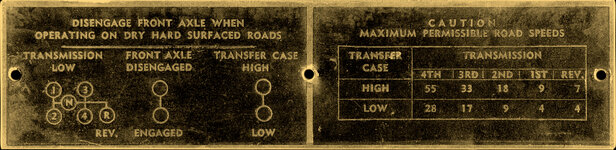
I placed the above image into Adobe InDesign and scaled it to actual size, and then re-drew the plate from scratch. I made two versions; one is a pretty accurate rendition of the original, and the other has 'improved' spacing and alignment of the contents. I did the latter just for fun. I'm actually planning to use the more accurate version on my vehicle to be more faithful to the original.

I then printed reversed positive films of the design. They are reversed in order to place the ink side of the film directly against the photoresist film to produce sharper edges on the photoresist image.

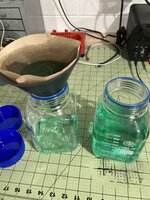
Then I applied photoresist film to a couple of sheets of .025" brass, exposed the photoresist through the above positive films, developed the photoresist to remove the unexposed portions, immersed the brass sheets in a special etching solution, blackened the background with Brass Black from Birchwood Casey, and removed the remaining photoresist with acetone. I also applied a thin clear satin acrylic coating, which deepened the black.
Here are both versions:
View attachment 2192610
The one shown below is the one I'll be using, which is most similar to the original.

The process is a bit tedious, but kind of fun. The hardest part (for me) is applying the photoresist film to the metal without getting any bubbles in it, but after doing a few data plates I'm getting better at it.