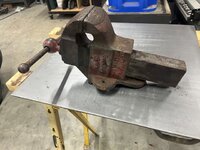
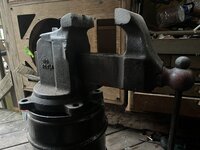
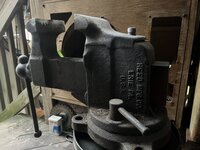
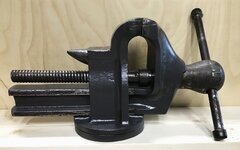
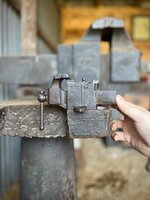
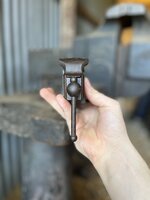
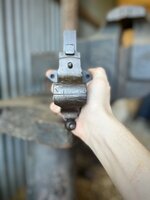
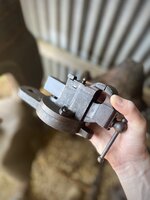
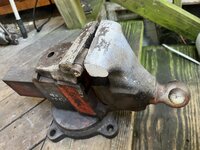
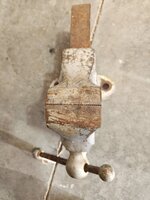
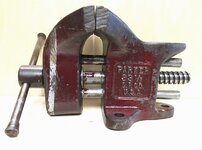
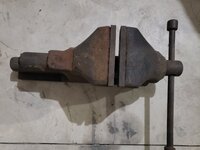
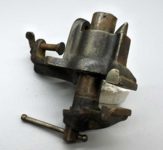
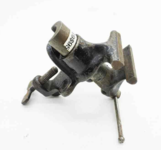
This is a 2” Prentiss jeweler’s vise that bears a second look. While not in pristine condition, it’s nonetheless rare, and I always jump at the opportunity to be illuminated about the various manufacturing changes that Prentiss implemented. To that end, a few notes…
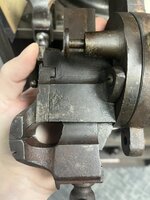
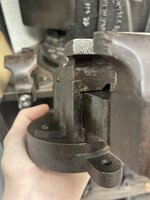
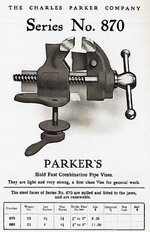
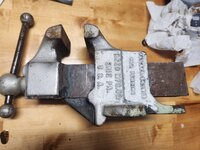
1) On Prentiss vises specifically (and many other brands as well), you’ll notice a STAIR-STEPPING on either side of the static jaw…the front step standing proud of the back step (ex. it’s often on the front step that Prentiss and other manufacturers cast their name). Prior to their last design change in the 1940s, the only vises in Prentiss’ main line that did NOT have this stair-stepping were 2” jewelers and 1¾” watchmakers vises. Instead, you’ll notice that 99.9% of these smaller Prentiss vises have a FLAT horizon on either side. However, this was NOT how the 2” jewelers vises were first advertised. In their 1882 catalog (see pictures), Prentiss depicts both the stationary and swivel base 2” jewelers vises WITH the stair-stepping. Given the rarity of 2” Prentiss vises with this feature, I can only assume that the company switched to the flat sides early on even though they continued to use the same depiction in their catalogues until 1917. This puzzles me, however. It would seem that the thicker walls of the front step provide a desirable increase in strength, especially given how incredibly thin the walls already are after machining out the slot for the swivel jaw. A mystery to ponder.
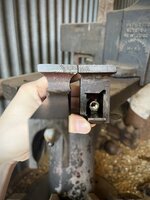
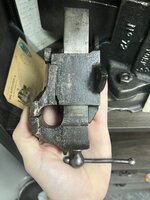
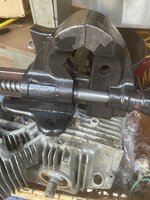
2) Not only is the spindle nut BRONZE (a feature that I’ve seldom seen on other Prentiss vises and one that I’ve never seen advertised by Prentiss), but it’s also “TRAPPED” inside the casting of the vise. As you can see from the pictures, the nut isn’t secured by the traditional pin jutting up against its rear through the base, but instead it’s surrounded on all sides by the casting itself. Once again, this is design choice (and a very early one, I believe) that I’ve never seen referenced in Prentiss advertisements. It makes complete sense that Prentiss would’ve left this design in the dust given the probability of users needing to eventually replace a broken or worn out nut and to do so with ease. A trapped nut design like this would’ve prevented a simple replacement.
3) Incredibly, the jaws are DUAL-USE, and they appear to be so from the factory. One side of each jaw has been crosshatched, and the other side is smooth. The jaws themselves are flush and true, so the dual-purpose nature doesn’t appear to be an aftermarket adaptation. Given that these vises could be ordered with either rough-cut or smooth jaws (per Prentiss’ 1882 catalog), I believe that these jaws were a special order.
4) I only know of two other 2” Prentiss vises in this style - One is a swivel base version with no markings, and the other is a broken stationary version with the “Prentiss Vise Co - NY” stamp. This vise has not even the faintest hint of a stamp anywhere, and taking into account the early design features of the vise as well as the rarely-seen ball-topped swivel jaw pin, I tend to believe that this is a very, very early Prentiss vise. And to top it all off, the holes in the feet happen to fit my one-of-a-kind, factory-original Prentiss swivel base PERFECTLY!