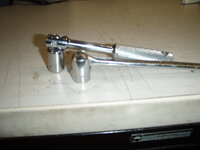
To each their own. A socket (deep or shallow, 8 pt of 16 pt with or without extensions to tune depth, strength and angular acceptance) on a breaker bars have very little slop in my set AND I have no issues with the socket on the end of the breaker bars drooping etc. I cannot speak to everyone and their sets, but that is my personal experience. Also, using a socket at the end of a compact roto-style ratchet (I use 3/8 anvil in 1/4 bodies so the head is very compact and still strong enough) also allows me all angles of incline AND the use of ratchets as well as flipping up to spin off. I am not going to break a high quality ratchet with hand force on a handle without a pipe (and I generally do not use pipes on wrenches). I have never broken a ratchet since I have enough to choose the right size for the job and need and I do not use pipes.
Color me skeptical on the overall utility and need. But there are always more than one way to do things. If it works well with your preferences, of course go for it. I just see the approach as lacking flexibility relative to what I am doing with what I have at present.
A footnote on this is the curious case of French mechanics being partial to L shaped pipe wrenches. I don't see this as significantly beneficial either since they would be even less flexible than a saltus-style wrench to fit in. But these would have the advantage of being as rigid as can be if one is phobic about slop. Those seem to be popular in France but, to my knowledge, seem to be rare in the USA (or at least I never saw them in stores and sales pages). Frenchmen are a little weird though ... like you might expect from any culture where they regard snails as good food.