
You are using an out of date browser. It may not display this or other websites correctly.
You should upgrade or use an alternative browser.
You should upgrade or use an alternative browser.
Unusual Vandoren Hammer.
- Thread starter Eilif
- Start date


RTM
Well-known member
Looks like around 1912

1911

1914

Trademarks in 1913
 ,
,
Ad here for a hammer

Magazine article on their hammer.

Hardware Dealers' Magazine
books.google.com
1911
Mill Supplies
books.google.com
1914
The National Builder
books.google.com
Trademarks in 1913
Annual Report
books.google.com
Ad here for a hammer
Popular Mechanics
Popular Mechanics inspires, instructs and influences readers to help them master the modern world. Whether it’s practical DIY home-improvement tips, gadgets and digital technology, information on the newest cars or the latest breakthroughs in science -- PM is the ultimate guide to our high-tech...
books.google.com
Magazine article on their hammer.
Wood Craft
books.google.com
@RTM Thanks for that!
I didn't realize it was two words. Lots more info popping up now.
1912 makes this one of my oldest tools. I got this in a random batch of hardware from my neighbor. She was a window in her 90s and her husband had been an antique dealer. Also got a drawer organizer with allot of antique furniture pulls and such.
I didn't realize it was two words. Lots more info popping up now.
1912 makes this one of my oldest tools. I got this in a random batch of hardware from my neighbor. She was a window in her 90s and her husband had been an antique dealer. Also got a drawer organizer with allot of antique furniture pulls and such.
Last edited:
four.cycle
Well-known member
Van Doren / Van Doren Mfg. Co., 56-58 W. Van Buren St., Chicago Heights, IL / est. 1906 inc. Sep 1906 acquired 1915 by American Axe & Tool / patent Feb 25 1913 / https://www.exploringaxehistory.com/post/the-van-doren-origin-of-kelly-vanadium-hatchets /
Van Doren was one of the first companies to use Vanadium in their alloy steel hammer heads.
The company first started making fishing poles before they made hammers. The hammer operation was sold to American Axe.
@RTM - I can't find the patent number on this one. Other specimens online are clearly stamped with patent date of Feb 25 1913, but I'm just not finding it.
Van Doren was one of the first companies to use Vanadium in their alloy steel hammer heads.
The company first started making fishing poles before they made hammers. The hammer operation was sold to American Axe.
@RTM - I can't find the patent number on this one. Other specimens online are clearly stamped with patent date of Feb 25 1913, but I'm just not finding it.
Thanks!Van Doren / Van Doren Mfg. Co., 56-58 W. Van Buren St., Chicago Heights, IL / est. 1906 inc. Sep 1906 acquired 1915 by American Axe & Tool / patent Feb 25 1913 / https://www.exploringaxehistory.com/post/the-van-doren-origin-of-kelly-vanadium-hatchets /
Van Doren was one of the first companies to use Vanadium in their alloy steel hammer heads.
The company first started making fishing poles before they made hammers. The hammer operation was sold to American Axe.
Any idea as to why the claw bends down so much? Was that common in older hammers.
RTM
Well-known member
searching USPTO for that date, and hammer, claw, or nail is not bringing up anything. trying it as application date is blanking. Going ahead to 1919 is also blanking .@RTM - I can't find the patent number on this one. Other specimens online are clearly stamped with patent date of Feb 25 1913, but I'm just not finding it.
Van doren fails as inventor, applicant, or assignee.
There was a hammer design patent that date, but doesn't seem appropriate.
OK, manually poking thru the design patents found these two (****, only 20 different from above, Not in DATAMP)
Design for a hammer by H. B. WILSON & H. O. GEPHART. HAMMER.
&
Well, heck, that's more excitement than I can stand in one Sunday night, I'm going to bed. Brute force searching through 1558 patent from that day in history. None of the design patents have their text available.

****, just realized if I had used this search, would have limited it to 18 items. Gotta frickin' remember all the tricks for USPTO searching

@Eilif , which of those two link images belongs to your hammer
Ed in Virginia
Well-known member
It makes it easier to pull nails back out in my opinion. I use a 22 oz. California framer that has a fairly straight head and it does not pull nails anywhere near as easily as my 16 oz. framer with a curved head like yours above.Thanks!
Any idea as to why the claw bends down so much? Was that common in older hammers.
Thanks for the research..
****, just realized if I had used this search, would have limited it to 18 items. Gotta frickin' remember all the tricks for USPTO searching
@Eilif , which of those two link images belongs to your hammer
Both of the pics above your question are just appearing as screen shots of a web page with no photographs visible.
Thanks!It makes it easier to pull nails back out in my opinion. I use a 22 oz. California framer that has a fairly straight head and it does not pull nails anywhere near as easily as my 16 oz. framer with a curved head like yours above.
This thread is making me glad I pulled this out of the "Don't need it, off to the resale shop" box.
Is there any reason not to use it? eBay doesn't seen to think it's particularly valuable. Might clean a bit of the rust away.
four.cycle
Well-known member
from "Exploring Axe History":
"The Van Doren Manufacturing Company was incorporated in early September of 1906 by William Van Doren Wright, Frank L. Borwell, and Theo A. Shaw, Jr. with $50,000 capital."
I ran multiple fruitless searches looking for "Wright", "Borwell", and "Shaw".
I am finding no connecting links between Wright, Borwell, or Shaw to Henry Olney Gephart (1859-1938), of Chicago Heights, or to Harry Bertram Wilson, of Chicago Heights. Nor am I able to find anything connecting witnesses Edward Thorpe, J.L. McAuliffe, Fred Landsea, or E.H. Lickmann to the aforementioned parties, but all of them appear to have been in the Chicago area when the patent was issued.
Both D43659 and D43660 are design patents for a "new, original, and ornamental design for a hammer", neither of which are exact matches to the OP's specimen (but that of course is certainly nothing out of the ordinary.)
It looks like it could be one of those two, but there's a whole bunch of gray area there.
Who's the hammer steward?
"The Van Doren Manufacturing Company was incorporated in early September of 1906 by William Van Doren Wright, Frank L. Borwell, and Theo A. Shaw, Jr. with $50,000 capital."
I ran multiple fruitless searches looking for "Wright", "Borwell", and "Shaw".
I am finding no connecting links between Wright, Borwell, or Shaw to Henry Olney Gephart (1859-1938), of Chicago Heights, or to Harry Bertram Wilson, of Chicago Heights. Nor am I able to find anything connecting witnesses Edward Thorpe, J.L. McAuliffe, Fred Landsea, or E.H. Lickmann to the aforementioned parties, but all of them appear to have been in the Chicago area when the patent was issued.
Both D43659 and D43660 are design patents for a "new, original, and ornamental design for a hammer", neither of which are exact matches to the OP's specimen (but that of course is certainly nothing out of the ordinary.)
It looks like it could be one of those two, but there's a whole bunch of gray area there.
Who's the hammer steward?
Last edited:
four.cycle
Well-known member
Private Lugnutz
Well-known member
Yes. Look through the catalogs of any prominent mfgr (e.g., Atha, Heller, etc) in that era and you will find a variety of hammers with various faces, polls, necks, and claws, including curved, regular (slight curve) and straight (or, often, "ripping").Any idea as to why the claw bends down so much? Was that common in older hammers.
Van Doren trademarked (90,938) "INT-OCEAN" on April 1, 1913. First use October 28, 1911. Van Doren also trademarked (90,937) "VANDOR" on April 1, 1913, claiming first use February 27, 1911. Both TM applications made a point of calling out commerce with Great Britain, New Zealand, and Australia, explicitly, which may help explain the rather odd term (i.e., overseas).The other side had this.
Do you have an example of the marking? Is the date accompanied by a PAT or PAT OFF marking? Could it have been in reference to a TM instead? Remember, it is the US Patent and Trademark Office, and we have seen several of these cases, where the marking is not referring to a patent or patent date, but a TM. They had a lot of TM activity at that time. See above. The reason I ask is, what is patentable about that claw hammer? I'm no framing hammer expert, but it seems unlikely. Looks like a fairly ordinary flat poll, flat neck, flat face hammer, probably with an ordinary adze eye. Composition (i.e., use of vanadium alloy) is not patentable as far as I know. Unless the marking you saw was on a different hammer.Other specimens online are clearly stamped with patent date of Feb 25 1913,
four.cycle
Well-known member
ahhhh! lemme dig some more.
I didn't lift the photo images... there are three or four other specimens on the web..
I didn't lift the photo images... there are three or four other specimens on the web..
Private Lugnutz
Well-known member
I found one. Marking is "PATD FEB.25.1913" under the Van Doren branding.there are three or four other specimens on the web..
RTM
Well-known member
And being ever the skeptic, I wonder if that is a wrong date stamp, again. I was too lazy to go to a high resolution screen to see if everyone was misreading,but I’m giving you two the benefit of skill.I found one. Marking is "PATD FEB.25.1913" under the Van Doren branding.
Private Lugnutz
Well-known member
No. It's correct. It refers to the D63459 patent assigned to Harry Bertram Wilson. It was not assigned to Van Doren, but he was listed as the secretary of the company when they applied for the "VANDOR" and "INT-OCEAN" TM's. It's a Design (ornamental) patent, so I suppose the novelty refers to the shape of the poll and neck. I've seen plenty of hammers that "look" like that, but who knows, maybe it was the first, or not. As you know, there was far less rigorous scrutiny on the Design patents than Utility patents.

four.cycle
Well-known member
RE: Feb 25 1913 patent date (D43659, 43660):
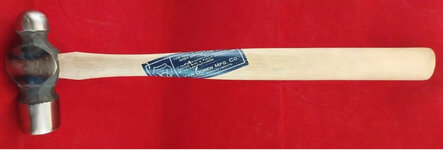
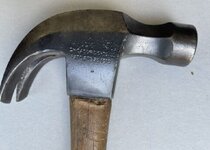
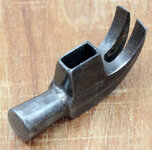
The patent date is clearly stamped on more than one specimen. The head designs on different example of their claw hammer vary, but at least one resembles one of the two patent drawings. (D43659, D43660) The eye is somewhat unique. They also apparently made ball pein hammers.
I'd posit that Lugs has found the connection between Harry Bertram Wilson (inventor) and the Van Doren company (manufacturer), and other examples show design features found in both of the patent drawings, so I think it would be reasonable to conclude those are the correct and applicable patents here.
The patent date is clearly stamped on more than one specimen. The head designs on different example of their claw hammer vary, but at least one resembles one of the two patent drawings. (D43659, D43660) The eye is somewhat unique. They also apparently made ball pein hammers.
I'd posit that Lugs has found the connection between Harry Bertram Wilson (inventor) and the Van Doren company (manufacturer), and other examples show design features found in both of the patent drawings, so I think it would be reasonable to conclude those are the correct and applicable patents here.
Attachments
-
 Van Doren ball pein hammer 02.jpg221.7 KB · Views: 5
 -
 Van Doren ball pein hammer 01.jpg143.9 KB · Views: 6
 -
 Van Doren hammer D 01.jpg120.2 KB · Views: 7
 -
 Van Doren hammer C 03.jpg214.5 KB · Views: 5
 -
 Van Doren hammer C 02.jpg191.8 KB · Views: 6
 -
 Van Doren hammer B 04.jpg213 KB · Views: 7
 -
 Van Doren hammer A 01.jpg136.4 KB · Views: 6
four.cycle
Well-known member
Van Doren / Van Doren Mfg. Co., 56-58 W. Van Buren St., Chicago Heights, IL / est. 1906 inc. Sep 1906 acquired 1915 by American Axe & Tool / patent D43659 Feb 25 1913 & D43660 Feb 25 1913 Henry Bertram Wilson and Henry Olney Gephart / TM 90937 Apr 1 1913 first use Feb 22 1911 & TM 90938 Apr 1 1913 first use Oct 28 1911 / https://www.exploringaxehistory.com/post/the-van-doren-origin-of-kelly-vanadium-hatchets / https://www.garagejournal.com/forum/threads/unusual-vandoren-hammer.540417/ /
updated list uploaded 11/26/24
updated list uploaded 11/26/24
Attachments


Last edited:
Just wanted to express my thanks and how impressed I am by the information you folks dug up. Looks like I've got a little bit of history here.
Doesn't seem to be particularly valuable, so I think I'll keep it for now. I think that the only other finishing hammer I have is a little cheapie in the little kit I keep in the house.
Doesn't seem to be particularly valuable, so I think I'll keep it for now. I think that the only other finishing hammer I have is a little cheapie in the little kit I keep in the house.
four.cycle
Well-known member
^ In the context of monetary value, "value" is determined by what a prospective buyer is willing to pay at point of sale.
Intrinsic value is a completely different can of worms, and involves a number of factors, one of them being rarity.
There are not a lot of those out there, obviously, or we would see them more commonly (and it might have already been on datamp.org or some other "tool" website.)
I would posit that the oddball eye might have been the cause of more than a few going into scrap metal bins (as opposed to having been re-handled) simply because it would be simpler to "just buy a new one" (as opposed to customizing a stock handle to fit.)
Also factor in they were producing them for less than a decade, and that decade ended over a century ago.
You found a rather uncommon artifact there.
Intrinsic value is a completely different can of worms, and involves a number of factors, one of them being rarity.
There are not a lot of those out there, obviously, or we would see them more commonly (and it might have already been on datamp.org or some other "tool" website.)
I would posit that the oddball eye might have been the cause of more than a few going into scrap metal bins (as opposed to having been re-handled) simply because it would be simpler to "just buy a new one" (as opposed to customizing a stock handle to fit.)
Also factor in they were producing them for less than a decade, and that decade ended over a century ago.
You found a rather uncommon artifact there.
Last edited:
Thanks,^ In the context of monetary value, "value" is determined by what a prospective buyer is willing to pay at point of sale.
Intrinsic value is a completely different can of worms, and involves a number of factors, one of them being rarity.
There are not a lot of those out there, obviously, or we would see them more commonly (and it might have already been on datamp.org or some other "tool" website.)
I would posit that the oddball eye might have been the cause of more than a few going into scrap metal bins (as opposed to having been re-handled) simply because it would be simpler to "just buy a new one" (as opposed to customizing a stock handle to fit.)
Also factor in they were producing them for less than a decade, and that decade ended over a century ago.
You found a rather uncommon artifact there.
That's roughly my thought as well. It's a cool bit of history. As it was formerly owned by an antiques dealer I wonder if he held onto it because her thought similarly.
I'm not a collector and I'm trying to avoid having multiples of tools I don't need. I'm just a guy who likes using vintage and USA-made tools for my occasional home and hobby tasks.
If it turned out to have an obvious monetary value or was desirable to collectors I'd probably put it up for sale both as a way to get some $ and to go some small way towards putting it in the hands of someone with a mind toward preserving a bit of history. Neither seems to particularly be the case now so I'll just keep it around and if it at some point seems to be worth selling I'll part with it.
In the meantime I've got an interesting hammer on the rack.
Last edited: