To avoid these ads, REGISTER NOW!

Entryway Flooring

paulsomlo

Well-known member
Joined
Jul 16, 2013
Messages
3,903
Location
Northern Colorado
Just inside my front door, I've got a 50 sf area to cover. It's currently cement with 1/4" thick cork tiles adhered to it. The main issue is that the glue holding down the cork tiles tested at 10% asbestos, so I'd rather not tear them up. On top of the cork, was vinyl tile - some of the adhesive still exists and there are areas where the cork is torn up or loosely adhered. My plan is to cover the cork with 1/4" plywood underlayment, screwing it down with Tapcons. First choice would be construction adhesive, but there are areas where the remaining adhesive from the vinyl tiles feels pretty slick, so not sure if construction adhesive would bond to it. On top of the underlayment will be rubber tile, 1/8" thick. I'll be adding 3/8" thickness, and I'd rather not increase the thickness anymore, as I've got a threshold to deal with, thus the thin underlayment.

One concern is that the Tapcons are going leave a bulge where I sink them and that'll telegraph through my rubber tile. I suppose I could run a countersink in the plywood after the masonry bit for the Tapcon, but I'd rather not. Or just sand down any bulges. At any rate, I imagine that all the fastener heads will need filler to keep from telegraphing.

Does this sound like a sane approach? Are some of my worries unfounded? Is there a better way to do this that I'm not seeing? I'll attach a picture of what I've got to work with.
 

Attachments

  • 20241120_113904.jpg
    20241120_113904.jpg
    366.7 KB · Views: 27
To avoid these ads, REGISTER NOW!

BillK

Well-known member
Joined
Aug 24, 2006
Messages
9,349
Location
Beautiful Southern Maryland
Personally I would take the cork tiles up. I think you are going to have nothing but problems leaving them. 50 sq ft is not that big an area. It sounds like you are allowed to remove it and dispose of it yourself and it is probably considered "non friable" asbestos so it might not be that big of a deal.


Even if you did have to pay to get rid of it I think it would be worth it just to make the whole job a lot easier.
 
OP
P

paulsomlo

Well-known member
Joined
Jul 16, 2013
Messages
3,903
Location
Northern Colorado
Personally I would take the cork tiles up. I think you are going to have nothing but problems leaving them. 50 sq ft is not that big an area. It sounds like you are allowed to remove it and dispose of it yourself and it is probably considered "non friable" asbestos so it might not be that big of a deal.


Even if you did have to pay to get rid of it I think it would be worth it just to make the whole job a lot easier.
Thank you, Bill - that's a website that I'm familiar with; living in a house that was built in 1958, seems every darn building material they used contains asbestos. Some of the tiles are really stuck down, so other than asbestos considerations, I think it would be difficult to remove them. And even then, I'm not sure what shape the remaining surface would be in. I did notice that isopropyl alcohol softens the adhesive, but getting it under the tile is the problem.
 

The Cobbler

Super Moderator
Staff member
Joined
Oct 24, 2013
Messages
25,949
Location
Niagara Region, Ontario, Canada
Yeah, I would get that up. I am certified for level 1 asbestos removal and that falls under that category.
Don't use machine to rip it up,use manual tools/scrapers etc.
It is non friable & considered low risk .I bet the tile has some asbestos in it as well .
 
OP
P

paulsomlo

Well-known member
Joined
Jul 16, 2013
Messages
3,903
Location
Northern Colorado
Yeah, I would get that up. I am certified for level 1 asbestos removal and that falls under that category.
Don't use machine to rip it up,use manual tools/scrapers etc.
It is non friable & considered low risk .I bet the tile has some asbestos in it as well .
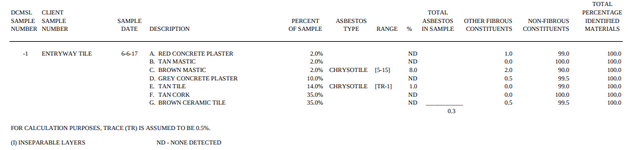
The cork itself didn't contain any asbestos, but the vinyl tile adhered to it did. I'll attach the report - there were several layers; on top was ceramic tile, then mortar (and grout), then vinyl tile, then mastic, then cork tile, then more mastic.

No matter what I do, I'll still need underlayment, as I need a clean surface to adhere the new rubber tiles to.Screenshot from 2024-11-21 10-43-08.png
 

Shiftless

Well-known member
Joined
Mar 9, 2014
Messages
14,555
Location
East Bay SFO
we us to use a product from Mapei . I forget the name but it was a cementitious floor patch . skim over the glue left behind then apply the new adhesive to that .
Excellent advice. Forget tapcons…go with glue.
And no machines to remove the mess. Just use scrapers, chisels, whatever and skim over the remaining to get it leveled out.
 

The Cobbler

Super Moderator
Staff member
Joined
Oct 24, 2013
Messages
25,949
Location
Niagara Region, Ontario, Canada
Fast-setting, cement-based, polymer-modified patching compound. For smoothing, patching and filling cracks, holes, voids, and depressions in concrete and approved wood underlayments prior to the installation of floor coverings. Floor coverings can be installed just 1 hour after application. Mix with PLANI/PATCH PLUS to use as an embossing leveller over properly prepared vinyl sheet goods, vinyl composition tile, cement terrazzo and residual cutback adhesive surfaces.
  • Smoothes, patches and fills cracks, holes, voids and depressions up to 1/2 In
  • For use over approved plywood and concrete
  • Fast-setting, install floor covering 1 hour after application
  • For interior use only
1732214951768.png
 
To avoid these ads, REGISTER NOW!

budget76

Well-known member
Joined
Jan 19, 2016
Messages
502
i definitely wouldn't stick a fan in the door, throw on a respirator, and chisel up that floor in an hour or two then throw everything in black trash bags. nope. wouldn't do that. definitely not...
 

duneslider

Well-known member
Joined
Jan 20, 2013
Messages
2,267
Location
Riverton, Utah
Just saying but its pretty uncommon for the asbestos in adhesive to be friable. It is usually well stuck in the glue/adhesive, and will never be airborne.

I personally would remove that cork underlayment. Unless that adhesive that has asbestos in it is crumbly and turns into a powder it will not become airborne and breathable. I'd remove all that **** and do it right. Anything you put over the cork is only going to be as good as the cork, it will just lead to problems down the road.
 

duneslider

Well-known member
Joined
Jan 20, 2013
Messages
2,267
Location
Riverton, Utah
unless drilling,grinding etc, using a machine to lift it, that sort of stuff.
From the training I have received on asbestos, the stuff in the glue is generally not a concern with it becoming airborne unless the glue has become completely dry/friable. This was pretty uncommon with a lot of the types of glues used BUT there were some waterbased glues that contained asbestos that are more likely to become dry and crumbly. I would avoid drilling and grinding though but wouldn't stress too much about scraping and vacuuming.
 
OP
P

paulsomlo

Well-known member
Joined
Jul 16, 2013
Messages
3,903
Location
Northern Colorado
There may be some drilling; if I'm going to use the underlayment that I've purchased, I may be attaching it with Tapcons. Unless I'm confident that adhesive will hold the underlayment down. I'd be drilling down through a quarter inch layer of underlayment.
 
To avoid these ads, REGISTER NOW!
Top Bottom