looking good


You are using an out of date browser. It may not display this or other websites correctly.
You should upgrade or use an alternative browser.
You should upgrade or use an alternative browser.
Champion 80 gallon Restomod has begun
- Thread starter Hohn
- Start date
walta
Well-known member
Now is the perfect time to hydro test the tank.
Plug all but one hole to fill and another with a 300-pound gage.
Take the tank outdoors.
Fill it with water.
Connect a pressure washer and pump it up to 300 PSI and check for leaks.
Walta
Plug all but one hole to fill and another with a 300-pound gage.
Take the tank outdoors.
Fill it with water.
Connect a pressure washer and pump it up to 300 PSI and check for leaks.
Walta
Do you have power to run a 7.5 HP motor? If you are on residential power the utility might frown running that large of motor. it is a bunch of inrush amps.
I know the OP has decided to go with the VFD, but figured I'd comment on this. I have a Quincy QT-7.5 (a "real" 7.5 HP, 30A); when I bought it, Quincy had some sort of disclaimer saying "check with your local utility first..." Of course, I ignored that
 - partly because I'm close to commercial businesses like auto repair and trucking. I have 250A service, so plenty coming in. But yes, it pulls over 100A for a fraction of a second when it starts up. It does run on a 50A breaker, and it has never tripped it over 20+ years. I know I should have a 60A; the only reason I tried the 50 was because I already had it- so I figured I'd give it a try
Oh, and it doesn't have an unloader so they're certainly not on every belt driven compressor. While this isn't the "best" compressor, it's not exactly a budget unit at over $3k currently. Yes, it's a splash lube compressor.
I didn't know about a VFD only being half it's rating. Seems like utter false advertising!
I bought a 15hp vfd for my 15hp Champion compressor.
Guess I'll either put a 5hp pump/motor combo on it (have same as the little pump on the compressor in this topic) or just **** can the whole plan and do something else I guess.
Figured the big compressor would be handy for sandblasting.
Current compressor is a 60 gallon, bargain basement Homes Depot unit. Only does like 9 cfm.
I bought a 15hp vfd for my 15hp Champion compressor.
Guess I'll either put a 5hp pump/motor combo on it (have same as the little pump on the compressor in this topic) or just **** can the whole plan and do something else I guess.
Figured the big compressor would be handy for sandblasting.
Current compressor is a 60 gallon, bargain basement Homes Depot unit. Only does like 9 cfm.
Last edited:
Half rating when connecting 1 PH to a 3 PH motor. 3 PH to 3Ph has no reduced rating.I didn't know about a VFD only being half it's rating. Seems like utter false advertising!
Yeah the VFD I got is 1ph to 3ph "20hp"Half rating when connecting 1 PH to a 3 PH motor. 3 PH to 3Ph has no reduced rating.
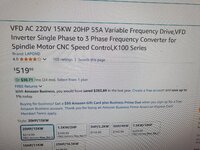
Well, some have a 1 PH to 3PH rating at 100%, but if you look at the rating it will do two times the HP on 3 PH in.Yeah the VFD I got is 1ph to 3ph "15hp"
Manufacturers play with numbers!
Wish I'd known that when I was researching on what was needed.Well, some have a 1 PH to 3PH rating at 100%, but if you look at the rating it will do two times the HP on 3 PH in.
Manufacturers play with numbers!
The 5hp setup i guess will work, just will be alot if work to plumb.
May just scrap it all and buy a regular 5hp single phase compressor and be done.
larry4406
Well-known member
Slightly off topic, but 7.5 HP single phase there are comments about startup, massive inrush current, and the grid/utility not being happy.
Can a soft start/hard start (whichever is the right term) be added like is done for AC units so they can start off a generator?
My 7.5 HP single phase Baldor starts fine at my residence on a 240V50A breaker. Quite a “bang” when the starter fires.
Can a soft start/hard start (whichever is the right term) be added like is done for AC units so they can start off a generator?
My 7.5 HP single phase Baldor starts fine at my residence on a 240V50A breaker. Quite a “bang” when the starter fires.
LopezBart
Well-known member
I'm seeing conflicting guidance that says compressors are constant torque loads while others are saying variable torque (like a pump would be). By my lights, the correct answer is somewhere in between. A recip compressor must have *some* sensitivity to outlet pressure in terms of drive torque.
A reciprocating compressor's torque requirement will be vary nearly linearly with output pressure, and be close to constant vs rpm at a fixed pressure. HP is of course torque x rpm (times a constant). With a VFD, as you noted you can get more air output at a lower pressure by spinning the motor faster. Attempts to continuously get more than the rated power out of the motor are a bad idea due to overheating, etc.
Thank you, Bart.A reciprocating compressor's torque requirement will be vary nearly linearly with output pressure, and be close to constant vs rpm at a fixed pressure. HP is of course torque x rpm (times a constant). With a VFD, as you noted you can get more air output at a lower pressure by spinning the motor faster. Attempts to continuously get more than the rated power out of the motor are a bad idea due to overheating, etc.
The SF rating of this motor is 1.15 at 60hz, but I don’t want to tap into that margin intentionally— IMO that is abuse.
I’m a bit conflicted at how much to “push it” with this motor. Experience tells me that industrial products tend to be quite a bit derated for durability. I’m pretty sure that even though the motor as a 14-amp FLA rating (230V), I suspect that the clamp meter will show more like 11a just before it cuts out at 175psi.
I will assume that running the pump and motor drive ratio at the original 5hp/175psig/1725mrpm/710prpm on the VFD will be perfectly safe even with the less capable insulation rating. Because it’s not a cheap motor or compressor and there’s some margin in there.
So initially I was planning to run the VFD at 60hz until it got up to 125psi, at which point the drive would shift it down to 40hz, which is a high enough speed to be above the minimum pump speed (of 400rpm) but is also a lower motor load of about 3hp. The pump would then spin slowly as it topped off from 125psi to 175psi.
While I’m sure that would be a nice and simple but useful arrangement, I’m thinking about how it compares to shifting the motor RPM and pump RPM slightly.
I’m thinking especially of that “constant torque” vs “constant power” side of the characteristic curve. If you want maximum performance, you’d want to have most of your speed range on the “constant power” part. And spinning the motor faster also improves motor cooling.
So what if instead of having the motor soft start to 60hz at low pressure, one instead programmed the VFD to soft start and then crank up the frequency until the motor load got to some amperage, then kick down to a lower frequency at higher pressure?
Thus, instead of having a 60hz/40hz two speed setup, it could be much as 82hz on the bottom, since that’s the maximum rated pump speed of 1050rpm, lowering from that upper limit as the VFD feels necessary to honor a current load limit.
This would be a nice real-world increase in air delivery at lower pressure.
I suspect you may be on to something, if the VFD plays along. I have a similar compressor and would love to be able to tune it that way. (But I'm too cheap and there's no way it would make financial sense. The stone knives and bearskins approach works well enough for the girls I used to go out with.)Thank you, Bart.
The SF rating of this motor is 1.15 at 60hz, but I don’t want to tap into that margin intentionally— IMO that is abuse.
I’m a bit conflicted at how much to “push it” with this motor. Experience tells me that industrial products tend to be quite a bit derated for durability. I’m pretty sure that even though the motor as a 14-amp FLA rating (230V), I suspect that the clamp meter will show more like 11a just before it cuts out at 175psi.
I will assume that running the pump and motor drive ratio at the original 5hp/175psig/1725mrpm/710prpm on the VFD will be perfectly safe even with the less capable insulation rating. Because it’s not a cheap motor or compressor and there’s some margin in there.
So initially I was planning to run the VFD at 60hz until it got up to 125psi, at which point the drive would shift it down to 40hz, which is a high enough speed to be above the minimum pump speed (of 400rpm) but is also a lower motor load of about 3hp. The pump would then spin slowly as it topped off from 125psi to 175psi.
While I’m sure that would be a nice and simple but useful arrangement, I’m thinking about how it compares to shifting the motor RPM and pump RPM slightly.
I’m thinking especially of that “constant torque” vs “constant power” side of the characteristic curve. If you want maximum performance, you’d want to have most of your speed range on the “constant power” part. And spinning the motor faster also improves motor cooling.
So what if instead of having the motor soft start to 60hz at low pressure, one instead programmed the VFD to soft start and then crank up the frequency until the motor load got to some amperage, then kick down to a lower frequency at higher pressure?
Thus, instead of having a 60hz/40hz two speed setup, it could be much as 82hz on the bottom, since that’s the maximum rated pump speed of 1050rpm, lowering from that upper limit as the VFD feels necessary to honor a current load limit.
This would be a nice real-world increase in air delivery at lower pressure.
Slightly off topic, but 7.5 HP single phase there are comments about startup, massive inrush current, and the grid/utility not being happy.
Can a soft start/hard start (whichever is the right term) be added like is done for AC units so they can start off a generator?
My 7.5 HP single phase Baldor starts fine at my residence on a 240V50A breaker. Quite a “bang” when the starter fires.
Good to hear that you also have a 50A breaker.
But, to your question, I don't think so. The nature of the beast. There is a huge inrush of current. The only way to start them on something that can't support the inrush would be to drain the tank so it starts totally unloaded. I notice a huge difference in starting violence when it starts on an empty tank, smooth, like if I went on vacation, vs 125 PSI- violent.
Like you, I have a 7.5 HP baldor and it starts HARD with ~125 PSI when it kicks on. With a bang, like you said. And as I said, it draws 100A+ for a millisecond.
larry4406
Well-known member
Mine has unloaders so I presume that eases the start somewhat.Good to hear that you also have a 50A breaker.
But, to your question, I don't think so. The nature of the beast. There is a huge inrush of current. The only way to start them on something that can't support the inrush would be to drain the tank so it starts totally unloaded. I notice a huge difference in starting violence when it starts on an empty tank, smooth, like if I went on vacation, vs 125 PSI- violent.
Like you, I have a 7.5 HP baldor and it starts HARD with ~125 PSI when it kicks on. With a bang, like you said. And as I said, it draws 100A+ for a millisecond.
If you are near the compressor when it decides to start, it will startle you!
Mine has unloaders so I presume that eases the start somewhat.
If you are near the compressor when it decides to start, it will startle you!
Wait until that day you forget to turn it off and it hits at 3AM
Talk about a heart attack. Oh, my compressor is in the basement, maybe 40' from my bed which is on the main floor. But when it starts up, it sounds like it's next to me. I've only forgotten to turn it off twice. Not sure how many more of those I can survive with my advancing age LOL.
csp
Well-known member
I bought a 15hp vfd for my 15hp Champion compressor.
Guess I'll either put a 5hp pump/motor combo on it (have same as the little pump on the compressor in this topic) or just **** can the whole plan and do something else I guess.
Yeah the VFD I got is 1ph to 3ph "20hp"
Wish I'd known that when I was researching on what was needed.
The 5hp setup i guess will work, just will be alot if work to plumb.
May just scrap it all and buy a regular 5hp single phase compressor and be done.
So did you buy a 15hp VFD or a 20 HP VFD?
Either one is way overkill for a 5hp setup so why not send whatever you bought back and get one sized correctly for 5hp?
Jswain
Well-known member
Nvm
20 for a 15hp. But overkill is ok for a 5. Price wasn't much difference and i wouldn't doubt if 20 hp in Chyna is like 5 real hot.So did you buy a 15hp VFD or a 20 HP VFD?
Either one is way overkill for a 5hp setup so why not send whatever you bought back and get one sized correctly for 5hp?
I bought it 3 i
or 4 months ago, it's past sending back.
The drive belts (dual) on this unit looked a bit tired, so I started looking into replacements. I learned a lot about V-belts along the way.
The 5L belts that were on the unit as received are "fractional hp" drive belts. The correct belts are "B" series. The Champion parts catalog shows a "B65" drive belt, a pair of them. However, the unit arrived with "5L680" belts on it.
At some point then, the belts were replaced with insufficient/incorrect belts that do work and fit, but they aren't as capable as the OEM belts that would have been B65. Perhaps this explains the abundance of "rubber dust" all over the unit that had clung to the oil seepage film to form a thick cake. I wonder if the belts were overloaded slightly and this was causing slippage and excess wear, especially at start/stop.
I didn't understand the difference in belt series until I found this excellent writeup:
https://www.rogerbrownco.com/interchange-fhp-with-classical-v-belts/
I decided to replace the belts with BX65s as the notched belts are compatible with these sheaves and should slightly improve efficiency. And that efficiency must result in lower temperature and/or wear.
The 5L belts that were on the unit as received are "fractional hp" drive belts. The correct belts are "B" series. The Champion parts catalog shows a "B65" drive belt, a pair of them. However, the unit arrived with "5L680" belts on it.
At some point then, the belts were replaced with insufficient/incorrect belts that do work and fit, but they aren't as capable as the OEM belts that would have been B65. Perhaps this explains the abundance of "rubber dust" all over the unit that had clung to the oil seepage film to form a thick cake. I wonder if the belts were overloaded slightly and this was causing slippage and excess wear, especially at start/stop.
I didn't understand the difference in belt series until I found this excellent writeup:
https://www.rogerbrownco.com/interchange-fhp-with-classical-v-belts/
I decided to replace the belts with BX65s as the notched belts are compatible with these sheaves and should slightly improve efficiency. And that efficiency must result in lower temperature and/or wear.
Last edited:

Jswain
Well-known member
Reverse a woodworking bar type clamp(s) if you have one or two and push them apart.
Or tighten the front left bolt(enough to hold it) on the motor in the pic then use some wood blocks & maybe a pry are to leverage it out on a swivel and tighten the rear right.
Bit of an art with only two hands. And it will usually take a couple attempts to get it nice and square and tight.
Or tighten the front left bolt(enough to hold it) on the motor in the pic then use some wood blocks & maybe a pry are to leverage it out on a swivel and tighten the rear right.
Bit of an art with only two hands. And it will usually take a couple attempts to get it nice and square and tight.
That occurred to me after I posted and I got it pretty much as I wanted:Reverse a woodworking bar type clamp(s) if you have one or two and push them apart.
Or tighten the front left bolt(enough to hold it) on the motor in the pic then use some wood blocks & maybe a pry are to leverage it out on a swivel and tighten the rear right.
Bit of an art with only two hands. And it will usually take a couple attempts to get it nice and square and tight.

Last edited:
I want to mention the compressor oil I used. It is a very high-grade synthetic from HP Lubes. It was water-clear going in! Pretty much pure PAO base as far as I can tell or very near it.
They call it “recip-life” consistent with their other product marketing (“differential life” etc).
They call it “recip-life” consistent with their other product marketing (“differential life” etc).
metalmagpie
Well-known member
Here's the trick I used tensioning my Champion:

Mine is an R30A. It's basically two R15s hung off a single crankcase.
I would encourage you to do a bit more to that air pump before you put it back in service. It's very easy to expose the valves on Champion pumps. Air compressor valves often are rusty or sticky or otherwise not quite right. The 15B pump's valves can be individually lapped. If one is too far gone a whole new valve assembly isn't that much money. Anyway, go through your valves for sure. I'm confident you will find it well worth it.
Also, with as much oil as yours had on it, I strongly suspect the seal at the flywheel end of the crankshaft is leaking. Oil leaking there gets blown all over the place by the fan effect of the flywheel. You do have to tear the pump down to where you can replace that seal, but it's well worth it. You can clean the crud off of the top of the pistons while you're in there, and you can make sure the rings in the pistons aren't stuck. None of this is particularly difficult wrenching.
You might consider replacing the air filter element. Yours has probably earned its retirement.
If any of the fins on your intercooler are bent or crushed, just take two small straight screwdrivers and gently straighten them back out. Those are made from pure aluminum which is very malleable. Mine were bad when I got the compressor but after some time straightening them out, they look oh so much better.
Champion parts diagrams are readily available online. There are several reputable vendors who sell parts for Champion pumps. (That's one of the reasons to own a quality US industrial compressor.)
I'm guessing your pistons, rods, wrist pins, rings, crank bearings and centrifugal unloader parts are all still usable. All you should have to buy are valve parts, gaskets and an oil seal. BTW if you do take the crankcase apart to get out the oil seal, don't destroy the seal getting it out. Write down the numbers. Mine was about $40 from the parts vendors but I bought one with the same numbers on ebay for $7.
Come to think of it, I have a spare cylinder gasket or two left over.
metalmagpie
Mine is an R30A. It's basically two R15s hung off a single crankcase.
I would encourage you to do a bit more to that air pump before you put it back in service. It's very easy to expose the valves on Champion pumps. Air compressor valves often are rusty or sticky or otherwise not quite right. The 15B pump's valves can be individually lapped. If one is too far gone a whole new valve assembly isn't that much money. Anyway, go through your valves for sure. I'm confident you will find it well worth it.
Also, with as much oil as yours had on it, I strongly suspect the seal at the flywheel end of the crankshaft is leaking. Oil leaking there gets blown all over the place by the fan effect of the flywheel. You do have to tear the pump down to where you can replace that seal, but it's well worth it. You can clean the crud off of the top of the pistons while you're in there, and you can make sure the rings in the pistons aren't stuck. None of this is particularly difficult wrenching.
You might consider replacing the air filter element. Yours has probably earned its retirement.
If any of the fins on your intercooler are bent or crushed, just take two small straight screwdrivers and gently straighten them back out. Those are made from pure aluminum which is very malleable. Mine were bad when I got the compressor but after some time straightening them out, they look oh so much better.
Champion parts diagrams are readily available online. There are several reputable vendors who sell parts for Champion pumps. (That's one of the reasons to own a quality US industrial compressor.)
I'm guessing your pistons, rods, wrist pins, rings, crank bearings and centrifugal unloader parts are all still usable. All you should have to buy are valve parts, gaskets and an oil seal. BTW if you do take the crankcase apart to get out the oil seal, don't destroy the seal getting it out. Write down the numbers. Mine was about $40 from the parts vendors but I bought one with the same numbers on ebay for $7.
Come to think of it, I have a spare cylinder gasket or two left over.
metalmagpie
Point taken, but I’m not using this thing ******** and a bit of efficiency loss isn’t really consequential for my needs.Here's the trick I used tensioning my Champion:
Mine is an R30A. It's basically two R15s hung off a single crankcase.
I would encourage you to do a bit more to that air pump before you put it back in service. It's very easy to expose the valves on Champion pumps. Air compressor valves often are rusty or sticky or otherwise not quite right. The 15B pump's valves can be individually lapped. If one is too far gone a whole new valve assembly isn't that much money. Anyway, go through your valves for sure. I'm confident you will find it well worth it.
Also, with as much oil as yours had on it, I strongly suspect the seal at the flywheel end of the crankshaft is leaking. Oil leaking there gets blown all over the place by the fan effect of the flywheel. You do have to tear the pump down to where you can replace that seal, but it's well worth it. You can clean the crud off of the top of the pistons while you're in there, and you can make sure the rings in the pistons aren't stuck. None of this is particularly difficult wrenching.
You might consider replacing the air filter element. Yours has probably earned its retirement.
If any of the fins on your intercooler are bent or crushed, just take two small straight screwdrivers and gently straighten them back out. Those are made from pure aluminum which is very malleable. Mine were bad when I got the compressor but after some time straightening them out, they look oh so much better.
Champion parts diagrams are readily available online. There are several reputable vendors who sell parts for Champion pumps. (That's one of the reasons to own a quality US industrial compressor.)
I'm guessing your pistons, rods, wrist pins, rings, crank bearings and centrifugal unloader parts are all still usable. All you should have to buy are valve parts, gaskets and an oil seal. BTW if you do take the crankcase apart to get out the oil seal, don't destroy the seal getting it out. Write down the numbers. Mine was about $40 from the parts vendors but I bought one with the same numbers on ebay for $7.
Come to think of it, I have a spare cylinder gasket or two left over.
metalmagpie
I would agree that the oil residue seemed to come from the crankcase and be blown by the fan, but having spent a lot of time very close to the residue up close and in person, I think it’s as likely that the leak was from the oil level monitor union to the crankcase. The residue was very thick there and it wasn’t even directly in the blast of the fan.
The fins on the intercooled crossover tube between stages were not at all equally fouled with residue. Near the front, the residue was mild. Near the back where it enters the high pressure stage, the residue was so thick you could barely make out fins. Since the residue was so much thicker near where the oil level monitor was, I’m thinking the leak source was the oil level monitor joint at the crankcase (it had a pretty marginal seal setup).
I’d expect a leaky shaft seal to have a residue pretty evenly distributed by fan blast vs strongly biased to the location of the oil monitor.
The spirit of this project isn’t a full restoration per se, but rather getting a good compressor back into service at minimal cost in cleaner condition. It’s not a proper vintage compressor (made in 2002) and it has no value as an antique.
At this point, the chance of needing to do any valve work or such on the pump is much less than the certainty of doing so preemptively. Since it’s the same amount of work either way and i don’t depend on this compressor, I’m willing to risk needing to dive into the pump to rebuild it reactively rather than proactively.
It’s the same reason I decided I’m not pressure testing the tank— the borescope shows it to be in very good condition inside, it’s super cold here and the tank has excellent resonance consistent with having no cracks when tap tested with a hammer.. It’s a huge amount of work to go from 95% confident to 99% confident. Not worth it and I find the risk acceptable for a home gamer compressor that will get maybe a dozen hours a year.
Well, I'm circling back on this, finally getting to focus a bit on getting this old (not that old-- early 2000s) Champion VR5-80 up and running.
The current state of affairs:
- I've cleaned it all off, removed the automatic oil level monitor that was puking oil everywhere. I don't need oil level monitoring when it's in my same room and I can peek at a sight glass. I am on the oil level monitor.
- Replaced the belts with premium cogged belts that should last forever and improve efficiency
- Inspected the tank and it's in superb condition.
- Drained the old pump oil (which was actually in excellent condition) and replaced with premium synthetic pump oil.
- I've reinstalled the discharge line to the tank.
- I've finalized my VFD selection (not yet purchased).
In the interest of simplicity and just getting it up and running, I've elected to forfeit for now any fancy aftercooling setups and instead will adhere to tank draining regularly.
The compressor refurb is part of a broader shop air upgrade. So I'm also running 3/4" black pipe to my primary usage point while protecting for the ability to add future drops quite easily.
The compressor is located in the NE corner of my 3-car garage near the main panel. Black pipe runs south along the east wall, the above the garage door to my primary point of use between the two garage doors (2+1 door config, the +1 being the door over which the piping passes.
I'll have a couple risers with water purge ball valves on the drops at several locations. Between those and the tank, I think I'll have manageable water levels.
WORK TO COME:
-- VFD installation and initial programming. I plan to say at 60hz for now just to get the unit commissioned and functional, then I'll play with adjusting speeds.
-- Finish the air piping.
VFD budget is temporarily on hold, might need to wait a bit longer but it should happen soon.
The current state of affairs:
- I've cleaned it all off, removed the automatic oil level monitor that was puking oil everywhere. I don't need oil level monitoring when it's in my same room and I can peek at a sight glass. I am on the oil level monitor.
- Replaced the belts with premium cogged belts that should last forever and improve efficiency
- Inspected the tank and it's in superb condition.
- Drained the old pump oil (which was actually in excellent condition) and replaced with premium synthetic pump oil.
- I've reinstalled the discharge line to the tank.
- I've finalized my VFD selection (not yet purchased).
In the interest of simplicity and just getting it up and running, I've elected to forfeit for now any fancy aftercooling setups and instead will adhere to tank draining regularly.
The compressor refurb is part of a broader shop air upgrade. So I'm also running 3/4" black pipe to my primary usage point while protecting for the ability to add future drops quite easily.
The compressor is located in the NE corner of my 3-car garage near the main panel. Black pipe runs south along the east wall, the above the garage door to my primary point of use between the two garage doors (2+1 door config, the +1 being the door over which the piping passes.
I'll have a couple risers with water purge ball valves on the drops at several locations. Between those and the tank, I think I'll have manageable water levels.
WORK TO COME:
-- VFD installation and initial programming. I plan to say at 60hz for now just to get the unit commissioned and functional, then I'll play with adjusting speeds.
-- Finish the air piping.
VFD budget is temporarily on hold, might need to wait a bit longer but it should happen soon.
Jswain
Well-known member
Ive used both Vevor & Mollom VFD's for my lathe and 7.5hp compressor. Mollom had a better instruction manual but they both seem well built & were easy enough to program with lots of features.
Since I had some recent experience with a Dwyer Omega PX119 pressure transducer, I had explored the option of using this transducer in lieu of pressure switches/pumptrol type setups.
But ultimately, the PID control and such didn't make much sense, and I still had to have a pressure switch anyway.
A more expensive option perhaps for the future would be combining a pressure transducer along with the switch. This provides the ability to adjust *how* the pump spins up and recovers pressure once it comes on.
But at the end of the day, there's not a huge amount of performance benefit to varying frequency for this application. The soft start/ramp up/down aspect is the primary benefit and a basic Pumptrol on a 40psi cut in/out spread is going to be quite sufficient.
But ultimately, the PID control and such didn't make much sense, and I still had to have a pressure switch anyway.
A more expensive option perhaps for the future would be combining a pressure transducer along with the switch. This provides the ability to adjust *how* the pump spins up and recovers pressure once it comes on.
But at the end of the day, there's not a huge amount of performance benefit to varying frequency for this application. The soft start/ramp up/down aspect is the primary benefit and a basic Pumptrol on a 40psi cut in/out spread is going to be quite sufficient.
Jswain
Well-known member
Biggest gain for me was the soft start. Used to dim the lights in the shop with a 5hp single phase now it doesn't flinch with the 7.5hp 3 phase.Since I had some recent experience with a Dwyer Omega PX119 pressure transducer, I had explored the option of using this transducer in lieu of pressure switches/pumptrol type setups.
But ultimately, the PID control and such didn't make much sense, and I still had to have a pressure switch anyway.
A more expensive option perhaps for the future would be combining a pressure transducer along with the switch. This provides the ability to adjust *how* the pump spins up and recovers pressure once it comes on.
But at the end of the day, there's not a huge amount of performance benefit to varying frequency for this application. The soft start/ramp up/down aspect is the primary benefit and a basic Pumptrol on a 40psi cut in/out spread is going to be quite sufficient.
I run it at 50hz unless I need more air and it still produces more than my 5hp did only much quieter.
I think my experience will be similar, only at a smaller scale.Biggest gain for me was the soft start. Used to dim the lights in the shop with a 5hp single phase now it doesn't flinch with the 7.5hp 3 phase.
I run it at 50hz unless I need more air and it still produces more than my 5hp did only much quieter.
I can probably run mine as more of a 3hp unit. As a home gamer with pretty modest air usage, an 80 gallon tank plus two aux tanks (116 gallons total) will last quite awhile when full pressurized.
By the time I'm at risk of running out of air, the job is done.
What kind of ramp time did you program in? I'm thinking I don't want to be too slow with the centrifugal unloaders. I think I want to spin up in about 3 seconds or so and shut down in 5-8 seconds.
I do like the idea of being able to overspeed somewhat and gain a bit more performance, but the reality check is that even at a steady 60hz this is a massive air upgrade for me and I'm likely never to need that additional performance.
Jswain
Well-known member
I will double check when I am home in a couple weeks but I believe it was 3s accel and for decel I left it as coast to a stop which I believe you will want to do as well if you research VFD/air compressors. Nothing to be gained from using the VFD as a brake. I wanted the fairly quick accel because of the centrifugal unloader on mine as well (Devilbiss 432 pump)I think my experience will be similar, only at a smaller scale.
I can probably run mine as more of a 3hp unit. As a home gamer with pretty modest air usage, an 80 gallon tank plus two aux tanks (116 gallons total) will last quite awhile when full pressurized.
By the time I'm at risk of running out of air, the job is done.
What kind of ramp time did you program in? I'm thinking I don't want to be too slow with the centrifugal unloaders. I think I want to spin up in about 3 seconds or so and shut down in 5-8 seconds.
I do like the idea of being able to overspeed somewhat and gain a bit more performance, but the reality check is that even at a steady 60hz this is a massive air upgrade for me and I'm likely never to need that additional performance.
I have NOT used the air compressor heavily by any means since installing everything just regular duty DIY shop stuff but it has been amazing. Electric motor stays cool as it isnt working very hard and mine has a quite large cooling fan on it.
Todd.Brock
Well-known member
Glad to see you back on the project. Was an interesting read! I have a bad habit of buying 80 gallon compressors. Champion at that. I've now had 4 of them. Some with R-15b with tighter fins and then the R-15A(I think), different fins... I bought and sold trying to get my way to a Saylor Beall. My last Champion developed a crack where the tank foot was welded so it moved along.
I have been eyeballing a Quincy 325 project but single phase 5 hp motors are a $1k or close to it. I debated a VFD set up and have been following along on your project until today- I picked up a 60 gal. Eaton air compressor from FB marketplace. The pump needs reed valves , possibly rings on one cylinder, but the pump is easy to find a decent replacement for. I think i did ok for $250 considering the motor is exactly what I need.
.

I have been eyeballing a Quincy 325 project but single phase 5 hp motors are a $1k or close to it. I debated a VFD set up and have been following along on your project until today- I picked up a 60 gal. Eaton air compressor from FB marketplace. The pump needs reed valves , possibly rings on one cylinder, but the pump is easy to find a decent replacement for. I think i did ok for $250 considering the motor is exactly what I need.
.
Very cool! I got my Champ off FB Marketplace too. It's amazing how many repairable and useful machines are out there that just need a little TLC to have a new lease on life.
I briefly toyed with replacing my motor with single phase and upgrading to 7.5hp since it's the same pump and just a higher pump rpm. But it didn't take long to figure out that 7.5hp on single phase is just a huge hassle in terms of huge breakers, massive wires and reactive power and low power factor and blah blah. And taking all that on to gain another 2.5hp of compressor I probably don't need? Especially when I already have a 2hp 120v compressor I could just plumb to the same shop piping if I wanted a bit more air?
Since a good 5hp single phase motor costs about what a VFD does, I figure I'd stick with 3ph especially once the motor shop checked it out and said it's perfectly fine and just need a hit or two of grease, which I have provided.
Barring over my R15b by hand, the whole motor/belt/pump drive feels VERY smooth. It sounds good too with the valves making all the right sounds. Ultimately a full commissioning process is the only real proof.
Hopefully soon. It looks like this legal baloney (see other threads of mine) may resolve soon, so I don't have to worry as much about another $30k in legal bills and I might be able to resume my life.
I briefly toyed with replacing my motor with single phase and upgrading to 7.5hp since it's the same pump and just a higher pump rpm. But it didn't take long to figure out that 7.5hp on single phase is just a huge hassle in terms of huge breakers, massive wires and reactive power and low power factor and blah blah. And taking all that on to gain another 2.5hp of compressor I probably don't need? Especially when I already have a 2hp 120v compressor I could just plumb to the same shop piping if I wanted a bit more air?
Since a good 5hp single phase motor costs about what a VFD does, I figure I'd stick with 3ph especially once the motor shop checked it out and said it's perfectly fine and just need a hit or two of grease, which I have provided.
Barring over my R15b by hand, the whole motor/belt/pump drive feels VERY smooth. It sounds good too with the valves making all the right sounds. Ultimately a full commissioning process is the only real proof.
Hopefully soon. It looks like this legal baloney (see other threads of mine) may resolve soon, so I don't have to worry as much about another $30k in legal bills and I might be able to resume my life.
Jswain
Well-known member
I don't think you'll ever regret putting a VFD on a compressor.
Project update:
Tank has passed pressure test. Initial testing showed a bad check valve (gummed up with cooked oil like residue) but an upgraded replacement from Zoro solved that. She holds as much pressure as my little 120v compressor can generate.
The tank has a new pressure gauge, some freshened plugs, a new check valve, and a verified leak-free but functional drain ball valve.
The tank is (mostly) clean, solid, and tight like a tiger.
The motor is ready to be powered, verified good by a local motor shop and it got a couple hits of some badly needed grease for the bearings.
The pump sounds right and feels right when I manually bar it over. Absolutely butter.
The belts a properly tensioned with premium Gates BX65 belts, and upgrade over the old B65s it came with. It should run cooler and a bit more efficiently.
The unit is plumbed into my shop air system and is in service as a large expansion of tank capacity.
The Champion is on the home stretch now, here’s the punch list as of now:
1) Finish the modifications to remove all remnants of the oil level monitor and automatic tank drain. This just means replacing the tee fitting on unloader inlet to a regular compression elbow and plugging off the port where the extra copper tubing was for the drain oil alarm function. This is literally a couple pipe plugs and compression fittings, so nothing challenging here.
2) Buy and wire in the VFD. More on this in a moment. I’ve settled on the GS23-2010 (10hp) from Auomation Direct. It’s taiwanese made and backed up a US company that is established in the industry. Not the cheapest, but anything cheaper is fly-by-night Chinese amazon stuff and I’m not willing to take such a gamble when I might need some support from a native English speaker.
3) Program the VFD based on my designed control strategy.
Tank has passed pressure test. Initial testing showed a bad check valve (gummed up with cooked oil like residue) but an upgraded replacement from Zoro solved that. She holds as much pressure as my little 120v compressor can generate.
The tank has a new pressure gauge, some freshened plugs, a new check valve, and a verified leak-free but functional drain ball valve.
The tank is (mostly) clean, solid, and tight like a tiger.
The motor is ready to be powered, verified good by a local motor shop and it got a couple hits of some badly needed grease for the bearings.
The pump sounds right and feels right when I manually bar it over. Absolutely butter.
The belts a properly tensioned with premium Gates BX65 belts, and upgrade over the old B65s it came with. It should run cooler and a bit more efficiently.
The unit is plumbed into my shop air system and is in service as a large expansion of tank capacity.
The Champion is on the home stretch now, here’s the punch list as of now:
1) Finish the modifications to remove all remnants of the oil level monitor and automatic tank drain. This just means replacing the tee fitting on unloader inlet to a regular compression elbow and plugging off the port where the extra copper tubing was for the drain oil alarm function. This is literally a couple pipe plugs and compression fittings, so nothing challenging here.
2) Buy and wire in the VFD. More on this in a moment. I’ve settled on the GS23-2010 (10hp) from Auomation Direct. It’s taiwanese made and backed up a US company that is established in the industry. Not the cheapest, but anything cheaper is fly-by-night Chinese amazon stuff and I’m not willing to take such a gamble when I might need some support from a native English speaker.
3) Program the VFD based on my designed control strategy.
Last edited:
Control strategy:
The pressure switch governs on or off state. The transducer says *how* the motor behaves when it's on. To narrow the infinite possibilities, let's explore the bookends of max performance and minimum performance.
The "max performance" approach is pretty straightforward-- kick on the compressor, ramp up the frequency as high as the FLA motor rating allows, then lower frequency only as needed to protect the motor. This approach seems needlessly hard on the motor-- it's essentially running a marathon by sprinting and resting. Especially as a single user, I doubt this level of performance is necessary to keep up with what my needs are. I want to have longer, milder cycles that reduce the number of total starts.
So I'm inclined toward a strategy that just asks the compressor to keep up with me. Here's what that looks like:
-- Kick on at 145psi, ramp to 40hz over 5 seconds. This produces just under 500 pump rpm, well above the splash lube min of 400rpm.
-- The transducer monitors pressure while the compressor is running. If the 40hz operation is enough to maintain tank pressure above 120psi, the compressor never runs up to rated speed, it sits there loafing at 40hz all the way to cutoff at 175psi.
-- IF the pressure drops below 120psi while the motor is running, the frequency kicks up from 40hz to 60hz over a 10 second period and stays at 60hz until you get above 150psi or so and you're confident you're recovering and don't need more pump speed.
This two speed strategy is my starting point for simplicity.
Alternatively, I'd consider a PID setup targeting 150psi or so. With the PID, the compressor kicks on at 145psi, ramps to whatever frequency, then starts modulating motor speed to try to keep 150psi. Since it can't go slower than whatever programmable floor (40hz), it will end up just riding that minimum all the way to cutoff.
This way if there's high air demand, the motor automatically ramps speed up and down as needed and within programmable limits on programmable accel/decel curves.
The pressure switch governs on or off state. The transducer says *how* the motor behaves when it's on. To narrow the infinite possibilities, let's explore the bookends of max performance and minimum performance.
The "max performance" approach is pretty straightforward-- kick on the compressor, ramp up the frequency as high as the FLA motor rating allows, then lower frequency only as needed to protect the motor. This approach seems needlessly hard on the motor-- it's essentially running a marathon by sprinting and resting. Especially as a single user, I doubt this level of performance is necessary to keep up with what my needs are. I want to have longer, milder cycles that reduce the number of total starts.
So I'm inclined toward a strategy that just asks the compressor to keep up with me. Here's what that looks like:
-- Kick on at 145psi, ramp to 40hz over 5 seconds. This produces just under 500 pump rpm, well above the splash lube min of 400rpm.
-- The transducer monitors pressure while the compressor is running. If the 40hz operation is enough to maintain tank pressure above 120psi, the compressor never runs up to rated speed, it sits there loafing at 40hz all the way to cutoff at 175psi.
-- IF the pressure drops below 120psi while the motor is running, the frequency kicks up from 40hz to 60hz over a 10 second period and stays at 60hz until you get above 150psi or so and you're confident you're recovering and don't need more pump speed.
This two speed strategy is my starting point for simplicity.
Alternatively, I'd consider a PID setup targeting 150psi or so. With the PID, the compressor kicks on at 145psi, ramps to whatever frequency, then starts modulating motor speed to try to keep 150psi. Since it can't go slower than whatever programmable floor (40hz), it will end up just riding that minimum all the way to cutoff.
This way if there's high air demand, the motor automatically ramps speed up and down as needed and within programmable limits on programmable accel/decel curves.
I've revised the control strategy based on two realizations.
1) Slowing the pump down doesn't make it much quieter (it just makes existing noise lower frequency, so perhaps perceived as less annoying)
2) The ODP motor runs hotter at lower speed because of the loss of cooling flow relative to torque demand.
The revised control strategy is now essentially two-speed. It defaults to to a 60hz soft start every time it comes on and runs there for at least 20 seconds. If the pressure is below 120psi, the motor is ramped to 85hz (the 7.5hp equivalent pump speed) where it will stay as long as the current draw is within limits. As pressure rises and current draw increases, the frequency will ramp down at 1hz/second and ride the current limiter until pressure hits 150psi.
At 150psi, the "demand response mode" cuts off and the motor ramps softly down to the 60hz nominal and native speed.
The advantages of this approach are many:
-- The tank will fill to a useful pressure at a rate similar to a 7.5hp compressor. This is about 40% more air than a nominal 5hp output, a real gain in performance.
-- The compressor is only ever operated within both pump and motor limits.
-- In high demand conditions where a normal 5hp compressor would struggle, I can throttle up the air output to the maximum capability of the motor. Again, real world performance closer to a much larger 7.5hp machine if and only if it's useful.
-- The motor never shuts down from any overload or overspeed condition
-- The motor always starts on a soft start and gets 20 seconds of 60hz operation before any ramp to higher speed, and gets over a minute of 60hz operation before cutting out. This avoids a high heat soak at shutdown.
All perfectly doable within the VFD with just a pressure switch and a transducer.
1) Slowing the pump down doesn't make it much quieter (it just makes existing noise lower frequency, so perhaps perceived as less annoying)
2) The ODP motor runs hotter at lower speed because of the loss of cooling flow relative to torque demand.
The revised control strategy is now essentially two-speed. It defaults to to a 60hz soft start every time it comes on and runs there for at least 20 seconds. If the pressure is below 120psi, the motor is ramped to 85hz (the 7.5hp equivalent pump speed) where it will stay as long as the current draw is within limits. As pressure rises and current draw increases, the frequency will ramp down at 1hz/second and ride the current limiter until pressure hits 150psi.
At 150psi, the "demand response mode" cuts off and the motor ramps softly down to the 60hz nominal and native speed.
The advantages of this approach are many:
-- The tank will fill to a useful pressure at a rate similar to a 7.5hp compressor. This is about 40% more air than a nominal 5hp output, a real gain in performance.
-- The compressor is only ever operated within both pump and motor limits.
-- In high demand conditions where a normal 5hp compressor would struggle, I can throttle up the air output to the maximum capability of the motor. Again, real world performance closer to a much larger 7.5hp machine if and only if it's useful.
-- The motor never shuts down from any overload or overspeed condition
-- The motor always starts on a soft start and gets 20 seconds of 60hz operation before any ramp to higher speed, and gets over a minute of 60hz operation before cutting out. This avoids a high heat soak at shutdown.
All perfectly doable within the VFD with just a pressure switch and a transducer.
Chris Stapley
Well-known member
Exactly what I used to determine pulley sizes when I upfitted my trusty old DeVilbissthis app works well in my opinion for determining pulleys ,rpm, spacing etc etc
5hp 60 gallon with a new compressor and motor to run my bead blast cabinet properly..
Jswain
Well-known member
Sounds good. I feel since you're going that far, a cheap 12v rad fan controlled by the VFD to cool everything for x amount of time once the motor stops would be a cool addition...