
You are using an out of date browser. It may not display this or other websites correctly.
You should upgrade or use an alternative browser.
You should upgrade or use an alternative browser.
Is a breaker bar or t-handle stronger?
- Thread starter mikey03
- Start date
four.cycle
Well-known member
^ I'd posit they would both be capable of handing equal amounts of abuse. The bar on the "sliding T" would probably bend before the anvil would break - I've seen a few that were a bit "curvy".
^ Not sure it's a function of "stronger". I recently acquired a one-inch drive set, and it would appear that the "sliding T handle" got as much (if not more) use than the 20-inch long breaker handle. I'm more inclined to think that "access" might be more a determining factor in choice of tool.
I use my 1/4" breaker as much (if not more) than any of the four ratchets in my "go to" 1/4" kit. If Indestro had MADE a 1/4" sliding T, I'd probably grab that first.
(Now that you've brought this up, I found a "no name" 1/4" "sliding T" orphan I think I'll throw into that kit.)
^ Not sure it's a function of "stronger". I recently acquired a one-inch drive set, and it would appear that the "sliding T handle" got as much (if not more) use than the 20-inch long breaker handle. I'm more inclined to think that "access" might be more a determining factor in choice of tool.
I use my 1/4" breaker as much (if not more) than any of the four ratchets in my "go to" 1/4" kit. If Indestro had MADE a 1/4" sliding T, I'd probably grab that first.
(Now that you've brought this up, I found a "no name" 1/4" "sliding T" orphan I think I'll throw into that kit.)
dnschmidt
Well-known member
The T-handle is never a long as a breaker bar so it's far less likely to break. Since I have about 20 air and cordless impacts this is a non-topic to me but in the rest of the world T-handles are quite popular. TOPTUL makes several which seemed weird to me since, as stated, I never use a hand tool when I've got a house full of impacts.
what if they were the same length and same handle thickness which is stronger of a design?The T-handle is never a long as a breaker bar so it's far less likely to break.
four.cycle
Well-known member

Firebrick43
Well-known member
Breaker bar is stronger by far. I have bent tee handles that subsequently a breaker bar handled finewhat if they were the same length and same handle thickness which is stronger of a design?
Wright makes a "Bull bar" tool in 3/4" and 1" drive - I believe they're intended to be more durable than than the ratchet, breaker bar, or T handle, but they are made in the T handle format. It seems to me that there is more material to deform before failure in a T handle than in a breaker bar.
Attachments
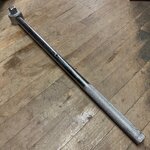
bongkar_YES_pasang_NO
Well-known member

I believe old L handle paired with extension bar shall take abuse with pleasure
B_Bimmer
Well-known member
I've personally bent a lot of t handles with surprisingly little force and never a pipe. Breaker bars are far preferred.
richfinn
Well-known member
I don't use a T handle for high torque situations, it's more of tool when you want equal pressure/balance over a fastener (like taps & dies) or for quickly spinning things on or off like the old wheel braces.
The T handle with a sliding anvil is useful when you need to adjust the length of the leverage applied.
The T handle with a sliding anvil is useful when you need to adjust the length of the leverage applied.
seber
Well-known member
Tee handles are meant to be used with two hands. Al long as you do that, there will be little difference. If you slide the anvil to the end, you are abusing the tool. Get a breaker bar.
john.k
Well-known member
I got a 1" drive T handle to cure the bends ..........the Koken 3/4 T is the only one that size that doesnt bend easily.
I thought the whole point was to break the fastener loose with the anvil slid to the end and then spin it free with two hands. Why else make the anvil able to slide to the end ?Tee handles are meant to be used with two hands. Al long as you do that, there will be little difference. If you slide the anvil to the end, you are abusing the tool. Get a breaker bar.
john.k
Well-known member
T handle is traditionally the cheapest drive for a socket set...........maybe on a par with the bent L drive.
john.k
Well-known member
Koken make a T bar thats as strong as a breaker .....the drive head is much larger diameter and hollow to lighten it ......the bar is much larger diameter ,and does not have the typical grooves at the ends ...its retained by spring loaded detents .........it doesnt bend with pipe extensions .
you might got clearance issuesI thought the whole point was to break the fastener loose with the anvil slid to the end and then spin it free with two hands. Why else make the anvil able to slide to the end ?
suppose the bolt your trying to turn is in a spot where all you can fit is a 10 inch tool
well now you can’t use a 18 inch breaker bar. But a 18 inch T bar maybe you can slide the anvil to the middle, and extend the other half past the bolt and maximize how much length the tool can be with the tight space you got to work with
and maybe even you got this bolt in some tight space but got 10 inches around it on all sides. You could fit a 20 inch t bar with the anvil in middle and use two hands on it compared to using a maximum length breaker bar of 10 inches if you even happen to have one of the exact length that would fit
I’ve done that before where I was using the t bar on some thread restore tools with the right socket and I adjusted the t handle length to fit exactly the spot I could fit and it worked real nice
seber
Well-known member
I use the T bar with a ratchet adapter when the extension is very long. 12 to 18 inches makes for an awkward arrangement with a normal ratchet.
Hmmm perhaps. I’m not sure there would be a better tool to use for these examples.you might got clearance issues
suppose the bolt your trying to turn is in a spot where all you can fit is a 10 inch tool
well now you can’t use a 18 inch breaker bar. But a 18 inch T bar maybe you can slide the anvil to the middle, and extend the other half past the bolt and maximize how much length the tool can be with the tight space you got to work with
and maybe even you got this bolt in some tight space but got 10 inches around it on all sides. You could fit a 20 inch t bar with the anvil in middle and use two hands on it compared to using a maximum length breaker bar of 10 inches if you even happen to have one of the exact length that would fit
I’ve done that before where I was using the t bar on some thread restore tools with the right socket and I adjusted the t handle length to fit exactly the spot I could fit and it worked real nice
This is basically how I’ve always seen a t-handle used. Break it loose and spin it free:
john.k
Well-known member
Hold the 4 way in your hand ,and tread down hard on the end nearest you.............thats how I get tight wheel nuts loose on the street............no way just hand pressure on a short bar will loosen a tire shop wheel...............the old Budd wheel nuts ,you would stand on a 6ft bar,bounce up and down, ,holding onto the side of the truck ,and the nuts would screech as they came loose............ a 3/4" HT chrome moly bar from the steel supplier ,only a few $ ............you could stand on a 6ft length in a wheel spanner ,and it would not bend
Fedwrench
ALLIANCE MEMBER
This sounds like a job for Project Farm or the Torque Test Channel 
I've never seen an 18 or 24 inch long Tee handle. I always thought of Tee handles being a European tool option.
I've never seen an 18 or 24 inch long Tee handle. I always thought of Tee handles being a European tool option.
J.A.F.E.
Well-known member
<snip>
I've never seen an 18 or 24 inch long Tee handle. I always thought of Tee handles being a European tool option.
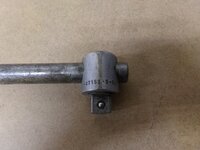
This is my SK 3/4 at 21" inches. At one time it was my only 3/4 drive tool and used as a breaker bar usually with a cheater. This poor SK has seen a lot of abuse over the years and had seen a lot before I got it - it has to be from the 70's at the latest. I have since got an SO 3/4 ratchet with the short and long handles.
I will say the SK handle is a little thicker than the comparable SO sliding T.

KnurledNut
Well-known member
Originally they were designed to be used together, back before the term “breaker bar” existed and they were called nut spinners.
I have seen more bent sliding T handles, but more broken breaker bar ears, pins, and twisted or sheared anvils. I think the head on a sliding T may be slightly stronger because there is more metal. That may explain why the handle yields first.
I have seen more bent sliding T handles, but more broken breaker bar ears, pins, and twisted or sheared anvils. I think the head on a sliding T may be slightly stronger because there is more metal. That may explain why the handle yields first.
Last edited:
four.cycle
Well-known member
I've never seen an 18 or 24 inch long Tee handle.
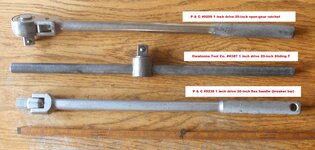
P & C 9209 Ratchet, P & C 9238 Breaker, Owatonna H387 Sliding T Handle 11/30/24
Both the ratchet and breaker show evidence of "extra leverage" having been applied at some point during their service life, but I do not see any evidence of the shafts having been bent or otherwise distorted. The shaft on the sliding T handle seems to be perfectly straight.
From the appearance of the sockets that were with these drive tools, these saw extensive (and severe) use.
Last edited:
Boogerman
Well-known member
I'm intrigued by finding out people actually use sliding tees. I thought those were an inexpensive expedient from 50 or 75 years ago, I've never known anyone who actually used one. But, I've often seen bent ones included in a socket set, I just toss them in the scrap iron and figure they were a cheap expendable.
What is the use case for a sliding tee? I have never used one, don't believe I even have one and I've got pretty comprehensive tools. The only use case I can see is using it like a 4 way lug nut wrench to spin off a nut. I'd use a flex ratchet turned up 90 degrees like a crank for that. Any angle less than that, I'd use a breaker bar or a ratchet.
What is the use case for a sliding tee? I have never used one, don't believe I even have one and I've got pretty comprehensive tools. The only use case I can see is using it like a 4 way lug nut wrench to spin off a nut. I'd use a flex ratchet turned up 90 degrees like a crank for that. Any angle less than that, I'd use a breaker bar or a ratchet.
KnurledNut
Well-known member
@Boogerman
They work great with tap sockets and give reach options a basic tap handle doesnt.
They work great with tap sockets and give reach options a basic tap handle doesnt.
Last edited:
Right. With respect to @mikey03 this is a made up problem. A big ratchet is always the answer when an impact gun won’t fit. I’ve never used a sliding tee. Anything a breaker can do a SHLF80A can do better.I'm intrigued by finding out people actually use sliding tees. I thought those were an inexpensive expedient from 50 or 75 years ago, I've never known anyone who actually used one. But, I've often seen bent ones included in a socket set, I just toss them in the scrap iron and figure they were a cheap expendable.
What is the use case for a sliding tee? I have never used one, don't believe I even have one and I've got pretty comprehensive tools. The only use case I can see is using it like a 4 way lug nut wrench to spin off a nut. I'd use a flex ratchet turned up 90 degrees like a crank for that. Any angle less than that, I'd use a breaker bar or a ratchet.
Last time this came up, someone maybe @richfinn mentioned spinning parts off with the slider. I wouldn’t call that essential, just maybe a technique he developed and got comfortable with.
I think @mikey03 is a young person. If you are starting out, you really need a decent battery or air impact and a SHLF80A or equivalent. When neither of those work, please take pictures and ask us. These sorts of hypotheticals are doing you no favors.
Which will break first? We have no idea and no specific data to base guesses on. A Snap On or Proto breaker will probably out gun a Chinese or old Taiwan tee. There’s no real obvious strength advantage between the 2.
I'm not going to read thru all of this, but the answer is:
"Properly designed, either will shear the anvil before any other failure"
So, they are the same if properly designed. Pretty simple, huh? There is no other correct answer as there are too many variables.
"Properly designed, either will shear the anvil before any other failure"
So, they are the same if properly designed. Pretty simple, huh? There is no other correct answer as there are too many variables.
KnurledNut
Well-known member
In real use, the sliding T bar handle will typically bend before the anvil shears.I'm not going to read thru all of this, but the answer is:
"Properly designed, either will shear the anvil before any other failure"
So, they are the same if properly designed. Pretty simple, huh? There is no other correct answer as there are too many variables.
In real use, the sliding T bar handle will typically bend before the anvil shears.
And I've bent a HF 1/2" breaker bar before the anvil failed. So, it wasn't properly designed. Which was my point.