Shiftless
Well-known member
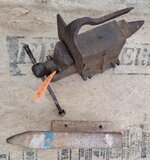
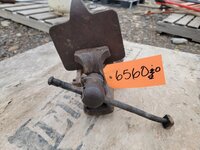
I paid that much for a broken one.Got this nice Reed 24 utility vise at an estate sale for $25. Nothing fancy but a nice user.
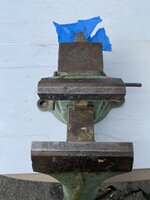


I paid that much for a broken one.Got this nice Reed 24 utility vise at an estate sale for $25. Nothing fancy but a nice user.
I need to play with the balance some. It kinda' wants to squirt out from under the vise when tipped back onto the casters. Maybe a handle bar would help to get the balance point under the vise instead of in front of it. Or maybe I just need to weld a big ol' hunk of steel to the front of the base as a counterweight.I really like the wheels for portability!
That sounds like a good idea.maybe I just need to weld a big ol' hunk of steel to the front of the base as a counterweight.
A little more lead than I have on hand... but I do have some 4X square tube and plenty of sand.That sounds like a good idea.
This being Garage Journal, I humbly suggest a length of 4x4 filled with lead.
Maybe a tiny little beer keg full of sand would be appropriate.A little more lead than I have on hand... but I do have some 4X square tube and plenty of sand.

maybe I just need to weld a big ol' hunk of steel to the front of the base as a counterweight.
I do have some 4X square tube and plenty of sand.
Maybe a tiny little beer keg full of sand would be appropriate.
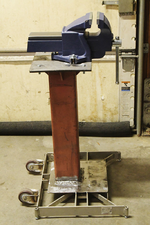
When I weld a plate on, that's plate's stayin' put. It'd be much easier to cut the casters off and move them to the front, which should oughta' fix the problem.I'm thinking dismount the vise plate, knock out the welds to the roller stand, flip the stand 180, and reweld. then the vise and column weight won't go over center so easily, and maybe dill a front to back hole in the post for a pipe handle about waist high or a bit lower?
Love the next level research 'Mr Prentiss'Maybe not George Washington’s diary…but the next best thing?!
This is a bank book from the Montour National Bank of New York that lists the account transactions for Frances Hastings Goodwin Mulford (wife of Civil War hero and Prentiss Vise Company president, General John E Mulford) from Nov, 1914 - July 1920. As a career accountant by day and researcher of the Prentiss Vise Company by night, the information in this book scratches both itches.
The handwriting is difficult to read in places, but it appears that Mrs. Mulford used this account primarily for birthday and Christmas gifts to various individuals and charities, the purchase of miscellaneous supplies, and for the deposit of dividends from multiple companies. The transactions postdate John Mulford’s death (Oct 18, 1908). John’s son, Edwin, was president of the company at this time. From multiple sources, it’s clear that John Mulford was a true businessman and entrepreneur, having invested in many companies during his lifetime and even having started several himself (among which are the Prentiss Vise Company and the Watkins and Havana Railroad Company). As expected, John’s investments passed to his wife after his death in 1908, and it’s within these pages that we get a glimpse of their financial activity. Among countless other investment transactions, there are multiple disbursements to and receipts from the Prentiss Vise Company, one of which includes a $4,000 dividend in 1918 (equivalent to $83,620 today)!
It’s the less glamorous, seldom-seen aspects of the Prentiss Vise Company like this that really get my heart racing. Understandably, this personal account activity was kept very private at the time, and honestly I’m amazed that those whose hands it passed through didn’t decide to throw it away. Thankfully, it surfaced along with several other unrelated bank books in Rochester, NY and has found a home in my collection.
You'll make @CRSINMICH happy if you find out- he has the same, or a very close copy.Any info on the maker of this little guy? Here is what I can tell you....It measures 3.5" tall by 3" wide, the jaws are 1.25" wide and a magnet sticks to it. There are no markings on it as far as I can tell.

Well that's either a really good thing that there's no info or a brickwall thing.....You'll make @CRSINMICH happy if you find out- he has the same, or a very close copy
This is for sale in OZ - 1 1/2" jaw, also no infoWell that's either a really good thing that there's no info or a brickwall thing.....

Wow ok thank you very much. For sale where? I am going to keep mine in my collection as a cute little conversation piece.
 can give you the site info if you want , that is the only Pic thou- $38 AUD - $25 USD
Thanks for the pic and the price. I picked mine up for a buck. Im happy,

Hello RTM,I saw that earlier, convinced myself I didn't need another vise right now. Did he have other goodies? There's been a guy posting some decent stuff in San Mateo lately that's been a surprise so I may have to look closer.
 )..
)..


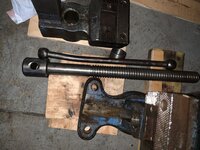


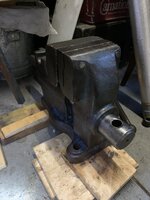

Hello RTM,
Tonight’s effortsThis was a lone family seller. Dad ( son in his 70s) bought it many decades ago, and it had been sitting untouched for at least 45, maybe more years , in the basement.
This individual had mentioned that they had some yard sales during the summer but this wasn’t on the table ( no pun intended
There is a very interesting guy that’s got a ton of stuff on the Peninsula CL, maybe in Palo Alto/San Carlos? Lots of vintage tools and things, for very reasonable prices-very eclectic items. He might be who you are thinking about?
I saw the No.3 ad right around his 26th day, and thought the same, but I pulled the trigger anyway.
I literally just got it wirewheeled to near completion about 30 minutes ago…The decades old blue engine enamel it wore was harboring a rusty film within the paint. I tried like heck to clean around it, and do the WD steel wool derusting massages , but it was fruitless .
Bit the bullet tonight and spent 45 minutes with my Dewalt angle Grinder getting it to bare steel. I left a few blue spots that were acceptable, but the rest needed dispatching. I’m glad I did as I was able to verify that there are zero damages/repairs.
Wiped it down with penetrating oil and will very likely wax it. I handpolished/burnished the massive lead screw with maroon scotch brite for 30 minutes today. Spent an hour last week tuning up the collar/set screw; the lower threads of the collar were stripped (along with the set screw threads) so the collar wasn’t seating properly
Chased the threads in the collar and setscrew itself so it is seating fully concentric around the shaft-runs 5X better than when I first tried it out .
This thing is a massive pig! Body weighs about 90#, lead screw about 25, and the dynamic is at 45. Something along those lines. It catalogs at 160. This one here is about a 1910 or newer due to the parallel script, lack of patent date, and the missing forward “WV” logo.
I’ve spent about 6 different sessions ( in the last 3 weeks or so) monkeying around with this thing ( 30-45 minutes each) and it’s a workout EVERY time. Even with it disassembled into the three parts, it’s still demanding. I’ve got to straighten out a minor bend in the handle and do a final scotch brite scrub of the internal threads/slide surfaces, and it’s done.
I’ll be happily sending it off to his new owner soon ( a coworker) and he can put it to work


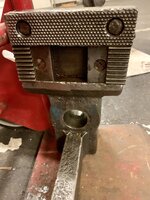


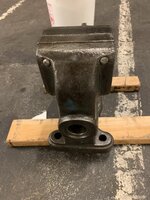
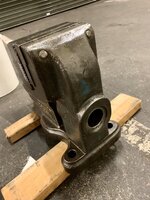

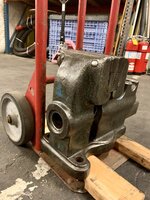

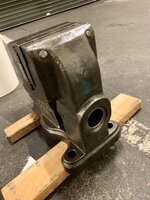


heres my one somewhat similar, farmers handy toolWTF? I've seen vises with anvils attached, but this looks like an anvil with a vise attached?

This is an auction with a month to go. Prices will likely go sky-high. I'm just wondering WHAT THAT IS? The spur thingy seems to be clamped into the jaws of the vise/anvil/whatever.

What paint/color did you use for the vise? I love it!Starrett 324 1/2 after refurbish, and Antique Vises jaws!
Looks Great!!What paint/color did you use for the vise? I love it!

What paint/color did you use for the vise? I love ill have to check which rustoleum...it never really hardened tho, and is coming off in the spring
 % correct. I shake the can for about merry Christmas thank you five minutes.
 . Last time I think I started electric blanket at 3am on low, and was painting about 7am. One day is a phase of primer, next day phase final, with appropriate sanding in between.. it is drawn out process and you’ll swear
  ALOT, but slower is better, in the end. I have other tricks I have developed, but I am sure I ran my mouth enough about it thus far.
 ️, often found in third stores. Time is money,
  but of course, if you have no deadline, waiting for excellent conditions, makes excellent results more plausible.
I've a little experience painting with Rusto rattle-cans. I don't have a great deal of patience when digging into a project for things like taking a week to get a good paint job. So I cheat.^ This.
"Rustoleum" in a rattle can requires you follow the directions.
Don't even open the can if the temperature is below 65° - 70° F - you're just wasting your time (and materials.)
Lay on thin coats.
Allow to fully cure two days before recoating.
Otherwise you're inviting grief and disappointment.
Yes... and the drying agents used in contemporary paints aren't stable compounds - over two years old: toss it into the trash can.
(There is a reason I choose "ACE" house brand spray paint for most of my projects - fast dry, but you still have to wait at least 24-36 hours to recoat.)

I think i had a bad can...was a new can and all steps followed like usualjustintendo:
I use Rustoleum a lot. It takes a while to harden up but not like a week. Did you spray at a temperature below 50 degrees? Did you try to lay on one thick coat instead of multiple thin coats? Was the can sitting around in your garage for years before you used it?
ONLY if you shoot the recoat within about 30 minutes. Any longer than that and you're ASKING for wrinkle finish - the solvents in the second coat will cause the stuff underneath to bubble up.In temps over 70F, recoat time for Rusto paints is about 15-30 min.

I've done this as well when pulling paint cans out of my garage on cooler days. I use Timms Toaster oven tip as well, and I have a full electric wall oven stored for this once I make space...One more note about spray paint:
Warming the propellant upside the can makes for better results when you're spraying. I either set it out in the sun, or drop it in the sink and open up the hot water tap and let it run.
 day we should list all these steps in order, but honestly this is way more fun..
Thanks! I ran to Lowes to buy some and guessed that was the color. Glad I was correct.Maui blue was the 324 1/2 color, for those interested
If my can of spray paint exploded in our kitchen oven, I would be installing a new oven pronto.If the phone rings and you forget you left it in the oven, it will take weeks to get that smell out of your house. (Don't ask me how I know this.)