Interested in purchasing a tool for bending pipe, heavier wall tubing etc. Not doing exhaust or anything thin walled. I'm trying to understand the difference between the ones that use a ram to push into the pipe causing a kink and the kind that uses a ram to roll the die to form the bend. Are they interchangeable or is one better suited for heavier material?

You are using an out of date browser. It may not display this or other websites correctly.
You should upgrade or use an alternative browser.
You should upgrade or use an alternative browser.
Bending Pipe and Heavier Wall Tubing
- Thread starter Zewnten
- Start date
jack stand
Well-known member

SWAG Off Road - Premium Metal Fabrication Tools and Accessories
Many of the products offered at Swag Off Road are an industry first. Every product is designed, developed, prototyped and tested here in Oregon & 100% proudly made in the USA. We specialize in off road products as well as unique & innovative fabrication tools. “DOING ORDINARY EXTRAORDINARY”
 www.swagoffroad.com
iagsxr
Well-known member
Telling us what types of things you plan to build would be a good start.
When I bought my JD2 bender years ago somewhere in the literature it said they had tested it bending 1" solid shaft. Not recommended, but it would do it.
When I bought my JD2 bender years ago somewhere in the literature it said they had tested it bending 1" solid shaft. Not recommended, but it would do it.
whateg01
Well-known member
No, tubing Bender and a pipe bender is what I think op is describing.It sounds like you're referring to a bender vs a roller. A bender is used to make sharper, smaller radius bends. A roller is used to make sweeping, larger radius bends.
f150skidoo
Well-known member
What are you wanting to bend? The cheap ram benders are simple but IMO ****. A draw bender will give you far superior bends. I have a JD2 model 32 with the hydraulic cylinder kit and have bent up to a 2" .188" wall square tube with a 6.5" radius. I've also bent 1.25" cold rolled round bar with a 4.5" radius die with great results.
pelletman
Well-known member
Diacro bender
theoldwizard1
Well-known member
It is not the "force" behind the bender that gets smooth bends, it is the mandrel/die/shoe !
You need a different die for each size of pipe you want to bend.
You need a different die for each size of pipe you want to bend.
Old Man Roger
Well-known member
I found a work around for my bender when bending pipe or tubing that didn't quite fit the die right. I used a 2 jaw puller to hold the pipe/tubing down in the center of the die. It kept it from rising up and kinking at the bend.
whateg01
Well-known member
Exhaust pipe split in half works well depending on the diameterI’ve used some sheet metal to make shims for dies that were slightly too large.
Spareparts
Well-known member
I put Hydraulic on mine, getting to old to ratchet
No room for the JD style bender. The two types of bender I'm considering have a much smaller footprint. I have a lead on a bender like this (https://www.ohiopowertool.com/greenlee-882cb) with several different dies etc. I couldn't find a picture of it for reference in my earlier post. I've seen people modify a stand for them to bend vertically instead of horizontal. Is this style better then, it's basically the same process as the JD.
f150skidoo
Well-known member
OP Several post have asked but what are you trying to bend?
That's a conduit bender...No room for the JD style bender. The two types of bender I'm considering have a much smaller footprint. I have a lead on a bender like this (https://www.ohiopowertool.com/greenlee-882cb) with several different dies etc. I couldn't find a picture of it for reference in my earlier post. I've seen people modify a stand for them to bend vertically instead of horizontal. Is this style better then, it's basically the same process as the JD.
Old Man Roger
Well-known member
Damn that Greenlee **** is expensive. You could buy a muffler shop type bender for the price of some of there benchtop stuff.
iagsxr
Well-known member
No room for the JD style bender. The two types of bender I'm considering have a much smaller footprint. I have a lead on a bender like this (https://www.ohiopowertool.com/greenlee-882cb) with several different dies etc. I couldn't find a picture of it for reference in my earlier post. I've seen people modify a stand for them to bend vertically instead of horizontal. Is this style better then, it's basically the same process as the JD.
I don't know how you're going to get any smaller footprint than a JD converted to vertical operation. Whatever you do has to be stable enough to sit still with tubing hanging out of it.
The main reason I bought my JD was the steel dies. I broke an aluminum die on my brother's Irvan-Smith bender once. My own fault, but I've done some dumb things with my JD dies and never hurt them.
I think you've got to realize that if there were a cheaper/easier way to bend tubing that's what everyone would do.
Heavier Wall tube and pipe as answered in the first post.OP Several post have asked but what are you trying to bend?
Haha not buying that one just the easiest picture I could find of the bender I was referring to.Damn that Greenlee **** is expensive. You could buy a muffler shop type bender for the price of some of there benchtop stuff.
I understand what you're saying but you're not answering the question. Is the bender I linked to actually bending the pipe or kinking it?I don't know how you're going to get any smaller footprint than a JD converted to vertical operation. Whatever you do has to be stable enough to sit still with tubing hanging out of it.
The main reason I bought my JD was the steel dies. I broke an aluminum die on my brother's Irvan-Smith bender once. My own fault, but I've done some dumb things with my JD dies and never hurt them.
I think you've got to realize that if there were a cheaper/easier way to bend tubing that's what everyone would do.
The last part of your answer, not saying I'm going to revolutionize the process or just beat my head against the wall but just saying there's no point in trying is how innovation dies.
Heavier Wall tube and pipe as answered in the first post.
Tube and pipe have different dimensions and require different dies and strength benders...
Can you provide some more details on what you're planning to bend?
iagsxr
Well-known member
Tube and pipe have different dimensions and requir d different dies and strength benders...
Can you provide some more details on what you're planning to bend?
^^^^ This. Define your material.
In my world anything over .095" wall is "heavy". If I were building gates or handrails or off-road trucks that would not be the case.
sqznby
Well-known member
You're being a bit vague with your answer.Heavier Wall tube and pipe as answered in the first post.
What do you consider to be "heavy wall"?
You have quite a few people with plenty of experience trying to help, why don't you tell everyone what you're trying to do so they can help you instead of beating around the bush.
Jim greengo
Well-known member
Eastwood.com
Not intending to be vague. I have several projects needing some custom bent pipe and tubing. Most of what I'll be using is 1" OD schedule 40 equivalent.You're being a bit vague with your answer.
What do you consider to be "heavy wall"?
You have quite a few people with plenty of experience trying to help, why don't you tell everyone what you're trying to do so they can help you instead of beating around the bush.
I don't have a specific project like a roll cage to tailor my needs to, that would be easy to answer. This post is about understanding the differences between tools used to bend pipe and pipe shaped materials. Everything I've found is making a roll cage use this tool, bending conduit use this and on for exhaust, galvanized fencing etc. None of them explained why this particular tool is better or worse for one material vs another.
I'm also not looking to spend a bunch on this. Again not making roll cages or something to sell; good enough is good enough.
whateg01
Well-known member
There are tubing benders out there that are similar in design to that conduit Bender you linked before. Pipe benders tend to be designed to be cheap and can afford to have the design they do because pipe tends to be thicker walled and so it's less susceptible to kinking. However, thinner wall tubing will kink very quickly if you try to bend it that way. That's why conduit gets bent the way it does. 1 in pipe is hardly what I would consider heavier pipe. Or heavier tubing. When I think of heavier tubing I think of 2-in diameter 3/8 in wool. But it's all relative. If I was out welding 36-in pipe everyday 2 inch would be pretty small. In general, a draw type Bender where it pulls the tube around a die is going to be more versatile because it is able to bend thin wall tubing as well as thick wall. The pipe bender simply will struggle with that on thin wall no matter what.
Firebrick43
Well-known member
All benders deform the pipe. Its just a matter of how much deformation and in what axis you are comfortable with.No room for the JD style bender. The two types of bender I'm considering have a much smaller footprint. I have a lead on a bender like this (https://www.ohiopowertool.com/greenlee-882cb) with several different dies etc. I couldn't find a picture of it for reference in my earlier post. I've seen people modify a stand for them to bend vertically instead of horizontal. Is this style better then, it's basically the same process as the JD.
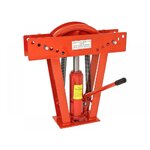
The worst deformation is going to be from this style, it will have quiet visible lumps where the die starts/stops. If you are making structural bends that you don't care what they look like or needs to be the strongest, this is the type of bender to get. And they are cheap
A follow shoe bender like the greenlee 882CB is better as more of the pipe is supported.
Most of them however are designed for tradesman that want portability from job site to job site and are to be used with conduit (or some are for hydraulic tubing) that is dead soft. They will break if used with mild steel tubing, especially with heavier walls. Its just to tough of material. Most of this type of bender is limited to a little past 90 degrees and you have to have a certain amount of space between bends as the pipe/tube will not fit right next to die/shoe with a bend in it. There will typically not be big lumps like the smash benders above but the width vs bend axis diameter of the pipe will be visually quite noticeable. Not a big issue if transporting liquids or housing wire, not great for structural purpose. I would not suggest this type of bender for any type of structural steel tubing.
A bender like the JD2 model 32, rouge fab, swag off road, or pro tools have an optimized die profile and are made of higher strength steel to minimize the amount of collapse that the above benders impart. There is still some collapse from being round but you have to put a set of calipers typically with these better benders to see the difference of the pipe diameter in width vs bend axis. They also have 180 degree dies for them which can be very important for some projects. If you are bending steel pipe and you care what it looks like, this is the type of bender for a DIY.
Mandrel benders pull a mandrel or pig(or several) thru the center of the pipe that moves with bend and stays adjacent to the outside die throughout and keep it from collapsing the least of the bender styles. A very long and expensive machine not usually seen in home shops and typically must use DOM tubing.
whateg01
Well-known member
Except that a pipe bender isn't going to have dies that fit tubing so they will flatten the tubing more than they should, probably ultimately leading to the tubing kinking.
Firebrick43
Well-known member
I assume your replying to me? For many sizes yes if he is using tubing. If he isn't building life safety equipment why buy tubing at all?Except that a pipe bender isn't going to have dies that fit tubing so they will flatten the tubing more than they should, probably ultimately leading to the tubing kinking.
According to the OP
Not intending to be vague. I have several projects needing some custom bent pipe and tubing. Most of what I'll be using is 1" OD schedule 40 equivalent.
I own a JD2 model 32 and would not be happy with a HF hydraulic pipe bender in any form or fashion. But to bend non structural things it might be just the ticket for the cost.
Old Man Roger
Well-known member
I found a work around for my bender when bending pipe or tubing that didn't quite fit the die right. I used a 2 jaw puller to hold the pipe/tubing down in the center of the die. It kept it from rising up and kinking at the bend.
See above.Except that a pipe bender isn't going to have dies that fit tubing so they will flatten the tubing more than they should, probably ultimately leading to the tubing kinking.
dr_clyde
Well-known member
Some thoughts on benders based on my years of experience bending and rolling tube and pipe, take it for what it is. Free advice is worth what you paid for it.
The common types of benders you'll see are just plain hydraulic ram type benders and rotary draw benders. Roller benders are also used pretty commonly, but they're not really benders in the same sense of the word as they can create a somewhat infinitely variable radius bend or rolled section instead of an elbow shaped bend.
Like any machine, what you end up selecting will be influenced by what you intend to do with the bender. You have been extremely vague about the intended usage and that will cause a lot of people to recommend things that may or may not work for you. Just saying "heavy wall" doesn't really matter. What matters is the desired bend radius, the material and the quality of the bend desired. Budget and the space the machine takes up are factors, but there are workarounds.
Remember, tubing runs true to the named OD and you spec the wall thickness or ID as the second dimension. Pipe is a SYSTEM, designed to work with fittings, hangers, threading equipment, insulation, and tons of other pre-made products. It has an OD and ID that adheres to the IPS sizing standards for a given size and schedule. A 1" sch. 40 pipe will have an ID of approximately 1 inch, but it's a NOMINAL value and will vary a bit. The OD is held to a pretty tight tolerance, but that is so it will fit threading dies and fittings, but it won't be anywhere close to 1". In general, pipes are designed to convey some sort of material, whether it's liquid, air, chemicals or wiring and tubes are intended to build structures with. This is obviously not 100% always the case, as you can obviously build things out of pipe and use tubes to move materials, but in general, this is a good rule to follow.
Pipe schedules are a ratio of wall thickness to diameter, and as the schedule increases, the wall thickness increases. Schedule 40 is the standard, meaning the closest to nominal, but what this means is that a 1" sch. 80 pipe will have nothing on it anywhere that measures 1". Tubing has no schedule, and is simply measured by the OD and either the wall thickness or the ID, whichever is specified. It is entirely possible to have tubing with wall thicknesses heavier than a similar sized OD pipe, so if you care a lot about wall thickness for strength, don't think you're stuck with only pipe, as it's almost certain you can get a tube with better mechanical specs.
So the cheap hydraulic ram jack benders are designed to bend PIPE, not tube. You will struggle to get a nice, round bend on tube because it will not fit the dies, either too small or too big. Typically, you will only use these to make non-geometrically critical bends in pipe systems where a fitting isn't appropriate. Think a bend at a ridge of a roof or a sweep around a corner for an air line or conduit. The bend radius isn't critical, all it needs to do is not collapse or kink the pipe. If your designs can tolerate the fixed radius from the die and is made from pipe, a ram bender probably will work fine. They are simple tools, and have a pretty small window of what they can do well, but what they do they do pretty good. You might only be able to get up to a 90° bend on one, however, and you'll be limited on how close you can put bends to other bends and stuff like that. The benders are cheap and relatively compact, but they're also pretty limited on what they can do.
The other really common type of tubing bend is a rotary draw bender. This kind of bender is capable of doing a whole heck of a lot more than a cheap ram bender, as the tooling is much more varied. You can buy a die set for most common types of tube OR pipe, round AND square. You can also get different die radii and sweep lengths, so you can bend up to a 180° bend in the material. Also, depending on your bender, you can do a lot more intricate bending, like offsets and various rotation changes close to each other. The most common manual bender like this is the JD² model 3, but Hossfeld, Swag, and numerous others make a similar bender. In manual applications, the die remains stationary and the operator pulls the tube around the die. In hydraulic or CNC benders, the die rotates and the tube is drawn in around it, but the principle of how the bender works is the same. The die supports the wall from collapsing, and a set of shoes guides and bends the tube around the die. The primary downside to the rotary draw bender is their cost. The bender itself is pretty cheap, usually only a few hundred bucks, but the dies are several hundred each, and if you want to bend much variety, you'll end up with a few grand in dies pretty quick. The manual versions also require a large amount of floor space, as the tube needs to sweep through the bend. The hydraulic versions eliminate this problem, as the die does the moving and the tube stays straight, but at a significant increase in price.
Both versions of common benders will bend heavy wall tubing or pipe, it all comes down to how strong you are on the manual stuff. They use compound leverage to make the bend, and you can generate huge forces with that. I've not ever had a problem bending heavy wall DOM tubes up to 2" on my JD² model 3. A Hossfeld style bender would really struggle with that, as its just direct force, no compounding lever.
So TL;DR, if you want a cheap bender, are bending pipe, and you don't care about radius get a hydraulic ram bender. If you're bending tubing the radius is important or need more intricate bends, get a rotary draw bender.
The common types of benders you'll see are just plain hydraulic ram type benders and rotary draw benders. Roller benders are also used pretty commonly, but they're not really benders in the same sense of the word as they can create a somewhat infinitely variable radius bend or rolled section instead of an elbow shaped bend.
Like any machine, what you end up selecting will be influenced by what you intend to do with the bender. You have been extremely vague about the intended usage and that will cause a lot of people to recommend things that may or may not work for you. Just saying "heavy wall" doesn't really matter. What matters is the desired bend radius, the material and the quality of the bend desired. Budget and the space the machine takes up are factors, but there are workarounds.
Remember, tubing runs true to the named OD and you spec the wall thickness or ID as the second dimension. Pipe is a SYSTEM, designed to work with fittings, hangers, threading equipment, insulation, and tons of other pre-made products. It has an OD and ID that adheres to the IPS sizing standards for a given size and schedule. A 1" sch. 40 pipe will have an ID of approximately 1 inch, but it's a NOMINAL value and will vary a bit. The OD is held to a pretty tight tolerance, but that is so it will fit threading dies and fittings, but it won't be anywhere close to 1". In general, pipes are designed to convey some sort of material, whether it's liquid, air, chemicals or wiring and tubes are intended to build structures with. This is obviously not 100% always the case, as you can obviously build things out of pipe and use tubes to move materials, but in general, this is a good rule to follow.
Pipe schedules are a ratio of wall thickness to diameter, and as the schedule increases, the wall thickness increases. Schedule 40 is the standard, meaning the closest to nominal, but what this means is that a 1" sch. 80 pipe will have nothing on it anywhere that measures 1". Tubing has no schedule, and is simply measured by the OD and either the wall thickness or the ID, whichever is specified. It is entirely possible to have tubing with wall thicknesses heavier than a similar sized OD pipe, so if you care a lot about wall thickness for strength, don't think you're stuck with only pipe, as it's almost certain you can get a tube with better mechanical specs.
So the cheap hydraulic ram jack benders are designed to bend PIPE, not tube. You will struggle to get a nice, round bend on tube because it will not fit the dies, either too small or too big. Typically, you will only use these to make non-geometrically critical bends in pipe systems where a fitting isn't appropriate. Think a bend at a ridge of a roof or a sweep around a corner for an air line or conduit. The bend radius isn't critical, all it needs to do is not collapse or kink the pipe. If your designs can tolerate the fixed radius from the die and is made from pipe, a ram bender probably will work fine. They are simple tools, and have a pretty small window of what they can do well, but what they do they do pretty good. You might only be able to get up to a 90° bend on one, however, and you'll be limited on how close you can put bends to other bends and stuff like that. The benders are cheap and relatively compact, but they're also pretty limited on what they can do.
The other really common type of tubing bend is a rotary draw bender. This kind of bender is capable of doing a whole heck of a lot more than a cheap ram bender, as the tooling is much more varied. You can buy a die set for most common types of tube OR pipe, round AND square. You can also get different die radii and sweep lengths, so you can bend up to a 180° bend in the material. Also, depending on your bender, you can do a lot more intricate bending, like offsets and various rotation changes close to each other. The most common manual bender like this is the JD² model 3, but Hossfeld, Swag, and numerous others make a similar bender. In manual applications, the die remains stationary and the operator pulls the tube around the die. In hydraulic or CNC benders, the die rotates and the tube is drawn in around it, but the principle of how the bender works is the same. The die supports the wall from collapsing, and a set of shoes guides and bends the tube around the die. The primary downside to the rotary draw bender is their cost. The bender itself is pretty cheap, usually only a few hundred bucks, but the dies are several hundred each, and if you want to bend much variety, you'll end up with a few grand in dies pretty quick. The manual versions also require a large amount of floor space, as the tube needs to sweep through the bend. The hydraulic versions eliminate this problem, as the die does the moving and the tube stays straight, but at a significant increase in price.
Both versions of common benders will bend heavy wall tubing or pipe, it all comes down to how strong you are on the manual stuff. They use compound leverage to make the bend, and you can generate huge forces with that. I've not ever had a problem bending heavy wall DOM tubes up to 2" on my JD² model 3. A Hossfeld style bender would really struggle with that, as its just direct force, no compounding lever.
So TL;DR, if you want a cheap bender, are bending pipe, and you don't care about radius get a hydraulic ram bender. If you're bending tubing the radius is important or need more intricate bends, get a rotary draw bender.
iagsxr
Well-known member
Could just pack with sand, heat the pipe a little and bend it over an old wheel.
Fun fact: In the 50s and 60s there were Top Fuel dragsters with sand bent chassis.
I've sand bent exactly one thing in my life.
Made a funky little gooseneck to hold a light fixture out of a piece of 1/2" or 3/4" black pipe. Varied the heat to control the radius(it wasn't a constant radius). Clamped the pipe in a vise. Buddy held the torch while I bent. Just free handed it, no die or pattern.
It was fun. If I were going to make little weird decorative pieces that's how I'd do it.
You have been extremely vague about the intended usage
I appreciate everyone's time in helping me with this. And thank you dr_clyde for the detailed response.
I'm not trying to be vague but my projects range from the definite: building bump cages and handling points for testing equipment: think generator frame, to pure conjecture such as a temporary car port frame for major in field teardowns. And the list goes on. But with all the advice given here I'm understanding how wide the topic really is.